15 Best Books to Build Confidence in 2026

Affiliate Disclosure: This article contains affiliate links. As an Amazon Associate and member of other affiliate programmes, we earn from qualifying purchases. We only recommend products we genuinely believe in to help you build real, lasting confidence.

Real confidence is not a fixed trait you inherit at birth. It is a skill you develop over time through consistent action, self-awareness, and small wins. True confidence comes from knowing you can handle challenges, adapt when things go wrong, and trust yourself to make decisions. This guide is for practical, time-poor men in their 20s to 40s who want clear, honest recommendations on books to build confidence through mindset shifts, discipline, social skills, emotional resilience and purpose.

In this long-form, SEO-optimised review, we’ve selected 15 standout titles across five foundational categories. Each book entry includes a brief summary, why it builds confidence, a notable quote and who the book is for. Read calmly, decide mindfully and pick the book that addresses your most immediate need.


Introduction

Confidence is often misunderstood as charisma or extroversion. In reality, it is an internal sense of capability grounded in competence, clarity and self-trust. You do not flip a switch to become confident. You build it through:

  • Learning frameworks and tools

  • Practising new skills

  • Embracing small failures as feedback

  • Integrating insights into daily routines

This list focuses on books offering practical exercises, clear take-aways and real-world examples. No hype, no quick fixes, just trustworthy guides to help you feel and act more confidently.


How We Categorised These Books

We organised these 15 books into five categories, each covering a core pillar of confidence:

  1. Mindset and Self-Belief

  2. Discipline and Competence

  3. Social Confidence and Communication

  4. Emotional Resilience and Self-Trust

  5. Purpose, Meaning and Identity

Each category overview explains how it contributes to confidence. Then you’ll find concise entries for each book.


Mindset and Self-Belief

A confident mindset starts with your internal dialogue and beliefs about yourself. These books help you reframe negative thoughts and adopt a growth-oriented perspective.

Mindset: The New Psychology of Success
$9.25


Buy Now
We earn a commission if you make a purchase, at no additional cost to you.
02/09/2026 10:22 am GMT

Brief Summary
Psychologist Carol Dweck explores fixed versus growth mindsets and how adopting the latter leads to resilience and achievement.

Why This Builds Confidence
By recognising that abilities can be developed, you shift from fearing failure to viewing challenges as opportunities to learn.

Notable Quote
“Becoming is better than being.”

Who This Book Is For
Anyone stuck in self-doubt or perfectionism who wants to embrace challenges and persist through setbacks.

The Confidence Gap: A Guide to Overcoming Fear and Self-Doubt
$14.70


Buy Now
We earn a commission if you make a purchase, at no additional cost to you.
02/09/2026 10:21 am GMT
Brief Summary
Russ Harris applies Acceptance and Commitment Therapy to help readers move from anxiety to action, focusing on values-driven choices.

Why This Builds Confidence
Teaches practical techniques to face fears and build self-trust by committing to what matters most.

Notable Quote
“Confidence is a tonic for self-doubt.”

Who This Book Is For
Men who struggle with anxiety or negative self-talk and want step-by-step tools to confidently take action.

Feel the Fear and Do It Anyway
$26.87


Buy Now
We earn a commission if you make a purchase, at no additional cost to you.
02/09/2026 10:21 am GMT
Brief Summary
Jeffers offers a roadmap for moving through fear by recognising that confidence grows when you push your boundaries.

Why This Builds Confidence
Provides strategies to reframe fear as a natural part of growth and take small steps that build courage.

Notable Quote
“The only way to conquer fear is to face it head on.”

Who This Book Is For
Readers who feel paralysed by fear and need simple, actionable techniques to break free.


Discipline and Competence

Confidence thrives on competence. These books teach habits, focus and routines that build skill and self-reliance.

Atomic Habits: An Easy & Proven Way to Build Good Habits & Break Bad Ones
$18.67
Buy Now
We earn a commission if you make a purchase, at no additional cost to you.
02/08/2026 12:09 pm GMT
Brief Summary
James Clear breaks down how tiny habits compound into remarkable results and shows you how to design systems for consistent improvement.

Why This Builds Confidence
Small wins reinforce belief in your ability to change, leading to a stronger sense of control and competence.

Notable Quote
“You do not rise to the level of your goals. You fall to the level of your systems.”

Who This Book Is For
Time-poor professionals who want bite-sized habit strategies to build competence and reinforce self-trust.
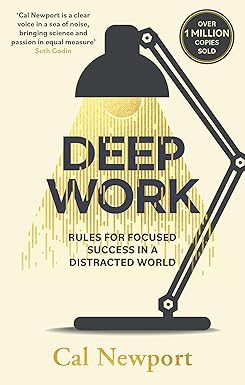
Deep Work: Rules for Focused Success in a Distracted World
$22.98
Buy Now
We earn a commission if you make a purchase, at no additional cost to you.
02/09/2026 05:05 am GMT
Brief Summary
Cal Newport argues that deep, undistracted work is the key to mastering complex skills and producing high-quality results.

Why This Builds Confidence
Demonstrates how dedicated focus amplifies skill acquisition, boosting confidence in your abilities.

Notable Quote
“Clarity about what matters provides clarity about what does not.”

Who This Book Is For
Anyone distracted by digital noise who wants a reliable framework for focused productivity and skill mastery.
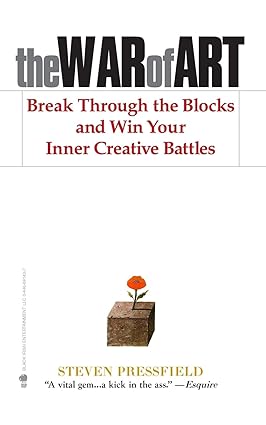
The War of Art: Break Through the Blocks and Win Your Inner Creative Battles
$17.95


Buy Now
We earn a commission if you make a purchase, at no additional cost to you.
02/09/2026 10:22 am GMT
Brief Summary
Steven Pressfield identifies “Resistance” as the inner force that keeps you from doing your best work and offers strategies to overcome it.

Why This Builds Confidence
Shows you how consistently defeating Resistance builds momentum and self-belief in your creative and professional pursuits.

Notable Quote
“The most important thing about art is to work. Nothing else matters.”

Who This Book Is For
Creative professionals and entrepreneurs who struggle with procrastination and need practical motivation to persist.


Social Confidence and Communication

Confident communication is essential in professional and personal spheres. These books provide skills to interact with clarity, empathy and assertiveness.

How to Win Friends and Influence People
$14.99


Buy Now
We earn a commission if you make a purchase, at no additional cost to you.
02/08/2026 11:10 am GMT
Brief Summary
A classic guide to effective communication and building rapport through empathy, active listening and genuine interest.

Why This Builds Confidence
Mastering interpersonal skills reduces social anxiety and reinforces your belief in handling social situations.

Notable Quote
“You can make more friends in two months by becoming interested in other people than you can in two years by trying to get other people interested in you.”

Who This Book Is For
Those looking to improve networking, leadership or everyday relationship skills with proven, time-tested principles.

Quiet: The Power of Introverts in a World That Can't Stop Talking
$10.50


Buy Now
We earn a commission if you make a purchase, at no additional cost to you.
02/08/2026 12:09 pm GMT
Brief Summary
Susan Cain celebrates the strengths of introverts and shows how quiet, thoughtful communication can be a powerful asset.

Why This Builds Confidence
Validates different communication styles and offers strategies for introverts to project confidence in group settings.

Notable Quote
“There is zero correlation between being the best talker and having the best ideas.”

Who This Book Is For
Introverted men who want to leverage their natural strengths for greater confidence in social and professional contexts.

Crucial Conversations: Tools for Talking When Stakes Are High, Second Edition
$9.99
Buy Now
We earn a commission if you make a purchase, at no additional cost to you.
02/08/2026 11:10 am GMT
Brief Summary
This guide teaches you how to handle high-stakes conversations calmly and productively, even under pressure.

Why This Builds Confidence
Confidence grows when you know you can navigate conflict and maintain composure in challenging discussions.

Notable Quote
“The pool of shared meaning grows only when people risk entering it.”

Who This Book Is For
Professionals facing difficult workplace dialogues or personal conversations who need a clear framework for success.


Emotional Resilience and Self-Trust

Emotional resilience allows you to absorb setbacks and bounce back with greater confidence. These books guide you through building inner strength.

Emotional Agility: Get Unstuck, Embrace Change, and Thrive in Work and Life
$15.59


Buy Now
We earn a commission if you make a purchase, at no additional cost to you.
02/09/2026 10:21 am GMT
Brief Summary
Susan David outlines techniques for recognising, understanding and managing emotions instead of suppressing them.

Why This Builds Confidence
Becoming emotionally agile lets you respond constructively in challenging situations, reinforcing self-trust.

Notable Quote
“Emotions are data, not directives.”

Who This Book Is For
Those overwhelmed by strong emotions who want practical methods to stay grounded and confident.

The Obstacle is the Way Expanded 10th Anniversary Edition: The Timeless Art of Turning Trials into Triumph
$23.06


Buy Now
We earn a commission if you make a purchase, at no additional cost to you.
02/08/2026 11:10 am GMT
Brief Summary
Inspired by Stoic philosophy, Ryan Holiday shows how to turn obstacles into opportunities for growth.

Why This Builds Confidence
Builds resilience by reframing challenges as steps toward progress, strengthening belief in your own resourcefulness.

Notable Quote
“Where the head goes, the body follows. Perception precedes action. Right action follows the right perspective.”

Who This Book Is For
Men who encounter setbacks or adversity and need a mindset shift to persist with confidence.

Daring Greatly: How the Courage to Be Vulnerable Transforms the Way We Live, Love, Parent, and Lead
$11.65


Buy Now
We earn a commission if you make a purchase, at no additional cost to you.
02/09/2026 10:21 am GMT
Brief Summary
Brené Brown examines the power of vulnerability, arguing that courage to be imperfect leads to stronger connections and self-worth.

Why This Builds Confidence
Accepting vulnerability reduces the fear of judgement and builds authentic confidence.

Notable Quote
“Vulnerability is the birthplace of innovation, creativity and change.”

Who This Book Is For
Individuals who fear exposure or criticism and want to build genuine self-trust through vulnerability.


Purpose, Meaning and Identity

A clear sense of purpose anchors confidence by aligning actions with values. These books help clarify your “why” and identity.

Start with Why: How Great Leaders Inspire Everyone to Take Action
$12.70


Buy Now
We earn a commission if you make a purchase, at no additional cost to you.
02/09/2026 10:21 am GMT
Brief Summary
Simon Sinek explores how leaders and organisations inspire action by understanding and communicating their core purpose.

Why This Builds Confidence
Having clarity on “why” you do what you do strengthens conviction and self-assurance.

Notable Quote
“People don’t buy what you do; they buy why you do it.”

Who This Book Is For
Anyone seeking direction or meaning in their work or personal life and who wants to act with greater confidence.

Man's Search For Meaning: The classic tribute to hope from the Holocaust
$11.90
Buy Now
We earn a commission if you make a purchase, at no additional cost to you.
02/09/2026 07:03 am GMT
Brief Summary
Psychiatrist Viktor Frankl reflects on finding meaning through suffering, sharing lessons from his time in a concentration camp.

Why This Builds Confidence
Demonstrates that even in the worst circumstances, finding purpose fuels resilience and inner strength.

Notable Quote
“When we are no longer able to change a situation, we are challenged to change ourselves.”

Who This Book Is For
Men confronting life transitions, adversity or existential questions who need a profound perspective on purpose.

The Subtle Art of Not Giving a Fck: A Counterintuitive Approach to Living a Good Life
$20.87
Buy Now
We earn a commission if you make a purchase, at no additional cost to you.
02/08/2026 12:10 pm GMT
Brief Summary
Mark Manson argues that choosing what to care about is the key to a more satisfying, confident life.

Why This Builds Confidence
By focusing on meaningful values and letting go of what doesn’t matter, you gain clarity and self-respect.

Notable Quote
“The desire for more positive experience is itself a negative experience.”

Who This Book Is For
Readers who feel overwhelmed by endless self-help advice and want a refreshingly honest approach to confidence.


Where to Buy These Books in Australia

Below are reliable Australian retailers to purchase your chosen titles. All links and images are preserved for your convenience and local shipping.

  1. Amazon Australia

    books to build confidence

     Website: https://www.amazon.com.au/books


  2. QBD Books


    QBD Books

    Website: https://www.qbd.com.au

  3. Readings


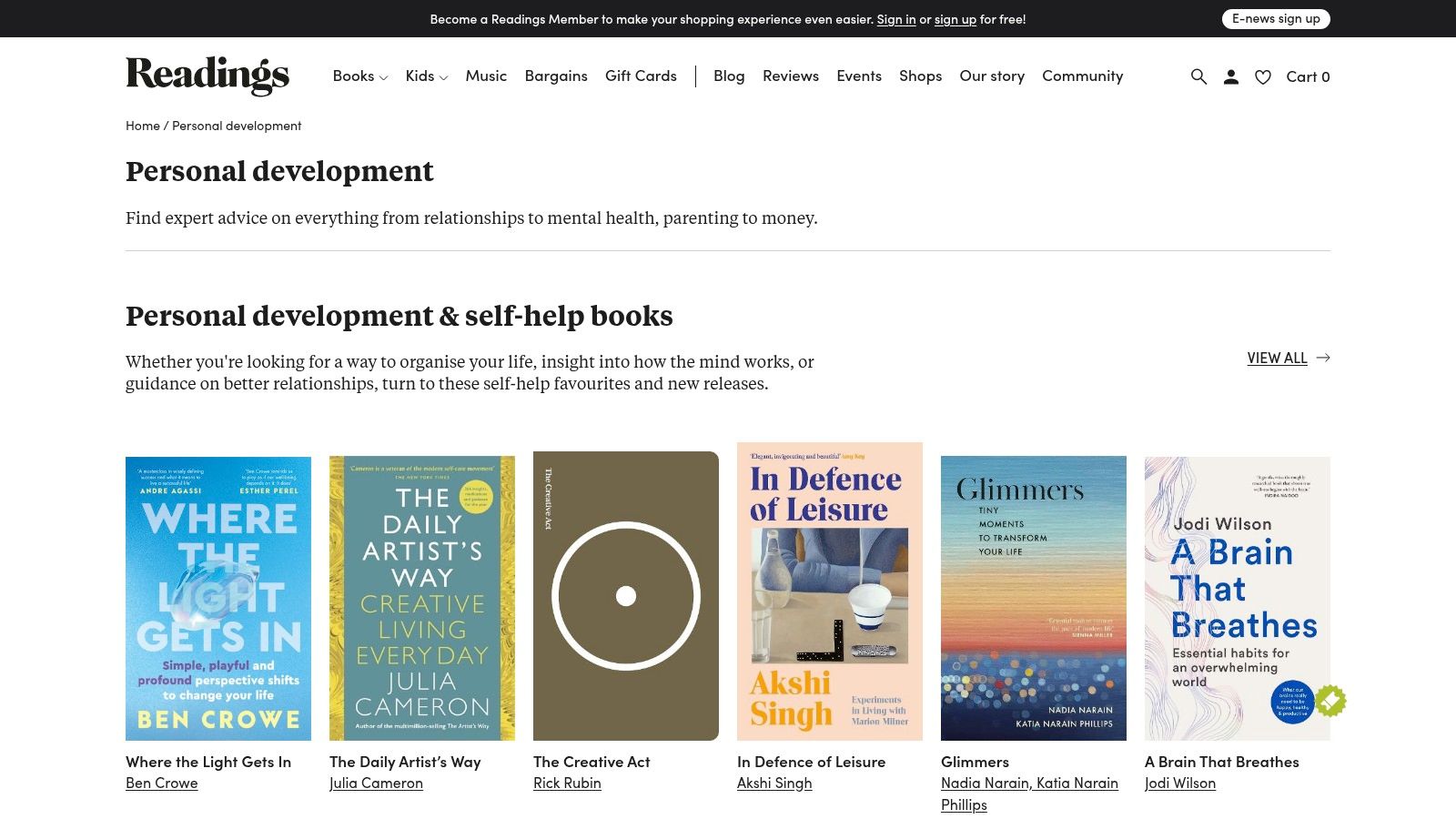
    Readings

    Website: https://www.readings.com.au/personal-development-self-help

  4. Angus & Robertson


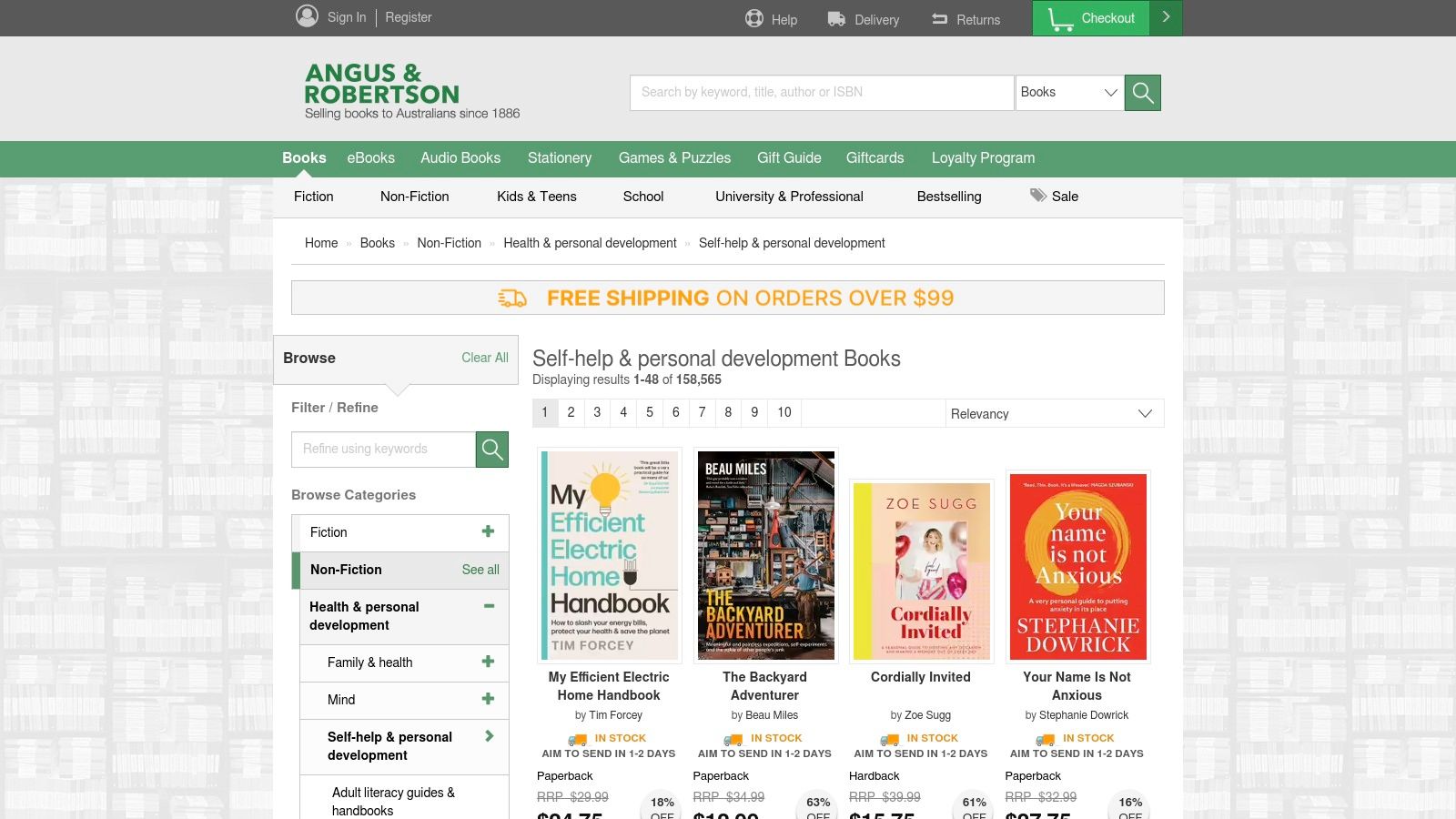
    Angus & Robertson

    Website: https://www.angusrobertson.com.au/books/non-fiction/health-and-personal-development/self-help-and-personal-development/c/B_VS

  5. Booktopia


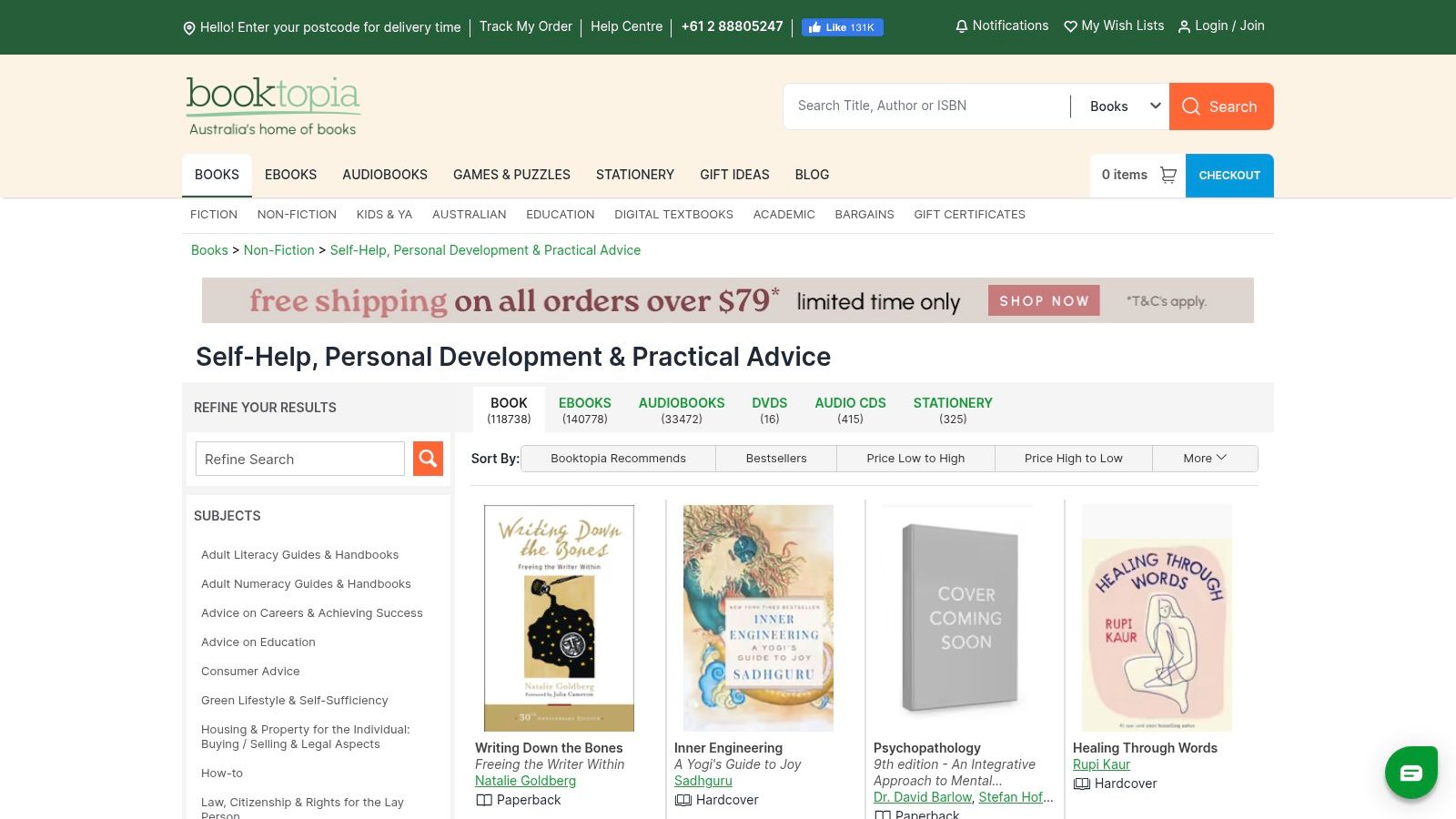
    Booktopia

    Website: https://www.booktopia.com.au/books-online/non-fiction/self-help-personal-development/cVS-p9.html

  6. Audible Australia


    Audible Australia

    Website: https://www.audible.com.au

  7. Google Play Books (AU)


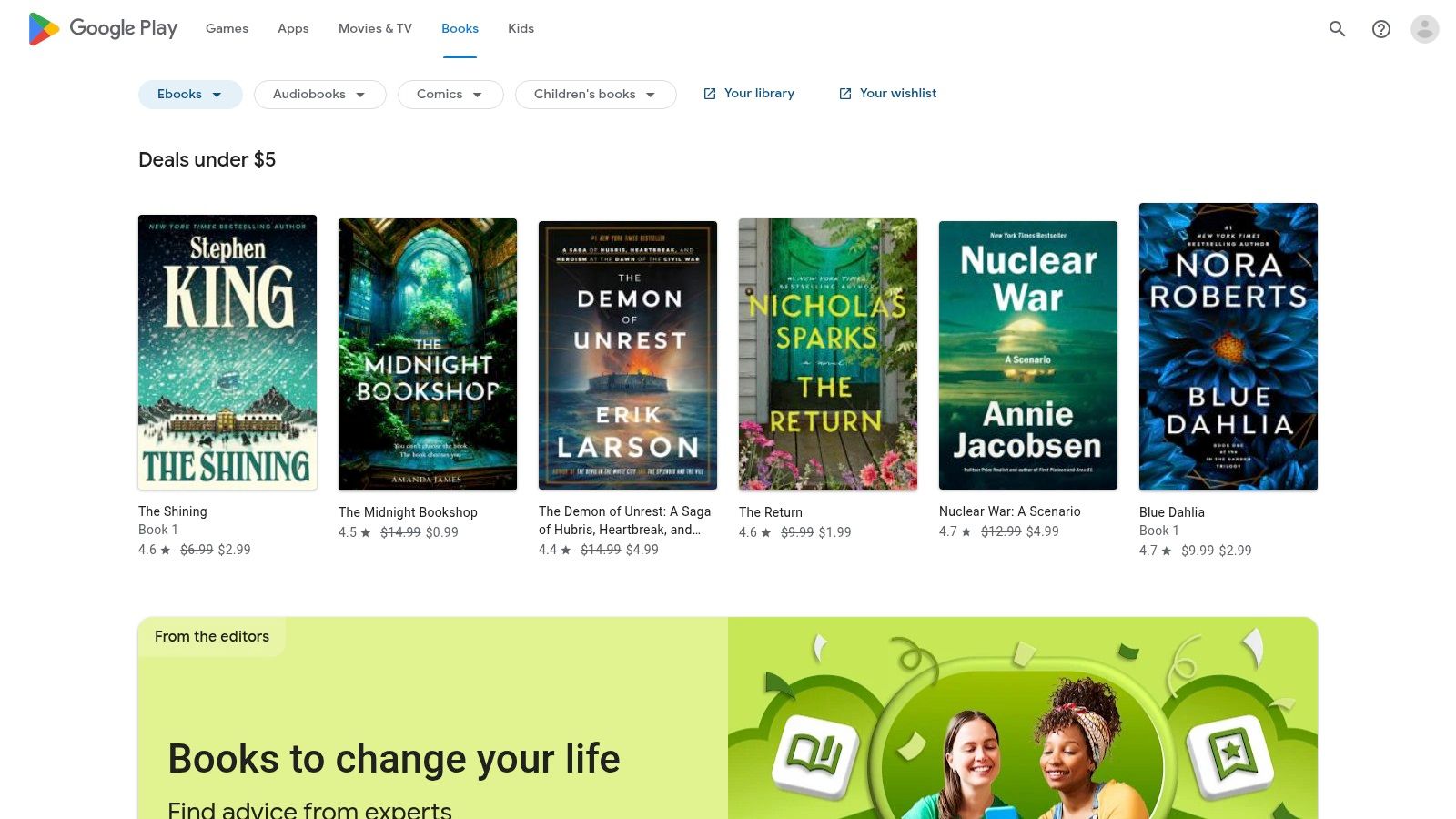
    Google Play Books (Australia)

    Website: https://play.google.com/store/books

  8. Rakuten Kobo (AU)


    Rakuten Kobo (Australia)

    Website: https://www.kobo.com/au/en/p/confidence-self-esteem-ebooks

  9. BorrowBox


    BorrowBox (Bolinda)

    Website: https://www.borrowbox.com


FAQ

What books actually help build confidence?
Books that combine mindset frameworks, practical exercises and real examples like Mindset, Atomic Habits and The Confidence Gap are most effective.

Can reading really improve confidence?
Yes, reading alone changes thinking. Applying book concepts through small daily actions solidifies new beliefs and skills, which builds confidence.

What should I read if I lack self-belief?
Start with mindset books like Mindset by Carol Dweck or Feel the Fear and Do It Anyway by Susan Jeffers to reframe negative self-talk.

Are confidence books worth it?
They are worth it if you choose the right title for your current challenge and commit to practicing the suggested exercises consistently.

How many confidence books should you read?
Focus on one or two books at a time. Fully apply their principles before moving to the next, ensuring you build confidence through practice rather than information overload.


Conclusion

Building confidence is a process of action, reflection and steady progress. These 15 books to build confidence cover the essential pillars you need: adopting a growth mindset, mastering productive habits, communicating with clarity, managing emotions and finding purpose. No single book is a magic cure; each offers tools for different stages of your journey. Choose the one that speaks to your most pressing challenge, apply its lessons and celebrate your small wins. With patience and persistence, you will transform knowledge into real, lasting confidence. Find out more at Your Bro.
What Should I Do With My Life? A Practical Path for Men

If you’re asking, “what should I do with my life?”, you’re in good company. It’s a heavy question. It usually hits late at night when the world is quiet and you’re scrolling through someone else’s highlight reel, feeling like you’re falling behind. This guide is a practical, no-fluff framework to help you find some real, solid direction.

That Nagging Feeling You Can’t Shake

It’s that quiet voice in your head that shows up when you’re not distracted. You see mates landing grad jobs, getting engaged, or backpacking through Europe, and that internal pressure starts to build. It can feel like everyone else got the life manual and yours was lost in the mail. This feeling of being adrift is incredibly common, yet it feels isolating when you’re in it.

The pressure comes from all angles: what your family expects, what you see online, and the high standards you probably set for yourself. It’s easy to look at all that confusion and think it’s a personal failure. It’s not. It’s the necessary starting point for building a life you actually want to live, one with intention behind it. You’re at a crossroads, and admitting that to yourself is the first proper step forward.

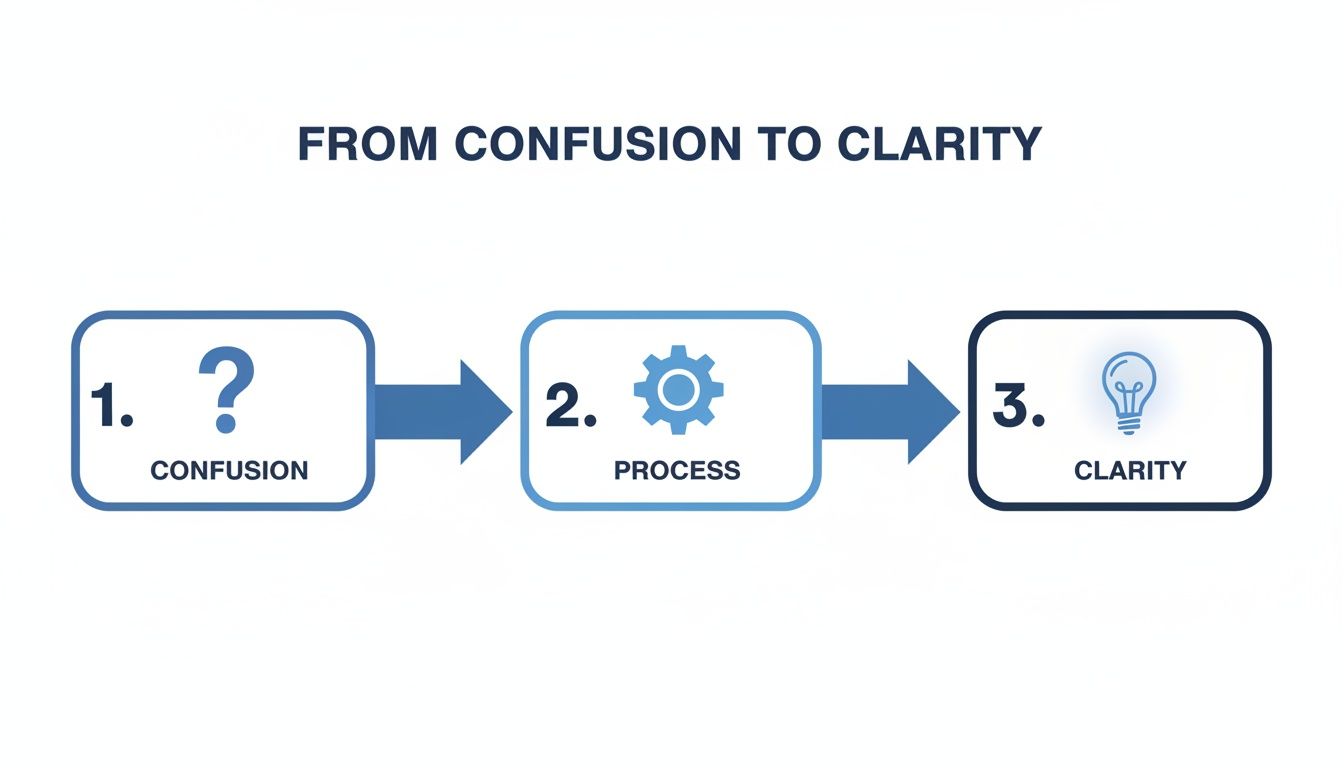
This guide gives you a structured way to cut through the noise and think clearly. We’ll dig into who you are right now, test a few different paths without you having to risk it all, and set up simple systems to keep you moving. Getting from confusion to clarity isn’t a lightning bolt moment. It’s a process of taking deliberate, small steps.

A diagram showing a three-step process from confusion (question mark) to clarity (lightbulb) via process (gear icon). What should I do with my life

This simple diagram nails it. Clarity isn’t magic. It’s the result of applying a solid process to the messy state of confusion you’re in. For a deeper dive into this first stage, you might find our article on feeling lost in life helpful.

  • If the question “what should I do with my life?” feels too big to tackle on your own, that’s where getting guidance can make all the difference. A coach is like a guide for this exact process, someone to give you structure and keep you accountable. Why not book a free discovery call with Your Bro and see how we can help you start building your own roadmap?

Start with a Brutally Honest Self Assessment

A thoughtful young man sits on a bed, looking at his phone with city lights outside, pondering "what should I do with my life?"

Before you can figure out where you’re going, you need an unfiltered look at where you are right now.

That massive question, “what should I do with my life?” feels impossible because most of us start with a picture of who we think we should be, not who we actually are. This first step is about dropping the performance and getting honest with yourself.

This isn’t therapy talk or a deep philosophical maze. Think of it as a practical inventory of your life as it stands today. The goal is to build a clear, non-judgmental picture of your starting point. Without it, any direction you pick will feel like you’re wearing someone else’s clothes. It just won’t fit.

Find Your Genuine Interests

First, let’s separate what you actually enjoy from what you perform for others. Social media has blurred this line massively. We end up curating hobbies for an audience, whether it’s one person or thousands of followers, instead of just doing things because they feel good.

It reminds me of those influencers who build a brand around a hobby, only to realise they don’t even like it when the camera is off. Your real interests are the things you do when no one’s watching.

Your real interests are often the things you do when no one is watching. They’re the activities you get lost in without thinking about how they look or what they say about you.

This is your first task. Grab a notebook and spend a week noticing what you naturally drift towards when you’re not trying to impress anyone. It could be listening to podcasts, fixing things around the house, or going for a long walk. No interest is too small or silly. Write it all down.

Map Your Real Skills

Next, let’s look at what you’re actually good at. Forget your resume for a second. Most blokes only think about skills in terms of job applications, which leaves a huge amount of practical ability off the table.

Your skills inventory should include everything. Are you the guy everyone calls to help them move because you’re a genius at packing a truck? Can you de-escalate a tense situation between mates? Maybe you can whip up a decent meal from whatever’s left in the fridge.

These are real, valuable skills.

Define Your Core Values

Finally, you need to know what truly matters to you. Your values are your personal rules for life. They act as your compass when you have to make a choice. If you don’t know what they are, you’ll just end up adopting the values of the people around you, a fast track to feeling hollow and unfulfilled.

Are you driven by security, freedom, community, or achievement? There are no right or wrong answers, only what’s true for you. Getting clear on this is so crucial we have a whole guide on how to figure out your values that can help you dig deeper.

To pull all this together, you can use a simple framework. The key is brutal honesty. No one is marking this but you.

Your Personal Inventory Framework

This is a simple framework to inventory your skills, interests, and values honestly.

Category Guiding Questions Your Honest Answer (Example)
Interests What do I do when no one is watching? What topics do I lose track of time reading about? Listening to history podcasts, trying new recipes, tinkering with my car.
Skills What do friends ask me for help with? What problems am I naturally good at solving, even if it’s not work-related? Good at planning group trips. Can fix most basic household stuff. A calm head in a crisis.
Values What principles would I not compromise on? What makes me feel proud? Angry? Fulfilled? Honesty, independence, loyalty to my mates. Can’t stand unfairness.

Going through this self-assessment process can be confronting, and it’s easy to get stuck in your own head. Sometimes an outside perspective makes all the difference. This is where coaching comes in.

At Your Bro, we provide the structure to help you see yourself clearly, without judgment. If you’re struggling with this part, a free discovery call is a solid place to start getting some clarity.

Explore and Experiment Without Pressure

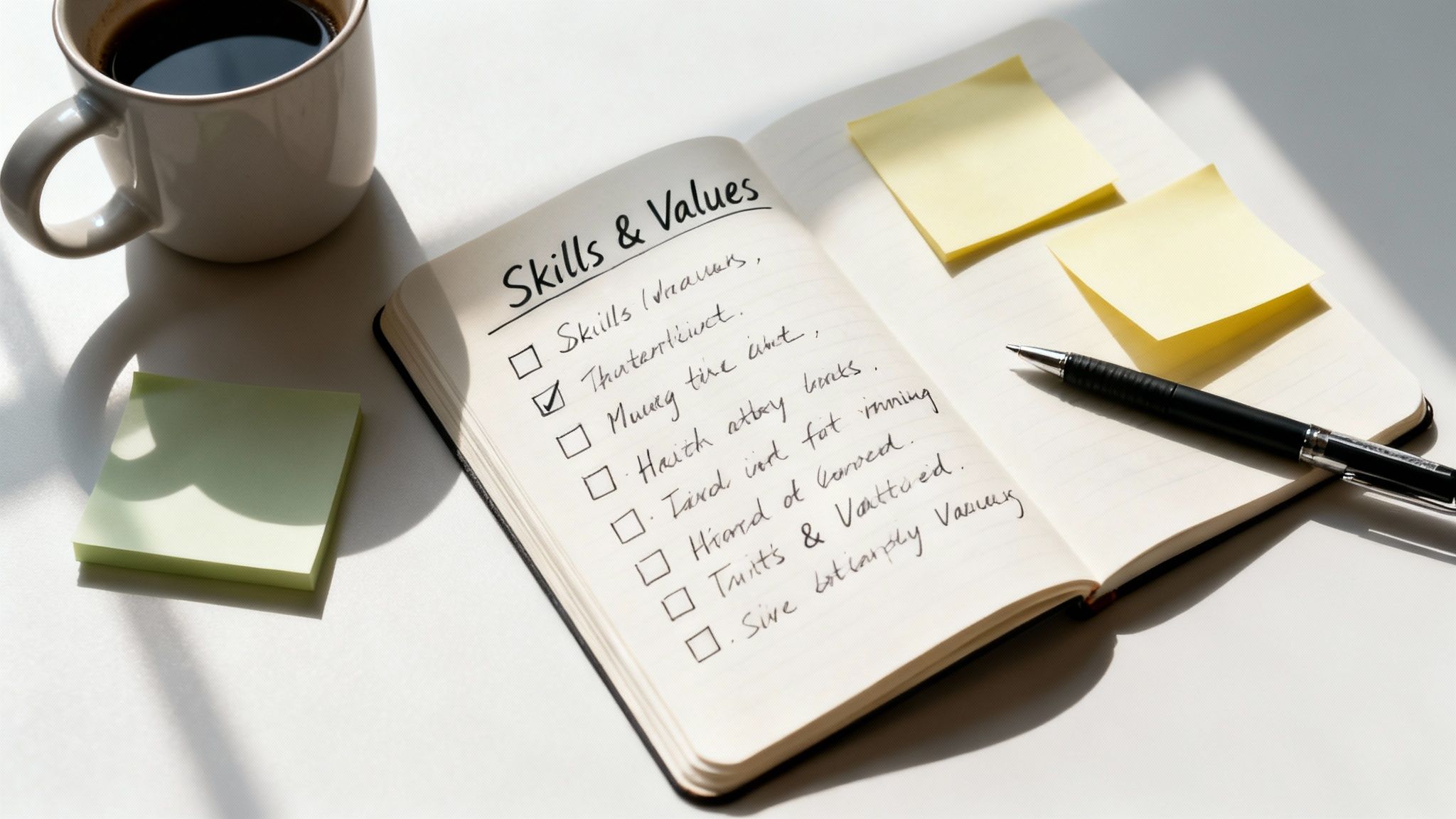
An open notebook titled 'Skills & Values' with a checklist, coffee mug, pen, and sticky notes on a table.

Let’s get one thing straight. The idea that you need to discover some grand, singular “purpose” is a trap. It’s a huge weight to put on your shoulders, and more often than not, it leads to doing nothing because you’re terrified of choosing the wrong path. That’s paralysis by analysis, and it’s a dead end when you’re trying to figure out what should I do with my life.

A much better way forward is to think like a scientist. Stop living in your head and start gathering real-world data about what actually clicks for you. This means shifting your focus from endless overthinking to practical doing, all through small, low-risk experiments.

This is all about taking action without the crushing pressure of a lifelong commitment. We’re going to look at how to design ‘mini-projects’ to test drive potential career paths, hobbies, or even lifestyle changes. Each one is just a short-term test, designed to give you priceless information.

Design Your First Mini-Project

The goal here is simple: get a realistic taste of an activity or path. It’s not about becoming an expert overnight. It’s about collecting data to see if something truly aligns with the skills, interests, and values you’ve already identified.

Your first experiment needs to be small and achievable. Don’t start with “become a software developer.” That’s a mountain. Instead, start with “complete a free, 10-hour online Python course.” The commitment is tiny, but the information you get back is massive.

Here are the key ingredients for a solid mini-project:

  • A Clear Objective: What do you really want to learn or feel? (e.g., “I want to see if I enjoy the logical problem-solving involved in coding.”)

  • A Specific Timeframe: How long is this test running for? (e.g., “I will dedicate four weeks to this.”)

  • A Low Cost: The cost should be minimal, in both time and money. Free is best.

  • A Way to Measure: How will you judge the outcome? (e.g., “Did I enjoy the process enough to want to learn more, or did I absolutely hate it?”)

This hands-on approach makes answering the question of what should I do with my life feel less like a monumental decision and more like an exciting exploration.

Practical Ideas for Low-Risk Experiments

Thinking about a path is one thing. Actually experiencing a small slice of it is something else entirely. Reading about being a personal trainer is a world away from shadowing one at a gym for a day. Theory is clean and simple. Reality is messy and far more informative.

Here are a few practical examples of mini-projects you could try:

  • Test a Creative Skill: Instead of just dreaming about being a YouTuber, commit to scripting, shooting, and editing three short videos on a topic you love. The goal isn’t to go viral. It’s to see if you can even stand the tedious editing process.

  • Explore a Trade: Interested in carpentry but not ready for an apprenticeship? Buy some second-hand tools and try building a simple project, like a bookshelf, by following a tutorial. See if working with your hands actually feels good.

  • Volunteer Strategically: If you think a particular cause matters to you, volunteer for a related organisation for one month. This gives you a direct look at the day-to-day reality of that field without any career commitment.

  • Start a Tiny Side Project: Got a business idea? Don’t write a 50-page business plan. Instead, try to get one paying customer. That single action will teach you more about marketing, sales, and your idea’s viability than months of planning ever could.

The point of these experiments isn’t to succeed in the traditional sense. The point is to learn. Finding out you absolutely hate something is just as valuable as discovering a new passion. Both outcomes give you clarity.

Structuring these experiments and making sense of the results can be tricky when you’re on your own. It’s easy to get discouraged if a project doesn’t go the way you’d hoped. This is where getting some outside guidance can be a massive help.

If you need a hand designing your first few experiments, a free Your Bro discovery call can give you the clarity and structure to get started properly. We can help you break down a big, intimidating idea into a manageable first step.

Alright, you’ve run a few experiments. The fog of confusion is starting to lift. You’ve got some real-world data and a couple of potential options on the table. That’s progress. Big progress.

But now, the game changes. We’re shifting from exploration to decision-making. It’s time to choose a direction for your next chapter.

The goal here isn’t some perfect, carved in stone, lifelong commitment. It’s about making a clear, deliberate choice based on what you’ve actually learned. We’re moving past a simple pros and cons list to something far more grounded in who you are.

This is about making a calm, evidence-based choice, not one driven by hype from your mates or that nagging voice of fear in your head. You need a way to filter your ideas so you can confidently pick one and start building some real momentum.

Go Beyond a Simple Pros and Cons List

Look, a basic pros and cons list is a decent starting point, but it’s often too shallow. It doesn’t account for the weight of each point. “Good pay” might be a pro, sure, but if the work completely stomps on one of your core values, it should carry a lot more negative weight than a simple tick in a box.

We need filters that tie directly back to the self-assessment work you did earlier. This makes sure your decision is aligned with who you actually are, not just what looks good on paper.

Here are three practical filters to run your options through:

  1. The Values Filter: Does this path actually line up with the core values you identified? If you value autonomy above all else, a career with a rigid corporate structure and a micromanager for a boss is going to be a terrible fit, no matter how fat the paycheque.

  2. The Growth Filter: Can you see a clear path for learning and picking up new skills here? A direction that lets you grow is infinitely more valuable in the long run than one that feels like a dead end from day one.

  3. The Lifestyle Filter: How does this choice realistically affect your day-to-day life? Think about work hours, location, and financial stability. Does it actually support the kind of life you want to build outside of your job?

Using these filters helps you see your options with much greater clarity. It frames the decision around your personal definition of a good life, which is the only one that truly matters.

Learn to Manage Risk Intelligently

One of the biggest things that paralyses us when making a decision is the fear of risk. But risk isn’t something you should avoid at all costs. It’s something to be understood and managed. Every choice, including the choice to do nothing, carries some kind of risk.

So, instead of asking, “Is this risky?” ask yourself, “What is the actual risk here, and how can I manage it?” More often than not, the worst-case scenario is nowhere near as catastrophic as your mind makes it out to be. Could you live with the worst possible outcome? If the answer is yes, the risk might just be worth taking.

Your decision doesn’t have to be permanent. Think of it as the next step on a path, not the final destination. If it turns out to be the wrong direction, you can always adjust your course with the new information you’ve gained.

Making a decision when you’re feeling overwhelmed is tough. Ever stared at the ceiling at 2 AM, wondering ‘what should I do with my life?’ The life coaching market is exploding because of it. While global figures peg the market at $3.68 billion, racing to $6.62 billion by 2029, AU-specific trends highlight personal development coaching as the leader for individuals like you. You can read the full report on these market trends and see why so many are seeking guidance.

Commit to a Direction

The final step is to commit. Once you’ve filtered your options and sized up the risk, pick one direction and go all-in for a set period. Give it a proper shot. This commitment creates momentum and gives you that powerful feeling of being in control of your own life.

If you’re still finding it hard to pull the trigger, having someone to talk it through with can make all the difference. A coach gives you a sounding board and a structured way to think through your options without the emotional fog getting in the way. A free discovery call with Your Bro is a no-pressure way to get that clarity and make your next move with genuine confidence.

Build Momentum with Systems, Not Just Goals

You’ve made a decision. You’ve chosen a direction. That’s a massive step, one that puts you ahead of most blokes who are still stuck just thinking about it.

But a decision without action is just a nice idea that will fade in a few weeks. The real work starts now. It’s not about making one big choice. It’s about building momentum through consistent, daily action.

Relying on motivation alone is a trap. Motivation is a feeling, and feelings are fickle. They come and go. If you only work on your new path when you feel like it, you’ll get nowhere fast. The key to turning your answer to what should I do with my life from a concept into your actual life is to build systems that make progress the default setting.

From Goals to Systems

A goal is a target you want to hit, like “lose 10 kilos” or “start a side hustle”. A system is the repeatable process you follow that makes hitting that goal almost inevitable.

Instead of focusing on the finish line, you focus on showing up and doing the work every day. Even on the days you don’t feel like it.

James Clear, author of Atomic Habits, explains this perfectly. He argues that tiny changes in your daily habits are what lead to remarkable results over time. It’s not about one heroic effort but about the compound interest of small, consistent actions.

Here’s a look at how this concept works in practice from his website.

The graph clearly shows that the impact of small, daily improvements is enormous over the long run. Focusing on your system, not just the outcome, is what creates this powerful upward curve.

Create Your Action Framework

Building a system doesn’t need to be complicated. In fact, the simpler it is, the more likely you are to stick with it. Here are three practical ways to start building your own action framework today.

  1. Habit Stacking: This is a simple technique where you link a new habit you want to form with an existing one you already do automatically. For example, if your goal is to learn a new skill, you could stack it like this: “After I finish my morning coffee (existing habit), I will spend 15 minutes on my online course (new habit).” It removes the need for willpower.

  2. Environment Design: Make your desired actions easier and your undesired actions harder. If you want to eat healthier, don’t buy junk food in the first place. If you want to practise a new skill, leave the tools or books out in plain sight where you can’t miss them. You’re engineering your environment to support your goals.

  3. Accountability Structures: It’s much harder to let yourself down when you know someone else is watching. This could be a weekly check-in with a mate where you both share your progress. For more structure, this is exactly where coaching can be a game changer. At Your Bro, a core part of our coaching is providing that external accountability to ensure you follow through on what you say you’re going to do.

To help with this, you can check out our simple but effective habit tracker template to keep yourself honest.

Accountability is a massive piece of the puzzle. Think about the digital fitness coaching market in Australia. It’s set to nearly double to USD 437.88 million by 2033 because guys are seeking structure.

Data shows that while 45% of 18-25-year-old men use workout apps, only 28% stick with it past three months, largely due to a lack of accountability. You can read more about how accountability drives the digital fitness market. This proves that having a good plan isn’t enough. You need a system to ensure you execute it.

If you have a direction but struggle to build the systems to make it happen, let’s have a chat. A free discovery call with Your Bro can give you the framework and support to turn your decisions into real, lasting momentum.

Right, let’s get into the final piece of the puzzle.

Figuring out what to do with your life isn’t a one-time event you solve and then shelve forever. It’s an ongoing process, a conversation you have with yourself that changes and evolves as you do. The person you are today isn’t the same person you’ll be in five or ten years.

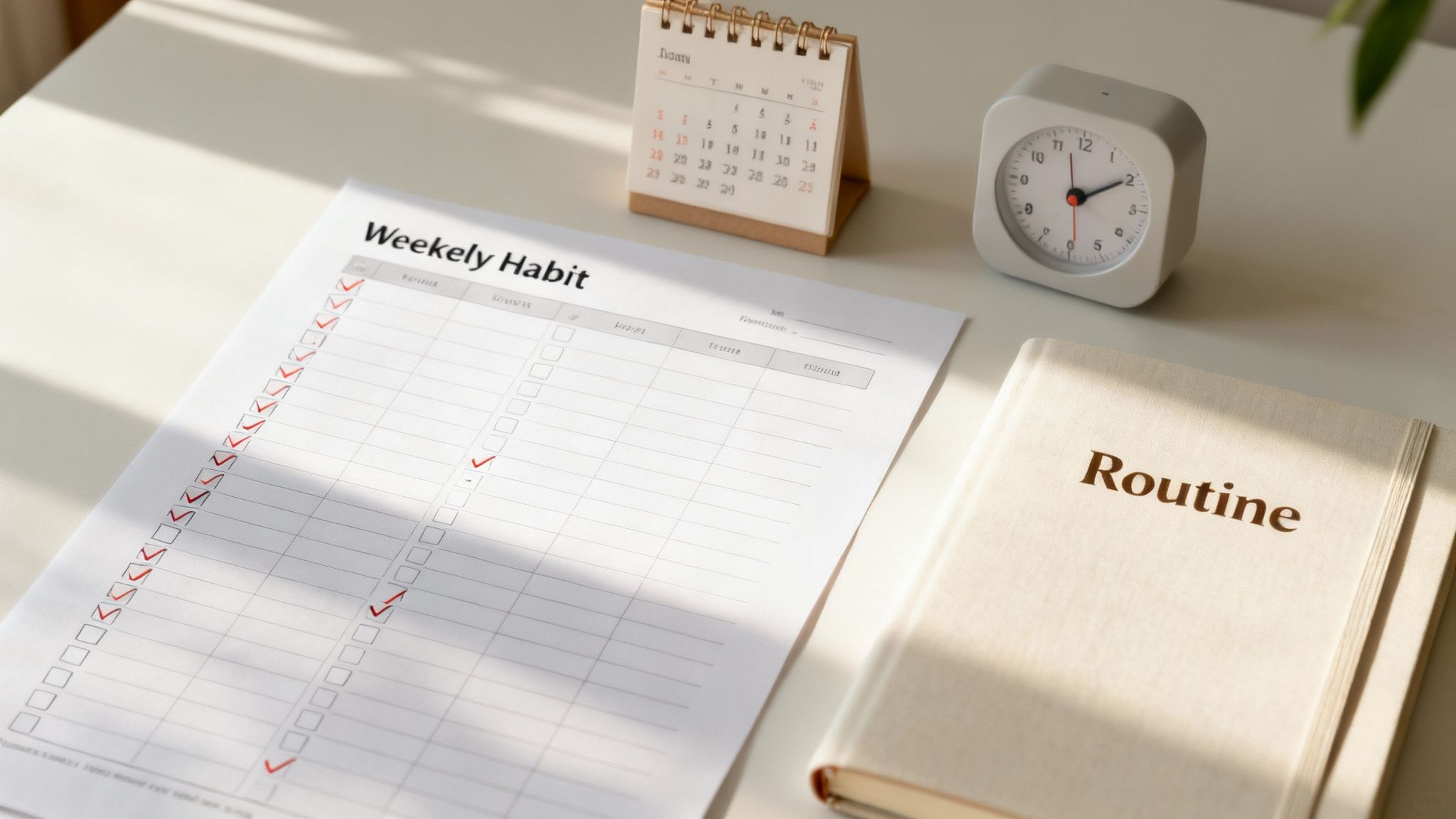
A minimalist desk setup with a weekly habit tracker, calendar, alarm clock, and 'Routine' notebook.

WThe point of this guide was never to lock you into some rigid, 30-year plan. That kind of thinking is fragile. It shatters at the first sign of trouble. The real goal was to give you a framework, a way of thinking and acting, so you can handle life’s inevitable curveballs with more intention and a lot less panic.

Handling Setbacks and Pressure

You are going to have setbacks. It’s guaranteed. An experiment will bomb, a path you thought was the one will turn out to be a dead end, or you’ll just lose steam. That’s okay. The key is to see these moments not as failures, but as data points. They’re just more information you can use to adjust your course.

At the same time, you’ll feel the heat from friends and family. They might not get why you’re trying something new or veering off the conventional track. Their opinions, while often well-intentioned, are filtered through their own experiences and fears, not yours. You have to learn to tune out that noise and stay true to the honest self-assessment you did earlier.

Remember this: a setback only becomes a failure if you stop moving. The process is about continuous adjustment, not perfect execution.

If you find yourself constantly derailed by setbacks or what other people think, it can be a sign that you need a stronger support system. This is where having someone in your corner can make a world of difference. Booking a free discovery call with Your Bro is a solid move to get personalised guidance and build a plan that actually fits you.

Embrace the Evolving Plan

The idea isn’t to have your whole life mapped out. It’s about always having an intentional next step. What’s the one thing you’re focusing on for the next three to six months? That’s a much more powerful and manageable question than trying to figure out the next three decades.

Trust me, this struggle is massive, and you’re not alone in it. Just look at the digital health coaching market in Australia. The sector hit USD 197.4 million and is projected to more than double to USD 409.6 million by 2030. The fastest-growing part of that? Mental Wellbeing Coaching. That tells you everything you need to know about how common this feeling is. You can check out the full findings on Australia’s digital health coaching market.

Think of your plan as a living document. Review it. Adjust it. Be willing to scrap parts of it as you gather more information and gain more life experience. Be compassionate with yourself when things go sideways, but don’t let yourself off the hook for taking consistent, deliberate action. That’s the balance that leads to real progress.

Frequently Asked Questions

Alright, let’s tackle some of the common questions that pop up when you’re trying to get a handle on your life’s direction. We’ll keep the answers straightforward and cut through the noise to give you that extra bit of clarity.

How Long Should This Process Take?

Look, there’s no deadline here. Trying to answer a question like “what should I do with my life?” over a single weekend is just setting yourself up for a bad decision.

Some guys get clarity after a few months of digging in with self-assessment and trying things out. For others, it can take a year or even longer. The real goal isn’t to find some final, ultimate answer, but to build a habit of continuous self-discovery. Focus on making small, consistent bits of progress rather than sprinting towards a finish line that doesn’t actually exist.

What If I Choose the Wrong Path?

This is a massive fear, but honestly, it’s mostly overblown. Very few decisions you make in your early twenties are set in stone.

If you commit to a path for six months and realise it’s a dead end, you haven’t failed. You’ve just gathered incredibly valuable data about what doesn’t work for you. Think of it like this: you’ve successfully scratched one bad option off the list, which gets you one step closer to a good one. That’s a win. The only real failure is staying stuck and doing nothing because you’re terrified of making a mistake.

Do I Need to Find My One True Passion?

Short answer: no. The whole idea of a single, magical “passion” is a myth that causes a heap of anxiety. It puts immense pressure on you to find that one perfect thing, which more often than not just leads to getting completely stuck.

A much more practical approach is to cultivate passion. You do this by getting good at something that you find interesting and that lines up with your core values. Passion is often the result of mastery and purpose, not the cause of it. Start with what sparks your curiosity and build out from there.

When Should I Consider Getting Help?

It’s a smart move to get some guidance when you feel like you’re just going around in circles. If you’ve done the self-assessment work, tried a few experiments, but still feel completely bogged down, an outside perspective can break that cycle.

A coach isn’t there to give you the answers. They’re there to provide a framework and hold you accountable so you can find your own. If you’ve read through this guide and feel like you need that kind of structure and a push in the right direction, it’s probably a good time to reach out. Answering “what should I do with my life” is a big job, and you don’t have to do it all on your own.


Feeling like you’ve got a clearer picture but need a hand turning these ideas into a solid plan? At Your Bro, we provide the grounded, practical guidance to help you build a life with intention. Book a free, no-pressure discovery call to see how we can work together.


What Are Your Values? A Practical Guide to Finding What Matters

Ever felt like you’re just drifting, unsure of which way to turn next? It’s a common feeling, and it’s usually what nudges people to start asking the big questions, like, "what are your values?"

If you’re reading this, chances are you feel a bit lost or unsure about what you should be aiming for. That’s completely normal. Most people live their whole lives without ever sitting down to figure this stuff out. They just go with the flow, picking up goals and expectations from parents, mates, and social media.

The problem is, when you live without a clear sense of your own values, you end up feeling pulled in a dozen different directions. You’re not in the driver's seat; you’re just a passenger. This guide is about putting you back in control, not with some rah-rah motivational hype, but with a practical, grounded way to figure out what actually matters to you.

What Are Your Values? (Plain English Explanation)

Let's cut through the jargon. Personal values are your guiding principles. They’re the fundamental beliefs that help you decide what is important and what isn’t. Think of them as your internal compass for making decisions and navigating life.

This isn't about being perfect. It’s about having a personal code to live by, something that helps you make sense of the world and your place in it. Your values are what you fall back on when you have to make a tough choice and nobody else is looking.

Difference between values and goals

It’s easy to mix these two up, but they’re completely different. Getting this right is the first step toward real clarity.

A goal is a destination you can reach. It’s something you can tick off a list, like running a marathon or getting a promotion. A value is the direction you travel in for your entire life. You can’t "complete" a value like Honesty or Growth; you just choose to live by it every day.

Goals are the what. Values are the how and the why. You can achieve a goal and still feel empty if it wasn't aligned with your values in the first place.

Difference between values and personality

Your personality is your natural set of tendencies. Are you introverted or extroverted? Spontaneous or a planner? It’s your default wiring, the stuff you don’t really choose.

Your values, on the other hand, are a conscious choice. You might be a quiet, introverted person who deeply values community and connection. Or you could be a loud, outgoing person who values stability and quiet reflection.

Your personality is what you are. Your values are what you choose to stand for.

Why Your Values Matter More Than Motivation

A man in black athletic wear tying his running shoe on a cold morning road, his breath visible. what are your values

We've all been there. You get a sudden jolt of inspiration to sort your life out. You hit the gym, start that project, eat clean. You’re on fire for a few days.

Then, life happens. A long day at work, a flat tyre, or you just wake up feeling flat. The fire is gone. Suddenly, the couch and a mindless scroll on your phone look a lot more appealing.

Relying on motivation alone is a terrible long-term strategy. It’s a feeling, and feelings are fickle. This is where your personal values come in.

Values are what get you out of bed on a cold morning when motivation has packed its bags and left. They're the solid, unchanging reason why you’re doing something in the first place. If you value ‘Health’, you go to the gym not because you feel like it, but because it aligns with the man you want to be. The action becomes an expression of your character, not just a reaction to your mood.

When you’re clear on your values, you have a reason to stay disciplined even when it’s hard.

How unclear values lead to procrastination and distraction

Without a clear set of values, your brain will always default to the easiest path. It's just how we're wired. This is why you end up scrolling on social media for an hour instead of doing that one thing you know is important. The cheap, easy dopamine hit is always more attractive than the difficult, meaningful work.

But when you’re crystal clear on what your values are, you create a filter for your decisions. You start asking better questions, like: “Does this decision move me closer to the man I want to be?” This simple shift helps you become proactive and intentional, rather than just reacting to whatever your brain feels like doing in the moment.

Signs You Haven’t Defined Your Values

That feeling of being stuck or adrift often comes from a disconnect between what you do every day and what you actually believe in. When you haven't defined your core values, life just happens to you. You’re not steering the ship; you’re just getting tossed around.

Here are a few common signs:

  • Feeling lost or directionless. You might have a job or be studying, but it feels like you're on a treadmill to nowhere. You don't have a good reason to get out of bed beyond just needing to.

  • Saying yes to things you regret. You agree to things that drain your energy because it's easier than setting boundaries. Your time gets spent on other people's priorities, not your own.

  • Constant comparison to others. You scroll social media and feel inadequate looking at other blokes who seem to have it all figured out. Without your own definition of success, you end up chasing someone else’s.

  • Chasing goals that feel empty. You get the pay rise or finish the big project, but the feeling of accomplishment is hollow and gone in a flash. Your goals aren't connected to a deeper "why".

  • Struggling to stay disciplined. You find it hard to stick to good habits because there's no strong, internal reason driving you forward when things get tough.

Recognising these signs isn't about beating yourself up. It’s about spotting the problem so you can start building a more solid foundation for your life.

Common Misunderstandings About Values

Before we go further, let's clear up some common bullshit around values. This isn’t a self-help exercise to make you feel good. It’s a practical tool.

Your real values are not:

  • What sounds good on paper. Words like "Innovation" or "Excellence" sound great in a corporate meeting room but often mean nothing in real life. Your values should be grounded and personal.

  • What your parents expect. A lot of us inherit a set of values from our family. Part of growing up is figuring out which of those you actually believe in, and which ones you're carrying just to please others.

  • What social media rewards. The online world rewards hot takes, outrage, and showing off. Chasing likes and validation is a guaranteed way to build a life that looks good but feels empty.

  • What makes you look successful. True values guide your behaviour when nobody is watching. They aren't about crafting an image or impressing people.

Getting honest about this is crucial. Defining your values is about discovering what is true for you, not performing for an audience.

How Values Are Formed

Your values don't just appear out of thin air. They're shaped over time by your experiences, for better or worse. Understanding where they come from can help you figure out which ones are truly yours.

  • Early life influences: What your parents, teachers, and family taught you about right and wrong forms the initial bedrock. These are your default settings.

  • Hard experiences: Getting fired, going through a tough breakup, or facing a major failure. These moments force you to figure out what you’re made of and what really matters when things fall apart.

  • Role models (or lack of them): The people you admire show you what certain values look like in action. Likewise, seeing people you don't want to be like can clarify what you stand against.

  • Reflection and deliberate choice: This is the stage you’re at now. It’s about consciously looking at all those influences and deciding for yourself what you want to stand for moving forward.

This isn’t about blaming your past. It’s about understanding it so you can make intentional choices about your future.

How to Figure Out What Your Values Are (Step by Step)

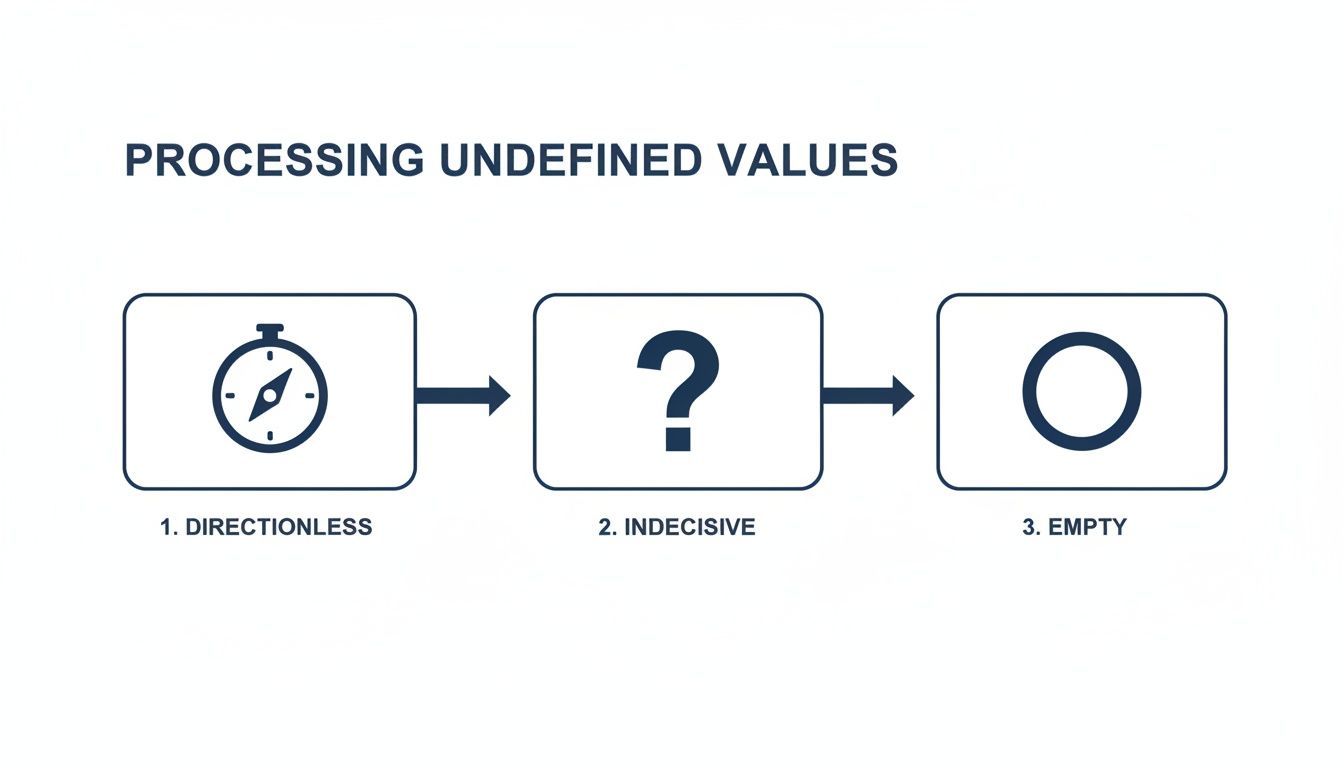
Flowchart illustrating the process of handling undefined values, moving from directionless to indecisive to empty.

Alright, let's get into it. This isn't about finding the "right" answers. It’s about finding your answers. The following steps are practical, designed to cut through the noise and get to what truly matters to you. Try not to overthink it, just be honest with yourself.

Step 1: Look at moments of pride and regret

Think back over your life. Pinpoint two or three moments when you felt genuinely proud of yourself. These don't have to be big achievements. Maybe it was sticking to a gym routine, helping a mate when you were exhausted, or telling the truth when a lie would have been easier.

For each memory, ask yourself:

  • What was I doing?

  • Why did that make me feel proud?

  • What principle was I living by in that moment?

Now do the opposite. Think of a couple of times you felt regret or disappointment in yourself.

  • What was I doing?

  • Why did I feel that way?

  • What principle did I violate?

The answers reveal a lot about your underlying values in life.

Step 2: Identify recurring frustrations

The things that consistently piss you off are powerful clues. Think about what really gets under your skin, not just minor annoyances.

Do you get wound up when people are flaky and don't keep their word? That points to you valuing Responsibility. Does it drive you mad when you feel like people aren't being straight with you? You almost certainly value Honesty.

Your anger often points directly to a value that's being violated. When you see something you believe is wrong, it's because it clashes with something you believe is right. Pay attention to that.

Step 3: Examine what you admire in others

Think about people you genuinely look up to. This could be a family member, a mentor, or even a public figure.

List three people you admire. Next to each name, write down the specific qualities that earned your respect. Is it their work ethic? Their loyalty? Their ability to stay calm under pressure?

The qualities you admire in others are often a mirror of the values you want to live by yourself.

Step 4: Narrow down what truly matters

Now, pull it all together. Based on the last three steps, brainstorm a big list of potential values. Don't filter yourself. Just get all the words down on paper.

Once you have your list, the real work begins. Your goal is to narrow it down to your top 3-5 core values. Any more than that and they become impossible to use as a practical guide.

Start by grouping similar words (e.g., 'dependability' and 'reliability' could fall under Responsibility). Then, make some tough calls. If you could only live by five of these principles for the rest of your life, which would they be? Circle them.

Step 5: Test values against real decisions

This is the final check. Look at your short list of values. How do they hold up against a tough decision you've made recently? Or one you're facing right now?

A real set of values should make hard decisions simpler (not necessarily easier). They give you a framework to choose the right path, even when it's the harder one. If your list doesn't help with that, you might need to refine it a bit more.

A List of Common Personal Values (With Explanations)

This isn't a menu to choose from. It’s a list to help you put words to the ideas you’ve been uncovering. See which of these resonate with what you've already discovered about yourself.

  • Integrity: Being honest and having strong moral principles. Doing the right thing, even when no one is watching.

  • Responsibility: Owning your actions and commitments. Being someone others can rely on.

  • Discipline: The ability to do what needs to be done, even when you don't feel like it.

  • Freedom: Having the independence to make your own choices and live life on your own terms.

  • Growth: A commitment to learning, improving, and pushing past your comfort zone.

  • Family: Placing importance on close relationships with family and loved ones.

  • Stability: Valuing security, predictability, and having a solid foundation in life.

  • Contribution: The desire to make a positive impact on others or the world around you.

  • Honesty: Being truthful and straightforward in your communication and actions.

  • Self-respect: Believing in your own worth and acting in a way that honours that belief.

  • Adventure: Seeking out new experiences, challenges, and excitement.

  • Loyalty: Being faithful and committed to the people and principles you care about.

  • Kindness: Treating others, and yourself, with compassion and decency.

Again, these are just examples. Don’t just pick the ones that sound good. Choose the ones that feel true.

How to Choose Your Values Intentionally

Here's the most important part: your values are a choice. While they are shaped by your past, you get to decide what you stand for from this day forward. This isn't about who you've been; it's about who you are choosing to become.

This means taking full responsibility. You can't blame your circumstances or your upbringing for not living by your principles. It's on you.

Your chosen values should guide your behaviour, not just be nice-sounding beliefs you hold. If you say you value "Health" but you're smashing junk food and avoiding the gym every day, you don't actually value health. You value comfort. Being honest with yourself about this gap between your stated values and your actual behaviour is where real change begins.

How to Live According to Your Values

Figuring out what you stand for is a massive step, but it’s only half the job. A list of words doesn’t change anything. The real work begins when you start using those words to steer your choices, every single day.

Aligning daily actions with values

This is about building a bridge from your big principles to your small, daily habits.

If one of your core values is Growth, your daily actions might include reading for 30 minutes or listening to an educational podcast. If you value Health, it means meal prepping on Sunday and scheduling your gym sessions like they're non-negotiable appointments. The key is to make it tangible and measurable. Using a simple tool like a habit tracker template can help you build this consistency.

Making trade-offs

Living an intentional life is all about making trade-offs. You can’t have it all. When your values are clear, these trade-offs stop feeling like sacrifices and start feeling like conscious, powerful choices.

For example, if you deeply value Stability, you might have to walk away from a risky but exciting business idea. If you value Freedom above all else, you might need to live a more minimalist life to avoid getting chained to a massive mortgage. It’s not about finding a perfect balance; it’s about knowing what you’re prioritising and why.

Accepting discomfort

Let’s be honest: the path aligned with your values is often uncomfortable. It means having the awkward conversation, dragging yourself to the gym when you’re tired, or saving money instead of buying the latest gadget.

Embracing this discomfort is a skill. The more you consciously choose the meaningful path over the easy one, the stronger you become. This is how you build genuine self-respect.

Using values as a filter for decisions

When you face a big decision, run it through your values. Should you take that new job? Move to a new city? End that relationship?

Instead of just asking "what do I want to do?", ask "what is the right thing to do based on my values?" This creates clarity and helps you make choices you can stand behind in the long run.

When Values Are Unclear, Life Becomes Reactive

Without a clear answer to "what are your values?", life becomes a constant reaction to outside forces. You react to your moods, to other people's expectations, and to the endless distractions fighting for your attention.

This leads directly to procrastination, because you have no strong "why" to power you through difficult tasks. It leads to distraction, because your phone offers an easier hit of stimulation than meaningful work. And ultimately, it leads to burnout, because you're spending all your energy on things that don't actually fuel you.

Clarity isn't just a nice idea. It's the foundation for a focused, disciplined, and fulfilling life.

How Coaching Can Help Clarify Your Values

Figuring this all out on your own can be tough. It’s hard to see the picture when you’re standing inside the frame. Sometimes you just go around in circles in your own head.

Some people find it helpful to work through this with guidance rather than alone. A coach or mentor doesn't give you the answers. They ask the right questions to help you find your own. It's a dedicated space to unpack your experiences and connect the dots without judgment.

At Your Bro, our one-on-one mentoring is built to do exactly that. We help young men get clear on their values and then turn that clarity into structure and action. If you feel like a bit of guidance could help, booking a Book a Free Discovery Call to Get Started is a no-pressure way to see if it’s a good fit.

Recommended Resources on Values

If you want to go a bit deeper, here are a couple of solid resources that cut through the hype.

  1. Book: Man's Search for Meaning by Viktor Frankl. It's a heavy read, but it’s the ultimate book on finding meaning and purpose in the toughest conditions imaginable. It shows how powerful values can be.

  2. Video: This video from The School of Life offers a calm, reflective take on finding fulfilling work, which is closely tied to understanding your values.

Conclusion

Figuring out what your values are is not a one-time event. It’s a process. The goal isn’t to come up with a perfect, permanent list. It’s to start the conversation with yourself and get a clearer sense of direction.

Be patient with yourself. This kind of reflection takes time. But the clarity and confidence you’ll gain from knowing what you stand for is worth the effort. You’ve taken the first step just by reading this. Now, it's time to do the work.

Self Improvement Journal for Men Who Want Clarity, Not Fluff

If you've heard the term "self improvement journal," you probably picture one of two things. A diary full of feelings, or some complicated self help trend that takes up too much time.

Let's get this straight. A self improvement journal is neither of those. It's a practical tool to get your thoughts in order so you can figure out what to do next. No fluff, no drama.

I get why people are skeptical. I didn't journal in my early 20s. It felt pointless. It was only later I learned to use it as a simple tool for clarity. This guide is the practical, low effort approach I wish I had back then. It's for guys who feel stuck and want clarity, not for people who love writing.

What a Self Improvement Journal Actually Is

Forget what you think journaling is. This isn't about writing beautiful sentences or documenting every small thing that happened. Think of it less like a diary and more like a logbook for your life.

It's a private space to think clearly on paper. That's it. It’s a simple way to untangle your thoughts, see what's holding you back, and start making better decisions.

It’s not a diary. A diary records what happened in the past. A personal growth journal is about looking forward. You use it to process what's happening now so you can plan what to do next.

It's also not therapy. While a self reflection journal can support your mental health, it’s not a replacement for professional help. Therapy is a guided process with a professional. Journaling is a tool you use yourself to get clear.

Think of it as a thinking and clarity tool. It helps you organise the noise in your head.

Why Journaling Helps With Self Improvement

So, how does writing in a notebook actually lead to self improvement? It’s more straightforward than you might think.

Your mind is a busy place. Trying to hold onto one thought is hard. A journal forces you to slow down, pick one thought, and actually finish it. This simple act cuts through the mental noise and brings some clarity.

It helps you create awareness. You can't fix a problem if you don't know it's there. Journaling is like holding up a mirror. You start to see patterns you’d otherwise miss, like procrastination or the excuses you make.

It helps you spot these patterns over time. When you write things down consistently, you can look back and see the same issues coming up again and again. This is how you find the real problem.

It also supports decision making. When you feel stuck on a big decision, journaling helps you lay out all the options without the emotional clutter. Writing it all down takes the pressure off and makes it easier to choose a path you feel good about.

Common Mistakes People Make With Journaling

Most guys who try journaling just stop. They go hard for a few days, then the notebook gathers dust. It’s not because the tool is broken. It’s because they’re using it wrong. This builds pressure and makes a simple habit feel like a chore.

Here are the common mistakes.

Writing too much is a big one. You don't need to fill pages. A few focused sentences that get to the point are more valuable than long, rambling entries. When it feels like a chore, you'll avoid it.

Another mistake is trying to sound deep. Your journal isn't a performance. The goal is to be honest, not impressive. You don't need to write a philosophical masterpiece. Just be straight with yourself.

Being inconsistent is another killer. Only reaching for your journal when things go wrong turns it into an emergency emotional dump. The real power comes from regular, consistent use. Journaling every day helps you spot patterns and build a solid habit of self reflection.

Using it only when things go wrong is a related mistake. This can turn your journal into a complaint book. It’s important to be honest about challenges, but you also have to acknowledge what worked. Balancing the good with the bad gives you a more accurate picture and keeps you moving forward.

How to Start a Self Improvement Journal (Step by Step)

Alright, let's get practical. Forget about fancy notebooks or needing an hour of quiet time. That's how you fail before you even start. This is a simple framework that takes five minutes a day.

Simplicity and consistency are the only things that matter. You're not writing a masterpiece. The goal is to make it so easy that you have no excuse to skip it.

An open self improvement journal, glass of water, and toothbrush on a bedside table next to a bed.

Here is a simple way to do it.

First, keep it short. Aim for five minutes, max. This is a quick check in, not an essay.

Second, journal at the same time each day. The best way to make a habit stick is to link it to something you already do. Do it right after you brush your teeth in the morning, or just before you turn out the light at night.

Third, answer the same few questions. This removes the problem of not knowing what to write. You just show up and answer the prompts.

Finally, focus on actions, not just feelings. A useful self improvement journal is a tool for action. It’s there to help you see what you did, understand what you learned, and decide what you’re going to do next. This focus on practical steps creates real momentum.

Simple Self Improvement Journal Prompts

Staring at a blank page can feel like a test. That pressure is why most guys give up.

Forget that. Your journal is a tool. These prompts are designed to be answered fast. They are practical questions to get you thinking about action. Pick one or two each day. Write a couple of honest sentences. That's it.

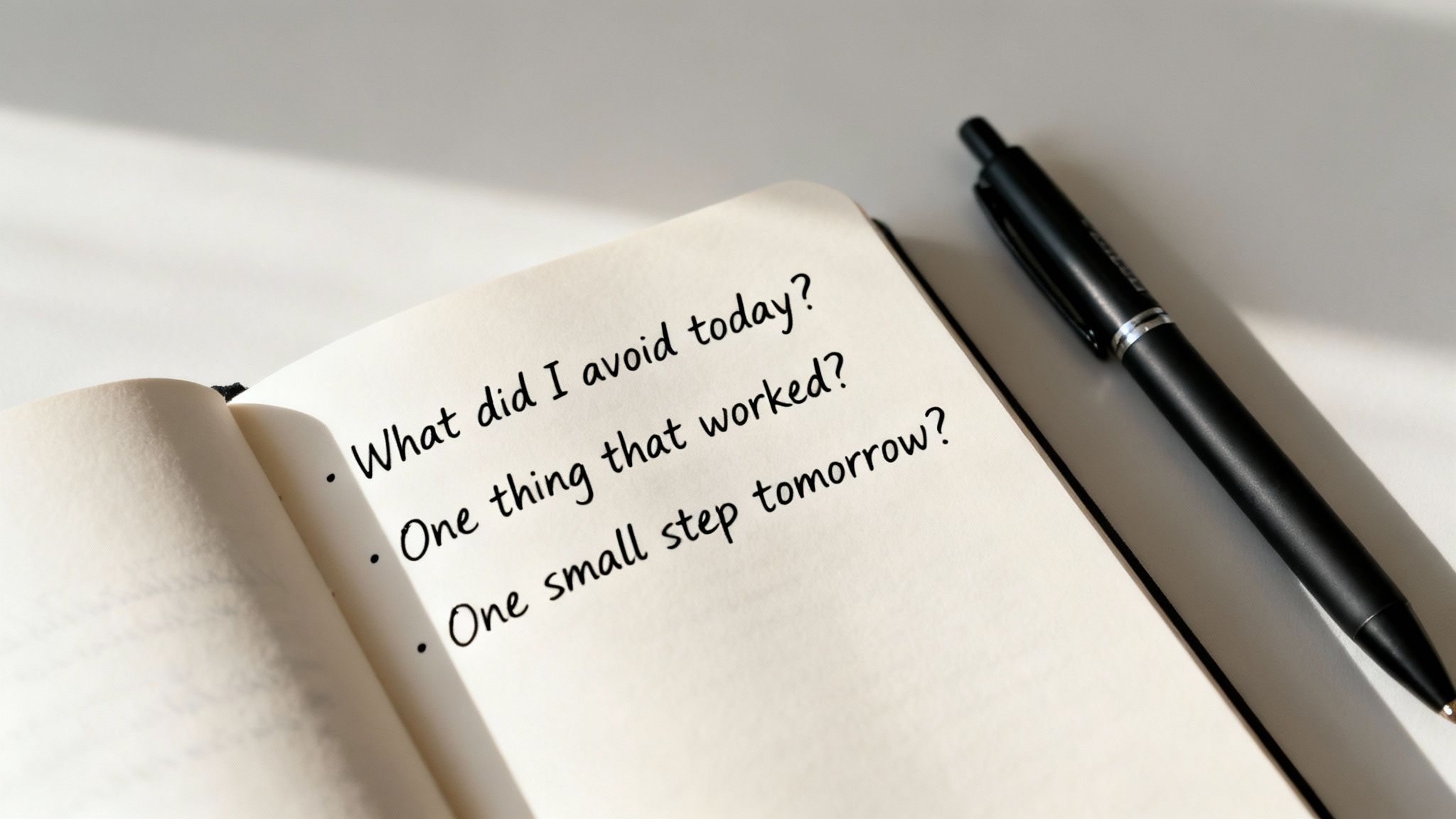
Open journal displaying self-reflection questions: 'What did I avoid today?' with a black pen.

Here are a few simple, practical prompts:

  • What did I avoid today? This helps you spot procrastination patterns. Being honest about what you’re putting off is the first step to dealing with it.

  • What mattered today? A lot of what fills our day is just noise. This question helps you refocus on the things that are actually moving you closer to your goals.

  • What worked and what didn’t? This forces you to acknowledge a win, no matter how small. It also helps you see what isn't working so you can adjust.

  • What’s one small thing I can do tomorrow? This shifts you from thinking about problems to planning the next practical step.

  • Where did I get stuck today? This helps you pinpoint the exact friction points. Instead of a vague feeling of frustration, you can identify the specific obstacle.

Consistency with these simple questions will give you more clarity than trying to write something deep every night. Show up, do the work, and see what happens.

When Journaling Isn’t Enough

Look, a self improvement journal is a powerful tool. It helps you untangle your thoughts and see your own patterns. But it’s not a magic fix for everything.

Journaling reveals problems, but it doesn’t always solve them. There comes a point where seeing the problem on the page isn't enough to actually fix it. Journaling is great for figuring out the "what." You can see you’re procrastinating or stuck in a negative loop.

But figuring out "how" to change? That's a different game.

Trying to solve all your problems on your own can feel like hitting a wall. This is where getting an external perspective helps. We all have blind spots, things we’re too close to our situation to see clearly.

Talking to a mate, a mentor, or a coach can help you see the way forward. It’s not about admitting defeat. It’s about being smart enough to use every tool you have. Support from someone else creates momentum when you feel stuck.

How Your Bro Uses Journaling in Coaching

Here at Your Bro, we don't just talk about this stuff. A simple self improvement journal is a core part of our coaching and mentoring.

It’s a tool we use together. It keeps our conversations grounded in what’s actually happening in your life. Journaling as part of mentoring helps bring clarity, discipline, and reflection to the process.

Your journal is your private space to untangle thoughts. Our coaching sessions are where we turn those thoughts into a solid plan. We use your journal entries as a starting point so we're always working on what's real and providing judgement-free guidance. No more talking in circles.

Journaling helps you spot the patterns. The right guidance helps you break them for good. If you feel like an outside perspective could be what you need to move forward, learn more about coaching with Your Bro. We keep things practical and focused on one thing: getting you unstruck.

Final Thoughts

You don't need to be a writer to use a self improvement journal. You just need to be willing to be honest with yourself for five minutes a day.

The goal is consistency over intensity. Start small. Pick one prompt and just start. Don't overthink it. This is a practical tool to help you get clear and move forward. You can do this.

Your Bro can help. Book your free Discovery Call to find out about our coaching.

How to Improve Your Emotional Intelligence (Without Overthinking It)

The term “emotional intelligence” gets thrown around a lot, and frankly, it can sound like a load of nonsense. Most guys hear it and picture some kind of feelings guru who wants you to talk about your emotions 24/7. Let’s forget all that.

Most of us weren’t taught how to handle our emotions. We were told to suck it up, push it down, or just not feel it. This is why so many men feel either disconnected from their emotions or completely controlled by them, lashing out before they even know why.

This guide will show you how to improve your emotional intelligence in a practical way. It’s not about endless navel-gazing. It’s about learning a skill that gives you more control, less regret, and a quiet confidence that you can handle whatever life throws at you. This is a learnable, practical skill, not a personality trait.

What Emotional Intelligence Actually Is

A woman sits peacefully with her eyes closed and hand on chest in a sunlit kitchen. How to Improve Your Emotional Intelligence.

In simple terms, emotional intelligence is understanding what’s happening inside your own head so you can manage your actions. It’s about noticing a feeling, like anger or frustration, without letting it take the wheel.

It’s the difference between snapping at your partner when you’re stressed versus taking a breath and dealing with the actual problem. It’s not about suppressing what you feel. It’s about understanding it so you can respond with a clear head instead of just reacting on impulse.

When you’re under pressure, this skill is what keeps you grounded. It lets you choose how you show up in the world.

Why Emotional Intelligence Matters More Than You Think

This isn’t some fluffy, feel-good concept. Building this skill has real, tangible benefits that will improve every part of your life.

  • Better relationships. When you understand your own reactions, you create less drama. You can communicate what’s actually going on instead of just getting angry or shutting down. This leads to more respect and less pointless conflict with your partner, mates, and family.
  • Better decisions. Ever made a dumb choice in the heat of the moment? A lack of emotional control clouds your judgment. Being able to pause and think clearly under pressure means you make choices you won’t regret later.
  • Less regret. When you’re in control of your responses, you do and say fewer things you have to apologise for. You leave situations feeling like you handled them well, even when they were tough.
  • More self-respect. True confidence isn’t about being the loudest guy in the room. It’s a quiet strength that comes from knowing you can handle your own state without losing your head.
  • Reduced emotional burnout. Constantly wrestling with your emotions, reacting to things, and cleaning up the mess is exhausting. Emotional intelligence helps you conserve that mental energy for things that actually matter.

Common Signs Your Emotional Intelligence Needs Work

This isn’t about diagnosing yourself. It’s just an honest look at common patterns. See if any of these feel familiar.

  • Reacting before thinking. Someone pushes your buttons, and you fire back instantly. The regret kicks in a few minutes later.
  • Avoiding difficult conversations. If your first instinct is to put off talking about something important with your boss or partner, it’s a sign you’re avoiding the feeling that comes with it.
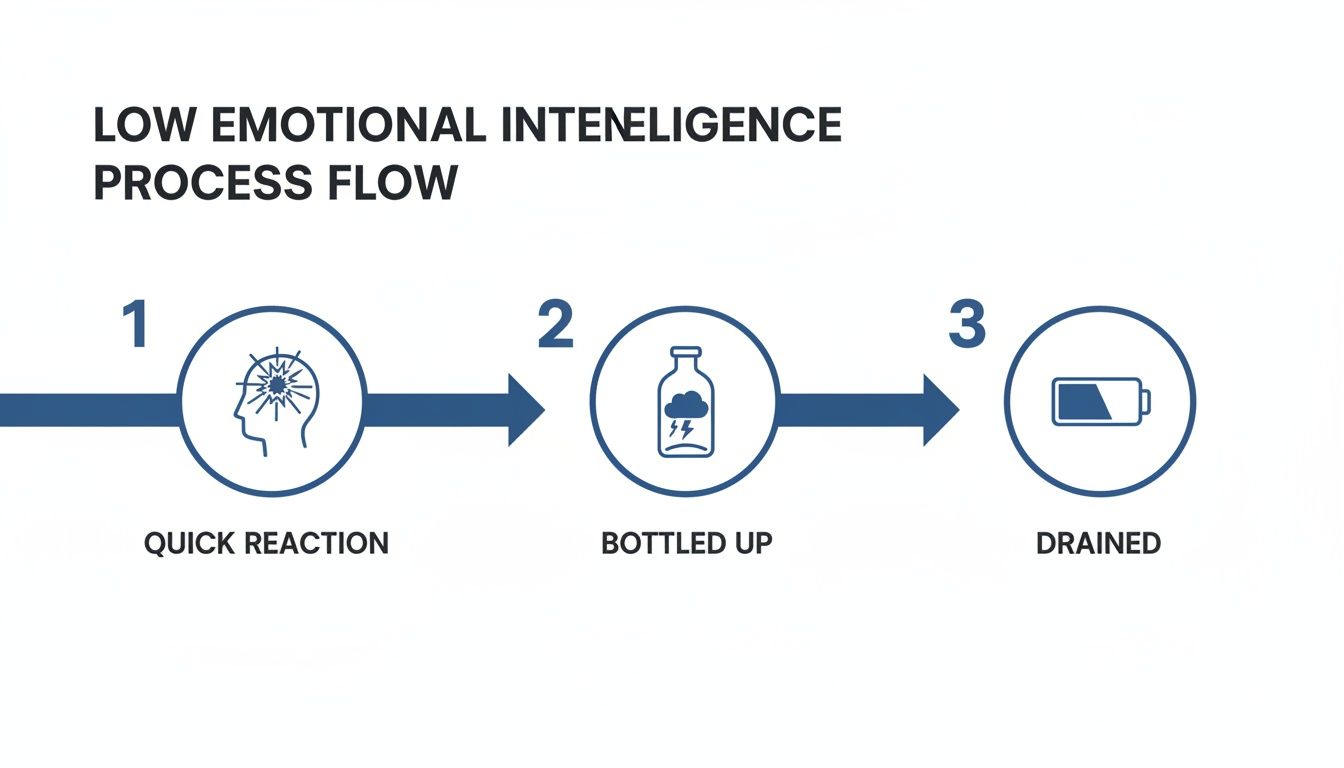
  • Bottling things up until they explode. You swallow frustration for weeks, then lose your mind over something small, like a dirty dish in the sink. The pressure builds until it has to escape somewhere.
  • Struggling to name what you feel. When someone asks what’s wrong, your answer is “nothing,” “stressed,” or “pissed off.” You find it hard to get more specific than that.
  • Feeling emotionally drained often. This is a sign you’re burning a huge amount of energy managing emotional blow-ups or recovering from them.

How to Improve Your Emotional Intelligence Step by Step

This is where the real work begins. Forget complicated theories. This is a practical framework with small, realistic steps.

Flowchart showing a low emotional intelligence process: quick reaction, bottled up emotions, and feeling drained.

The goal is to break the cycle shown above. Instead of reacting, you learn to respond with intention. Here’s how.

1. Learning to pause before reacting

The most powerful skill you can build is creating a small gap between a trigger and your reaction. Even one second is enough to change the outcome.

When you feel that flash of anger, force a pause. Clench your fists. Take one slow breath. This tiny action interrupts the autopilot and gives your logical brain a chance to catch up. Ask yourself: “Will what I’m about to do make this better or worse?”

2. Naming emotions accurately

Most of us have a small emotional vocabulary: “mad,” “sad,” “fine.” But there’s a huge difference between feeling angry, feeling disrespected, feeling disappointed, or feeling frustrated.

When you can put an accurate name to a feeling, it loses its power over you. It becomes something you can look at and understand. Are you just “stressed,” or are you feeling overwhelmed and unsupported? Getting specific is the first step to knowing what to do next.

3. Understanding triggers

We all have triggers. It might be someone questioning your work, feeling ignored, or being told what to do. These are your personal emotional landmines.

Think about the last few times you lost your cool. What happened right before? Who was there? Look for the pattern. Once you know what sets you off, you can prepare for those moments or see them coming, which puts you back in control.

4. Practising emotional regulation in real situations

The next time you feel a strong emotion, try a simple regulation technique.

If you’re angry, instead of lashing out, go for a walk. If you’re anxious, focus on your breathing for 60 seconds. This isn’t about suppressing the feeling. It’s about choosing a constructive action instead of a destructive one. You feel the emotion, but you decide what happens next.

5. Reflecting after emotional moments

After a tough situation, take five minutes to reflect without beating yourself up. This is a debrief, not a self-criticism session.

Ask yourself:

  1. What was the trigger?
  2. What did I feel?
  3. How did I react?
  4. What would I do differently next time?

Doing this consistently trains your brain to see these moments as learning opportunities, not failures.

What Emotional Intelligence Is Not

There’s a lot of confusion out there. To build trust in this process, let’s be clear about what this is not.

  • It is not being overly emotional. It’s the opposite. It’s about being less controlled by your emotions, so you can think more clearly.
  • It is not constantly talking about feelings. It’s about understanding your feelings so you don’t have to. You process them internally and move on.
  • It is not being passive or weak. A man who can manage his emotions under pressure is seen as stable and strong. He doesn’t get rattled. This is about quiet confidence, not being a pushover.
  • It is not suppressing emotions. Suppression is bottling things up until they explode. This is about acknowledging a feeling, understanding its message, and choosing a smart response.

Why Doing This Alone Is Hard

Trying to see your own emotional habits is like trying to see the back of your own head. You know it’s there, but you can’t get a clear look. We all have blind spots.

You might think you’re being direct, but others think you’re aggressive. You might not even notice that you shut down when a conversation gets difficult. These patterns are almost impossible to spot on your own.

An external perspective helps you see what you’re missing. Getting guidance isn’t a sign of weakness; it’s a shortcut. A mentor can point out your habits in real-time and offer a different way forward. This support accelerates your progress and helps you see the game in slow motion.

How Your Bro Helps Build Emotional Intelligence

Two professionals discussing at a cafe table, with a woman taking notes during their conversation.

If this approach makes sense to you, we can help put it into practice. Our one-on-one mentoring is built to give you these real-world emotional skills.

We provide calm, judgement-free support to help you sharpen your emotional awareness and build more control in your daily life. There’s no therapy-speak, just practical guidance from someone who gets it. This isn’t about changing who you are. It’s about giving you the tools to show up as the best version of yourself, especially when things get tough.

If you think having someone in your corner could help, you can learn more about coaching with Your Bro.

We can help you unlock your potential – book your Free Discovery Call today.

It’s About Progress, Not Perfection

Learning to manage your emotions is a skill, and like any skill, it takes practice. You won’t get it right every time, and that’s okay.

The goal isn’t to become a robot who feels nothing. The goal is to feel everything but to stay in the driver’s seat. Be patient with yourself. Focus on making small improvements over time. Every time you choose to pause, reflect, and respond with intention, you’re building a stronger foundation for the rest of your life. Keep practicing. You’ve got this.

How to Overcome Procrastination Without Motivation or Guilt

If you’re here, chances are you’re feeling frustrated with yourself. You know what you need to do, but for some reason, you just can’t seem to do it. Let’s get one thing clear from the start: procrastination isn’t a character flaw. It doesn’t mean you’re lazy or broken. It’s a normal human response to feeling overwhelmed, uncertain, or stuck.

The good news is that you can learn how to overcome procrastination naturally. This article won’t give you productivity hacks or tell you to “just get motivated.” Instead, we’re going to look at what’s really going on and build a realistic plan that doesn’t rely on motivation or guilt.

What Procrastination Actually Is

A young person sits at a white desk with a closed laptop, open notebook, and a cup of tea. How to overcome procrastination

In plain English, procrastination is when you voluntarily delay doing something despite knowing it will probably make things worse later. It’s your brain’s attempt to avoid a negative feeling, like boredom, fear, or confusion.

You don’t put off things you enjoy. You put off things that feel difficult or uncomfortable. It’s a defence mechanism, but the short-term relief it offers almost always leads to more stress down the line. That’s the cycle.

The first step to learning how to overcome procrastination is to drop the self-blame. It’s not laziness. It’s often a sign that a task feels too big, you’re not sure where to start, you’re afraid of doing it wrong, or you have too many options.

Why Motivation Doesn’t Fix Procrastination

Have you ever told yourself, “I’ll do it when I feel motivated”? We all have. We treat motivation like a magical force we need to capture before we can start.

The problem is that motivation is a feeling, and feelings are unreliable. They come and go. Waiting for motivation to show up is just another form of procrastination. You’re handing control over to a mood that might not arrive for days.

Relying on motivation creates a bad cycle. You don’t feel motivated, so you don’t act. Then you feel guilty for not acting, which kills any motivation you might have had. The way to break this is to stop waiting to feel like it.

Action creates motivation, not the other way around. When you take a tiny first step, you create momentum. That momentum is what builds the feeling of motivation. Instead of waiting for inspiration, focus on creating a simple structure. A good structure works whether you feel motivated or not.

Common Reasons You’re Procrastinating

Think of procrastination as a signal. It’s your brain telling you that something about a task feels off. Instead of trying to force your way through it, it’s more effective to understand what’s really stopping you.

Here are some of the most common reasons you might be putting things off:

  • The task feels too big or vague. Goals like “get fit” or “sort my life out” are so massive your brain doesn’t know where to begin, so it does nothing.

  • You don’t have a clear next step. You might know the final goal, but the very next physical action you need to take is unclear. This uncertainty creates resistance.

  • You’re distracted by your phone or screens. Your phone offers an easy escape from uncomfortable tasks. Every scroll and notification provides a small dopamine hit that helps you avoid what you need to do.

  • You’re afraid of doing it wrong. This is perfectionism in disguise. The pressure to do something perfectly can be so intense that it feels safer not to start at all.

  • You lack a routine or structure. Without a default plan for your day, you have to rely on willpower. When your willpower runs out, procrastination takes over.

Recognising your specific pattern is the key. Once you know why you procrastinate, you can use the right strategy to move forward.

A Simple Framework to Overcome Procrastination

This is where we get practical. Learning how to overcome procrastination isn’t about some massive life overhaul. It’s about building a simple, realistic system that makes it easier to do the things you need to do, especially when you don’t feel like it.

This framework is the core of how you can stop procrastinating for good.

Clarify the Smallest Next Action

This is the most important step. When a task feels huge, your brain shuts down. The fix is to break it down into something so small it feels almost silly not to do it.

Don’t think about the whole project. Just identify the very first, physical action.

  • Instead of “write the report,” the next action is “Open a new document and write a title.”

  • Instead of “go to the gym,” it’s “Put on my gym clothes.”

  • Instead of “clean the house,” it’s “Put three things in the bin.”

The goal isn’t to finish. It’s just to start. This tiny, clear step removes the friction of overwhelm and makes it easier to begin.

Decision tree flowchart for procrastination triggers: clarify tasks, start small, research other reasons.

Reduce Friction and Distractions

Your environment has a huge impact on your behaviour. If your phone is easier to reach than your textbook, your phone will win. You need to make doing the right thing easier and the wrong thing harder.

  • Put your phone in another room. Not on silent, but physically out of sight. The small effort it takes to get it is often enough to keep you on task.

  • Prepare in advance. If you want to work out in the morning, lay out your clothes the night before. This removes a decision point when you’re tired.

These small changes reduce the willpower needed to start.

Work in Short, Defined Time Blocks

The idea of working on something difficult for hours is draining. So don’t. Commit to a short, focused burst of work instead.

Try working for just 15 minutes. Set a timer, and focus only on your one small task until it goes off. When it does, you can stop. Often, you’ll find that starting was the hardest part, and you’ll have enough momentum to continue. This makes any task feel less intimidating.

Focus on Consistency, Not Intensity

An “all or nothing” mindset is a trap. A messy, 20-minute effort is infinitely better than doing nothing at all. The goal is to build the habit of showing up.

Consistency is what builds real momentum and teaches your brain that you can follow through. Every time you do what you said you would do, no matter how small, you are building trust with yourself. This is how you overcome procrastination naturally and for the long term.

What to Do When You Still Avoid the Task

Even with the best plan, there will be days when you feel stuck. This is normal. It doesn’t mean you’ve failed or that the system is broken.

The worst thing you can do is fall back into guilt and self-criticism. That has never worked. Instead, get curious. Your resistance is a signal that something in your plan needs a small adjustment.

Ask yourself: Was my “smallest next action” still too big? If so, make it even smaller. What was I feeling right before I stopped? Naming the feeling, like boredom or fear, helps you understand the real roadblock.

This isn’t about deep analysis. It’s about practical troubleshooting. Be patient with yourself. Setbacks are part of the process. Every time you get stuck and calmly adjust your plan, you are strengthening your ability to follow through.

When Procrastination Is a Sign You Need Support

Trying to change deep-rooted habits on your own is harder. If you’ve tried these strategies and still feel like you’re spinning your wheels, it might be time to get some support.

An Asian woman takes notes while consulting with a man in a bright room.

External structure and accountability can make a huge difference. Having someone in your corner can help you see your blind spots and stay on track without judgment. Getting support isn’t a sign of weakness. It’s a sign of strength. It shows you’re serious about making a change.

How Your Bro Helps Men Overcome Procrastination

This is why Your Bro exists. I spent years in my twenties stuck in the same cycles of procrastination and overwhelm. I learned that what young men often need isn’t more hype, but simple clarity, structure, and accountability.

Our online mentoring and coaching is built for that. We work together to figure out what you want, create a realistic plan, and build the structure you need to follow through. It’s a no-judgment, no-hype space focused on helping you build momentum.

If that sounds like what you need, it might be time to take the next step. Learn more about coaching with Your Bro.

Conclusion

Learning how to overcome procrastination is a skill, not a personality transplant. It takes practice and patience. You don’t have to become a productivity machine overnight.

The goal is progress, not perfection. By focusing on small, clear actions and building a simple structure, you can start to break the cycle of avoidance and guilt. You can work through this. Remember to be honest, stay curious, and give yourself credit for every small step you take.

Visit our Coaching page to find out more about how Your Bro can help you on your journey, or jump straight into it with a Free Discovery Call.

Feeling Lost in Life? You’re Not Broken

If you’re reading this, chances are it’s late and you’re staring at a screen, trying to figure out what’s wrong. This feeling of being lost in life isn’t a sign you’re broken; it’s a signal that something needs your attention. It’s that heavy, nagging feeling of drifting without a map. You’re going through the motions, but you aren’t actually getting anywhere.

This feeling is incredibly common, especially for guys in their late teens and twenties. You’re not the only one. So let’s talk about it honestly, without the usual hype or clichés.

What Does “Feeling Lost in Life” Actually Mean?

Feeling lost is more than just having a bad day. It’s a quiet confusion, a sense of drifting while it feels like everyone else is moving forward. It’s the feeling of being stuck in neutral.

Think of it like a warning light on your car’s dashboard. That light isn’t there to tell you the car is a piece of junk. It’s a heads-up that something under the hood needs a look. Ignoring it won’t make the problem go away.

This feeling works the same way. It’s a signal, not a failure. It’s a prompt from deep down, telling you it’s time to pull over and figure out what’s really going on. It often shows up as:

  • Confusion: You don’t know what you want or what the next step should be.
  • Lack of Direction: You’re just passing time without any real sense of purpose.
  • Drifting: Days blend into weeks with nothing to show for it.
  • Avoidance: You put off decisions because doing nothing feels safer than making the wrong move.

This isn’t a sign of laziness. It’s a direct result of having zero clarity. When you don’t have a destination in mind, it’s impossible to take a confident step in any direction.

Why So Many Young Men Feel Lost Today

If you feel this way, it’s not just a personal failing. It’s a normal response to a world that has become incredibly complex and noisy.

Previous generations often had clearer paths. Go to uni, get a trade, find a stable job, buy a house. While that life wasn’t for everyone, it provided a sort of blueprint. Today, that blueprint is gone. You’re left with a blank page.

Here are a few reasons why so many of us feel adrift:

  • Lack of Clear Paths: The old roadmaps don’t exist anymore, leaving you to figure it out from scratch.
  • Too Many Options: We’re told choice is good, but having hundreds of potential careers and life paths is overwhelming. It often leads to paralysis, where you do nothing because you’re terrified of choosing wrong.
  • Constant Comparison: Social media is an invisible scoreboard where it feels like everyone is winning but you. You see mates buying houses or travelling the world, and it’s easy to feel like you’re falling behind, even when you don’t know what race you’re supposed to be running.
  • Distraction and Overstimulation: Your phone provides a constant stream of easy dopamine hits that keep you from having to sit with the uncomfortable question: “What am I actually doing with my life?”
  • Absence of Guidance: Many of us are navigating early adulthood without a mentor or older figure to offer grounded advice. We’re left to figure it out alone.

Recognising these external pressures is the first step toward giving yourself a break and focusing on what you can actually control.

Common Signs You’re Feeling Lost in Life

That vague, heavy sense of being lost shows up in your day-to-day habits. Recognising these patterns isn’t about judging yourself. It’s about getting honest so you can see the signals for what they are.

  • Feeling unmotivated without knowing why: You know you should do things, but the drive just isn’t there. Motivation follows clarity, so when you’re unclear, you feel flat.
  • Avoiding decisions: Big or small, making a choice feels impossible. Doing nothing seems safer than risking the wrong move.
  • Excessive phone or screen use: You burn hours scrolling, not because you’re enjoying it, but because it’s an easy way to numb your mind and avoid bigger questions.
  • Comparing yourself to others: You scroll social media and get that gut-punch feeling of being left behind, even if you’re not sure what you’re behind on.
  • Feeling behind without a clear reason: There’s a constant, nagging sense that you’re not where you’re “supposed to be,” but you can’t define what that even means.

These aren’t character flaws. They are just signposts pointing towards a deeper need for clarity.

What Not to Do When You Feel Lost

Before we talk about what to do, let’s cover the common traps that keep guys stuck. Avoiding these is your first real win.

  • Waiting for motivation: Motivation is a result of action, not the cause of it. You can’t wait to feel like it. You have to do something small, and the feeling will follow.
  • Comparing timelines: Your path is your own. Measuring your life against someone else’s carefully curated highlight reel is a game you will always lose. Focus on your own journey.
  • Trying to “fix everything” at once: Deciding to overhaul your entire life by Monday is a recipe for burnout. When you inevitably fail, you feel worse than when you started. Aim for small, sustainable progress, not a total revolution.
  • Consuming endless content without action: Watching self-help videos and reading articles feels productive, but it’s often just another form of procrastination. Information without action is just entertainment.

A Practical Way to Start Finding Direction

This isn’t about finding some magical “purpose” overnight. It’s about building a foundation of clarity and control, one small piece at a time. No hype, just grounded steps to get the wheels turning again.

A young man writing in a notebook about feeling lost in life at a sunlit desk with coffee, a plant, and an alarm clock.

1. Slow down and face reality honestly.
Stop distracting yourself. Find a quiet moment with a pen and paper and get honest. What parts of your life are draining you? What are you avoiding? Just write it all down without trying to fix it. Clarity starts with an honest look at where you are right now.

2. Clarify your values.
A lot of feeling lost comes from chasing goals you think you should want. Your values are your internal compass. Things like freedom, security, creativity, or connection. Figuring out what your personal values are helps you make decisions that feel right for you.

3. Create basic structure.
When your inner world is chaotic, bringing order to your outer world helps. You don’t need a military schedule. Just a simple morning routine can be a game-changer. For example: wake up at the same time, drink a glass of water, and get 10 minutes of sunlight before looking at your phone. It’s about starting the day with intention, not reaction.

4. Take small, deliberate steps.
Forget giant leaps. Focus on tiny wins. If you value health, your step is a 20-minute walk. If you value learning, it’s reading for 15 minutes instead of scrolling. The goal is to build momentum and prove to yourself that you can follow through. This is how you stop feeling lost in life.

You Don’t Have to Figure This Out Alone

Trying to solve this problem while stuck inside your own head is like trying to read the label from inside the jar. Your thoughts just go in circles.

Getting an outside perspective is one of the smartest things you can do. It’s not a sign of weakness; it’s a strategic move. A mentor or coach can help you see your own blind spots and ask the right questions to get you moving.

This isn’t therapy, which often looks at the past. This kind of guidance is forward-facing. It’s about getting clear on where you want to go and building a practical plan to get there. It’s about turning that vague, heavy feeling of being stuck into a series of clear, manageable steps.

Support for Young Men Who Feel Lost

At Your Bro, we offer online mentoring and coaching for young men who are ready to cut through the noise and find some real direction.

It’s a judgement-free, grounded space focused on helping you build clarity, discipline, and a life that actually feels like your own.

If you think having someone in your corner could help, you can learn more about coaching with Your Bro.

Book your Free Discovery Call today.

Conclusion

This feeling of being lost is not a life sentence. It’s not proof that you’re lazy or broken.

It’s a signal. It’s a message that the way you’ve been living isn’t quite lining up with the man you want to be. This is a starting point, not the end.

Be patient with yourself. There is no “supposed to be.” The only timeline that matters is yours. Your next move isn’t some giant leap. It’s a small, quiet step. Take one today. You’ve got this.

Looking for a Screen Time App? A Practical Guide to Reducing Screen Time Without Going Extreme

If you feel like you're losing a daily battle with your phone, you're not alone. Most of us feel a bit guilty or frustrated with how much time we spend scrolling. It's a common feeling, and it’s not a personal failure.

This isn’t a lecture about willpower. It’s a practical guide to help you get a handle on your phone use. We'll look at how a screen time app can be a useful tool, but only as part of a realistic plan to get your time and focus back.

Why Screen Time Is So Hard to Control

Young man intensely watching a smartphone with glowing holographic social media icons and likes.

It’s easy to blame yourself for spending too much time on your phone. You decide to cut back, but a few hours later, you find yourself scrolling again. This happens for a reason, and it has almost nothing to do with being lazy or undisciplined.

The truth is, your phone and the apps on it are designed by very smart people to hold your attention for as long as possible.

Think about opening Instagram or TikTok for a minute. Before you know it, 30 minutes have disappeared. That’s not an accident; it’s by design. These apps use powerful algorithms that learn exactly what you like, feeding you an endless stream of content to keep you hooked. Every like and swipe trains the algorithm to know you better.

This constant stimulation creates a strong habit loop in your brain.

  • The Cue: A moment of boredom, a notification buzz, or just waiting for the kettle to boil.

  • The Routine: You automatically unlock your phone and open an app.

  • The Reward: You get a small hit of satisfaction from a new post, a funny video, or a message.

This loop repeats hundreds of times a day until picking up your phone is an unconscious reflex, not a conscious choice. You're not choosing to get distracted; you're following a deeply ingrained pattern. Struggling with screen time is a normal response to the technology we use every day. It's not a personal failure.

What a Screen Time App Can (and Can’t) Do

So, you're thinking about getting a screen time app. That's a solid first step. But it's important to be clear about what these tools can and can't do.

Think of an app to reduce screen time like a good tool. It can help you build something better, but it can’t do the work for you. The app is there to support the changes you want to make, not replace the need to make them.

Good screen time apps create a bit of helpful friction. They make it slightly harder to mindlessly open Instagram or get lost in YouTube when you should be doing something else.

Their main benefits are straightforward:

  • Blocking problem apps: You can set schedules to lock yourself out of your biggest time wasters during important parts of your day, like your morning routine or when you need to work.

  • Showing you the data: Most apps track your usage and show you exactly where your time is going. Seeing the numbers can be a real wake up call.

  • Scheduling focus time: If you need an hour of deep work, you can lock your phone down to remove the temptation to check it.

These features are great for interrupting autopilot behaviour. They create a moment of pause, giving you a chance to ask, "Do I really need to be doing this right now?"

But let's be realistic. An app can’t fix the reason you reach for your phone in the first place. It won’t solve boredom, reduce stress, or help you with the big task you’re avoiding.

A screen time app backs up the good decisions you’re already trying to make. It can't make those decisions for you. Without a plan for what you’ll do with your reclaimed time, you'll likely end up fighting the app's restrictions or just deleting it. The real work is in deciding what you want to do instead of scrolling. The app just helps you create the space for it.

A Structured Approach to Reducing Screen Time

Alright, let's get practical. Lasting change comes from building a simple, sustainable system, not from extreme measures that lead to burnout. A good screen time app is the tool that can help hold this system together. It provides the structure and friction needed to make more intentional choices.

First, Face the Numbers Without Judgement

The first step is always awareness. Before changing anything, you need an honest look at where your time is actually going. Your phone's built in tracker or your new app will show you this.

For the first week, just let it run. Don’t try to change your habits. The goal is to get a baseline, a clear picture of your current phone use. You might be surprised to see how much time you spend on certain apps.

This isn’t about feeling guilty. It’s just data. Seeing that you spend 25 hours a week on your phone is just the starting point on your map.

Remove Frictionless Access (Apps vs Browser Use)

Once you know where your time is going, you can start being strategic. The goal isn't to punish yourself; it's to make it slightly harder to access your biggest time wasting apps.

This is where your app to reduce screen time is a huge help. Use it to set up simple blocks during times you need to focus.

  • Protect your morning: Block social media and news apps until 9 AM. This gives you a couple of hours for yourself before the day’s distractions begin.

  • Create work or study zones: If you work from 9 to 5, lock down everything but essential apps. No more "quick scrolls" that turn into 30 minutes.

  • Set an evening wind down: Block endless scroll apps after 10 PM. This helps your brain switch off and prepare for sleep.

The idea is to interrupt the mindless "open and scroll" habit. Sometimes, even a 10 second delay is enough to make you stop and think about what you're doing.

Infographic showing screen time app benefits: track usage, block apps, and improve focus, productivity, and sleep.

Replace Phone Use with Intentional Alternatives

This is the most important part. You can't just create a void. If you free up two hours a day, you need a plan for that time. Otherwise, boredom will drive you right back to your phone.

Before your scheduled blocks start, decide what you'll do instead. You're not just stopping a bad habit; you're starting a better one.

Make a list of simple things: read a book, go for a walk without headphones, do some stretching, or work on a project you care about. When the urge to scroll hits, you'll have a ready made decision.

Review Progress Weekly Without Judgement

Finally, check in with yourself once a week. Look at your screen time report. Did your numbers go down? Where did you struggle?

There's no failure here, only learning. If you constantly overrode your blocks, maybe they were too aggressive. Ease them back. If you protected your mornings, that's a win. Acknowledge it.

This process is about small, consistent adjustments. Using a simple tool like our free habit tracker template can be useful for monitoring your progress.

My Experience Using a Screen Time App

Person holding a steaming coffee mug next to a smartphone and notebook on a sunlit wooden table.

I want to share my own story, not to sell you on anything, but to show you what’s possible when you become more intentional with your phone. This is an honest look at the struggle and what it took to make a change.

A few years ago, my screen time report regularly showed 4 to 5 hours a day. I felt drained, my focus was gone, and I was annoyed with myself for letting so much time disappear into mindless scrolling.

After trying and failing to "just use my phone less," I knew I needed to add some real friction. I found a screen time app called Opal. What worked for me was its ability to schedule strict, recurring blocking sessions that were difficult to override.

I started small. My biggest weakness was scrolling in the morning, which set a distracted tone for my day. My first move was to use Opal to block Instagram, news sites, and YouTube until 9 AM. The first few days were tough. But soon, that time became my own again. I started making coffee, reading, or planning my day in peace.

The biggest breakthrough wasn't the app itself, but the consistency it helped me build. The app was a guardrail that kept me on track long enough for better habits to form.

Progress wasn't a straight line. There were weeks my usage went up, especially during stressful times. But the app was always there, enforcing the boundaries I’d set for myself. It stopped small slip ups from turning back into old habits.

Today, my daily average is under 2 hours. I still use social media, but on my terms. Finding the right app to reduce screen time was key, not because it solved my problems, but because it gave me the structure I needed to solve them myself. Consistency was more important than perfection.

Other Simple Changes That Help Reduce Screen Time

A person interacts with a smartphone charging on a wooden table next to a 'phone-free zone' sign.

While a good screen time app provides structure, you can boost its effectiveness with a few simple tweaks to your phone's environment. These are small changes that support your goal to reduce phone screen time. It’s about making your phone a less tempting and more intentional tool.

Widget Based Screen Time Visibility

Out of sight, out of mind. The reverse is also true. Most phones let you add a screen time widget to your home screen. Do it.

Seeing that number every time you unlock your phone is a powerful reminder of your goal. It keeps you honest with yourself throughout the day.

Deleting Apps and Using Browser Access

For social media apps that are particularly hard to resist, try deleting the app from your phone entirely. You can still access them through your phone's web browser.

This adds a significant layer of friction. Logging in through a browser is slower and less satisfying than opening a slick, optimised app. That small inconvenience is often enough to deter mindless checking.

Notification Control

Your phone's notifications are not your to do list. Most are just apps begging for your attention. It's time to be ruthless.

Go into your settings and turn off notifications for every app that isn't essential. Do you really need a banner when someone likes your photo? Or a buzz from a news app every hour?

Leave notifications on for texts, calls, and your calendar. Everything else is just noise designed to pull you back in. This one change can dramatically reduce how often you're tempted to pick up your phone.

Phone Free Zones or Times

Your environment shapes your behaviour. A simple way to manage screen time is to create physical spaces and times where your phone isn't allowed.

Start with one or two powerful boundaries:

  • The Bedroom: Get your phone out of the bedroom. Buy a cheap alarm clock. This protects your sleep and stops you from starting and ending your day staring at a screen.

  • The Dinner Table: Make mealtimes a phone free zone, whether you're alone or with others.

These small rules help break the habit of having your phone constantly in your hand. They reintroduce moments of quiet and presence into your day.

When Apps Aren’t Enough

So you’ve tried it all. You have a good screen time app, you've set up blocks, and you've created phone free zones. But you still find yourself scrolling for hours.

If this is you, listen: this isn't a sign that you've failed. It’s a clue that your phone use might be a symptom of something deeper. This is more common than you might think.

Often, our phones are the easiest escape from things we don’t want to face, like boredom, loneliness, anxiety, or a lack of direction. The phone isn't the problem; it's just the way you're dealing with it.

For many of us, excessive screen time is tied to bigger issues. When you don’t have a clear sense of purpose or a good structure to your day, the endless feed provides an easy substitute. It fills a void.

Recognising this pattern is a huge first step. It shifts the problem from "I need to use my phone less" to "What am I avoiding, and what do I want to build instead?"

If your phone is your main source of stimulation or escape, fighting it will always be an uphill battle. The real goal is to build a life that’s more interesting and engaging than what's on your screen. This is where tools and apps can fall short, because they can’t address the underlying reasons for your behaviour.

Getting Help With Screen Time and Focus

If you've tried using a screen time app and other tools but still feel stuck, it might be time to consider getting some support. Sometimes, the problem isn't the phone itself, but the lack of structure, discipline, and focus in other areas of your life.

This is what we do at Your Bro. We provide online coaching and mentoring for young men who want to build a more intentional and disciplined life. It’s not about judgement or quick fixes. It’s about getting clear on what you want and building a practical plan to get there.
Working with someone can provide the accountability and guidance that tools alone can't offer. If you're ready to tackle the root causes of distraction and build lasting focus, we can help.

Learn more about coaching with Your Bro.

Conclusion

Reducing your screen time is completely possible. It’s not about finding the perfect screen time app or achieving some extreme digital detox. It’s about making small, consistent changes that put you back in control.

Focus on progress, not perfection. Be honest about what is and isn't working, and adjust your approach as you go. And remember, you don't have to figure it all out on your own. We're here to help. Book your Free Discovery Call today to learn about screen time apps and much, much more.

Looking for a Life Coach Online in 2026? Here’s What to Know Before You Choose One

So, you’ve typed “life coach online” into Google. Now you’re staring at a wall of search results, and it’s a bit overwhelming, right?

You’re probably here because you feel like you need some direction, but you’re also sceptical about the whole thing. Is this industry even legit? Is it just a bunch of motivational hype? Will it actually do anything for me? These are all fair questions.

This guide is here to give you a straight, honest look at what online life coaching is all about. No promises of overnight transformations or miracle cures. Just a clear roadmap so you can figure out for yourself if hiring a life coach online is the right move for you.

What Is an Online Life Coach?

A man in a light shirt focused on typing on a silver laptop at a white desk looking for a life coach online, with a coffee mug.

Let’s cut through the fluff. An online life coach is basically a thinking partner. Their job is to help you get from where you are now to where you want to be.

They don’t give you the answers. Instead, they help you find your own by asking good questions, offering a different perspective, and providing some structure. The focus is on practical things like getting clear on your direction, building better habits, making tough decisions, and staying accountable to your goals.

Most online life coaching happens over video calls, like Zoom or Google Meet. You’ll usually have regular sessions, maybe weekly or fortnightly, to check in, talk about what’s working, and set clear next steps. The flexibility means it can fit around your work or study schedule without any hassle.

It’s crucial to understand that a life coach is not a therapist. Coaching is forward-looking. It’s about building strategies for your future. Therapy, on the other hand, is for working through past trauma and treating mental health conditions like depression or anxiety. They are two different things, and a good coach will be very clear about that boundary.

Why More People Are Choosing a Life Coach Online

Two businesswomen on a laptop screen having an a online meeting, one taking notes during a video call.

The idea of getting a life coach online isn’t just a trend. It’s a shift in how people get support, and it makes sense for how we live now.

First, it’s convenient. You can have a session from your own room without having to travel anywhere. This makes it much easier to fit into a busy schedule.

Being in your own space also tends to make the conversations feel more relaxed and less formal. For a lot of young guys, that’s a much better fit than a clinical or corporate-style office.

Going online also gives you a much wider choice of coaches. You aren’t limited to whoever is in your local area. You can find someone who genuinely gets your situation and life stage, even if they live on the other side of the country. This means you’re more likely to find the right fit, which is the most important part. You can read more about the growth of digital coaching in Australia to see the stats for yourself.

Who Online Life Coaching Is (and Isn’t) For

This is an important one, and the only useful answer is an honest one. An online life coach can be a game-changer, but only for the right person at the right time.

Online life coaching is for the guy who feels a bit stuck or adrift. You know you’re capable of more, but you’re not sure what to do next or how to build momentum. You feel generally okay mentally, but you lack direction, struggle with consistency, or just need a solid plan and someone to keep you accountable. If you’re ready to put in the work but need guidance to focus your energy, coaching could be a great fit.

However, online life coaching is not a substitute for professional mental health care. It is not therapy.

You should see a therapist or a registered psychologist if you are dealing with significant depression, anxiety, past trauma, addiction, or any other serious mental health condition that impacts your daily life. A therapist is a trained professional who can help you heal. A coach’s job is to help you build, but you need a stable foundation first. Being honest with yourself about which one you need is the first step to making real progress.

Common Reasons Young Men Look for a Life Coach Online

A laptop displays a virtual group yoga class with nine people in their homes.

If you’re thinking about this, you’re not alone. Here are some of the common reasons young guys start looking for a life coach online. See if any of these sound familiar.

  • Feeling stuck or directionless. You’re not sure what you want to do with your career or your life, and the uncertainty is draining.
  • Struggling with discipline. You know what you should be doing, like going to the gym or working on a side project, but you can’t make yourself do it consistently.
  • Too much screen time. You feel like you’re wasting too much time on your phone, social media, or gaming and want to get that under control.
  • Career or life uncertainty. You’re at a crossroads, maybe finishing uni or thinking about a career change, and need a clear head to make a good decision.
  • Confidence and identity issues. You’re not totally sure who you are or what you stand for, and it’s affecting your confidence.
  • Lack of guidance. You feel like you’re just winging it and wish you had a mentor or an older brother figure to give you some grounded advice.

If you can relate to these, it doesn’t mean you’re broken. It just means you’re human and could probably use a bit of guidance. This is exactly what online life coaching is designed to help with. A good place to start is to get clear on what drives you by learning how to discover your core values.

What to Look for in a Life Coach Online

Hands hold a tablet showing online coach profiles while reviewing a checklist on a white desk.

Alright, so you think online coaching could be for you. Now, how do you find the right person without falling for some guru selling hype? Here’s what actually matters.

  • Coaching Style and Communication: Find someone who talks like a normal person. Does their style feel grounded and relatable, or does it sound like a motivational Instagram feed? Watch their videos, read their stuff, and book an intro call to see if you actually click.
  • Lived Experience: Qualifications are one thing, but lived experience is another. Look for a coach who has actually been where you are. Someone who has felt stuck in their twenties and had to build their own discipline will have a much deeper understanding of your challenges.
  • Relatability and Life-Stage Alignment: The right coach for you is someone you feel you can have a straight, honest conversation with. If you’re 23, advice from a 60 year old corporate coach might not hit the mark. Finding someone who is maybe a decade ahead of you can be a good sweet spot.
  • Judgement-Free Support: You need to feel like you can be completely honest without being judged. The whole point is to have a space where you can talk openly about what’s not working.
  • Clear Boundaries: A good coach knows their limits. They should be very clear that they are not a therapist. If they start making promises about fixing your anxiety, that’s a huge red flag.
  • Accountability and Structure: Look for someone who offers more than just a chat. A good coach will help you build a clear plan and have a system to keep you accountable. A good personal development plan template can show you what a structured approach looks like.

Mentoring vs Traditional Online Life Coaching

The term “life coach online” can sometimes feel a bit stiff or corporate. What I do, and what a lot of young men are looking for, is better described as mentoring.

Traditional coaching often follows a rigid script. Mentoring is different. It’s about getting real-world guidance from someone who has already walked the path you’re on. Think of it as having a grounded older brother in your corner. Someone who gets what you’re going through because they’ve been there themselves.

This approach is built on shared experience, not just a certificate. The guidance is practical because it comes from a place of real understanding. It’s calm accountability without the hype or pressure you see elsewhere. It’s less about buzzwords and more about building the fundamentals that actually matter: discipline, clarity, and self awareness.

This is a growing field. In Australia, the digital health coaching market is booming and expected to hit USD 409.6 million by 2030. Young guys are looking for authentic support to navigate their lives and careers. You can discover more insights about this growing market and see how it’s changing things.

Online Life Coaching at Your Bro

At Your Bro, we offer online mentoring for young men who feel stuck and want to build a life with more direction and purpose.

I work with guys in their late teens and twenties who are mentally well but need guidance and accountability to get moving. Our online sessions are straightforward and practical. We have honest conversations over video call, figure out what you really want, and build a simple, actionable plan to get you there.

What makes Your Bro different is the older brother approach. It’s not clinical, and it’s not full of hype. It’s just grounded advice from someone who has been where you are. You can expect a judgement free space, a clear plan, and someone in your corner to keep you on track. It’s about building your own momentum, one step at a time. Understanding the difference between intrinsic vs extrinsic motivation is a core part of this process.

If that sounds like what you’re looking for, you can learn more about online coaching with Your Bro.

Is Hiring a Life Coach Online Worth It?

This is the bottom line question. Is it a good investment? The honest answer is that it depends entirely on you.

Hiring a coach is like hiring a personal trainer. They can give you the workout plan and show you the right form, but they can’t lift the weights for you. You have to be the one to show up and do the work. Your results will be a direct reflection of the effort you put in.

The real value is in the focus, clarity, and accountability it provides. It carves out dedicated time to work on your life with someone whose only goal is to help you move forward. For many guys, that structure is the missing piece of the puzzle.

The most important factor is the fit. If you find the right person who gets you and offers a grounded, no nonsense approach, then yes, it can absolutely be worth it. It’s an investment in yourself, and that’s usually a pretty good bet to make.

What’s the Next Step?

You’ve made it this far, which means you’re serious about making a change. That’s the hardest part.

The goal of this page was to give you an honest overview so you can make a decision that feels right for you, without any pressure. If you’re still curious, the next step is simple.

You can explore the coaching page to see exactly how it works, or book a free, no obligation discovery chat to see if we’re a good fit. It’s just a conversation to help you get clear on what you need. No sales pitch, I promise.

Looking for a Life Coach in Australia in 2026? Here’s What to Know Before You Choose One

Googling “life coach in Australia” can feel a bit weird. The term gets thrown around a lot, and it’s easy to be sceptical. You see a lot of hype, vague promises, and guys who sound more like gurus than actual coaches.

If you’re feeling a bit lost or stuck but the whole “life coach” thing makes you cringe, that’s normal. Most of it isn’t aimed at you.

The truth is, not all coaching is the same. Good coaching isn’t about motivational quotes or magic fixes. It’s about getting practical, forward-focused support from someone who can help you get out of your own way. This page is here to help you figure out if it’s the right move for you, without any of the usual sales pressure.

What Does a Life Coach in Australia Actually Do?

Let’s cut through the jargon. A life coach is basically a thinking partner and an accountability source. Their job is to help you get clear on what you actually want and then build a simple, realistic plan to get there.

Think of it like having a personal trainer for your direction in life. They provide a structured, private space for you to sort through your thoughts and make decisions. A good Australian life coach helps you move from feeling stuck to taking consistent, meaningful action. It’s a partnership focused on building momentum.

This usually breaks down into a few key things:

  • Clarity: Cutting through the mental noise to figure out what you genuinely want. A new career path? Better habits? More confidence? A coach helps you nail it down.
  • Direction: Once you know what you want, they help you build a simple, step-by-step plan. No fluff, just practical moves.
  • Habits: Pinpointing the habits that are holding you back and helping you build new ones that actually stick.
  • Accountability: This is a big one. They’re the person who checks in and asks, “Did you do what you said you’d do?” That external support can make a huge difference.

It’s not about them giving you the answers. It’s about them asking the right questions so you can find your own. The goal is to build your ability to make better decisions for yourself, long after the coaching is done. It is forward-focused support, plain and simple.

How Is Life Coaching Different From Therapy?

This is a really important point. While both can be helpful, they do completely different jobs.

Therapy is a clinical practice. It often focuses on healing and processing past events, trauma, or managing mental health conditions like ongoing anxiety and depression. A therapist is a qualified mental health professional who helps you understand your past to improve your present wellbeing.

Life coaching is all about looking forward. It starts with where you are right now and focuses on where you want to go. A life coach for young men in Australia is less concerned with digging into your childhood and more focused on helping you build your future. It is not a substitute for therapy. Any decent coach will refer you to a therapist if your needs fall outside their scope of practice.

Who Life Coaching Is (and Isn’t) For

Alright, let’s be honest. Life coaching isn’t a magic pill, and it’s not for everyone. It’s important to be straight up about this, because the only thing that matters is getting the right kind of support for what you’re actually going through.

Coaching works best for a guy who’s generally doing okay but just feels stuck. Maybe you’re spinning your wheels, feeling a bit lost, or you know you’re capable of more but can’t figure out the next step. You need to be ready to take action, accept some honest feedback, and actually do the work between sessions.

Think of it this way: your coach can help you with the game plan, but you’re the one who has to get on the field and run the plays.

Flowchart diagram illustrating a coaching decision path: Start by asking if you're feeling stuck. If yes, consider coaching; if no, you're good. Life coach in Australia.

If you’re fundamentally okay but just can’t seem to get out of your own way, coaching is a solid option.

When Therapy Is the Right Call

Now for the other side of the coin. If you’re wrestling with deep-seated depression, serious anxiety, unresolved trauma, or addiction, a life coach in Australia is not the right person to talk to. These are serious mental health challenges that need the expertise of a qualified and registered therapist or psychologist. Full stop.

Choosing therapy isn’t a sign of weakness; it’s a sign of strength and self-awareness. It means you’re taking your mental health seriously and getting the proper clinical support you need. Any decent coach will respect this boundary and will refer you to a therapist if they see your needs are outside their scope. Your wellbeing comes first, always.

Common Reasons Young Men in Australia Seek a Life Coach

A young man sits at a desk with a laptop, looking thoughtfully out a window at the ocean.

If you’ve landed here, chances are something just feels a bit off. That’s completely normal. Feeling stuck or unsure is a huge part of being in your twenties, but nobody really gives you a manual for it.

Most young men who look for a life coach in Australia aren’t broken. They’re just trying to figure things out in a world that can feel incredibly noisy and overwhelming. It’s not about needing to be fixed. It’s about wanting some guidance and a solid sounding board. The reasons are usually pretty simple and relatable.

  • Feeling stuck or directionless. This is the big one. That sense of spinning your wheels without getting any real traction. You know you’re capable of more, but the “what” and “how” feel blurry.
  • Struggling with discipline or consistency. You know what you should be doing, like hitting the gym or working on a side project. The problem isn’t the knowing; it’s the doing.
  • Overuse of phones/social media. It’s easy to lose hours every day to digital noise, leaving you feeling drained and like you’ve achieved nothing.
  • Career uncertainty. The old path of getting one job for 40 years is dead. This creates a lot of pressure to find the “perfect” career or some deep sense of purpose.
  • Confidence and identity issues. Your twenties are about figuring out who you are. A lack of confidence can hold you back from trying new things or going after what you want.
  • Lack of guidance or mentorship. Sometimes you just need an older, more experienced voice to give you some perspective.

What to Look for in a Life Coach in Australia

A tablet on a cafe table displays a 'What to look for' checklist, with two people having a discussion in the blurred background.

So, you’ve decided coaching might be the right move. Now for the tricky part: finding the right person. The coaching industry has exploded, which means there are a lot of people calling themselves a life coach in Australia. Here’s a simple checklist to help you find someone who actually gets you.

  • Experience vs credentials. Formal qualifications can be a good sign, but they don’t tell the whole story. The best guidance often comes from people who have real, lived experience with the same stuff you’re trying to figure out. Lived experience can bring a level of understanding you can’t learn from a textbook.
  • Coaching style. Some coaches are direct and will call you on your excuses. Others are gentler. Neither is right or wrong, but one will work better for you. You need to find a style you connect with.
  • Age/life-stage alignment. It’s hard to get advice on navigating your twenties from someone who hasn’t been there for decades. An Australian life coach who’s a bit older but not ancient can make a world of difference. They get the specific pressures you’re under.
  • Communication style. Their communication should be clear, simple, and practical. Do they talk like a real person or a corporate robot reading from a script?
  • Whether it feels safe and judgement-free. This is non-negotiable. You have to feel like you can be completely honest without being judged. During your first chat, ask yourself: Does it feel safe to be honest here? If not, they’re not the right person.
  • Australian context and relatability. Finding a coach who understands the local context matters. They’ll get the nuances of career paths, education, and the general culture here in Australia, which makes their guidance much more relevant.

Why Some Men Prefer Mentoring Over Traditional Life Coaching

Let’s be honest, the term “life coach” can feel a bit off. For a lot of young guys, it sounds a bit soft. This is where the difference between a traditional life coach and a mentor becomes really important.

A typical life coach in Australia is trained to be a neutral guide. They use specific questioning techniques to help you find your own answers. It’s an effective method for some people, but it’s not for everyone.

Mentoring is different. A mentor has walked a similar path and isn’t afraid to share what they’ve learned. Think of it as the difference between a facilitator and a straight-talking older brother. A mentor will still ask questions, but they’ll also give you direct, real-world advice based on their own mistakes and wins. For many young guys, this just feels more natural and practical.

This older-brother style of guidance often works better because it cuts through the noise. It’s not about finding some perfect answer buried deep inside you. It’s about getting an honest perspective from someone who’s already been through similar challenges and figured it out. It’s accountability without judgement.

Life Coaching for Young Men at Your Bro

A father and son walk on a coastal path at sunset, sharing a warm moment.

At Your Bro, we don’t do hype. Our approach is grounded, practical guidance designed for young men in Australia (18–25) who feel stuck, overwhelmed, or directionless.

I work with guys one-on-one. The sessions are straightforward and focused on getting you results. No BS, just honest conversation aimed at building clarity, creating a solid plan, and holding you accountable.

What makes Your Bro different is the older-brother style of mentorship. I’m not a guru. I’m a guy in my early 30s who spent a lot of my twenties feeling exactly how you might be feeling now. I had to build discipline and direction from the ground up through lived experience. My approach is based on that.

We keep things simple and focus on what works:

  • Real-world Perspective: We talk about lived experience and hard-won lessons, not just textbook theories.
  • Action Over Talk: The goal is to help you build momentum and see real progress.
  • No Judgement, Ever: This is a safe space for you to be completely honest about what’s going on.

What you can expect is a calm, supportive partnership. We’ll work together to help you cut through the noise, make clear decisions, and take consistent action. If you’re looking for a life coach for young men in Australia who takes a no-nonsense mentoring approach, this might be for you.

Learn more about coaching with Your Bro.

Is Life Coaching Worth It?

So, is it worth the money?

The honest answer is: it depends entirely on you.

Life coaching isn’t a passive experience. A coach is a guide and an accountability partner, but they can’t do the work for you. The results you get are directly tied to the effort and honesty you bring to the table. If you show up ready to do the work, challenge your own excuses, and follow through between sessions, then yes, it can be a fantastic investment.

The real value of hiring an Australian life coach is in finding the right person at the right time.

  • Timing is key: Are you genuinely ready to make changes right now?
  • The right fit matters: Does the coach’s style and experience connect with you?
  • It’s a partnership: The coach provides the framework, but you’re the one who has to build with it.

Ultimately, you create the results. A great coach just helps you find the clearest path and holds you to account along the way.

If you’ve read this far and it resonates, you’re probably in the right headspace to get something out of it. There’s no pressure here. Feel free to have a look around the site.

When you’re ready, you can Learn more about our no-BS coaching approach and book a free discovery call.

Find us on Google

What is Eudaimonia?

Ever felt like you're stuck on a treadmill, chasing highs that disappear as soon as they arrive? It’s a common feeling, and it’s a clear sign that our modern pursuit of just 'feeling good' is fundamentally broken.

Real, lasting fulfilment isn't found in fleeting pleasure. It comes from something the ancient Greeks called eudaimonia: a life built not on feeling good, but on living well.

Tired of Chasing Temporary Happiness?

So you’re doing everything you’re “supposed” to do. You’re getting the likes, buying the new gear, chasing the next promotion… only to find the satisfaction vanishes almost instantly. Sound familiar?

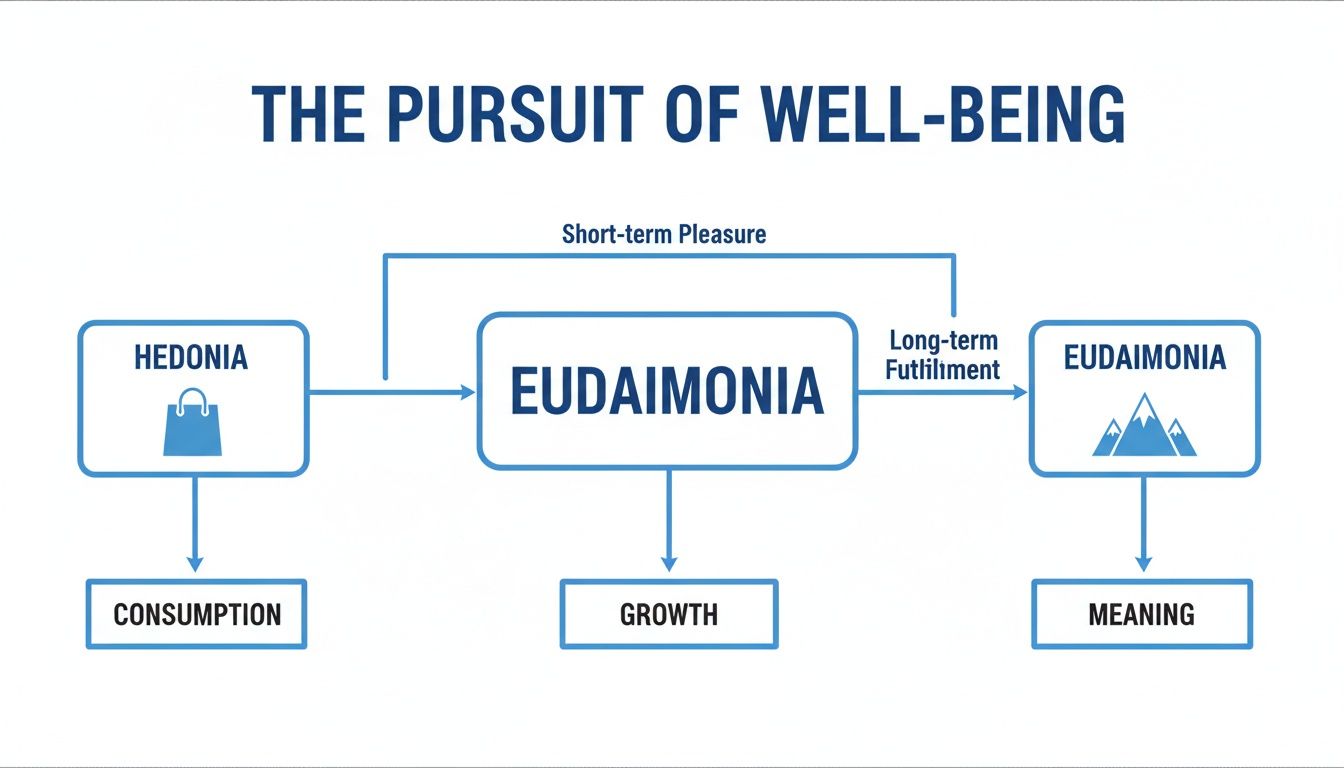
This endless cycle of seeking short-term hits of pleasure is exhausting. More often than not, it leaves you feeling more empty than when you started. You are definitely not alone in feeling this way.

This sense of being adrift comes from a massive misunderstanding of what a good life actually is. We’ve been sold the idea that happiness is the same as momentary pleasure. A life built on that foundation is like a house built on sand; it’s unstable and crumbles at the first sign of a storm. The constant need for the next buzz just keeps you distracted, preventing you from building anything real and substantial.

Young man sitting on a treadmill, looking out a window with augmented reality overlays.

Shifting Focus from Feeling Good to Living Well

This is where eudaimonia stops being an old, dusty term and becomes a practical roadmap for your life. It offers a powerful alternative: stop chasing feelings and start building character.

Instead of asking, "What will make me feel good right now?" you start asking, "What action will make me a better, stronger person?"

This is a profound shift. It’s about moving your focus to the things you can actually control:

  • Your Actions: How you choose to respond to challenges and opportunities.

  • Your Values: The non-negotiable principles that guide your decisions.

  • Your Purpose: The 'why' that pulls you forward, especially on the tough days.

Eudaimonia is the deep satisfaction that comes from living a life of purpose and integrity, realising your potential through consistent effort and responsibility. It’s the difference between the fleeting joy of a great party and the profound pride of building the house yourself.

To put it simply, this is about building a life that feels genuinely meaningful from the inside out. It's not about being perfect. It’s about the consistent, daily practice of living with intention.

This guide will show you exactly how to get off that treadmill and start constructing a life of deep, sustainable wellbeing.

Chasing Happiness vs Living With Purpose

It's easy to confuse these two paths, but they lead to entirely different destinations. One is a rollercoaster of highs and lows; the other is a steady climb toward a meaningful summit.

Here’s a quick comparison to show you the fundamental differences between chasing temporary pleasure (feeling good) and building a meaningful life (living well).

Aspect Chasing Happiness (Feeling Good) Living With Purpose (Living Well)
Focus External pleasure, immediate gratification Internal growth, long-term fulfilment
Source Events, possessions, sensory experiences Values, character, personal potential
Timeframe Short-term, fleeting Long-term, sustainable
Motivation Seeking pleasure, avoiding pain Seeking meaning, embracing challenges
Response to Difficulty Avoidance, frustration, distraction Resilience, growth, learning
Outcome A rollercoaster of emotions Deep, stable sense of wellbeing and purpose

As you can see, one path is about consuming experiences, while the other is about creating a life of substance. The choice to move from the left column to the right is the first real step toward eudaimonia.

Understanding Eudaimonia In Plain English

Let's cut through the academic jargon. At its core, eudaimonia is about human flourishing. Think of it as the deep, stable kind of satisfaction you feel when you’re living as your best, most authentic self by striving to reach your full potential.

Forget the idea of a constant, euphoric state of happiness. That’s not what this is about. Eudaimonia isn't measured in smiles per hour; it’s measured in substance and character. It’s the quiet pride that comes from acting with integrity, even when no one’s watching.

Think of it like building a house. Chasing temporary happiness is like throwing a great housewarming party, fun for a night, but it’s over before you know it. Eudaimonia is the act of laying the foundation, raising the walls, and building a sturdy roof. It’s the hard, rewarding work that creates something that lasts.

Living Well vs Feeling Good

The critical difference here is between living well and just feeling good. Feeling good is temporary and often depends on external things: a compliment, a new purchase, or a good meal. Living well, however, is an internal achievement.

It's about the fulfilment that comes from pushing yourself to grow, mastering a difficult skill, or simply being the person you said you would be. This kind of satisfaction isn't a fleeting high; it’s a bedrock of self-respect that stays with you.

This is where discipline and responsibility come into the picture. Eudaimonia requires you to:

  • Act on your values: Your actions must line up with what you truly believe is right.

  • Embrace challenges: You see difficulties not as threats to your happiness, but as genuine opportunities for growth.

  • Take ownership: You are the architect of your life, responsible for the choices you make.

Living a life of eudaimonia means you stop asking, "What do I want to feel?" and start asking, "Who do I want to be?" The good feelings that follow are a byproduct of living with purpose, not the goal itself.

This shift in perspective is the foundation for a life with real meaning. It moves you from being a passenger, tossed around by fleeting emotions, to being the driver, intentionally navigating toward a worthy destination.

It’s not some abstract ideal; it’s a practical, daily commitment to becoming the strongest version of yourself. For a deeper look into this, you can explore our guide on finding what is the purpose and meaning of life and how it connects to your actions.

Why Living Well Beats Feeling Good

We're drowning in a culture obsessed with the quick fix. A 'like' on Instagram, the thrill of an online purchase, the mindless comfort of binge-watching a new series, they all give us a little buzz. This is the world of temporary pleasure. It's exciting, it's easy, and it's also incredibly shallow.

This constant chase for the next 'feel-good' moment is a massive source of the anxiety and distraction so many of us feel. It puts you on a hamster wheel, always needing another hit just to feel okay. But a life built on these fleeting highs is like building a house on sand. When the storms of life inevitably hit, there’s nothing solid underneath you.

This is where eudaimonia, or living well, offers a real alternative. It’s about trading the cheap thrill of a notification for the deep, lasting satisfaction that comes from mastering a difficult skill. It’s the difference between seeking flimsy validation from others and earning profound self-respect by conquering a personal challenge.

The Foundation of Real Fulfilment

Living well means showing up. It’s being a reliable partner, a present parent, or a disciplined professional, especially on the days you don't feel like it. This quiet commitment to your values and responsibilities builds something temporary pleasure never can: resilience.

When your sense of self is grounded in your character and your actions, you're not so easily shaken by things outside your control. You start to build genuine mental toughness and a strong identity that isn't dependent on the next dopamine hit.

This approach is a direct antidote to that feeling of aimlessness. Instead of just drifting from one distraction to the next, you begin to intentionally build a life you actually respect. That process alone creates a powerful sense of momentum and direction.

Eudaimonia isn't about feeling happy every second of the day. It's the quiet confidence that comes from knowing you're living a life of substance, guided by your own purpose and integrity.

Australian wellbeing research backs this up completely. Major studies make a clear distinction between happiness from pleasure (just feeling good) and eudaimonic wellbeing (actually living well). The long-running Australian Unity Wellbeing Index consistently finds that our national wellbeing is a stable state of flourishing, not just a temporary spike of positive emotion. This lines up perfectly with what the ancient thinkers were talking about all those years ago.

On top of that, a huge study of over 12,000 Australian adults discovered that making consistent, positive changes, like simply eating more fruit and veg each day, led to a jump in life satisfaction comparable to going from unemployed to having a job. This is huge. It shows that real wellbeing is forged in our daily routines and disciplined actions, not just our fleeting feelings. You can read more in the full research on lifestyle and life satisfaction.

This is the heart of eudaimonia: a robust, lasting fulfilment that cheap pleasures can't even begin to touch. It’s the profound satisfaction of building something meaningful, one disciplined choice at a time.

The Four Pillars of a Flourishing Life

So, how do we take this ancient idea of eudaimonia and actually use it? It's simpler than you might think. This isn't about grand gestures or becoming a monk on a mountaintop. It's about building your life around four practical pillars that anyone can start laying today.

These aren't quick fixes. Think of them as the foundations. When you practise them consistently, they create a life of substance, resilience, and genuine satisfaction.

This little concept map nails the core difference between chasing pleasure (a temporary fix) and building eudaimonia (lasting fulfilment).

Flowchart illustrating the pursuit of well-being, showing Hedonia leading to consumption, and Eudaimonia leading to growth and meaning.

As you can see, one path leads to endless consumption and dependency. The other leads to genuine growth and meaning. It's a clear choice.

1. Define Your Core Values

First things first: you need to know what you stand for. Your values are your personal, non-negotiable principles. They’re the compass for your decisions. Without them, you’re just reacting to life, getting pulled in whatever direction the wind blows.

When you know your values, things like integrity, family, or personal growth, making hard choices becomes simpler. You stop asking, "What's easiest?" and start asking, "What's right for me?" This alignment between what you believe and what you do is a massive source of personal power and self-respect. If you're a bit stuck, have a look at our list of personal values examples to find what resonates.

2. Take Full Responsibility

This is the pillar that separates the adults from the children. Taking full responsibility means owning your choices, your actions, and your outcomes. No blame, no excuses. It’s the raw understanding that while you can’t control everything that happens to you, you have 100% control over how you respond.

When you blame external factors, your boss, the economy, your past, you’re literally giving away your power to change things. True freedom only comes when you acknowledge your role in your own life. It’s tough, but it's the only way to build a future you actually want.

The moment you stop making excuses is the moment you reclaim control over your life. Responsibility isn't a burden; it's the ultimate tool for creating your own path.

3. Embrace Constructive Discipline

Discipline gets a bad rap. We often see it as punishment or restriction. But in the context of eudaimonia, it’s the exact opposite: discipline is the tool that creates freedom. It’s the structure you build that allows you to actually achieve your goals.

Think about it:

  • The discipline to wake up early gives you the freedom of a quiet, productive morning.

  • The discipline to manage your money gives you the freedom from financial stress.

  • The discipline of regular exercise gives you the freedom of a healthy, capable body.

Constructive discipline isn't about forcing yourself to do things you hate. It's about consistently doing the things your future self will thank you for.

4. Pursue a Worthy Purpose

The final pillar is having a 'why' that pulls you forward. A purpose doesn’t have to be some grand, world-changing mission (though it can be). For most of us, it’s a more personal reason for being, a direction that gives our daily grind meaning.

Your purpose could be being a great father. It could be building a small business that helps your community, or simply mastering a craft you love. It’s the reason you get out of bed on the hard days. It provides the fuel to push through challenges because you know your effort is contributing to something bigger than your own momentary comfort.

This is what truly drives a flourishing life.

How to Put Eudaimonia Into Action Today

Alright, knowing what eudaimonia is feels good, but living it? That’s a whole different game. The good news is you don’t need to flip your life upside down overnight. A flourishing life isn’t built with one grand gesture; it’s pieced together with small, consistent, and intentional actions. Progress, not perfection, is the name of the game here.

This isn’t about floating around in abstract theory. It’s about getting your hands dirty with practical steps that start building a more aligned and meaningful life, right now. Let's make this real.

Person writing 'VALUES' in a notebook with a pen, beside a cup of tea on a desk.

The Values Audit

Think of your values as the compass for your life. If you’re heading north but your actions are taking you south, you’re going to feel that friction, that nagging sense of conflict and dissatisfaction. Time for a quick audit.

  1. List Your Top 5 Values: Grab a pen and paper. No overthinking. Just jot down the five principles that matter most to you. Think honesty, family, growth, freedom, health, whatever they are for you.

  2. Assess Your Last 48 Hours: Now, look back at the last couple of days. Did the way you spent your time and energy actually reflect those values?

  3. Identify One Small Shift: Find one tiny action you can take tomorrow that brings you a step closer to alignment.

This simple exercise is incredibly powerful for snapping you out of autopilot and into intentional living. It's the first real step. If you want to build a bigger roadmap, you can start structuring your goals using a personal development plan template.

The Responsibility Check-in

Blame and excuses are the enemies of a flourishing life. Why? Because they hand your power over to someone or something else. Taking ownership is how you snatch it back.

  • Identify One Excuse: Be honest. Where in your life have you been blaming external factors for a lack of progress?

  • Decide on a New Action: What’s one small, concrete action you can take that represents 100% ownership? Maybe it’s a tough conversation, setting a boundary, or finally creating that budget.

This isn't about beating yourself up. It’s about empowering yourself to be the one who makes the change.

The core of eudaimonic living is recognising that your power lies in your response. By choosing responsibility over excuses, you move from being a victim of circumstance to the architect of your future.

The Discipline Starter

Discipline is the engine that drives a flourishing life. Forget the idea of it being punishment; it’s about consistently doing the things your future self will thank you for.

  • Choose One Habit: Pick one small, non-negotiable habit you can commit to for just seven days. A 10-minute walk. Reading 10 pages. Waking up 15 minutes earlier without hitting snooze. Keep it simple.

  • Track Your Progress: Mark off each day you do it. The goal isn’t a perfect streak; it’s to build a little momentum and prove to yourself that you’re someone who follows through.

Here in Australia, this whole idea of eudaimonia ties directly into what researchers often call “subjective wellbeing.” Data from the ABS backs this up, showing that stable, supportive relationships, a massive part of a flourishing life, are strongly linked to higher life satisfaction. For instance, 81% of married Australians report being satisfied, compared to just 60% of lone parents. It's a stark reminder that our connections and commitments are vital pillars of a well-lived life.

Stop Drifting and Start Building Your Life

The path to eudaimonia starts with a simple choice. It's the decision to stop being a passenger in your own life, just reacting to whatever comes your way. It’s about consciously picking up the tools to become the architect of your own fulfilment.

This isn’t some lofty idea reserved for ancient thinkers. It's a grounded, practical way to build a life of substance and meaning, one you can be genuinely proud of. You have everything you need to start right now.

Think of it like this: your life is built on a foundation of your personal values, fortified by constructive discipline, and guided by a purpose that actually matters to you. Every responsible choice, every moment you act with integrity, is another brick laid in a foundation of self-respect and lasting wellbeing.

Your Chance to Take Control

Making this shift from passive to active is more important than ever. Long-term Australian data shows that both happiness and eudaimonia aren't static; in fact, average happiness has been declining since 2009.

Ipsos data also reveals a fascinating generational gap: Baby Boomers report the highest levels of happiness (75%), while Gen X reports the lowest (65%). For the 62% of unhappy Australians, financial pressure is a huge driver, which really highlights the need to separate our sense of purpose from our paycheque. As you can learn more about Australian happiness trends, it becomes crystal clear that building an eudaimonic life is the most powerful way to reclaim a sense of control.

Eudaimonia is your chance to stop drifting and start building. The process itself, the effort, the growth, the alignment, is where true satisfaction is found.

Your best life isn't something you find; it's something you build. Let's start today.

Your Questions About Eudaimonia, Answered

Alright, let's get into the nitty-gritty. When you start exploring a concept like eudaimonia, a few practical questions always pop up about how it actually works in the real world. Here are some straight answers to the most common ones, without the academic fluff.

Can I Chase Eudaimonia and Still Have Fun?

One hundred percent. Let's clear this up right now: eudaimonia is not about turning into a joyless robot who meditates on a mountaintop and renounces all worldly pleasures. That's a common misconception.

A flourishing life absolutely includes a good laugh, great food, and kicking back with your mates. The difference is that those moments of pleasure aren't the only thing you're living for. They're part of a bigger picture, one that's framed by your values and your purpose. Think of it this way: pleasure is the seasoning, not the main course.

Is Eudaimonia Just Another Word for Stoicism?

They're definitely related, but they're not the same thing. It's simpler to think of it like this: eudaimonia is the destination – that state of genuine human flourishing you're aiming for. Stoicism, on the other hand, is one of the maps you can use to get there.

Stoicism offers a brilliant toolkit of practical strategies (like focusing only on what you can control) to build resilience, inner peace, and character. Many of its practices are incredibly powerful for living a eudaimonic life, but they are the path, not the end goal itself.

The core idea is simple: Eudaimonia is the 'what' (a flourishing life), while philosophies like Stoicism can be the 'how' (a practical framework to build it).

How Long Does It Take to 'Get' Eudaimonia?

This is probably the most common question, and answering it requires a bit of a mental shift. Eudaimonia isn't a trophy you win or a finish line you cross. It's a continuous process of living with intention, day in and day out.

It’s a practice, not a prize. You don’t just wake up one morning and find you've "achieved" it. Instead, you start feeling the benefits, a deeper sense of self-respect, stronger resilience when things go wrong, and a clear purpose, the moment you start aligning your daily actions with what truly matters to you. The journey itself is the reward.


Feeling like you're stuck in a rut or just winging it? If you're ready to stop drifting and start building a life you're genuinely proud of, Your Bro is here to back you up. We offer practical, no-BS life coaching to give you the clarity, tools, and accountability you need to get moving. Book a free discovery call and let's start mapping out your plan today.

No more posts to show