The term “emotional intelligence” gets thrown around a lot, and frankly, it can sound like a load of nonsense. Most guys hear it and picture some kind of feelings guru who wants you to talk about your emotions 24/7. Let’s forget all that.
Most of us weren’t taught how to handle our emotions. We were told to suck it up, push it down, or just not feel it. This is why so many men feel either disconnected from their emotions or completely controlled by them, lashing out before they even know why.
This guide will show you how to improve your emotional intelligence in a practical way. It’s not about endless navel-gazing. It’s about learning a skill that gives you more control, less regret, and a quiet confidence that you can handle whatever life throws at you. This is a learnable, practical skill, not a personality trait.
What Emotional Intelligence Actually Is

In simple terms, emotional intelligence is understanding what’s happening inside your own head so you can manage your actions. It’s about noticing a feeling, like anger or frustration, without letting it take the wheel.
It’s the difference between snapping at your partner when you’re stressed versus taking a breath and dealing with the actual problem. It’s not about suppressing what you feel. It’s about understanding it so you can respond with a clear head instead of just reacting on impulse.
When you’re under pressure, this skill is what keeps you grounded. It lets you choose how you show up in the world.
Why Emotional Intelligence Matters More Than You Think
This isn’t some fluffy, feel-good concept. Building this skill has real, tangible benefits that will improve every part of your life.
- Better relationships. When you understand your own reactions, you create less drama. You can communicate what’s actually going on instead of just getting angry or shutting down. This leads to more respect and less pointless conflict with your partner, mates, and family.
- Better decisions. Ever made a dumb choice in the heat of the moment? A lack of emotional control clouds your judgment. Being able to pause and think clearly under pressure means you make choices you won’t regret later.
- Less regret. When you’re in control of your responses, you do and say fewer things you have to apologise for. You leave situations feeling like you handled them well, even when they were tough.
- More self-respect. True confidence isn’t about being the loudest guy in the room. It’s a quiet strength that comes from knowing you can handle your own state without losing your head.
- Reduced emotional burnout. Constantly wrestling with your emotions, reacting to things, and cleaning up the mess is exhausting. Emotional intelligence helps you conserve that mental energy for things that actually matter.
Common Signs Your Emotional Intelligence Needs Work
This isn’t about diagnosing yourself. It’s just an honest look at common patterns. See if any of these feel familiar.
- Reacting before thinking. Someone pushes your buttons, and you fire back instantly. The regret kicks in a few minutes later.
- Avoiding difficult conversations. If your first instinct is to put off talking about something important with your boss or partner, it’s a sign you’re avoiding the feeling that comes with it.
- Bottling things up until they explode. You swallow frustration for weeks, then lose your mind over something small, like a dirty dish in the sink. The pressure builds until it has to escape somewhere.
- Struggling to name what you feel. When someone asks what’s wrong, your answer is “nothing,” “stressed,” or “pissed off.” You find it hard to get more specific than that.
- Feeling emotionally drained often. This is a sign you’re burning a huge amount of energy managing emotional blow-ups or recovering from them.
How to Improve Your Emotional Intelligence Step by Step
This is where the real work begins. Forget complicated theories. This is a practical framework with small, realistic steps.
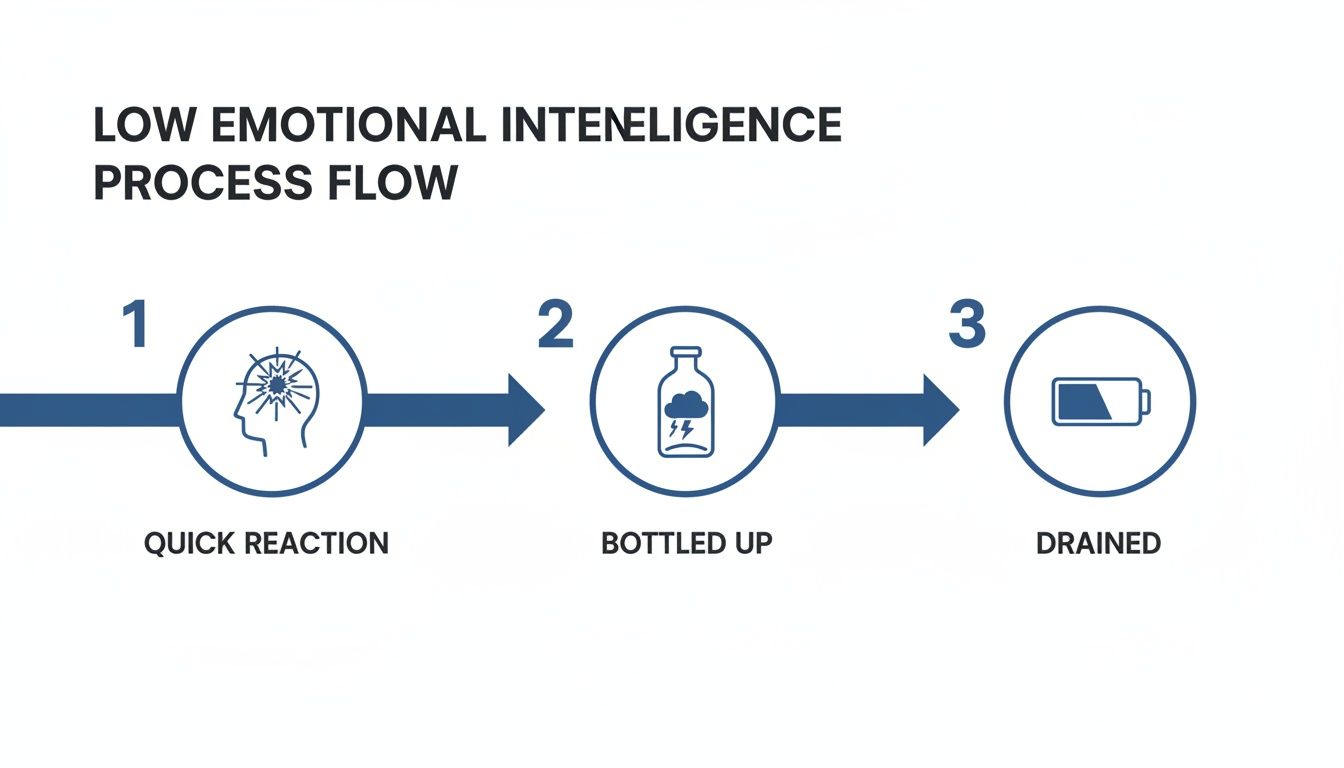
The goal is to break the cycle shown above. Instead of reacting, you learn to respond with intention. Here’s how.
1. Learning to pause before reacting
The most powerful skill you can build is creating a small gap between a trigger and your reaction. Even one second is enough to change the outcome.
When you feel that flash of anger, force a pause. Clench your fists. Take one slow breath. This tiny action interrupts the autopilot and gives your logical brain a chance to catch up. Ask yourself: “Will what I’m about to do make this better or worse?”
2. Naming emotions accurately
Most of us have a small emotional vocabulary: “mad,” “sad,” “fine.” But there’s a huge difference between feeling angry, feeling disrespected, feeling disappointed, or feeling frustrated.
When you can put an accurate name to a feeling, it loses its power over you. It becomes something you can look at and understand. Are you just “stressed,” or are you feeling overwhelmed and unsupported? Getting specific is the first step to knowing what to do next.
3. Understanding triggers
We all have triggers. It might be someone questioning your work, feeling ignored, or being told what to do. These are your personal emotional landmines.
Think about the last few times you lost your cool. What happened right before? Who was there? Look for the pattern. Once you know what sets you off, you can prepare for those moments or see them coming, which puts you back in control.
4. Practising emotional regulation in real situations
The next time you feel a strong emotion, try a simple regulation technique.
If you’re angry, instead of lashing out, go for a walk. If you’re anxious, focus on your breathing for 60 seconds. This isn’t about suppressing the feeling. It’s about choosing a constructive action instead of a destructive one. You feel the emotion, but you decide what happens next.
5. Reflecting after emotional moments
After a tough situation, take five minutes to reflect without beating yourself up. This is a debrief, not a self-criticism session.
Ask yourself:
- What was the trigger?
- What did I feel?
- How did I react?
- What would I do differently next time?
Doing this consistently trains your brain to see these moments as learning opportunities, not failures.
What Emotional Intelligence Is Not
There’s a lot of confusion out there. To build trust in this process, let’s be clear about what this is not.
- It is not being overly emotional. It’s the opposite. It’s about being less controlled by your emotions, so you can think more clearly.
- It is not constantly talking about feelings. It’s about understanding your feelings so you don’t have to. You process them internally and move on.
- It is not being passive or weak. A man who can manage his emotions under pressure is seen as stable and strong. He doesn’t get rattled. This is about quiet confidence, not being a pushover.
- It is not suppressing emotions. Suppression is bottling things up until they explode. This is about acknowledging a feeling, understanding its message, and choosing a smart response.
Why Doing This Alone Is Hard
Trying to see your own emotional habits is like trying to see the back of your own head. You know it’s there, but you can’t get a clear look. We all have blind spots.
You might think you’re being direct, but others think you’re aggressive. You might not even notice that you shut down when a conversation gets difficult. These patterns are almost impossible to spot on your own.
An external perspective helps you see what you’re missing. Getting guidance isn’t a sign of weakness; it’s a shortcut. A mentor can point out your habits in real-time and offer a different way forward. This support accelerates your progress and helps you see the game in slow motion.
How Your Bro Helps Build Emotional Intelligence

If this approach makes sense to you, we can help put it into practice. Our one-on-one mentoring is built to give you these real-world emotional skills.
We provide calm, judgement-free support to help you sharpen your emotional awareness and build more control in your daily life. There’s no therapy-speak, just practical guidance from someone who gets it. This isn’t about changing who you are. It’s about giving you the tools to show up as the best version of yourself, especially when things get tough.
If you think having someone in your corner could help, you can learn more about coaching with Your Bro.
We can help you unlock your potential – book your Free Discovery Call today.
It’s About Progress, Not Perfection
Learning to manage your emotions is a skill, and like any skill, it takes practice. You won’t get it right every time, and that’s okay.
The goal isn’t to become a robot who feels nothing. The goal is to feel everything but to stay in the driver’s seat. Be patient with yourself. Focus on making small improvements over time. Every time you choose to pause, reflect, and respond with intention, you’re building a stronger foundation for the rest of your life. Keep practicing. You’ve got this.