Part of the “Life Skills No One Teaches You” Series
Mate, let’s be honest. Staring at that blank page, trying to figure out how to write good cover letters, feels like a chore. You’ve already polished your resume, listed your skills, and now you have to write a whole other thing? It’s easy to think, “Does anyone even read these?”
I get it. I’ve been on both sides of this. I’ve been the guy sending out applications into the void, and I’ve been the guy sifting through hundreds of them. And I can tell you the straight-up truth: a good cover letter has one job. It’s not about repeating your resume. It’s your one chance to connect the dots for the hiring manager and tell a story your resume can’t. It’s how you show them you’re not just another applicant, you’re the solution to their problem.
This guide is designed to get you from that blank page to a finished, confident application, today. We’ll cut through the noise and give you a simple, practical method that actually works in the Aussie job market. No fluff, just a clear plan to help you land the interview.
Why a Good Cover Letter Still Matters in Australia
Let’s cut to the chase. Writing a cover letter often feels like a pointless formality. You’ve already put all the effort into your resume, so why bother with another document they might just skim over?
It’s a fair question, but in the competitive Aussie job market, thinking that way is a massive mistake. A strong cover letter is your single best opportunity to stand out from the pack. It’s the handshake and introduction your resume can’t give.

Think of it like this:
-
Your resume is the what. It’s a list of your skills, your qualifications, and your past jobs. It’s the facts.
-
Your cover letter is the why. It explains why those facts make you the perfect person for this specific job. It connects your story to their needs.
This is your moment to prove to the hiring manager that you’ve actually done your homework. You’re not just another person blindly firing off resumes into the digital abyss. You’ve taken the time to understand their company, you get what they’re looking for, and you’re genuinely interested in this role. That effort alone puts you ahead of so many other applicants. When you learn how to write good cover letters, you are learning how to show respect for the employer’s time, which they will notice.
The Harsh Reality of Skipping It
Still not sold on the idea? Let’s look at the hard facts. In Australia’s crowded job market, where a single opening can attract hundreds of applicants, the cover letter has become a critical filtering tool for recruiters. Some data suggests that a significant percentage of recruiters might instantly reject a candidate who doesn’t bother to submit one.
This is especially true for entry-level positions, apprenticeships, or graduate roles where there are heaps of applicants with similar qualifications. Without a cover letter, you’re just another resume in the pile. You miss the chance to show your personality, your work ethic, and your genuine enthusiasm. Skipping the letter means you could be out of the race before it even starts.
A good cover letter is also a powerful tool for showing how your personal values align with the company’s mission. Understanding what matters to you is a crucial first step, and you can explore more on the meaning of your values in our detailed guide. This alignment can be the deciding factor between you and another candidate.
This guide will break down a proven method that shows you’re the right person for the job, helping you feel confident instead of overwhelmed. If you’re looking for one-on-one help to build that clarity and confidence, a free discovery call with Your Bro coaching could be your next best step. We can help you tailor your job applications without the usual stress.
The Simple Three-Paragraph Method That Always Works
Forget all the overly complicated templates and conflicting advice you’ve seen online. The absolute key to understanding how to write cover letters that actually get read is a simple, effective, three-paragraph structure. You can adapt this for any role, from an apprenticeship to a corporate gig. It’s a blueprint that just works because it’s laser-focused on what a hiring manager actually needs to see.
This isn’t about filling a page with waffle. It’s about building a sharp, powerful argument for why you’re the right person for the job, without the stress and the guesswork. This is the foundation of how to write good cover letters.
Let’s walk through exactly what each paragraph needs to do to get you that interview.
Your Hook: The First Paragraph
Your first paragraph has one critical job: grab their attention immediately. This is your hook. From the very first sentence, you need to prove you’re not just another random applicant sending out a generic letter.
You do this by making a direct, personal connection. Of course, you need to mention the specific role you’re applying for and where you saw it. But the real magic is in showing you’ve done a bit of research on the company.
What does this look like in the real world?
-
Mention a recent project: “I was particularly impressed by your recent work on the community solar project in Bendigo, and I’m excited by the opportunity to contribute my skills as a Project Coordinator.”
-
Reference their company values: “Your company’s commitment to sustainable practices, which I read about in your latest annual report, aligns perfectly with my own professional values.”
-
Show genuine enthusiasm: “Having followed your company’s innovative approach to apprentice training for some time, I was thrilled to see the opening for a first-year Carpentry Apprentice.”
This instantly tells the reader you’re intentional and have a genuine interest in them. It sets a positive tone and makes them actually want to keep reading your letter. It’s a small detail that makes a massive difference.
Your Proof: The Second Paragraph
Okay, this is the heart of your cover letter. Paragraph two is where you deliver the evidence. It’s your chance to directly connect your skills and experience to the key requirements they’ve laid out in the job description.
Don’t just repeat your resume here. That’s a rookie mistake. Instead, pick out two or three of the most crucial duties or skills from the job ad and give a specific example of a time you’ve successfully used them. Think of it as telling a mini-story for each point. This is central to learning how to write good cover letters.
Pro Tip: Use the “Problem, Action, Result” (PAR) formula. Briefly set the scene with a problem you faced, explain the action you took to solve it, and then spell out the positive result. This makes your experience tangible and far more impressive.
For instance, if the job ad asks for “strong problem-solving skills,” you could write something like this:
“In my previous role at Smith & Co, we were dealing with recurring inventory errors which were causing delays for customers. I took the initiative to analyse our process, identified the main bottleneck in our receiving system, and proposed a new digital tracking system. After we rolled it out, we cut inventory errors by 30% in the first quarter alone and improved customer satisfaction.”
See how much more powerful that is than just saying, “I am a great problem solver”? You’ve offered concrete proof of your value.
Your Close: The Third Paragraph
The final paragraph is your close. This is where you confidently wrap things up and make the next step crystal clear. You need to accomplish two simple things here.
First, restate your enthusiasm for the role and the company. A simple, confident sentence is all you need. “I am confident that my skills in customer service and my dedication to teamwork would make me a valuable asset to your team.”
Second, you need a clear call to action. Don’t be passive or wishy-washy. Instead of weakly saying, “I hope to hear from you soon,” take control of the situation. A much stronger finish is something like, “I am available for an interview next week and look forward to discussing how my experience can contribute to your company’s success.”
This shows confidence and makes it easy for the hiring manager to know what to do next. It leaves no room for ambiguity.
And that’s the whole framework. It’s simple, repeatable, and effective.
The Simple Three-Paragraph Cover Letter Structure
This table sums up the entire method. Keep it handy, and you’ll be able to whip up a strong, tailored letter for any application without breaking a sweat. It’s the core of how to write good cover letters.
| Paragraph | Purpose (What it does) | Key Ingredients (What to include) |
|---|---|---|
| Paragraph 1: The Hook | Grabs their attention and shows you have a genuine interest. | The specific role, where you saw it advertised, and a genuine, specific compliment or connection to the company (e.g., a recent project, their values, a news article). |
| Paragraph 2: The Proof | Provides solid evidence of your skills and how you can add value. | Two to three specific examples that directly match the key job requirements, using the "Problem, Action, Result" method to show your impact. |
| Paragraph 3: The Close | Ends on a confident note and clearly prompts the next action. | A final statement of enthusiasm for the role, and a clear, proactive call to action (e.g., "I am available for an interview…"). |
Three simple paragraphs, each with a clear job to do. Together, they build a compelling case for why you’re the person they need to call for an interview. It’s simple, it’s effective, and it works every time.
Cover Letter Examples for Different Aussie Jobs
Alright, theory is one thing, but seeing it all come together in practice is where it really clicks. Knowing the three-paragraph method is great, but applying it to your own situation is the final step. The way you learn how to write good cover letters for an apprenticeship is completely different from how you’d write one for a government job or a career change.
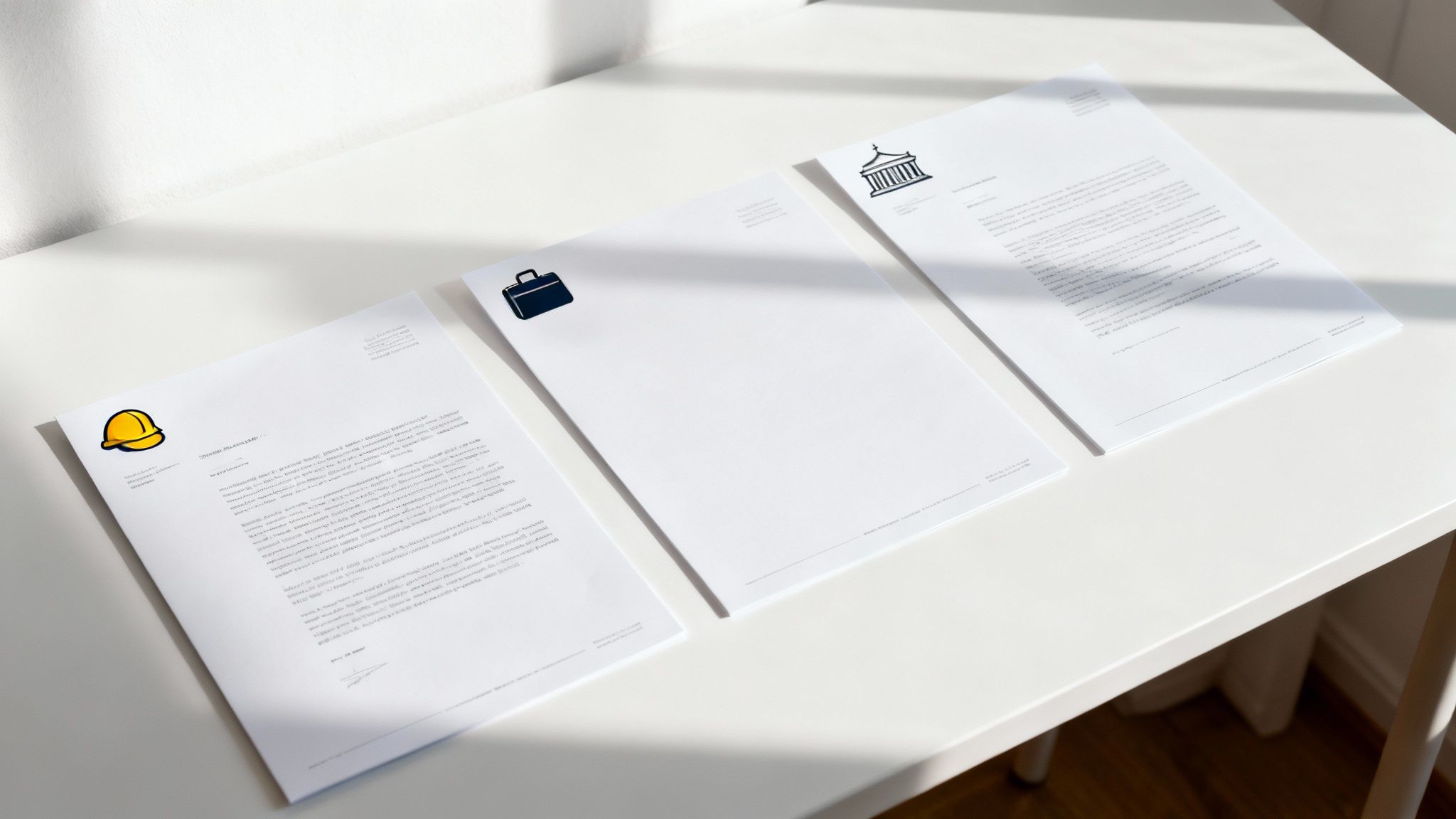
To help you get this done today, we’re going to break down three practical, annotated examples for situations you’re likely to face. We’ll look at an Apprentice Electrician with limited formal experience, a Career Changer moving from a trade into an office job, and a Government Graduate role. Each one follows our simple three-paragraph structure, and I’ll add notes explaining why certain bits work so well.
Example One: Apprentice Electrician
This first example is for a young bloke, let’s call him Tom, applying for a first-year electrical apprenticeship. He doesn’t have a long CV, but he has practical skills, a great attitude, and a solid work ethic. His main goal is to show that he’s reliable, eager to learn, and ready for hands-on work from day one.
Dear Mr. Henderson,
(Paragraph 1 – The Hook) I am writing to express my strong interest in the First Year Electrical Apprenticeship with Henderson Electrical, which I saw advertised on SEEK. Having followed your company’s work on several local commercial projects, including the recent fit-out at the new community sports centre, I am incredibly impressed by your team’s reputation for quality and safety. I am eager to start my career with a business that values high standards.
Analysis: Tom immediately shows he’s done his homework. He names a specific local project, which proves he has a genuine interest in this company, not just any old apprenticeship. This simple detail sets him apart from 90% of other applicants who send a generic letter.
(Paragraph 2 – The Proof) During my final year at TAFE studying a Certificate II in Electrotechnology, I developed a solid foundation in safe work practices and electrical principles. I excelled in the practical modules, particularly residential wiring, where I consistently finished projects ahead of schedule while maintaining a 100% safety record in all assessments. Furthermore, in my part-time job at Bunnings, I am trusted to manage stock in the electrical aisle, which has honed my problem-solving skills and taught me how to assist tradies in finding the right components for their jobs.
Analysis: He links his TAFE course directly to the job’s requirements. The mention of his 100% safety record is a brilliant move, as safety is the most important thing in this trade. He also cleverly uses his retail job to show relevant skills like problem-solving and product knowledge. This is a great way to handle having limited “formal” work experience.
(Paragraph 3 – The Close) My practical skills, strong work ethic, and genuine passion for the electrical trade would make me a dedicated and reliable apprentice for your team. I have my driver’s licence and my own transport and am available for an interview at your earliest convenience. Thank you for considering my application.
Analysis: The close is confident and practical. Mentioning his licence and transport answers a key logistical question for any trade employer before they even have to ask. The call to action is polite but direct, showing he’s organised and ready to go.
Example Two: Career Changer
Now, let’s look at Ben. He’s been a carpenter for ten years and wants to move into a Project Coordinator role in a construction company. His challenge is to show how his on-the-tools experience translates directly into valuable office skills. This is a common challenge, but how to write good cover letters for a career pivot is about framing your past, not hiding it.
Dear Ms. Chen,
(Paragraph 1 – The Hook) I am writing to apply for the Project Coordinator position at Buildwell Group, as advertised on LinkedIn. With a decade of hands-on experience as a qualified carpenter on commercial sites, I have admired Buildwell’s commitment to innovative design and efficient project delivery from a unique, on-the-ground perspective. I am now looking to apply my deep understanding of the construction lifecycle to a coordination role where I can help drive projects to successful completion.
Analysis: Ben immediately frames his trade background as a major strength, not a weakness. He shows he understands the industry from a different angle, which is a huge asset for a coordination role. He’s not apologising for his past; he’s leveraging it.
(Paragraph 2 – The Proof) In my previous role as a Leading Hand Carpenter, I was responsible for more than just my tools. I coordinated the daily schedules for a team of four, ensuring we met our project deadlines without sacrificing quality. For example, on the Parramatta office tower project, I identified a sequencing issue between the framing and plumbing teams that would have caused a two-week delay. I raised this in the site meeting and proposed an adjusted workflow, which was adopted and ultimately kept the project on schedule. This experience has given me strong skills in stakeholder communication, proactive problem-solving, and interpreting complex project plans, all of which are essential for this role.
Analysis: This is a perfect example of translating skills. He doesn’t just say he’s a leader; he gives a concrete “Problem, Action, Result” story that proves it. He turns “talking to the plumber” into “stakeholder communication,” which is exactly what a recruiter for an office job wants to see. If you’re struggling to frame your own experiences, remember that coaching can provide clarity. A Your Bro coaching free discovery call can help you identify and articulate your transferable skills with confidence.
(Paragraph 3 – The Close) I am confident that my practical site experience combined with my natural ability to organise and communicate will allow me to quickly become a valuable member of your project team. I am excited about the opportunity to discuss how my unique background can benefit Buildwell Group and am available for an interview next week.
Analysis: He ends by reinforcing his unique selling point: the blend of hands-on and organisational skills. The call to action is confident and specific, showing he’s serious about the role.
Example Three: Government Graduate
Finally, we have Aisha, applying for a graduate program with a state government department. Government applications often require you to address specific “selection criteria.” The best way how to write good cover letters for these roles is to weave your answers directly into your proof paragraph, making it easy for the panel to tick their boxes.
Dear Selection Committee,
(Paragraph 1 – The Hook) I am writing to apply for the 2025 Graduate Program with the Department of Community Services, as advertised on the I WORK FOR NSW website. Having recently completed my Bachelor of Social Work with a focus on youth policy, I have been consistently impressed by the Department’s innovative programs aimed at supporting at-risk young people. I am passionate about contributing to public service and believe my skills align perfectly with your mission.
Analysis: Clear, formal, and direct. She names the department, the program, and where she saw it. She also shows she understands their mission and isn’t just applying for any government job. For more examples and frameworks, you can explore a comprehensive sample cover letter for job application to see other professional approaches.
(Paragraph 2 – The Proof) My studies and volunteer experience have equipped me with the key capabilities you require. Regarding your criterion of strong research and analytical skills, my final-year thesis required me to analyse policy data to identify service gaps for regional youth, for which I received a High Distinction. To address your need for effective communication skills, I spent two years volunteering as a youth mentor at Headspace, where I facilitated group discussions and provided one-on-one support, tailoring my communication style to build trust with diverse individuals.
Analysis: This is flawless for a government application. She explicitly names the selection criteria in bold and then provides a specific, evidence-based example for each one. This makes the selection panel’s job incredibly easy; she’s literally ticking their boxes for them. This is the gold standard for this type of role. For anyone feeling overwhelmed trying to figure out their path, our guide on what you should do with your life offers practical steps for finding direction.
(Paragraph 3 – The Close) I am eager to apply my academic knowledge and practical skills in a challenging and rewarding public sector environment. I am confident I can contribute positively to the Department of Community Services and look forward to the opportunity to discuss my application in an interview.
Analysis: A professional and respectful closing that restates her interest and looks toward the next step. It’s perfectly toned for a government role.
Common Mistakes That Get Your Cover Letter Binned
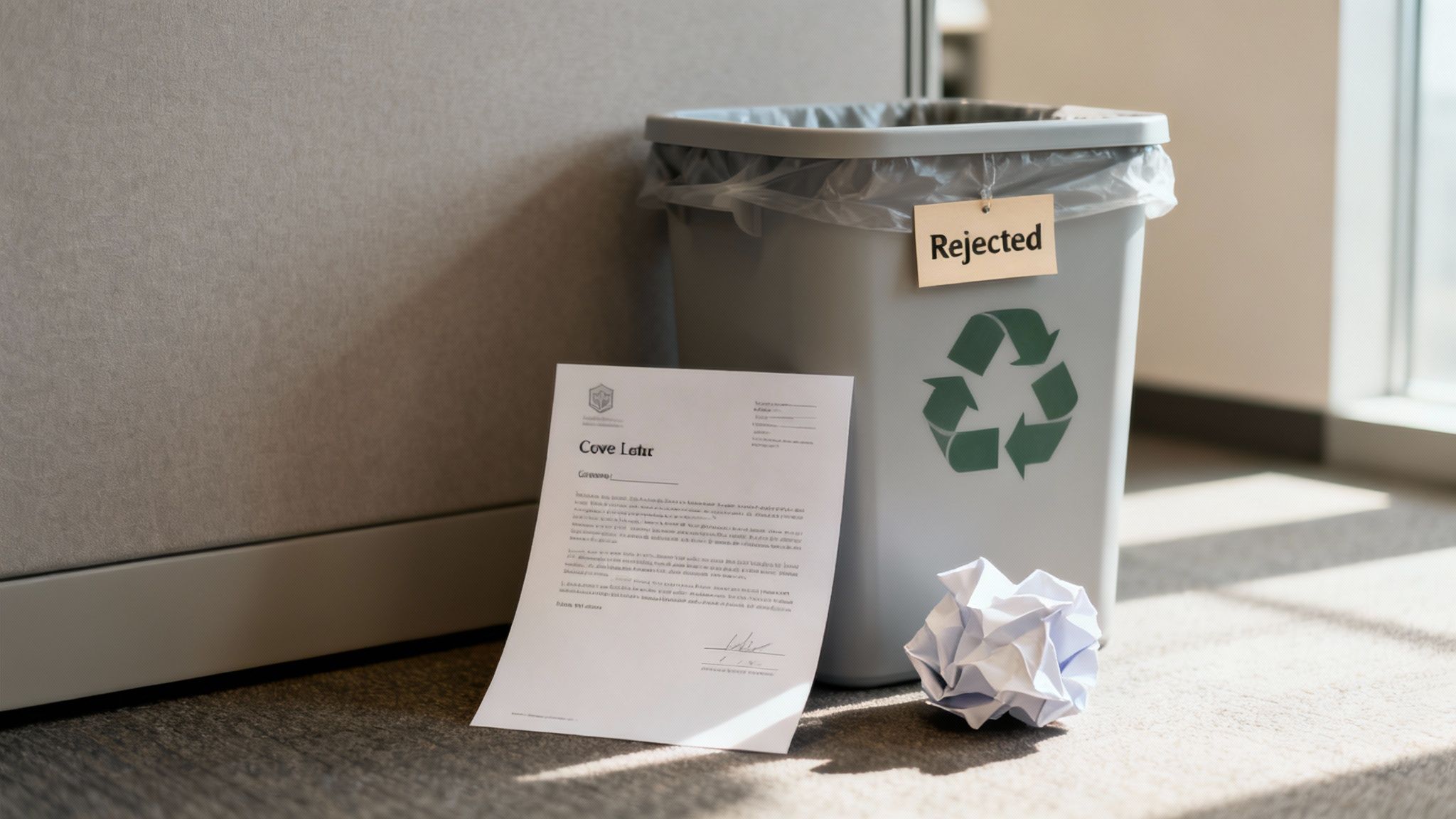
Right, let’s talk about the rookie errors, the simple mistakes that get your cover letter and resume tossed straight into the ‘no’ pile.
I’m not trying to scare you, but I want to give you the inside track on what recruiters and hiring managers are truly sick of seeing. Once you know what makes them sigh and hit the delete button, you can easily sidestep those common traps.
The whole point here is to self-audit your work before you send it. You don’t want to be rejected for simple, fixable stuff. Learning how to write good cover letters is as much about what you don’t do as what you do.
The Generic Greeting and Fluffy Buzzwords
Nothing screams “I couldn’t be bothered” quite like a generic greeting. Kicking off your letter with “Dear Sir/Madam” or “To Whom It May Concern” is an instant red flag. It tells the reader you didn’t spend two minutes on LinkedIn or the company website to find a name. Honestly, it’s just lazy, and in a competitive market, it’s the fastest way to get your application binned.
Just as bad is cramming your letter with empty, meaningless buzzwords. Phrases like “hard-working,” “team player,” “results-driven,” or “dynamic self-starter” mean absolutely nothing without proof. Anyone can say those things about themselves.
Instead of just stating these qualities, you need to show them in action.
-
Instead of: “I’m a dynamic problem-solver.”
-
Try: “I noticed a recurring error in our stocktake process, so I created a simple checklist that our team could use, which cut mistakes by 15% in the first month.”
That small shift from telling to showing makes all the difference. It provides concrete evidence.
Repeating Your Resume Word for Word
This one’s a classic mistake. A lot of people treat their cover letter as if it’s just a long-form version of their resume. The hiring manager already has your resume; they don’t need you to rehash the same bullet points in paragraph form. It’s a huge waste of their time and a massive missed opportunity for you to add value.
Your cover letter’s job is to add context, personality, and a direct link to the role. It should tell the story behind the facts on your resume. Think of it as the highlight reel with your expert commentary.
Your resume lists your achievements. Your cover letter explains why those achievements matter specifically to this company and this role. Don’t make them read the same information twice.
Research backs this up. A huge number of job seekers send out generic letters that don’t speak to the company at all. As pointed out in this breakdown of bad cover letters on Career Success Australia, things like impersonal greetings and overused buzzwords are the most common mistakes that lead to rejection. At the end of the day, personalisation is what separates a great letter from a forgettable one.
Focusing on What You Want, Not What They Need
And finally, the classic blunder: making the entire letter about you and what you hope to get out of the job. Phrases like “I’m looking for an opportunity to grow my skills” or “This role would be a great next step for my career” put all the focus on your needs, not theirs.
While your career growth is important, the company is hiring to solve a problem they have. Your application needs to be about how you can solve that problem for them. You need to frame your skills and experience as the solution they’ve been looking for.
If you’re stuck trying to figure out how to do this, it might be time for an outside perspective. A Your Bro coaching free discovery call can help you get the clarity you need to frame your applications properly, without all the usual overwhelm. It’s about building the confidence to show them exactly why you’re the person they need.
How to Use AI Without Sounding Like a Robot
Alright, let’s talk about the elephant in the room: AI. Tools like ChatGPT can feel like a massive shortcut when you’re learning how to write good cover letters, and in some ways, they are. But if you’re not careful, they can also strip all the personality right out of your application, making it sound painfully generic and robotic.
The trick is to think of AI as your assistant, not your writer. Use it to brainstorm ideas, help structure your thoughts, or polish up your grammar. But never, ever just copy and paste what it spits out. Recruiters are getting flooded with identical, robotic-sounding letters, and they stand out for all the wrong reasons.

Making AI Your Smart Assistant
The rise of AI in job applications is a real phenomenon. Recent data shows that a large number of job seekers have used ChatGPT for their resumes or cover letters. While many of them scored interviews, there’s a huge catch: when hiring managers received multiple AI-generated letters, they were often nearly identical. This creates a sea of sameness that completely defeats the purpose of standing out.
The good news? Many Australian employers are fine with candidates using AI, as long as it’s used smartly as a starting point, not the final product. You can read more about these job seeker trends on CommsRoom.co.
So, how do you use it without falling into the generic trap?
-
Brainstorming: Feed the AI the job description and your resume. Ask it to “identify the key themes” or “suggest some powerful action verbs to describe my experience.”
-
Structuring: Ask it to “create an outline for a cover letter based on the three-paragraph method” we’ve been talking about.
-
Refining: Paste your own draft in and ask it to “check for grammar and spelling errors,” “suggest alternative phrasing to sound more professional,” or “help me make this more concise.”
This approach keeps your voice and your unique stories right where they belong: at the centre of the letter.
Injecting Your Personality Back In
Once AI has done the initial heavy lifting, your job is to breathe life back into the text. This is the human element that AI simply can’t fake. It’s about adding those specific details and personal touches that make the letter uniquely yours.
Remember, AI can’t tell your personal stories, convey your genuine enthusiasm, or explain why you care about this specific job. That’s the part that gets you the interview.
Go through the AI-assisted draft line by line and look for every opportunity to add:
-
Specific examples: Swap out generic fluff like “I am a strong communicator” with a real story, like the ones we’ve covered in our examples. Be specific.
-
Your unique voice: Read the letter aloud. Does it actually sound like something you’d say? Tweak the words until it feels natural, authentic, and confident.
-
Genuine interest: Add that specific detail you found about the company during your research. Show them you’ve done your homework and you care about them.
If you struggle to pull out those personal stories or articulate your unique value, that’s a very common hurdle. It’s tough to see your own strengths clearly from the inside. This is exactly where coaching can make a huge difference.
A Your Bro coaching free discovery call can help you uncover the powerful, personal stories that AI will never find, giving you the confidence to truly stand out. Building this skill is also tied to your emotional intelligence, which you can learn more about improving in our guide.
Your Final Checklist Before You Hit Send
Alright, you’ve made it through the hard part. You now have a solid framework for how to write good cover letters that actually work. This is a skill that will genuinely serve you every single time you look for a new role, so it’s worth taking the time to get it right.
Let’s turn all that theory into a simple, repeatable action plan. Think of this as your final checkpoint before you confidently hit ‘send’ on that application.
Your Immediate Next Steps
Here’s your quick-reference guide to putting it all into practice right now:
-
Find the Name: Seriously, spend five minutes on LinkedIn or the company’s ‘About Us’ page to find the hiring manager’s name. Address it to a real person. This small step makes a massive first impression. If you can’t find it, ‘Dear Hiring Manager’ is better than ‘To Whom It May Concern’.
-
Use the Three-Paragraph Method:
-
The Hook: Kick things off with a specific, genuine connection to the company. Show you’ve done your research.
-
The Proof: Give them two or three concrete examples that directly link your skills to their problems, using the Problem, Action, Result formula.
-
The Close: End with a confident, clear call to action that tells them what you want to happen next.
-
-
Proofread It Out Loud: Read your final draft aloud to yourself. It might feel a bit weird at first, but it’s the single best way to catch awkward phrasing, typos, and sentences that don’t flow. It’s a simple trick that works wonders for improving your tone.
This is the core of it. This is how you write a cover letter that gets results.
Final Check: Does your letter focus on what you can do for them, not what they can do for you? Shifting to this mindset is the most important change you can make. Your letter should be all about the value you can bring to their team.
When You Need a Bit More Help
Sometimes, even with the best plan in the world, it can feel bloody overwhelming. If you’re staring at the screen, struggling to dig up your own stories or just can’t find the right words to explain your value, that’s completely normal. This is where a bit of one-on-one support can make all the difference.
Your Bro coaching is designed to bring that clarity and confidence to your job search. We work together to build a solid, practical plan, so you can tackle your applications with genuine confidence instead of that sinking feeling of dread.
If you’re ready to stop feeling stuck and start getting results, book a free, no-pressure discovery call to see if coaching is the right fit for you.
Your Cover Letter Questions, Answered
Even with the best game plan, a few nagging questions always seem to pop up right when you’re about to hit ‘send’. Let’s clear the air with some quick, straight-up answers to the most common things people ask when figuring out how to write good cover letters in Australia. My goal here is to squash any last-minute doubts so you can submit your application feeling totally confident.
How Long Should a Cover Letter Be?
Keep it short and sharp. The sweet spot is somewhere between three-quarters of a page and one full page when formatted properly. Recruiters are busy people; they are skimming for key information, not settling in to read a novel.
If you find your letter spilling onto a second page, you’ve definitely written too much. It’s time to be ruthless. Go back and cut out anything that isn’t absolutely essential. Keep only your strongest, most relevant points.
Do I Really Need a New Letter for Every Single Job?
Yes. One hundred percent, yes. A generic, copy-paste cover letter is a complete waste of your time and a surefire way to get your application ignored.
You absolutely have to tailor each letter to the specific company and the role they’re hiring for. That means directly addressing their unique needs (as listed in the job ad) and weaving in keywords from their description. It’s the clearest and most effective way to show you’ve done your homework and are genuinely keen on this job, not just any job.
What If I Don’t Have Any “Direct” Experience?
This is a big one, especially for young guys or career changers. The key is to stop thinking about “direct” experience and start focusing on your transferable skills. Don’t have any office experience? Talk about how your retail job taught you incredible customer service skills and how to perform under pressure. No formal leadership titles on your resume? Mention how you organised the local footy team’s end-of-year trip or got a community project off the ground.
Everyone has relevant experience. Your job is to connect the dots for the hiring manager, showing them how your background, whatever it is, has prepared you for this specific role.
If you need more guidance on the nuts and bolts of job seeking in Australia, the government’s Fair Work Ombudsman website has some solid resources on getting ready for a new job. Nailing your story is crucial, and if you’re struggling to see your own value, sometimes a bit of personalised coaching can make all the difference in the world.
Feeling a bit lost or unsure how to package your story for an employer? At Your Bro, we specialise in helping you find that clarity and confidence. Book a free, no-pressure discovery call today and let’s see how we can build a practical plan together. Find out more at https://yourbro.com.au.