To really learn how to write neater, you need a solid plan. Forget artistic calligraphy for a second. This is about deliberate practice and fixing the fundamentals. It’s about building control, consistency, and clarity in your script through targeted drills and smart adjustments. This is a skill, and like any skill, it can be learned with focused effort, giving you a tangible win that builds real confidence.
Why Neat Handwriting Is Still a Damn Good Skill to Have
It’s easy to write off handwriting these days. We type everything, on our phones, laptops, tablets. But learning how to write neater is about more than just making your words look good on the page. This is one of those crucial ‘Life Skills No One Teaches You’, and the discipline it builds will benefit every other part of your life. For you, this isn't just about pretty letters; it's about building a foundation of discipline you can apply everywhere.
Think about it. When you make a conscious effort to write clearly, you’re forced to slow down, to actually organise your thoughts before they hit the paper. This simple act can make a massive difference to your memory retention in a lecture or a TAFE class. It brings a hell of a lot of clarity when you’re mapping out business ideas on a whiteboard.
For an apprentice filling out a job safety analysis or a professional taking meeting notes, legible writing isn’t a nice-to-have. It prevents expensive stuff-ups and signals that you take your work seriously. This small skill makes you look more competent and reliable.
The Real Impact of Messy Writing
Let’s be honest, messy, rushed handwriting is often a mirror for a cluttered mind. It's a physical symptom of feeling scattered, overwhelmed, or unfocused. In a world of endless digital noise, the deliberate, physical act of writing is a powerful way for you to reclaim your attention and sharpen your mental discipline. It forges a direct link between your brain and the page that typing just can’t replicate.
Unfortunately, this fundamental skill is on the decline. A recent look at NAPLAN results in Australia shows a pretty serious drop in writing proficiency among students over the last decade. One report pointed out that by 2018, almost one in five Year 9 students couldn't meet the minimum writing standard. We're talking about teenagers writing at a level expected of much younger kids. This isn't just a school problem; it’s a life problem that follows you into your adult years.
Building Confidence Through Action
The good news is that improving your handwriting is an achievable goal that pays off big time. It’s a tangible way for you to practise consistency and follow-through, two cornerstones of genuine personal growth.
The discipline you build by showing up for 15 minutes a day to practise your letters is the exact same discipline you need to hit your fitness goals, sort out your finances, or build a business. It’s about proving to yourself that you can commit to a process and see it through.
If you struggle with staying consistent or feel like you’re just ‘winging it’ through life, this is a perfect place to start. It’s a low-stakes way to build the confidence you need to take on bigger challenges.
For men who want to apply that same structured approach to all areas of their life, a free discovery call with Your Bro coaching can help map out that path. Ultimately, the journey to clearer handwriting is part of the bigger picture: the pursuit of a well-lived life, which we explore in our guide on finding your purpose and living with intention.
Right then, before we even think about picking up a pen for drills, we need to know what we’re up against. This is about taking an honest look at your current handwriting. It’s not about beating yourself up; it’s about getting a clear, no-nonsense starting point.
This first step is absolutely critical if you're serious about learning how to write neater. It turns that vague goal of "better handwriting" into a concrete, actionable plan you can follow.
Grab a pen you like and a bit of lined paper. Now, just write a few sentences like you normally would. Don’t try to pretty it up or slow down too much. The goal here is to capture your natural, everyday script. Scribble down what you did today, copy a paragraph from a book, whatever. Just get a decent sample down on the page.
Taking Stock of Your Writing
Got your sample? Good. Now it's time to play detective. We’re going to break down your handwriting into its core parts. Remember, this isn't about judgement, it’s about observation. You're just gathering intel to build your plan.
Look at these elements one by one:
Size and Proportion: Are your tall letters (like l, h, k) all reaching the same height? Do your short letters (a, c, e) sit neatly and consistently below them? Wildly different letter sizes are a common culprit behind messy-looking text.
Spacing: What’s the go with the space between your letters and words? Are letters all jammed together, or do they look like they’re social distancing? Even, consistent spacing is a hallmark of tidy, legible handwriting.
Slant: Do all your letters lean in the same direction, or is it a free-for-all? A consistent slant, whether it’s straight up, to the right, or to the left, brings a sense of order and intention to your writing.
Alignment: Are your words sitting squarely on the baseline, or are they floating above and dipping below it? A steady, consistent baseline is one of the quickest fixes for improving readability.
To make this process a bit more structured, use the checklist below. It helps you move from a vague feeling of "my writing is messy" to pinpointing the exact areas that need work. Be honest with your ratings. This is for your eyes only.
Handwriting Self-Assessment Checklist
| Handwriting Element | What to Look For | My Rating (1-5, 1=Needs Work) |
|---|---|---|
| Letter Size | Are tall, short, and descending letters consistently sized? | |
| Letter Spacing | Is the space between letters inside a word even? | |
| Word Spacing | Is there a consistent space (about one letter's width) between words? | |
| Slant Consistency | Do all letters lean at the same angle? | |
| Baseline Alignment | Do words sit firmly on the line without floating or dipping? | |
| Letter Formation | Are letters fully closed (like 'o' and 'a') and clearly formed? | |
| Pressure | Is the pressure even, or do you have very light and very dark strokes? |
Once you've gone through the list, you'll have a much clearer picture. You might find your spacing is actually pretty good, but your alignment is all over the place. That's a win! Now you know exactly what to focus on.
This initial analysis is your roadmap. Pinpointing whether your main issue is spacing, slant, or size will help you focus your practice where it actually counts. Don’t get discouraged by what you find; every issue you spot is an opportunity for targeted improvement.
Finding it tough to stay objective, or just feeling a bit overwhelmed by it all? That's completely normal. If you notice that a lack of follow-through is a bit of a pattern in your life, not just in learning how to write neater, it might be time for a different approach.
Sometimes the real hurdle isn't the skill itself, but the discipline to stick with it. A free discovery call with Your Bro coaching can help you build that rock-solid discipline needed to tackle goals like this head-on. Consider this self-assessment your first step towards real, manageable change.
Mastering the Fundamentals of Good Penmanship
Sloppy handwriting often starts before the pen even touches the page. It's a classic case of bad habits piling up over the years without us even realising it, from slouching over a desk to choking the life out of our pen. If you want to know how to write neater, the fastest way you can see a real improvement is to get your physical setup right first.
Think of it like setting up for a workout. You wouldn't try to lift heavy with a rounded back and sloppy form, would you? Writing is exactly the same. It's a physical skill that relies on your body working correctly, so getting these fundamentals sorted is about building a stable, relaxed foundation for clean, controlled lettering.
The process is simple: you write, you analyse what you've written, and then you plan your next steps.

This isn't about mindless, endless practice. It's a cycle of deliberate action and review. That's where you'll see real progress happen.
Check Your Posture and Paper Position
First things first, let's sort out how you're sitting. Sit up straight in your chair, both feet flat on the floor. Hunching over your desk puts a heap of strain on your back, neck, and shoulders, and that tension travels all the way down to your fingertips. This tension is the mortal enemy of smooth, neat handwriting.
Your paper position is just as critical. For right-handers, tilt the paper slightly to the left, so the top right corner is higher than the top left. For left-handers, it’s the opposite: tilt the paper to the right. This angle lets your writing arm move naturally across the page, preventing that awkward hooked wrist that many lefties fall into.
Getting your posture and paper angle right isn't just about comfort. It’s about creating a clear, unobstructed path for your hand to travel, reducing strain and allowing for a more natural writing motion. This will directly improve your results.
This adjustment can feel a bit weird at first, but stick with it. It’s a game changer for cutting down hand fatigue and improving the flow of your script. A great resource, particularly for parents and educators, is the Victorian Department of Education's page on handwriting, which backs up these foundational principles.
Loosen That Death Grip
Alright, now let's look at how you hold your pen. One of the most common culprits behind messy writing is the 'death grip', clutching the pen so tightly your knuckles turn white. This doesn't just cause painful hand cramps; it makes your writing stiff, jerky, and laboured.
A relaxed grip is absolutely key to learning how to write neater. Your pen should rest gently between your thumb and index finger, with your middle finger providing support from underneath. Don't squeeze it. Your hold should be firm enough for control, but light enough that someone could easily pull the pen from your hand.
Making these changes takes conscious effort. You're fighting years of ingrained muscle memory. If you find yourself struggling to stick with these small but critical adjustments, it might point to a bigger pattern. Building study discipline and consistency is something we tackle head-on in Your Bro coaching. Book a free discovery call and let's talk about how a structured plan can help you build the follow-through you need.
Alright, you’ve done the diagnostic work and sorted out your setup. Now for the fun part: turning theory into action and actually retraining the muscles in your hand and arm. This is how you really learn how to write neater.
Forget about mindlessly copying pages out of a book. That’s a slow, boring way to get nowhere. Instead, we’re going to use targeted drills to build control, consistency, and clean letterforms. This isn't about grinding for hours; it's about making 10 to 15 minutes a day really count for you.
Start with the Basic Shapes
Before you even think about writing full letters, you need to warm up. Get those fine motor skills firing properly, just like you’d stretch before a workout.
Jump onto some lined paper and start with these fundamental movements:
Ovals: Draw a continuous line of connected ovals. Try to keep them the same height, width, and slant. Go both clockwise and anticlockwise to get the full range of motion.
Loops: Next, draw lines of connected loops. Think of the bottom of a lowercase ‘l’ or the top of an ‘f’. Again, focus on making the loops consistent in size and slant.
Lines: Practice drawing straight vertical lines (up and down) and slanted lines. The goal here is to make them parallel and evenly spaced.
These simple drills might feel a bit silly, but they train your hand to make the smooth, controlled movements that are the foundation for everything else.
Focus on Individual Letters
Once you’re warmed up, it’s time to tackle the alphabet. But don’t just write letters at random. Pick one or two letters you flagged as problematic during your self-assessment and focus only on them for the session.
For example, if your 'a's and 'o's are constantly left open at the top, spend five minutes writing rows of just those letters. Consciously focus on closing that circle every single time you write one.

The key takeaway here is consistency. Each letter has a specific structure, and mastering it through repetition is a huge part of learning how to write neater.
Sadly, a lot of us missed out on this foundational practice. A 2022 survey of Australian primary teachers found that handwriting instruction often gets pushed aside, with teachers spending less than 35 minutes a week on it. That means many of us hit adulthood without the right muscle memory, but the good news is, it's entirely fixable with this kind of deliberate practice.
Slow is Smooth and Smooth is Fast
One of the biggest enemies of neat handwriting is speed. When you rush, your letterforms crumble, spacing goes out the window, and your writing turns into a scrawl. The single most effective thing you can do right now to improve is to simply slow down.
Learning to write neatly is not a race. By intentionally slowing your pace, you give your brain time to send the right signals to your hand. Control comes first; speed will follow naturally once the correct muscle memory is built.
This is where discipline comes into play. It's tough to stick with something that requires this much patience, and if you find yourself slipping, that's a sign that a bit of external structure could help. For a no-nonsense approach to building solid habits, check out our free habit tracker template and get yourself started.
Building Consistency and Staying Motivated
Knowing the right drills is one thing. Actually showing up to do them, day after day, is a different beast entirely. This is where most guys fall off, but it's also where the real, lasting change happens. Learning how to write neater isn't about some innate talent, it's about building a solid, unbreakable habit.
The secret isn't finding a massive chunk of time to dedicate to it. It's about weaving small, consistent practice into the routine you already have. This is how you make it stick.
Make Handwriting Part of Your Day
You don't need to block out an hour for handwriting drills. That approach is a fast track to burnout. Instead, look for small, practical ways to use your developing skill throughout the day. It makes practice feel useful, not like another chore on your list.
A few ways you can make it stick:
Write Your To-Do List by Hand: Start each day by grabbing a pen and writing out your top three priorities. This takes five minutes, tops, and immediately puts your practice into a real-world context.
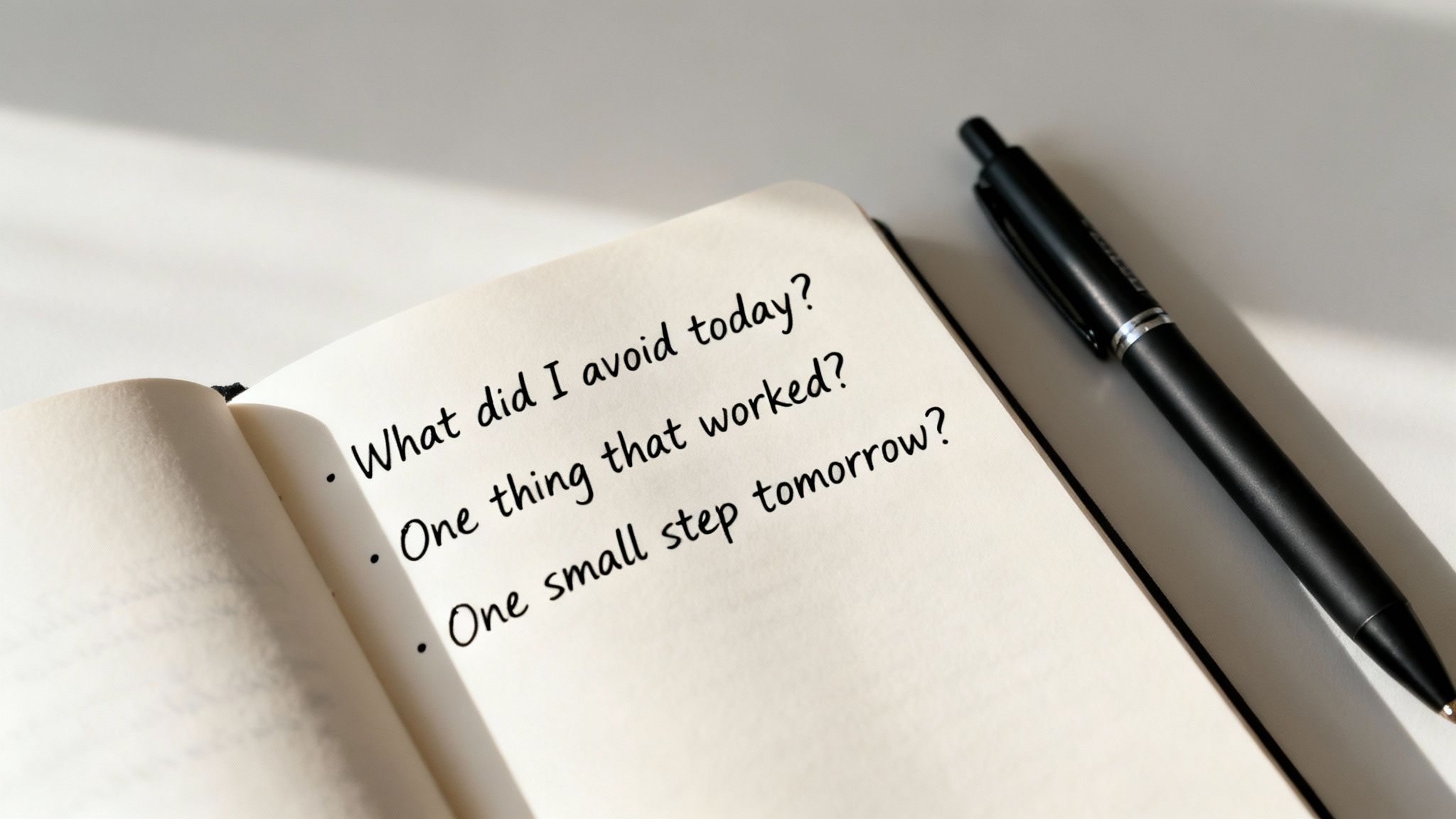
Keep a Five-Minute Journal: Right before bed, jot down a few thoughts about your day. It’s a powerful way to clear your head and get in some valuable pen time without any pressure.
Take Notes in Meetings: Ditch the laptop for one meeting a week and take notes the old-fashioned way. You'll actually find you remember more, and it forces you to write with intention.
Overcoming Common Roadblocks
Let's be real: you're going to hit plateaus. Some days your hand will feel tired, or you'll get frustrated because it feels like you’re not making any progress. This is normal. The key is for you to push through without letting it derail you.
A big reason for inconsistent handwriting in adults actually goes back to childhood. In Australia, there are five different major handwriting styles taught across the states, causing massive disruption for the roughly 500,000 primary school kids who move schools each year. This lack of a unified system often leads to fractured, messy skills later in life. By committing to consistent practice now, you're building the solid foundation you might have missed out on. You can read more about Australia's handwriting challenges.
When you feel stuck, go back to the basic drills for a session. Seriously. Just focusing on simple loops and ovals can reset your muscle memory and build your confidence back up. Don't mistake a temporary stall for a permanent failure.
This is where having a coaching mindset is so powerful. If you struggle with follow-through in other areas of your life, learning how to write neater is an incredible way to build that muscle of discipline. You can also dive deeper into what drives you by getting a handle on your intrinsic vs extrinsic motivation.
For men who know they need that extra layer of accountability to stay on track, a Your Bro coaching discovery call can be the next logical step. We build structured, no-nonsense plans to help you follow through on your goals, whether it’s fixing your handwriting, getting fit, or taking control of your career.
Tools of the Trade and Final Tips
The best training in the world won’t help if your gear is fighting you every step of the way. Using a scratchy pen or flimsy paper that lets ink bleed everywhere is just setting yourself up for frustration. Getting this right is a simple, non-negotiable part of the process for you.
Choosing your weapon is a personal decision, but let’s break down the main options. A solid ballpoint is an old reliable, but you often have to press down hard, which leads to a cramped, tired hand. Gel pens glide nicely and leave a bold line, but the cheaper ones are notorious for smudging. Fountain pens? They offer the smoothest ride with the least amount of pressure, but they do have a bit of a learning curve.
Don’t overthink it. Just try a few out. The mission for you is to find a pen that feels like an extension of your hand, not something you have to wrestle across the page.

Paper and Practice Structure
Just as critical as the pen is the surface you write on. For all your practice sessions, you need to be using lined or grid paper. No exceptions. It gives you the scaffolding you need to keep your letters uniform and your lines straight. If you're an apprentice or a TAFE student, a good quality grid notebook is a sound investment for both your coursework and your handwriting drills. You can get decent, hard-wearing stationery from Aussie suppliers like Officeworks, who have a massive range for any trade or purpose.
To make sure your practice actually happens without becoming a grind, you need a simple, structured schedule. Consistency will always beat cramming.
Here’s a sample weekly plan to build the habit without it feeling like a chore.
Recommended Practice Schedule
| Day | Focus Activity (10-15 Minutes) | Goal |
|---|---|---|
| Monday | Basic Strokes: Up, down, slant, circles | Warm up the hand and arm muscles |
| Tuesday | Lowercase Drills: Focus on 5-6 letters | Build consistent shape and size |
| Wednesday | Uppercase Drills: Focus on 5-6 letters | Master control and proportion |
| Thursday | Word Practice: Write out 10-15 words | Connect letters smoothly |
| Friday | Sentence Practice: Copy a quote or paragraph | Work on spacing and flow |
| Saturday | Free Write: Journal or write anything | Apply skills naturally, without drills |
| Sunday | Rest / Review | Look back at the week's work |
Stick to this, and you'll build momentum that carries you forward.
Getting this right is about more than just neat letters. It's proof to yourself that you can see a commitment through. That’s a skill that pays dividends in your work, your studies, and every other part of your life.
If that follow-through is the part you always stumble on, maybe it's time for a more direct approach. Building that kind of unbreakable discipline is the foundation of what we do at Your Bro coaching. This guide gives you the 'how-to', but a coach helps you build the 'will-do'.
Final Tips to Lock in Your Skill
Once you see the improvements coming, the job is to make them permanent.
Review Your Work: Once a week, grab something you wrote and give it an honest look. What's better? What still looks a bit rough?
Create Reasons to Write: Send a handwritten thank you note. Leave a note for your partner on the kitchen bench. The more you use it, the more it becomes second nature.
Embrace the Process: You'll have good days and bad days. Don't get hung up on a single messy word. Learning how to write neater is a long game.
This isn't just about handwriting. It's about building confidence and proving to yourself that you can systematically master a skill. For men ready to apply this level of structure and discipline to the bigger goals in life, a free discovery call with Your Bro coaching is the next logical step.
Right, you've got the drills and the right gear. Let's get into some of the common questions that always come up when you're trying to learn how to write neater. Getting these sorted will help you sidestep the usual frustrations and keep you moving forward.
How Long Does It Really Take to See Improvement?
This is the big one, and the honest answer is: it depends.
But, if you're putting in a consistent 10-15 minutes every single day, most blokes will see a real difference in their control and clarity within a few weeks. Don't expect some miracle overnight transformation, though.
The real challenge here is overwriting years of sloppy, ingrained muscle memory. To make a significant, lasting change that becomes your new normal, you're looking at a few months of solid work. Be patient. Focus on the process, not just the end result.
Is It Better to Practise with a Pen or a Pencil?
Start with a pencil. Full stop.
It gives you much better sensory feedback from the paper, letting you feel the texture and experiment with pressure without the finality of ink. A decent quality HB pencil is the perfect tool for all your initial drills.
Once you start feeling more confident and your letterforms are looking sharp, then you can make the switch to a smooth-flowing pen that feels good in your hand. The pencil work builds the foundation; the pen is for refining it.
Can I Change My Handwriting Style Completely?
Look, it's possible to adopt an entirely new style, but it requires a level of dedication that's off the charts. For most of us, a much smarter and more practical goal is to dramatically improve the legibility and consistency of the style you already have. This approach will get you much better results, much faster.
Just focus on nailing the fundamentals we've covered: consistent spacing, uniform letter size, a steady slant, and proper alignment on the line. Getting just those elements right will make your current handwriting look infinitely better.
Hand fatigue is almost always a sign that you’re gripping the pen too tightly. This 'death grip' is a stubborn habit you have to consciously break. Focus on relaxing your hand, your wrist, and even your shoulder.
Make sure you take short breaks during practice to stretch out your fingers. A key technique here is to start using your whole arm to guide the pen across the page, not just your fingers. This massively reduces strain and helps you create much smoother, more fluid lines.
If you find that hand fatigue or a lack of consistency keeps tripping you up, it might be a sign that the real issue is maintaining focus and discipline. For men who struggle with follow-through, building that kind of mental toughness is exactly what we focus on in coaching. It’s all about creating systems that actually work for you.
This entire article is part of our series on 'Life Skills No One Teaches You'. If you're ready to stop "winging it" and build the discipline to master skills like this and tackle bigger life goals, a free, no-obligation discovery call with Your Bro could be your next step. Let's build a plan that works.