How to Write Neater: A Practical Guide to Clearer Handwriting

To really learn how to write neater, you need a solid plan. Forget artistic calligraphy for a second. This is about deliberate practice and fixing the fundamentals. It’s about building control, consistency, and clarity in your script through targeted drills and smart adjustments. This is a skill, and like any skill, it can be learned with focused effort, giving you a tangible win that builds real confidence.

Why Neat Handwriting Is Still a Damn Good Skill to Have

It’s easy to write off handwriting these days. We type everything, on our phones, laptops, tablets. But learning how to write neater is about more than just making your words look good on the page. This is one of those crucial ‘Life Skills No One Teaches You’, and the discipline it builds will benefit every other part of your life. For you, this isn't just about pretty letters; it's about building a foundation of discipline you can apply everywhere.

Think about it. When you make a conscious effort to write clearly, you’re forced to slow down, to actually organise your thoughts before they hit the paper. This simple act can make a massive difference to your memory retention in a lecture or a TAFE class. It brings a hell of a lot of clarity when you’re mapping out business ideas on a whiteboard.

For an apprentice filling out a job safety analysis or a professional taking meeting notes, legible writing isn’t a nice-to-have. It prevents expensive stuff-ups and signals that you take your work seriously. This small skill makes you look more competent and reliable.

The Real Impact of Messy Writing

Let’s be honest, messy, rushed handwriting is often a mirror for a cluttered mind. It's a physical symptom of feeling scattered, overwhelmed, or unfocused. In a world of endless digital noise, the deliberate, physical act of writing is a powerful way for you to reclaim your attention and sharpen your mental discipline. It forges a direct link between your brain and the page that typing just can’t replicate.

Unfortunately, this fundamental skill is on the decline. A recent look at NAPLAN results in Australia shows a pretty serious drop in writing proficiency among students over the last decade. One report pointed out that by 2018, almost one in five Year 9 students couldn't meet the minimum writing standard. We're talking about teenagers writing at a level expected of much younger kids. This isn't just a school problem; it’s a life problem that follows you into your adult years.

Building Confidence Through Action

The good news is that improving your handwriting is an achievable goal that pays off big time. It’s a tangible way for you to practise consistency and follow-through, two cornerstones of genuine personal growth.

The discipline you build by showing up for 15 minutes a day to practise your letters is the exact same discipline you need to hit your fitness goals, sort out your finances, or build a business. It’s about proving to yourself that you can commit to a process and see it through.

If you struggle with staying consistent or feel like you’re just ‘winging it’ through life, this is a perfect place to start. It’s a low-stakes way to build the confidence you need to take on bigger challenges.

For men who want to apply that same structured approach to all areas of their life, a free discovery call with Your Bro coaching can help map out that path. Ultimately, the journey to clearer handwriting is part of the bigger picture: the pursuit of a well-lived life, which we explore in our guide on finding your purpose and living with intention.

Right then, before we even think about picking up a pen for drills, we need to know what we’re up against. This is about taking an honest look at your current handwriting. It’s not about beating yourself up; it’s about getting a clear, no-nonsense starting point.

This first step is absolutely critical if you're serious about learning how to write neater. It turns that vague goal of "better handwriting" into a concrete, actionable plan you can follow.

Grab a pen you like and a bit of lined paper. Now, just write a few sentences like you normally would. Don’t try to pretty it up or slow down too much. The goal here is to capture your natural, everyday script. Scribble down what you did today, copy a paragraph from a book, whatever. Just get a decent sample down on the page.

Taking Stock of Your Writing

Got your sample? Good. Now it's time to play detective. We’re going to break down your handwriting into its core parts. Remember, this isn't about judgement, it’s about observation. You're just gathering intel to build your plan.

Look at these elements one by one:

  • Size and Proportion: Are your tall letters (like l, h, k) all reaching the same height? Do your short letters (a, c, e) sit neatly and consistently below them? Wildly different letter sizes are a common culprit behind messy-looking text.

  • Spacing: What’s the go with the space between your letters and words? Are letters all jammed together, or do they look like they’re social distancing? Even, consistent spacing is a hallmark of tidy, legible handwriting.

  • Slant: Do all your letters lean in the same direction, or is it a free-for-all? A consistent slant, whether it’s straight up, to the right, or to the left, brings a sense of order and intention to your writing.

  • Alignment: Are your words sitting squarely on the baseline, or are they floating above and dipping below it? A steady, consistent baseline is one of the quickest fixes for improving readability.

To make this process a bit more structured, use the checklist below. It helps you move from a vague feeling of "my writing is messy" to pinpointing the exact areas that need work. Be honest with your ratings. This is for your eyes only.

Handwriting Self-Assessment Checklist

Handwriting Element What to Look For My Rating (1-5, 1=Needs Work)
Letter Size Are tall, short, and descending letters consistently sized?
Letter Spacing Is the space between letters inside a word even?
Word Spacing Is there a consistent space (about one letter's width) between words?
Slant Consistency Do all letters lean at the same angle?
Baseline Alignment Do words sit firmly on the line without floating or dipping?
Letter Formation Are letters fully closed (like 'o' and 'a') and clearly formed?
Pressure Is the pressure even, or do you have very light and very dark strokes?

Once you've gone through the list, you'll have a much clearer picture. You might find your spacing is actually pretty good, but your alignment is all over the place. That's a win! Now you know exactly what to focus on.

This initial analysis is your roadmap. Pinpointing whether your main issue is spacing, slant, or size will help you focus your practice where it actually counts. Don’t get discouraged by what you find; every issue you spot is an opportunity for targeted improvement.

Finding it tough to stay objective, or just feeling a bit overwhelmed by it all? That's completely normal. If you notice that a lack of follow-through is a bit of a pattern in your life, not just in learning how to write neater, it might be time for a different approach.

Sometimes the real hurdle isn't the skill itself, but the discipline to stick with it. A free discovery call with Your Bro coaching can help you build that rock-solid discipline needed to tackle goals like this head-on. Consider this self-assessment your first step towards real, manageable change.

Mastering the Fundamentals of Good Penmanship

Sloppy handwriting often starts before the pen even touches the page. It's a classic case of bad habits piling up over the years without us even realising it, from slouching over a desk to choking the life out of our pen. If you want to know how to write neater, the fastest way you can see a real improvement is to get your physical setup right first.

Think of it like setting up for a workout. You wouldn't try to lift heavy with a rounded back and sloppy form, would you? Writing is exactly the same. It's a physical skill that relies on your body working correctly, so getting these fundamentals sorted is about building a stable, relaxed foundation for clean, controlled lettering.

The process is simple: you write, you analyse what you've written, and then you plan your next steps.
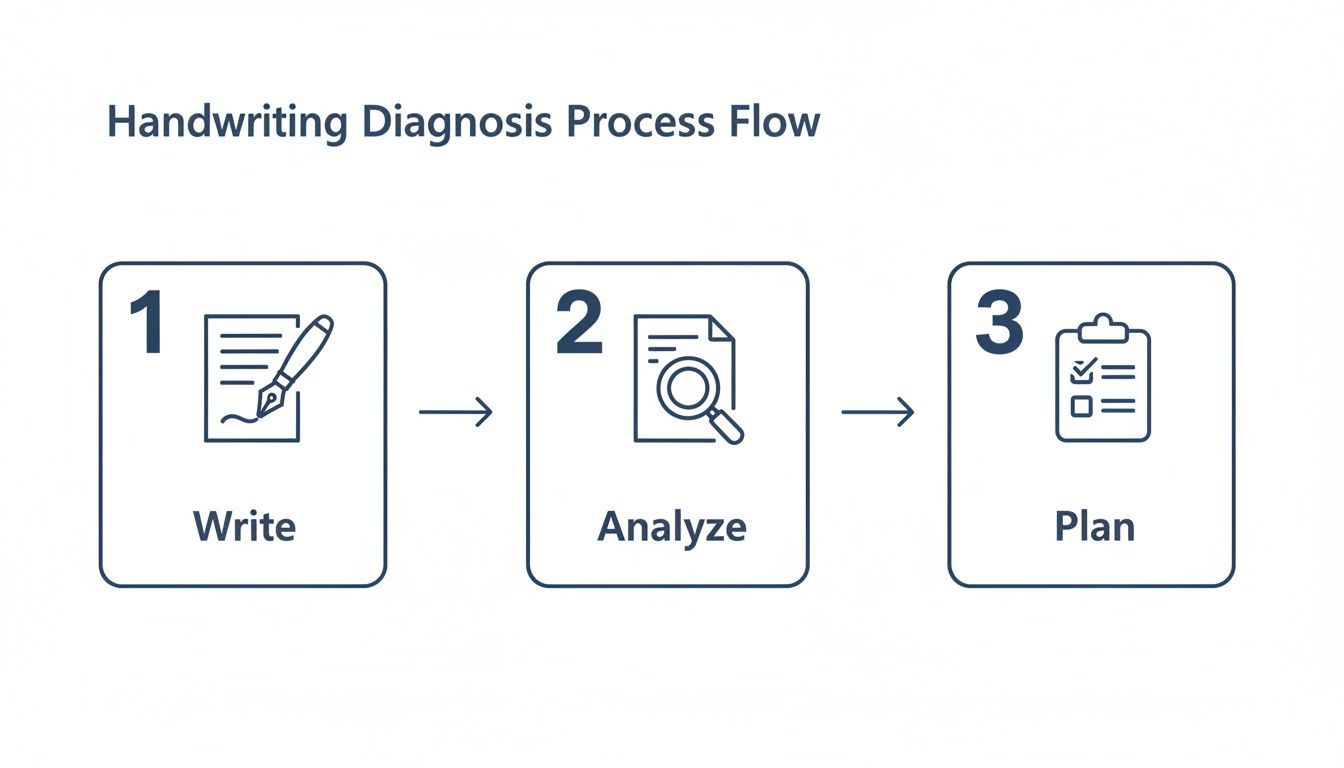
A three-step flowchart outlines the handwriting diagnosis process: Write, Analyze, and Plan. How to Write Neater.

This isn't about mindless, endless practice. It's a cycle of deliberate action and review. That's where you'll see real progress happen.

Check Your Posture and Paper Position

First things first, let's sort out how you're sitting. Sit up straight in your chair, both feet flat on the floor. Hunching over your desk puts a heap of strain on your back, neck, and shoulders, and that tension travels all the way down to your fingertips. This tension is the mortal enemy of smooth, neat handwriting.

Your paper position is just as critical. For right-handers, tilt the paper slightly to the left, so the top right corner is higher than the top left. For left-handers, it’s the opposite: tilt the paper to the right. This angle lets your writing arm move naturally across the page, preventing that awkward hooked wrist that many lefties fall into.

Getting your posture and paper angle right isn't just about comfort. It’s about creating a clear, unobstructed path for your hand to travel, reducing strain and allowing for a more natural writing motion. This will directly improve your results.

This adjustment can feel a bit weird at first, but stick with it. It’s a game changer for cutting down hand fatigue and improving the flow of your script. A great resource, particularly for parents and educators, is the Victorian Department of Education's page on handwriting, which backs up these foundational principles.

Loosen That Death Grip

Alright, now let's look at how you hold your pen. One of the most common culprits behind messy writing is the 'death grip', clutching the pen so tightly your knuckles turn white. This doesn't just cause painful hand cramps; it makes your writing stiff, jerky, and laboured.

A relaxed grip is absolutely key to learning how to write neater. Your pen should rest gently between your thumb and index finger, with your middle finger providing support from underneath. Don't squeeze it. Your hold should be firm enough for control, but light enough that someone could easily pull the pen from your hand.

Making these changes takes conscious effort. You're fighting years of ingrained muscle memory. If you find yourself struggling to stick with these small but critical adjustments, it might point to a bigger pattern. Building study discipline and consistency is something we tackle head-on in Your Bro coaching. Book a free discovery call and let's talk about how a structured plan can help you build the follow-through you need.

Alright, you’ve done the diagnostic work and sorted out your setup. Now for the fun part: turning theory into action and actually retraining the muscles in your hand and arm. This is how you really learn how to write neater.

Forget about mindlessly copying pages out of a book. That’s a slow, boring way to get nowhere. Instead, we’re going to use targeted drills to build control, consistency, and clean letterforms. This isn't about grinding for hours; it's about making 10 to 15 minutes a day really count for you.

Start with the Basic Shapes

Before you even think about writing full letters, you need to warm up. Get those fine motor skills firing properly, just like you’d stretch before a workout.

Jump onto some lined paper and start with these fundamental movements:

  • Ovals: Draw a continuous line of connected ovals. Try to keep them the same height, width, and slant. Go both clockwise and anticlockwise to get the full range of motion.

  • Loops: Next, draw lines of connected loops. Think of the bottom of a lowercase ‘l’ or the top of an ‘f’. Again, focus on making the loops consistent in size and slant.

  • Lines: Practice drawing straight vertical lines (up and down) and slanted lines. The goal here is to make them parallel and evenly spaced.

These simple drills might feel a bit silly, but they train your hand to make the smooth, controlled movements that are the foundation for everything else.

Focus on Individual Letters

Once you’re warmed up, it’s time to tackle the alphabet. But don’t just write letters at random. Pick one or two letters you flagged as problematic during your self-assessment and focus only on them for the session.

For example, if your 'a's and 'o's are constantly left open at the top, spend five minutes writing rows of just those letters. Consciously focus on closing that circle every single time you write one.

A close-up shot of a hand holding a pen and practicing writing letters on lined paper.

The key takeaway here is consistency. Each letter has a specific structure, and mastering it through repetition is a huge part of learning how to write neater.

Sadly, a lot of us missed out on this foundational practice. A 2022 survey of Australian primary teachers found that handwriting instruction often gets pushed aside, with teachers spending less than 35 minutes a week on it. That means many of us hit adulthood without the right muscle memory, but the good news is, it's entirely fixable with this kind of deliberate practice.

Slow is Smooth and Smooth is Fast

One of the biggest enemies of neat handwriting is speed. When you rush, your letterforms crumble, spacing goes out the window, and your writing turns into a scrawl. The single most effective thing you can do right now to improve is to simply slow down.

Learning to write neatly is not a race. By intentionally slowing your pace, you give your brain time to send the right signals to your hand. Control comes first; speed will follow naturally once the correct muscle memory is built.

This is where discipline comes into play. It's tough to stick with something that requires this much patience, and if you find yourself slipping, that's a sign that a bit of external structure could help. For a no-nonsense approach to building solid habits, check out our free habit tracker template and get yourself started.

Building Consistency and Staying Motivated

Knowing the right drills is one thing. Actually showing up to do them, day after day, is a different beast entirely. This is where most guys fall off, but it's also where the real, lasting change happens. Learning how to write neater isn't about some innate talent, it's about building a solid, unbreakable habit.

The secret isn't finding a massive chunk of time to dedicate to it. It's about weaving small, consistent practice into the routine you already have. This is how you make it stick.

Make Handwriting Part of Your Day

You don't need to block out an hour for handwriting drills. That approach is a fast track to burnout. Instead, look for small, practical ways to use your developing skill throughout the day. It makes practice feel useful, not like another chore on your list.

A few ways you can make it stick:

  • Write Your To-Do List by Hand: Start each day by grabbing a pen and writing out your top three priorities. This takes five minutes, tops, and immediately puts your practice into a real-world context.

  • Keep a Five-Minute Journal: Right before bed, jot down a few thoughts about your day. It’s a powerful way to clear your head and get in some valuable pen time without any pressure.

  • Take Notes in Meetings: Ditch the laptop for one meeting a week and take notes the old-fashioned way. You'll actually find you remember more, and it forces you to write with intention.

Overcoming Common Roadblocks

Let's be real: you're going to hit plateaus. Some days your hand will feel tired, or you'll get frustrated because it feels like you’re not making any progress. This is normal. The key is for you to push through without letting it derail you.

A big reason for inconsistent handwriting in adults actually goes back to childhood. In Australia, there are five different major handwriting styles taught across the states, causing massive disruption for the roughly 500,000 primary school kids who move schools each year. This lack of a unified system often leads to fractured, messy skills later in life. By committing to consistent practice now, you're building the solid foundation you might have missed out on. You can read more about Australia's handwriting challenges.

When you feel stuck, go back to the basic drills for a session. Seriously. Just focusing on simple loops and ovals can reset your muscle memory and build your confidence back up. Don't mistake a temporary stall for a permanent failure.

This is where having a coaching mindset is so powerful. If you struggle with follow-through in other areas of your life, learning how to write neater is an incredible way to build that muscle of discipline. You can also dive deeper into what drives you by getting a handle on your intrinsic vs extrinsic motivation.

For men who know they need that extra layer of accountability to stay on track, a Your Bro coaching discovery call can be the next logical step. We build structured, no-nonsense plans to help you follow through on your goals, whether it’s fixing your handwriting, getting fit, or taking control of your career.

Tools of the Trade and Final Tips

The best training in the world won’t help if your gear is fighting you every step of the way. Using a scratchy pen or flimsy paper that lets ink bleed everywhere is just setting yourself up for frustration. Getting this right is a simple, non-negotiable part of the process for you.

Choosing your weapon is a personal decision, but let’s break down the main options. A solid ballpoint is an old reliable, but you often have to press down hard, which leads to a cramped, tired hand. Gel pens glide nicely and leave a bold line, but the cheaper ones are notorious for smudging. Fountain pens? They offer the smoothest ride with the least amount of pressure, but they do have a bit of a learning curve.

Don’t overthink it. Just try a few out. The mission for you is to find a pen that feels like an extension of your hand, not something you have to wrestle across the page.

A flat lay of various pens (fountain, gel, ballpoint) and a grid-lined notebook on a desk with shadows.

Paper and Practice Structure

Just as critical as the pen is the surface you write on. For all your practice sessions, you need to be using lined or grid paper. No exceptions. It gives you the scaffolding you need to keep your letters uniform and your lines straight. If you're an apprentice or a TAFE student, a good quality grid notebook is a sound investment for both your coursework and your handwriting drills. You can get decent, hard-wearing stationery from Aussie suppliers like Officeworks, who have a massive range for any trade or purpose.

To make sure your practice actually happens without becoming a grind, you need a simple, structured schedule. Consistency will always beat cramming.

Here’s a sample weekly plan to build the habit without it feeling like a chore.

Recommended Practice Schedule

Day Focus Activity (10-15 Minutes) Goal
Monday Basic Strokes: Up, down, slant, circles Warm up the hand and arm muscles
Tuesday Lowercase Drills: Focus on 5-6 letters Build consistent shape and size
Wednesday Uppercase Drills: Focus on 5-6 letters Master control and proportion
Thursday Word Practice: Write out 10-15 words Connect letters smoothly
Friday Sentence Practice: Copy a quote or paragraph Work on spacing and flow
Saturday Free Write: Journal or write anything Apply skills naturally, without drills
Sunday Rest / Review Look back at the week's work

Stick to this, and you'll build momentum that carries you forward.

Getting this right is about more than just neat letters. It's proof to yourself that you can see a commitment through. That’s a skill that pays dividends in your work, your studies, and every other part of your life.

If that follow-through is the part you always stumble on, maybe it's time for a more direct approach. Building that kind of unbreakable discipline is the foundation of what we do at Your Bro coaching. This guide gives you the 'how-to', but a coach helps you build the 'will-do'.

Final Tips to Lock in Your Skill

Once you see the improvements coming, the job is to make them permanent.

  • Review Your Work: Once a week, grab something you wrote and give it an honest look. What's better? What still looks a bit rough?

  • Create Reasons to Write: Send a handwritten thank you note. Leave a note for your partner on the kitchen bench. The more you use it, the more it becomes second nature.

  • Embrace the Process: You'll have good days and bad days. Don't get hung up on a single messy word. Learning how to write neater is a long game.

This isn't just about handwriting. It's about building confidence and proving to yourself that you can systematically master a skill. For men ready to apply this level of structure and discipline to the bigger goals in life, a free discovery call with Your Bro coaching is the next logical step.

Right, you've got the drills and the right gear. Let's get into some of the common questions that always come up when you're trying to learn how to write neater. Getting these sorted will help you sidestep the usual frustrations and keep you moving forward.

How Long Does It Really Take to See Improvement?

This is the big one, and the honest answer is: it depends.

But, if you're putting in a consistent 10-15 minutes every single day, most blokes will see a real difference in their control and clarity within a few weeks. Don't expect some miracle overnight transformation, though.

The real challenge here is overwriting years of sloppy, ingrained muscle memory. To make a significant, lasting change that becomes your new normal, you're looking at a few months of solid work. Be patient. Focus on the process, not just the end result.

Is It Better to Practise with a Pen or a Pencil?

Start with a pencil. Full stop.

It gives you much better sensory feedback from the paper, letting you feel the texture and experiment with pressure without the finality of ink. A decent quality HB pencil is the perfect tool for all your initial drills.

Once you start feeling more confident and your letterforms are looking sharp, then you can make the switch to a smooth-flowing pen that feels good in your hand. The pencil work builds the foundation; the pen is for refining it.

Can I Change My Handwriting Style Completely?

Look, it's possible to adopt an entirely new style, but it requires a level of dedication that's off the charts. For most of us, a much smarter and more practical goal is to dramatically improve the legibility and consistency of the style you already have. This approach will get you much better results, much faster.

Just focus on nailing the fundamentals we've covered: consistent spacing, uniform letter size, a steady slant, and proper alignment on the line. Getting just those elements right will make your current handwriting look infinitely better.

Hand fatigue is almost always a sign that you’re gripping the pen too tightly. This 'death grip' is a stubborn habit you have to consciously break. Focus on relaxing your hand, your wrist, and even your shoulder.

Make sure you take short breaks during practice to stretch out your fingers. A key technique here is to start using your whole arm to guide the pen across the page, not just your fingers. This massively reduces strain and helps you create much smoother, more fluid lines.

If you find that hand fatigue or a lack of consistency keeps tripping you up, it might be a sign that the real issue is maintaining focus and discipline. For men who struggle with follow-through, building that kind of mental toughness is exactly what we focus on in coaching. It’s all about creating systems that actually work for you.


This entire article is part of our series on 'Life Skills No One Teaches You'. If you're ready to stop "winging it" and build the discipline to master skills like this and tackle bigger life goals, a free, no-obligation discovery call with Your Bro could be your next step. Let's build a plan that works.


Book Your Free Discovery Call with Your Bro

How to Find Your Passion and Build a Life You Actually Love

Let’s be real for a moment. Being told to “just find your passion” is some of the most frustrating, unhelpful advice you can get. It makes it sound like your purpose is a single, mythical treasure buried somewhere, and if you just dig hard enough, you’ll have a life-changing epiphany.

For you, and for most of us, life just doesn’t work that way. It’s not a lightning strike of inspiration. This pressure to find the one thing often leaves you feeling stuck, guilty, or even broken because nothing seems to ignite that magical spark everyone talks about.

The problem isn’t you; it’s the whole premise. This guide is here to give you a practical, actionable plan that puts you back in control.

A thoughtful young man with a map, notebook, and compass, planning an adventure or seeking direction. How to find your passion.

From Myth to Your Action Plan

Here’s the truth I’ve learned from years of coaching people through this exact struggle: Passions aren’t found, they’re built. They grow from a flicker of curiosity you already have, nurtured with a bit of effort and real-world experience.

It’s less of a sudden discovery and more of a slow burn that you develop over time.

So, let’s ditch the frustrating spiritual quest. Your real goal is much more practical and, honestly, much more achievable: to build a life that actually aligns with your values, strengths, and curiosities. When you frame it like that, it stops being this overwhelming search and becomes a manageable project you can start today.

“The moment you start viewing every interest through the lens of income, it becomes another task, another job, another performance. Passion doesn’t thrive under pressure, it needs breathing room.”

This shift in mindset is the key to your success. It gives you permission to explore, to play, and even to “fail” without the crushing weight of expectation that every interest needs to become a career. This creates the space you need for experimentation, which is where the real magic happens.

Before we dive into the ‘how’, let’s lock in this mindset shift. It’s the foundation that will make everything else possible for you.

The Mindset Shift That Unlocks Your Potential

The Old Way (Keeps You Stuck) Your New Actionable Approach
Waiting for a lightning bolt of inspiration. Actively following small sparks of your curiosity.
Searching for one perfect, lifelong “calling”. Building multiple interests and skills over time.
Believing passion should feel easy and effortless. Understanding that passion grows through your effort.
Fearing you’ll pick the “wrong” thing. Running small experiments to see what sticks for you.
Needing to have it all figured out before you start. Taking small, messy actions to gather real data.

Seeing the difference? One approach keeps you stuck in your head, while the other gets you out into the world, learning and growing. This is about empowering you to take action.

A Practical Framework for Your Discovery

To make this journey less abstract and more concrete for you, I’ve broken it down into a simple, three-part framework. This isn’t about vague encouragement; it’s an actionable path you can actually walk.

Here’s your game plan:

  • Look Inward (Self-Discovery): You’ll start by gathering data on the most important subject: you. This means getting brutally honest about where your energy goes, doing a proper audit of your skills (the ones you enjoy using!), and pinpointing the kinds of problems you genuinely get a kick out of solving.
  • Look Outward (Exploration): Next, you’ll take those internal insights and put them to the test in the real world. I’ll show you how to run tiny, low-risk “micro-experiments” to explore your interests without having to quit your job or blow up your life.
  • Take Action (Integration): Finally, you’ll connect the dots. This is where you learn how to turn a promising spark into something tangible, whether that’s a new hobby that lights you up, a side project, or even the beginnings of a career pivot that feels right for you.

This structured approach takes the guesswork out of the equation. It’s not about waiting around for inspiration to strike; it’s about giving you the tools to proactively build a more engaging and purposeful life, one intentional step at a time.

Doing a Personal Self-Audit to Uncover What Really Drives You

Before you can build a life that feels right, you first need to understand your own operating system. This isn’t about some woo-woo navel-gazing; it’s about gathering real, practical data on yourself so you can make smarter decisions.

Just like a business audits its finances to see where the money is really going, you need to audit your personal landscape. Where do your time, energy, and focus actually go each day? Answering this will give you the clarity you’ve been looking for.

This process moves you past the vague question of “what’s my passion?” and onto much more solid ground. You’re looking for patterns in what genuinely lights you up versus what leaves you feeling completely drained. Think of it as laying the foundation of self-awareness you’ll need before you start looking at career paths or new hobbies.

You can’t draw a map to where you’re going if you don’t even know where you are. This self-audit is your “You Are Here” pin on that map.

Uncover Clues with Targeted Journaling

Just writing in a journal is fine, but to get results, you need to be more strategic. You’re not just rambling about your day; you’re hunting for specific clues about what makes you tick. The goal is to get past the surface-level answers and discover what truly motivates you.

Instead of asking yourself massive, overwhelming questions, try these more pointed prompts. Just spend 10-15 minutes on one or two of them. Don’t censor yourself; the answers are for your eyes only, and they hold the key.

  • What kind of problems do I actually enjoy solving? Think beyond your job. Do you get a kick out of organising a messy garage, figuring out a complex video game strategy, or helping a mate untangle a personal drama? The answer reveals how your mind works.
  • What topics do I find myself reading about or watching videos on in my spare time, with no real goal in mind? This points directly to your natural, unfiltered curiosities.
  • When did I last lose track of time? What was I doing? This is a huge sign you were in a state of ‘flow,’ where the challenge you were facing was perfectly matched to your skills.
  • What do my friends or family always ask for my help with? This often points to skills you take for granted in yourself, but that others clearly see and value in you.

This isn’t a one-and-done thing. Revisit these questions weekly to see what new patterns emerge. You’re building a library of personal data that will start pointing you toward genuinely fulfilling activities.

Run a Personal Energy Audit

Passion isn’t just an idea in your head; it’s a feeling. It’s the energy you get from an activity. To find it, you need to become a detective of your own energy levels. A simple Energy Audit is a seriously powerful tool that will give you instant clarity.

For one week, track your main activities each day and give them a quick rating based on how they made you feel. You can use a notebook or a basic spreadsheet with three columns:

Activity Time Spent Energy Level (After)
Team meeting about budgets 1 hour Drained (-2)
Helping a new team member 30 mins Energised (+1)
Scrolling Instagram 45 mins Numb (0)
Brainstorming a new project 1 hour Excited (+2)

After a week, you’ll have a clear, data-driven picture of what gives you energy and what sucks it away. You might be shocked to find that a small, overlooked part of your day is actually the most rewarding bit.

Key Takeaway: Your energy is your most valuable currency in this search. By tracking where it goes, you can consciously start investing more of it in the things that fill your tank, not empty it.

This audit gives you concrete evidence, cutting through the confusion of what you think you should enjoy versus what you actually do.

Map Your Skills and Curiosities

The final piece of your self-audit is to create a simple inventory of your skills. This has nothing to do with polishing your resume; it’s about getting an honest look at what you can do and where you want to grow, helping you connect your interests to real-world actions.

Grab a piece of paper and divide it into two columns:

  • Skills I Have & Enjoy Using: List everything you’re good at that you genuinely like doing. This could be anything from ‘explaining complex ideas simply,’ to ‘building detailed spreadsheets,’ or ‘making people feel comfortable at a party.’ Be honest with yourself.
  • Skills I Want to Develop: What are you curious about? This could be anything. Maybe it’s ‘learning basic graphic design,’ ‘getting better at public speaking,’ or ‘understanding how to code.’

Looking at these two lists side-by-side will spark powerful connections. For example, if you enjoy explaining complex ideas and you’re curious about graphic design, perhaps creating educational infographics is a path worth exploring for you. This simple map turns your abstract interests into potential micro-experiments you can actually test.

If you’re a young bloke in Sydney, scrolling TikTok late at night and feeling a bit directionless, know that you’re far from alone. The Australia digital health coaching market, which includes services helping people find their purpose, hit USD 197.4 million in revenue in 2024. That number is projected to more than double to USD 409.6 million by 2030, driven by a massive demand from young Aussies just like you, wrestling with a lack of purpose in a world full of noise. It just shows how many people are out there actively looking for guidance. You can find out more about the rise of digital coaching in Australia.

Right, so all that soul-searching is great, but it’s pretty useless if it doesn’t lead to you actually doing something. The insights you’ve pulled together from your self-audit? They’re your starting line, not the finish. Now you get to move from thinking to doing. It’s time to take what you’ve uncovered and put it to the test in the real world.

Now, hold on. Forget any dramatic ideas about quitting your job tomorrow to become a potter or packing up and moving to Italy. That’s the kind of high-stakes pressure that leads straight to paralysis. Instead, you’re going to use what I call ‘micro-experiments’. These are small, low-risk, and almost always low-cost ways for you to take your curiosities for a test drive.

This whole approach is about one thing: gathering data. Every experiment, whether it feels like a “win” or a “flop,” is just information for you. It completely removes the fear of getting it wrong and reframes the entire process as pure exploration. You’re not committing to a new life path; you’re just trying something out for an afternoon.

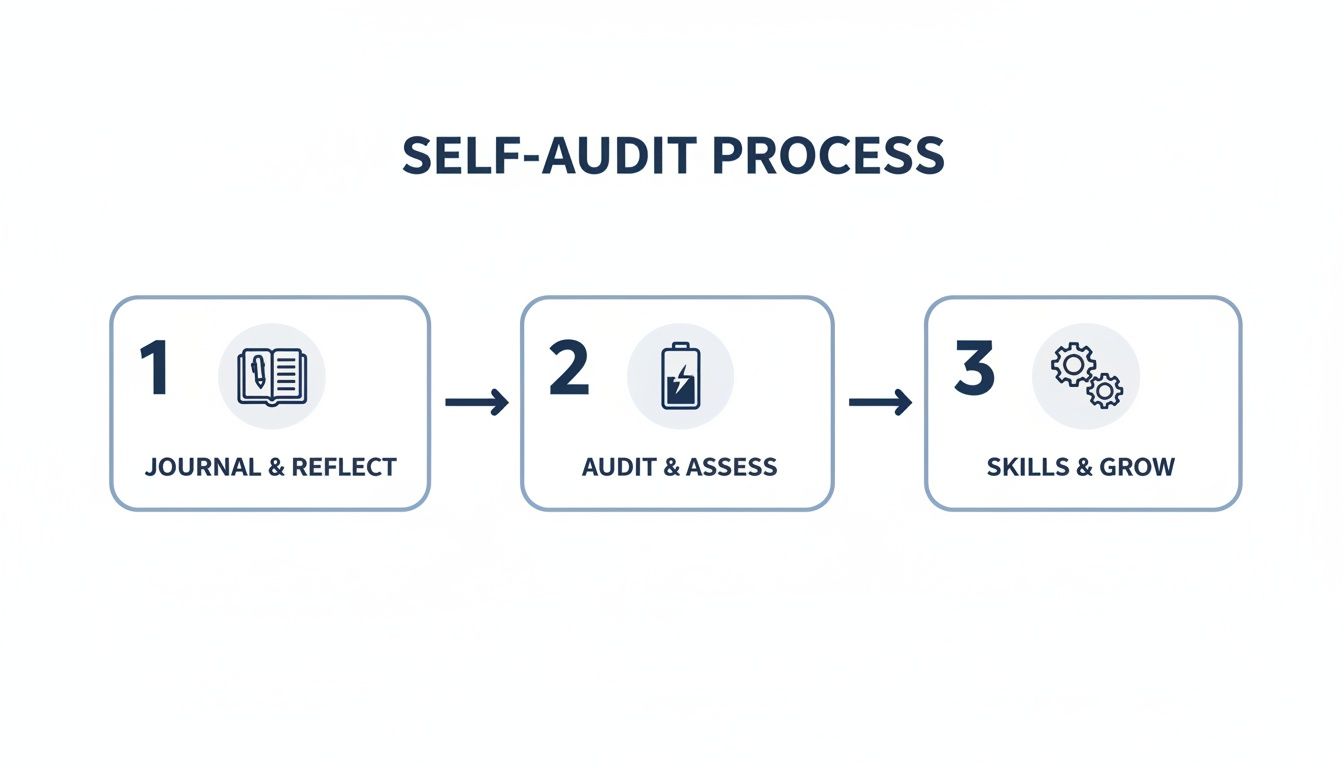
This is all about building on the foundation you’ve already laid. The simple process of journaling, auditing your energy, and analysing your skills gives you the raw material you need to design your first experiments.

Diagram illustrating a three-step self-audit process for personal and professional growth.

This three-step flow: “Journal, Audit, and Analyse Skills” gives you everything you need to create targeted micro-experiments that actually line up with who you are.

Designing Your First Experiment

A solid micro-experiment for you needs to be specific, time-bound, and low-stakes. The goal is for you to get a genuine feel for an activity without needing a massive commitment of time, money, or ego. The trick is to take a big, vague interest and shrink it down to its smallest possible, actionable step.

Let’s look at how this works in practice. Notice how you can turn a fuzzy idea into a concrete, manageable task.

  • Your Vague Interest: “I think I might like coding.”
    • Your Micro-Experiment: Complete a free, two-hour ‘Introduction to Python’ tutorial on YouTube this Saturday afternoon.
  • Your Vague Interest: “Maybe digital marketing is for me.”
    • Your Micro-Experiment: Offer to run the social media for a local charity or a mate’s small business for one month, committing to just three posts a week.
  • Your Vague Interest: “I’ve always been curious about woodworking.”
    • Your Micro-Experiment: Sign up for a one-day beginner’s workshop at a local community centre to build a simple birdhouse.

Each of these experiments delivers a real, tangible experience. Trust me, you’ll learn far more from two hours of actually writing code than you will from 20 hours of watching videos about what it’s like to be a coder.

The Power of Data Collection

Think of yourself as a scientist studying a fascinating subject: you. The point of each micro-experiment isn’t to decide if this is your “one true passion” for life. It’s just to collect data that will guide your next step.

After you finish an experiment, give yourself just 15 minutes to reflect. Don’t overthink it. Just jot down some quick notes to these questions.

Questions to Ask Yourself After Your Experiment:

  • Energy Check: Did this activity leave me feeling more energised or more drained than when I started?
  • Flow State: Did I lose track of time at any point, or was I constantly watching the clock?
  • Problem-Solving: What specific bits of the activity did I enjoy most? Was it the creative brainstorming, the technical troubleshooting, or seeing the final result?
  • Curiosity Level: Am I more curious to learn more about this now, or has my interest kind of faded?

This process turns your vague feelings into usable insights. You might discover you loved the logical puzzle of coding but hated staring at a screen for hours. That’s a crucial piece of data for you! It tells you to look for other things that involve similar problem-solving skills but in a totally different environment.

You’re not looking for a perfect score on the first try. You’re looking for clues. A “failed” experiment that shows you what you don’t like is just as valuable as one that confirms an interest.

This approach keeps you moving forward, stopping that “analysis paralysis” that comes from trying to map out the perfect path from your armchair.

Creating a System for Your Exploration

To keep your momentum going, it really helps to build a simple system for your experiments. Don’t just do one and stop. Aim to run one small experiment every couple of weeks. This builds a powerful habit of curiosity and action that will lead you to a breakthrough.

Here’s a simple framework to organise your thoughts and keep you on track.

My Interest Area My Micro-Experiment Idea My Time/Cost Commitment What I Hope to Learn About Myself
Graphic Design Design a simple logo for a fictional brand using a free tool like Canva. 3 hours / $0 Do I enjoy the creative process of visual branding?
Writing Write a 500-word blog post on a topic from my self-audit and post it on a free platform. 4 hours / $0 Does the process of structuring my thoughts and writing them down feel rewarding to me?
Public Speaking Join a local Toastmasters club as a guest for one meeting. 2 hours / ~$20 guest fee Can I handle the nerves, and do I enjoy the challenge of speaking to a group?

This structure makes your exploration intentional. It turns a chaotic search into a clear project with measurable steps and learning goals. Over time, you’ll build a rich portfolio of experiences that paint a clear picture of what truly engages you.

This is how you find your passion, not by waiting for a lightning bolt, but by actively building a life aligned with your curiosity, one small experiment at a time.

Overcoming the Fear and Paralysis Holding You Back

You’ve done the hard yards on the internal work. You’ve even got a few micro-experiments lined up, ready to go. Then, it hits you: a brick wall of fear.

It’s that little voice whispering, “What if I fail?” or “What will people think?” This is exactly where your journey to find your passion can grind to a screeching halt.

Let me tell you, this paralysis is completely normal. Stepping outside your comfort zone is bloody terrifying. The goal isn’t to get rid of the fear. Your real mission is to learn how to act despite it.

You need to treat these mental roadblocks just like any other problem, by breaking them down into smaller, more manageable pieces. And it all starts with getting brutally honest about what’s really holding you back.

Name Your Fears to Tame Them

A vague, undefined fear feels huge and insurmountable. But when you drag it kicking and screaming into the light, it often shrinks. This is the core idea behind a powerful technique called ‘fear-setting’. Instead of setting goals, you map out your fears in detail to regain control.

Grab a piece of paper and draw three columns. This simple exercise can be an absolute game-changer for you.

  1. Define: What’s the absolute worst-case scenario if you try this new thing and it doesn’t work out? Get specific. Don’t just write “I’ll fail.” Write “I’ll spend $50 on a workshop and feel like I wasted a Saturday.”
  2. Prevent: What small, practical steps could you take to stop that worst-case from happening, or at least reduce the odds? For the workshop example, you could read a few reviews or watch some free videos on the topic first to see if you’re genuinely interested.
  3. Repair: If the worst does happen, what could you do to get back to where you are now? In this case, you’d be out $50 and a few hours, but you’d have gained solid data about what you don’t enjoy. The “damage” is tiny.

When you see it laid out like this, you start to realise most of your fears are temporary and reversible. It’s rarely the catastrophe your mind makes it out to be.

Breaking Free from Outside Expectations

Another huge source of paralysis is the weight of other people’s expectations. You worry about what your parents, partners, or mates will think if you stray from the “sensible” path. This pressure can be suffocating, making you second-guess your own gut feelings.

It’s absolutely critical for you to learn how to separate their definition of success from your own. Whose life are you actually living? Sometimes, your deepest fears aren’t about your own failure, but about disappointing others.

This journey is yours and yours alone. Giving yourself permission to pursue something just for you, not for status, not for a paycheque, but for the pure joy of it, is one of the most freeing things you can do.

This might mean having some tough conversations, or it might just mean quietly giving yourself permission to explore your interests without needing anyone else’s approval. Your future self will thank you for it.

Using Action to Defeat Analysis Paralysis

Sometimes the roadblock isn’t fear, but “analysis paralysis”, endlessly researching, planning, and thinking without ever actually doing anything. You get stuck trying to find the perfect first step. The best way for you to break this cycle is with ridiculously small actions.

Enter the ‘five-minute rule’.

Whatever it is you’re putting off, just commit to doing it for five minutes. That’s it. If you want to learn guitar, pick it up and watch one beginner tutorial for five minutes. Curious about writing? Open a document and just type for five minutes.

Often, starting is the hardest part. This tiny commitment tricks your brain into bypassing that initial resistance. More often than not, you’ll find you keep going long after the five minutes are up, building momentum effortlessly.

This principle of using discipline to build momentum is incredibly powerful. For instance, look at the rise of digital fitness coaching in Australia. The market soared to USD 242.42 million in 2024 and is projected to hit USD 437.88 million by 2033. This growth is partly driven by young men realising that the discipline gained from fitness gives them the mental toughness to pursue other passions.

Turning a Spark of Interest into a Tangible Plan

Alright, you’ve done a few micro-experiments and felt that genuine flicker of excitement. Don’t underestimate this moment. It’s a huge step, moving you from just being curious to knowing there’s something real there worth digging into.

But what now? This is the exact point where so many people get stuck. That tiny flame of interest feels great, but they have no idea how to stop it from fizzling out.

The trick is to shift gears from random exploration to intentional planning. It’s about building a solid bridge between a fleeting interest and an actual, tangible goal you can work towards. This isn’t about making a rash, life-changing decision overnight. It’s a methodical process of connecting the dots from your self-audit and experiments to create a realistic plan that actually fits your life.

Map Your Potential Pathways

Before you can build a plan, you need a destination. A newfound passion doesn’t automatically have to become your next career. You need to be brutally honest with yourself about what role you genuinely want this to play in your life.

Generally, you’ve got three main pathways to think about:

  • A Fulfilling Hobby: This is all about your pure enjoyment, with zero pressure to make a cent. It’s about carving out time for something that recharges you, whether that’s weekend woodworking, finally learning the guitar, or mastering landscape photography.
  • A Side Hustle: Here, you start exploring ways to earn a bit of income from your interest without quitting your day job. This could be anything from selling handmade goods online to offering freelance writing services or coaching the local footy team on weekends.
  • A New Career Trajectory: This is the big one, a deliberate pivot in your professional life. It requires the most research and planning, as you’ll need to understand the industry, what qualifications you might need, and what the job prospects really look like.

Getting clear on which path feels right for you right now is absolutely critical. It defines the scale of your plan and keeps your expectations in check, which stops a joyful hobby from being crushed under the weight of financial pressure.

Don’t fall into the trap of thinking every passion has to become a paycheque. Sometimes, the most valuable thing an interest gives you is a sense of joy and purpose that has nothing to do with your work life.

Build a Realistic Action Plan

Once you’ve got a potential pathway in mind, it’s time to break it down into small, achievable steps. A vague goal like “become a graphic designer” is completely overwhelming and just leads to paralysis. A proper, structured plan, on the other hand, builds the momentum you need.

Start by working backwards. If you want to end up at your chosen destination, what skills, knowledge, or resources would you need to get there?

Example Scenario: Your Interest in Podcasting

Let’s say your experiments with recording and editing audio felt amazing, and you’re thinking about turning it into a side hustle.

  1. Define Your Next Milestone: Launch the first three episodes of your podcast. That’s specific and measurable.
  2. Identify Necessary Skills: You’ll need to learn basic audio editing, how to structure an episode, and some marketing fundamentals to get it out there.
  3. List Your Actionable Steps:
    • Research and buy a decent entry-level microphone.
    • Complete a 4-hour online course on the editing software Audacity.
    • Brainstorm and outline your first five episode ideas.
    • Record and edit episode one by the end of the month.

See how that works? A step-by-step approach turns a massive ambition into a simple to-do list, making your progress feel inevitable instead of impossible.

The Value of Accountability and Guidance

Making a plan is one thing; actually sticking to it when life gets in the way is another beast entirely. This is where accountability becomes a game-changer for your success.

Sharing your goals with a mate you trust, joining a community of people on a similar path, or working with a coach can give you the structure and support you need to stay on track.

There’s a reason the life coaching industry in Australia is booming. Oceania alone clocked $195 million in coaching revenue in 2023, which is part of a global $5.34 billion industry. Research consistently shows that coaching delivers a huge return on investment and can boost self-esteem by as much as 80% giving people like you the confidence to actually chase their goals. It just goes to show how valuable a bit of external guidance can be when you’re turning a spark into a real plan.

If you feel you need that external push and a solid framework to hold you accountable, exploring professional life coaching services can provide the personalised support to turn your plan into reality.

Got Questions About Finding Your Passion?

As you start making progress, it’s completely normal for a few nagging questions to pop up. These are the usual sticking points that can throw a spanner in the works just when you feel like you’re getting somewhere. Let’s tackle them head-on so you can keep moving forward.

Think of this as your no-nonsense guide to getting unstuck. The goal here isn’t just to throw information at you, but to help you navigate these mental roadblocks with confidence.

What if I Have Too Many Interests?

First off, this is a quality problem to have. It beats feeling like nothing excites you. The trick is to shift your mindset from “I have to pick just one” to “Which one will I explore first?”

Don’t let the sheer number of options freeze you in your tracks.

  • Find the Theme: Lay out all your interests. Is there a common thread tying them together? Maybe your interest in graphic design, woodworking, and creative writing all point to a deeper desire you have to build something from nothing.
  • Run an ‘Energy’ Check: Go back to your energy audit. Which of these interests gives you the biggest jolt of genuine excitement right now? Your gut knows. Trust it and start there. The others aren’t going anywhere.
  • Try a ‘Mash-Up’: Sometimes, your real magic happens where two interests collide. If you love fitness and writing, you could start a killer fitness blog. If you’re into tech and music, you could get lost in digital audio production.

Your aim isn’t to find the ‘one’ perfect thing for life. It’s simply to start with what’s pulling you in the most today. This isn’t a lifelong contract; it’s just your next step.

How Long Does This Whole Process Take?

This is probably the most common question I get, and the honest answer is there’s no set timeline for you. It’s different for everyone. Finding what truly clicks with who you are is a marathon, not a sprint. Some people have a lightbulb moment in a few months. For others, it’s a slow burn that unfolds over years.

Trying to rush the process is the fastest way to get frustrated and quit. Your only job is to stay curious, keep running small experiments, and pay attention to what the results are telling you.

Forget the deadline and focus on consistent, small actions instead. The journey of self-discovery is where you’ll find most of the good stuff, anyway. If you’re looking for more ideas on how to keep your momentum going, check out some of the other articles on our blog.

What if My Passion Doesn’t Become a Career?

This is a big one. You might get tripped up by the myth that every single passion needs to be monetised. Not only is that untrue, but it can also be incredibly destructive to your motivation.

Seriously, putting financial pressure on a new interest is the quickest way to suck all the joy out of it for yourself.

  • Protect Your Hobby: It is 100% okay to have a passion that is just for you. Its only job might be to bring you joy, slash your stress levels, and make your life richer. That’s more than enough of a return on your time.
  • Redefine ‘Success’ for Yourself: Success doesn’t always come with a paycheque. It could be the feeling of finishing a personal project, mastering a new skill, or simply having an outlet that recharges you after a tough week.

Sometimes, the most valuable role a passion can play is to make the rest of your life better, not to replace your job. Give your interests room to breathe without the crushing weight of expectation.


At Your Bro, we believe that finding your path is about taking consistent, intentional action, not waiting around for a magical answer. If you’re ready to move past the questions and start building a concrete plan with real accountability, a good first step is our free, no-BS discovery call. Find out more and book your spot at https://yourbro.com.au.

Page curated by outrank.so

No more posts to show