Right then, let’s get straight into it. If you want to learn how to write quicker, you need to know it's not about some secret hack or magic formula. It’s all about having a solid game plan: smart planning, focused drafting, and ruthless editing. Simple as that.
Your Guide on How to Write Quicker
Welcome to the first part of our series, Life Skills No One Teaches You. Forget those dry uni lectures. This is real, practical advice from someone who’s been in the trenches and figured it out, designed to stop you from losing a whole weekend stressing over an assignment or a job application. It’s written for you, the young Aussie bloke who just wants to get things done without the hassle.
The absolute key to writing faster is separating your tasks. Think about it. You would not try to build the frame of a house and paint the walls at the exact same time, would you? The same logic applies here. You have got to plan your structure first, then just get the words down on the page without judging them, and finally, go back and polish it all up.
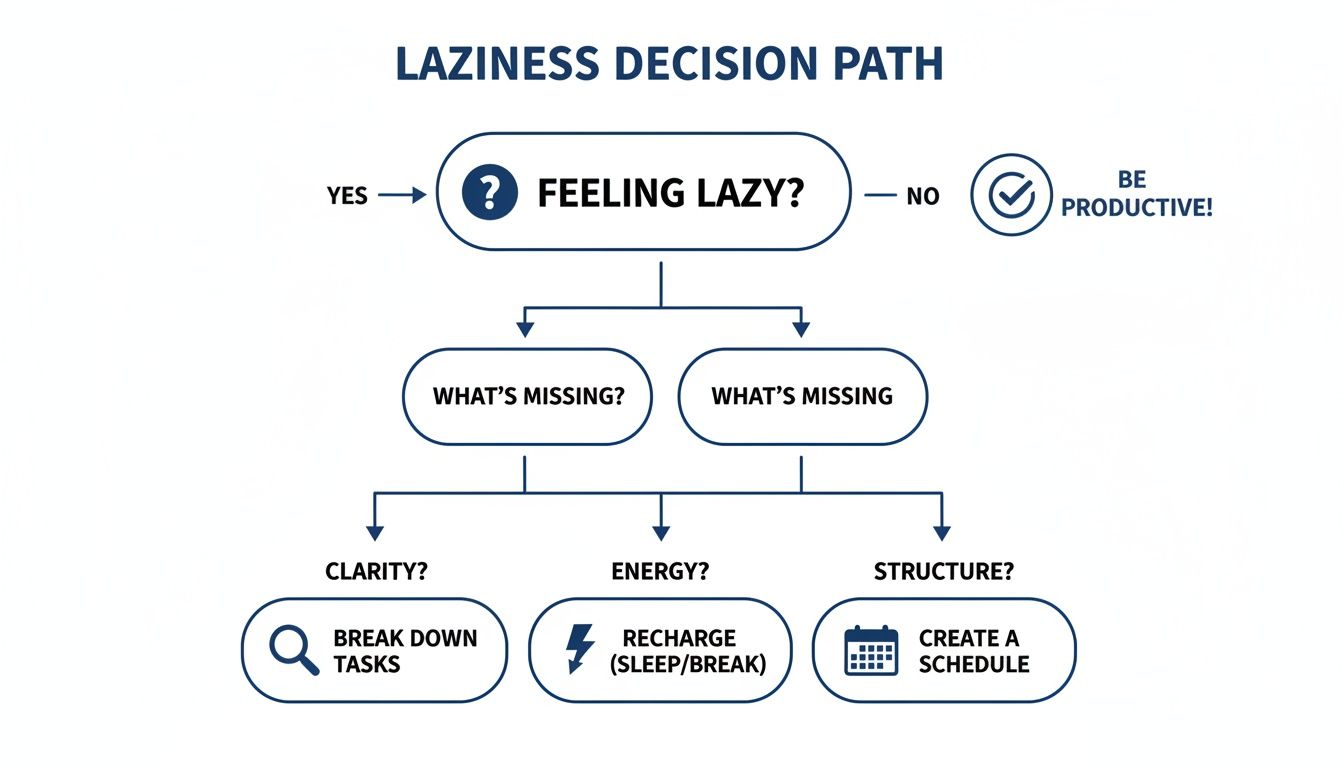
This approach is a lifesaver whether you're at TAFE, uni, or just trying to sound like you know what you are talking about in a workplace email. The image below shows the basic three stage process we are going to break down.

It looks almost too simple, I know. But consciously splitting your effort into these distinct phases is the secret sauce for both speed and quality. This entire guide is built around mastering each one of these steps so you can learn how to write quicker for good.
Why Learning to Write Fast Is a Game Changer
Before we dive into the nuts and bolts, let’s get real about why this stuff actually matters for you. A lot of Aussie blokes I know get stuck when they need to put their thoughts down on paper, whether it’s for a uni assignment, a job application, or a simple but important email to the boss. It ends up chewing up their entire weekend and causes a heap of unnecessary stress.
When you figure out how to write quicker, something just clicks. You get this massive confidence boost because that task you have been putting off no longer feels like climbing a mountain. That awful feeling of procrastination starts to fade. All of a sudden, you have got more time for the things you actually want to do: hit the gym, work on a side hustle, or just enjoy your life. It’s a genuine, practical edge that makes you feel more in control.
More Than Just a School Skill
Let’s be honest, the way they teach writing in school can feel completely disconnected from the real world. And the stats back it up. Writing performance in Aussie schools has been sliding for a while now. Research has shown a serious drop in students' writing ability between 2011 and 2018, with more than one in five Year 9 students not even hitting the minimum national standard. If you want to go down the rabbit hole, you can check out the official NAPLAN data report for yourself.
This is not about pointing fingers. It is about recognising there is a gap that needs filling, and you are the one who has to fill it.
The ability to communicate your ideas clearly and efficiently is one of the most underrated skills you can have. It is not about being a novelist; it is about being effective in everything you do.
Learning how to write quicker is your way of bridging that gap. It is a skill that pays off every single day, from sending a clear message on a dating app to putting together a business proposal that someone actually reads from start to finish. Being the bloke who gets things done without the drama makes you incredibly valuable.
Take Back Your Time and Energy
Just think about the mental energy you burn thinking about a writing task. It hangs over your head, ruins your downtime, and makes you feel guilty for relaxing. The methods we are about to cover are designed to cut right through that noise and give you that time back.
Building this skill is just like building any other muscle. It takes a bit of consistency, but it is not complicated. If you find yourself struggling to stay on track, that is where a bit of guidance can make all the difference. It is exactly what we focus on at Your Bro coaching. We help blokes build these systems into their lives so they can take back control.
Curious how it works? Jump on a free discovery call. This is not about a quick fix; it is about building a skill that will serve you for life.
Master Your Prep Work for Faster Drafting
Alright, let's get into the first real step of learning how to write quicker. The biggest mistake most blokes make is just opening a blank document and hoping for the best. That is like trying to build a shed without any plans; you will waste hours just staring, getting frustrated, and probably end up with something wonky.
The secret to fast, efficient drafting happens before you even write the first proper sentence. It is all in the prep work.
Think of it like a chef doing their mise en place. They chop all the veggies, measure out the spices, and get every single thing ready before the heat is even on. When it is go time, everything is right there. No fumbling around.
That is exactly what we are going to do with your writing.
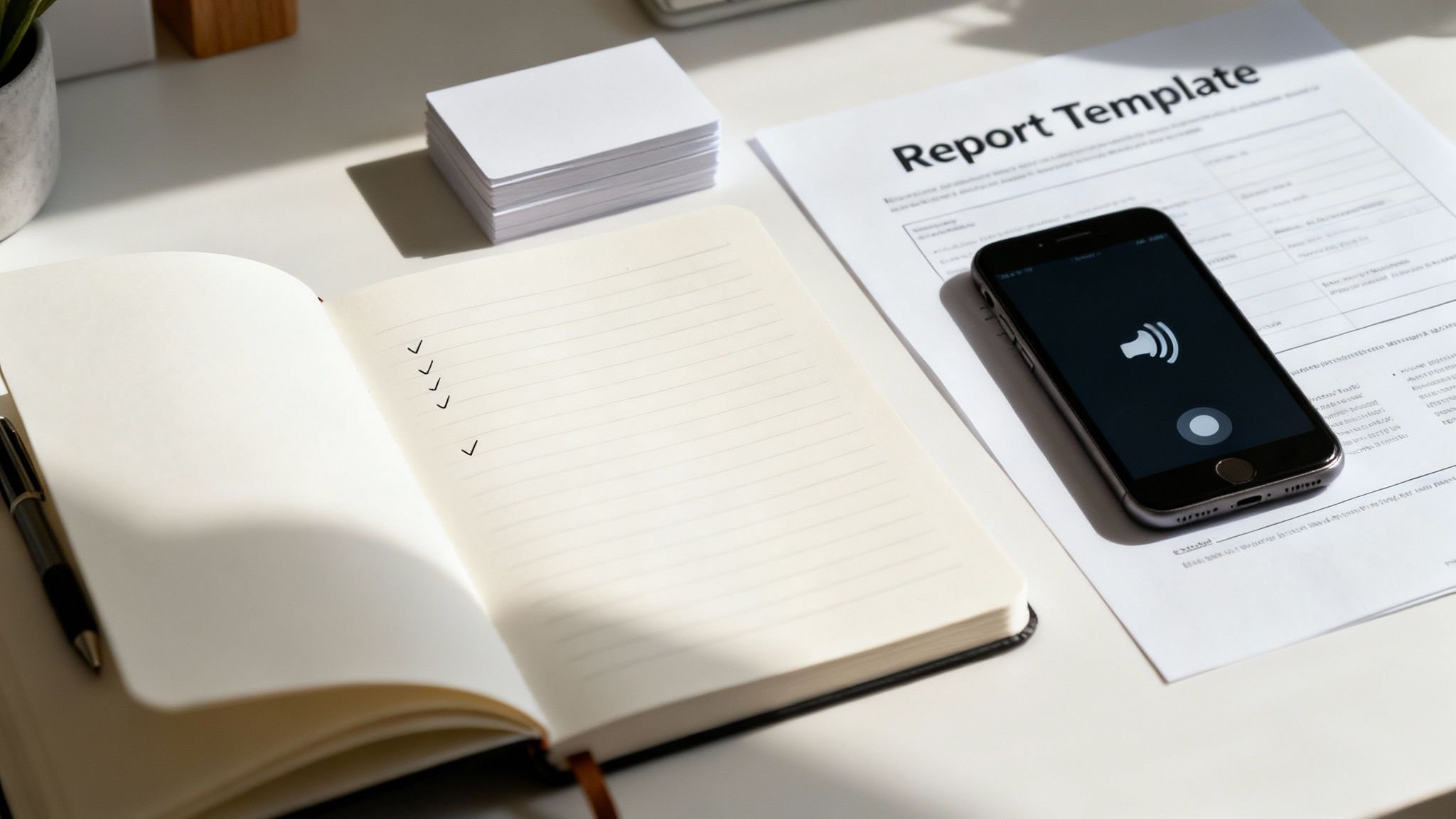
Create a Simple Roadmap Outline
An outline is not that scary, formal thing you were forced to do in high school. Forget that. Think of it as a simple roadmap for your thoughts. Its only job is to stop you from getting lost halfway through a project.
Your outline can be as basic as a few bullet points in a notes app. For a uni essay, it might look something like this:
-
Intro: State my main argument (the core idea).
-
Point 1: Back it up with the first bit of evidence.
-
Point 2: Hit 'em with the second piece of evidence.
-
Counter-argument: Acknowledge the other side (shows you have thought it through).
-
Conclusion: Sum it all up and drive the main point home again.
That is it. That simple structure gives you direction. When you sit down to draft, you are not thinking, "What the hell do I write next?" You are just filling in the blanks. Trust me, this small habit is a massive part of how to write quicker.
Use Templates for Repetitive Tasks
You do not need to reinvent the wheel every single time you write. For those common tasks, job cover letters, weekly project updates, or TAFE reports, having a template is a total game changer. It saves a huge amount of mental energy you could be using elsewhere.
A template provides the basic structure so you can just focus on plugging in the new, relevant information.
Think of a template as the pre-built frame for your writing. You still have to put the walls up and paint them, but you are not starting from a pile of timber on the ground.
This is not cheating; it is being efficient. For instance, UTS offers some great assignment templates and cover sheets that get you started without the guesswork. Using resources like these means you spend less time wrestling with formatting and more time on the actual content that matters. This is a practical step that shows you how to write quicker.
Building a system of templates and outlines is one of the core skills we help you develop at Your Bro coaching. A solid framework makes consistency so much easier. If you want to see how this could work for you, a free discovery call is a great, no-pressure way to chat about it. For more ideas on structuring your thoughts, you can also explore our guide on keeping a self-improvement journal.
Unlocking Your Speed with Focused Drafting Techniques
Alright, this is the main event: getting the actual words down. This is where you stop thinking and start doing.
The drafting phase is all about momentum. Forget spelling, forget grammar, and tell that nagging inner critic to take a hike. Your only job right now is to turn that outline of yours into a messy, complete first draft.
This is where most blokes get tripped up. They try to write the perfect sentence the first time, get stuck rewriting it for twenty minutes, and kill their flow. It turns a simple task into a massive chore. To learn how to write quicker, you have to embrace the ‘zero edit’ rule: just write.

The goal here is not quality; it is quantity. Get everything out of your head and onto the page. I promise you, we will clean it all up later.
Embrace Timed Writing Sprints
One of the best ways to force yourself into this ‘just write’ headspace is by using timed writing sprints. It sounds simple, but it is incredibly effective.
Set a timer for 25 minutes. For that entire block, you do nothing but write. No checking your phone, no looking up a quick fact, no rereading what you just wrote. Just pure, uninterrupted typing.
When the timer goes off, take a five minute break. Walk around, grab a drink, whatever. Then you go again. This method, often called the Pomodoro Technique, forces you to focus and builds momentum. It makes the whole thing less intimidating because you are only committing to short bursts of effort. If you find procrastination is still winning, our guide on how to overcome procrastination offers some deeper strategies.
Turn Dead Time into Productive Time
Got a long commute on the train? Waiting for a mate? You can use that dead time to get ahead.
Most smartphones have excellent voice-to-text features built right in. Just open a notes app and start talking through your ideas. Dictate a rough section of your article or brainstorm the key points for that work email. It feels a bit weird at first, but it is a brilliant way to capture thoughts in a natural, conversational way.
You will end up with a chunk of raw text you can copy, paste, and polish up later on your computer. It is a simple trick, but it is a massive part of how to write quicker when you are constantly on the move.
The core idea of drafting is to separate creation from criticism. When you are drafting, you are the creator. The critic can have his say later, during the editing phase.
Interestingly, even in our digital world, the physical act of writing can be powerful. Research from Edith Cowan University found that primary students often produce higher quality work with a pen and paper compared to a keyboard. While typing fast is essential, handwriting can sometimes connect your brain to the words more directly. If you get stuck typing, try scribbling your ideas in a notebook first.
Just Get It Done
Ultimately, the goal of this phase is to have a finished first draft. It does not need to be good. It just needs to be done.
Having a complete draft, no matter how rough, gives you something to work with. Remember, you cannot edit a blank page.
Building this habit of separating drafting from editing is tough, especially if you are a perfectionist. This is where having some accountability can be a game changer. At Your Bro coaching, we help you build these practical systems and stick with them. A free discovery call is an easy way to see if that kind of supportive guidance could work for you. Learning how to write quicker is a skill, and like any skill, it just gets easier with consistent practice.
The Power of Separating Your Writing and Editing
Trying to write and edit at the same time is like trying to drive with one foot on the accelerator and the other on the brake. You will jerk forward, stall, and burn a whole lot of fuel just to go nowhere.
It is one of the biggest reasons blokes get stuck, and it absolutely kills your momentum.
If you seriously want to learn how to write quicker, you have to treat writing and editing as two completely separate jobs. Because that is what they are. One is about creation: getting the ideas out of your head and onto the page. The other is about refinement. Mixing them up just ties your brain in knots.
The writing phase is purely for getting that messy first draft done. That is it. Let it be rough. The editing phase is for cleaning up that mess later.
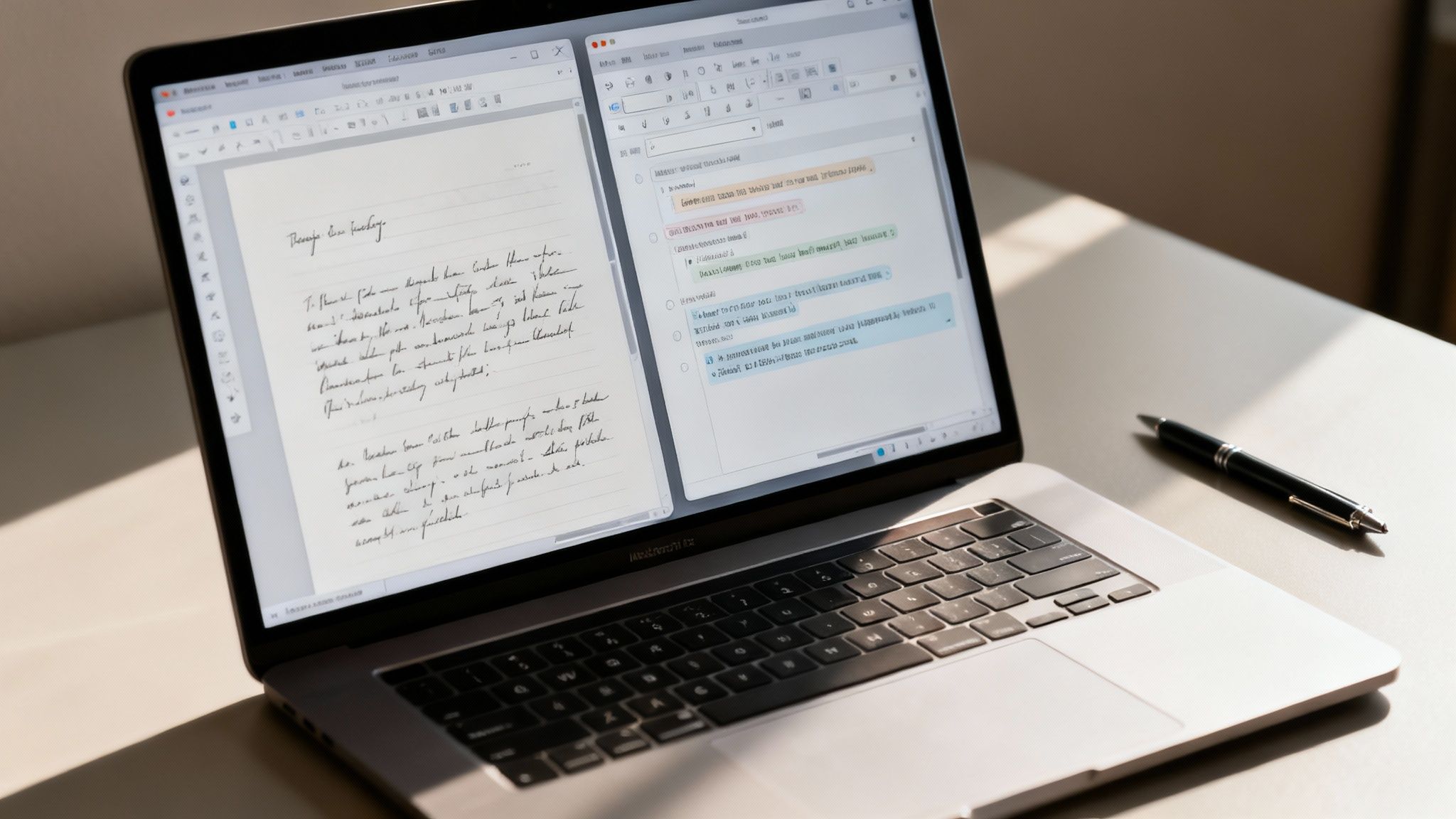
Your Two-Pass Editing System
To make editing less of a headache, do not try to fix everything at once. You will just get overwhelmed. Instead, break it down into two distinct passes. This approach stops you from getting bogged down in tiny details when the whole structure might be off.
This system is a core part of learning how to write quicker because it gives you a clear, repeatable process you can rely on every time.
Pass 1: The Big-Picture Edit
Your first read through has absolutely nothing to do with commas or spelling. Forget about them for now. You are only looking at the structure and the flow of your ideas.
Ask yourself these questions:
-
Does this actually make sense? The best way to check is to read it aloud. If it sounds clunky or confusing, you will hear it straight away.
-
Is my main point clear? If someone read only your first and last paragraphs, would they know what you are trying to say?
-
Is everything in a logical order? Does each point flow naturally into the next, or are you jumping all over the place?
-
Have I missed anything important? Look back at your original outline. Did you cover all the key points you planned to?
I find using the comment feature in Google Docs or Word is perfect for this. Just leave notes for yourself. The key is: do not start rewriting yet. Just identify the big structural problems.
Pass 2: The Fine-Details Edit
Once you are happy with the overall structure and flow, then you can zoom in on the small stuff. This is your second pass.
The first pass is for the architect, checking the building's foundation and frame. The second pass is for the painter and decorator, making sure everything looks good up close.
Now you are hunting for things like:
-
Spelling and Grammar: This is the obvious one. Use a tool like Grammarly, but also trust your own eyes. A great trick for spotting errors is to read your text backwards, sentence by sentence. You can also find some solid resources on this from the University of Melbourne’s Academic Skills unit.
-
Clarity and Word Choice: Are you using simple, direct language? Cut out any jargon or waffle that does not add value. Get straight to the point.
-
Consistency: Is your tone consistent all the way through? Do you need to fix any weird formatting issues?
Separating these two passes is crucial. It is a method that forces you to focus on what matters most at each stage. This structured approach is fundamental for anyone wanting to learn how to write quicker and more effectively.
Getting this habit locked in is a genuine game changer, and it is something we focus on heavily at Your Bro coaching. If building solid systems like this sounds like what you need, book a free discovery call to see how we can help. This is a practical skill you will use for uni, work, and life in general.
Building Habits That Make Fast Writing Automatic
Look, all the techniques we have talked about are great, but they are pretty useless if you only use them once. The real secret to writing quicker for good is turning these actions into automatic habits.
It is about weaving these strategies into your default routine so you do not even have to think about them anymore. This is how you make a real, lasting change for yourself.
This is not about some massive, life changing overhaul. It is about small, consistent steps that build up over time. You are not trying to become a professional author overnight; you are just trying to make that next TAFE assignment or work report less of a pain in the arse. This is the essence of how to write quicker.
Start Small to Win Big
The biggest mistake blokes make is setting a massive goal, failing on day two, and giving up completely. Instead of saying, "I'm going to write for two hours every day," start with something ridiculously small.
Commit to just 15 minutes of focused writing each day. That is it.
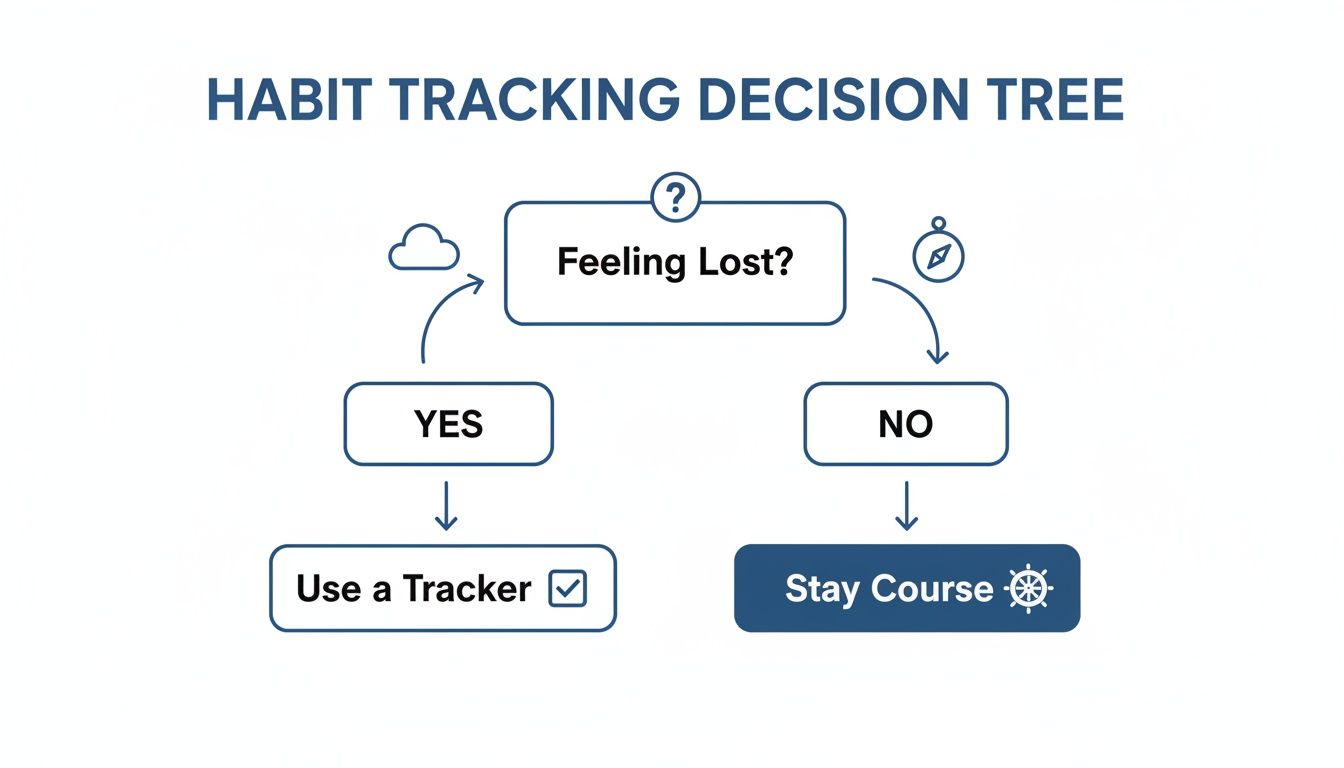
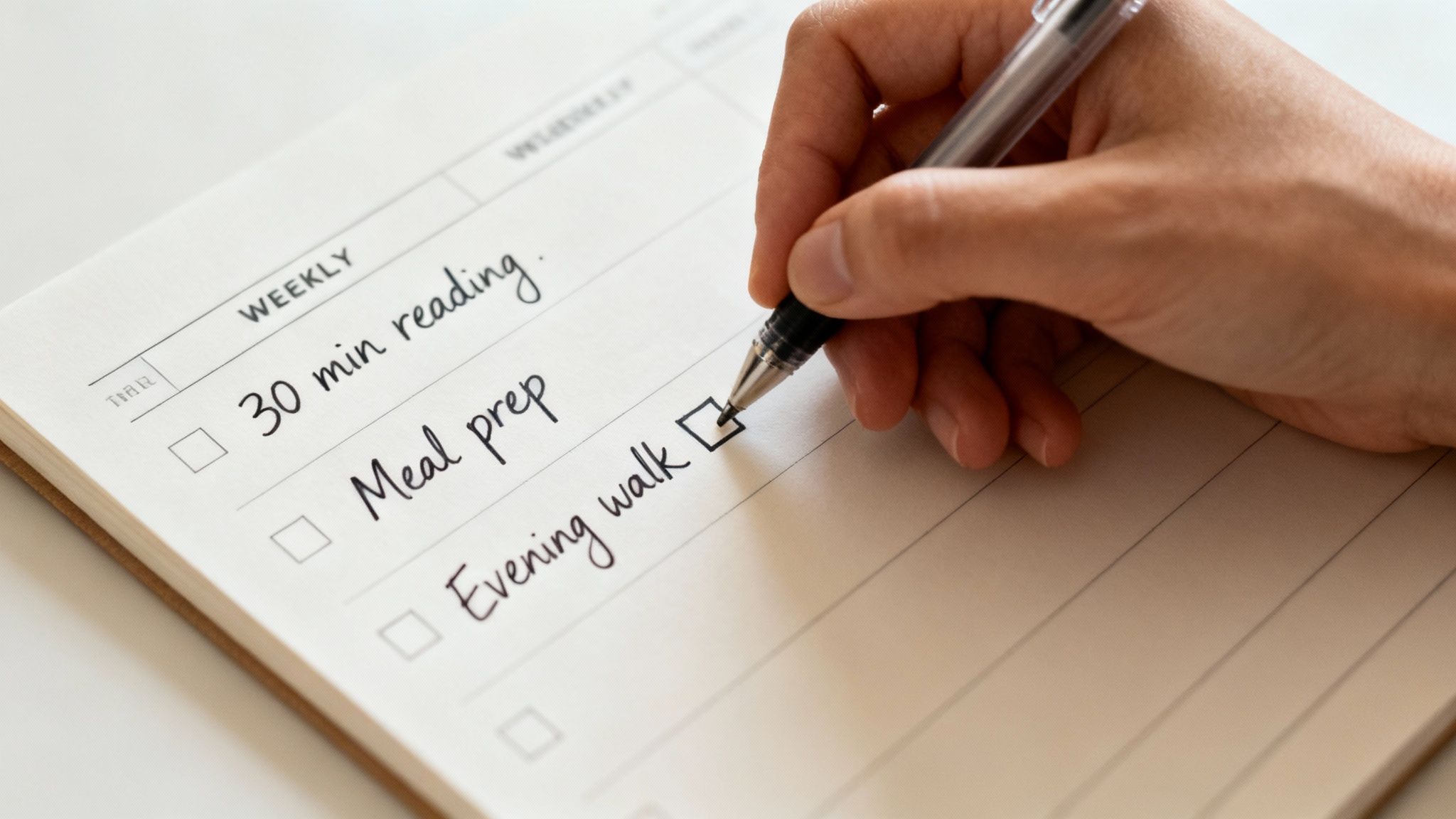
Anyone can find 15 minutes. This approach builds a winning streak, and that momentum is what creates a lasting habit. You are teaching your brain that writing is not this huge, scary task. It is just something you do. For more on this, check out our simple but effective habit tracker template to keep you on track.
Track Your Progress and Reward Yourself
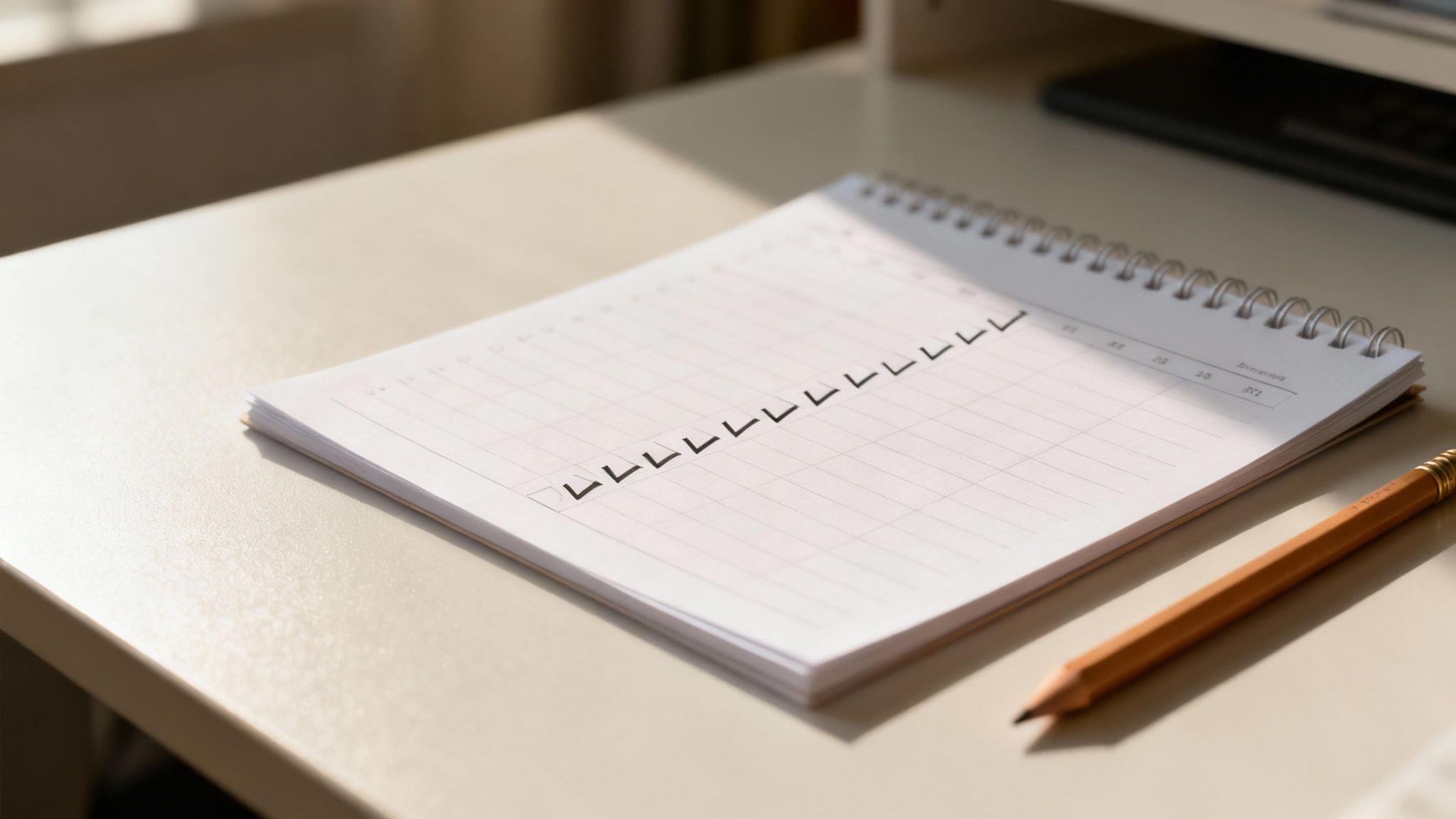
You need to actually see that you are getting somewhere. Use a simple app or even just a notebook to track your daily writing time or word count. Seeing those ticks add up gives you a visual cue that you are making genuine progress.
And when you hit your goals, reward yourself. It does not have to be anything massive.
-
Hit your goal for 5 days straight? Grab a decent beer or that takeaway you have been craving.
-
Finished a big project ahead of schedule? Take a proper arvo off to do absolutely nothing.
This simple loop of cue, routine, and reward is how your brain locks in new behaviours. It is a fundamental part of learning how to write quicker consistently.
The Power of Accountability
Let’s be honest, sticking to new habits on your own is tough. Having some form of accountability makes a massive difference.
You can get a mate on board and check in with each other. Just a quick message saying, "Did you get your 15 minutes in today?" can be enough to keep you both honest.
Accountability is not about being judged. It is about having someone in your corner who reminds you of the commitment you made to yourself.
This is especially important in the current climate. A 30 year policy failure in Australian writing instruction has left a lot of young professionals struggling with workplace writing. This means that developing strong, fast writing habits now gives you a genuine competitive advantage that others simply do not have. You can discover more insights about this educational gap on ThinkWrite.
Sometimes, a mate is not enough, and you need more structured guidance. That is where something like Your Bro coaching comes in. We act as that accountability partner, providing the support and framework to help you build these skills and make them stick.
If you feel like you are just spinning your wheels, booking a free discovery call is a solid first step towards getting real traction. Learning how to write quicker is not just a trick; it is a habit you build, one day at a time. It is about building a system that works for you, so you can stop stressing and start doing.
Still Got Questions About Writing Quicker?
We have covered a fair bit of ground, but I get it. Sometimes it is the small, nagging questions that stop you from actually putting new ideas into practice. Let's get those sorted so you can start applying these strategies with a bit more confidence and see some real results for yourself.
Here are a few quick answers to the common roadblocks blokes face when trying to speed up their writing.
And look, if you find you need more personalised strategies to get over your specific hurdles, a free discovery call with Your Bro coaching is a great way to get targeted advice. But for now, let’s tackle these common questions head on.
What Do I Do If I Get Stuck During a Writing Sprint?
It happens to everyone. You are in the zone, the timer is ticking, and then… nothing. Your brain just hits a brick wall. The absolute worst thing you can do is sit there staring at the blinking cursor. That just builds anxiety and completely kills your momentum.
Instead, try one of these two things:
-
Type about being stuck: I am not kidding. Literally type out, "I do not know what to write next," or "I am not sure how to explain this bit." It is a weird little trick, but it keeps your fingers moving and often helps unblock the very thought you were trying to find.
-
Jump to another section: Have a quick glance at your outline and find a part you feel more confident about. Your first draft does not have to be written in perfect, chronological order. The only goal is to get words on the page.
The point of a writing sprint is momentum, not perfection. Keep the wheels turning, even if it feels a bit messy. You can always come back and fix it later.
How Do I Balance Speed With Quality?
This is probably the biggest mental hurdle for anyone learning how to write quicker. There is this nagging feeling that if you speed up, the quality of your work is going to plummet.
The solution is simple but surprisingly powerful: stop trying to do both at the same time.
You find the balance by separating the processes completely. Your first draft is all about speed. It is for dumping ideas, making connections, and building a foundation to work from. The quality comes later, during your dedicated editing passes. You cannot edit a blank page, so your first priority is always to create something, anything, that you can work with. This is the smartest way to learn how to write quicker.
Is Using Voice-to-Text Really Effective?
Absolutely. It is one of the most underrated tools for learning how to write quicker, especially if you find typing a bit of a slog or your thoughts just move faster than your fingers. It is fantastic for brainstorming and capturing raw ideas without the filter of your internal editor slowing you down.
Think of it this way: you can speak a hell of a lot faster than you can type.
Using voice to text helps you get into a natural, conversational flow. You can then just copy, paste, and polish it up later. It is a tool for capturing thoughts, not a complete replacement for writing and editing. For any bloke who spends a lot of time commuting, it is a brilliant way to turn that dead time into productive time.
Learning how to write quicker is a skill that pays off in every area of your life. It gives you back time, cuts down on stress, and seriously boosts your confidence. Building these habits takes consistency, and having someone to keep you accountable can make all the difference.
At Your Bro, we provide the guidance and support to help you build practical, effective systems that actually stick. If you are ready to stop stressing and start making real progress, book a free discovery call today.