Being asked to write statutory declarations for the first time can feel like you’ve been thrown a pop quiz on a subject you never studied. This guide is part of our ‘Life Skills No One Teaches You’ series, and I’m going to break down this formal written statement into simple, manageable chunks. You’ll see exactly how to get one done correctly and with confidence. Your goal is to handle this task smoothly, and this guide will show you how to write statutory declarations so you can move on with your life without the stress.
What’s a Statutory Declaration, Anyway? (No Jargon Allowed)

Let’s cut through the official-speak. A statutory declaration, or ‘stat dec’ as it’s commonly known, is just a written statement of facts that you solemnly declare to be true.
Think of it as making a formal, legally binding promise in writing that everything you’ve laid out is accurate. It carries real legal weight, so it’s a document to be taken seriously. Knowing how to write statutory declarations is a practical skill that gives you control when dealing with official matters.
When You’ll Actually Need One
You’ll probably run into stat decs in all sorts of everyday situations. They’re a common tool for organisations to verify information when other forms of proof just aren’t available. Understanding when to use one is a key part of knowing how to write statutory declarations.
I’ve seen them used for heaps of things:
-
Proof of Relationship: Crucial for visa applications or registering a de facto relationship.
-
Identity Verification: To confirm your name is correct after a typo on a document or to declare a legal name change.
-
Insurance Claims: Stating the circumstances around a lost or stolen item when there’s no police report.
-
Work and Licences: Maybe you’ve lost a payslip you need for a loan, or you need to provide extra details for a licence application.
-
Financial Matters: Confirming your financial situation for a bank or a hardship application.
The whole point is to provide a truthful, written account that an organisation can legally rely on. To get a feel for the structure, it can be helpful to look at a general sworn statement template, as they share a similar formal nature.
Why It’s a Big Deal to Get It Right
Because a stat dec is a legal document, honesty is completely non negotiable. Knowingly making a false statement is a serious offence that comes with some hefty penalties. This isn’t meant to scare you, but just to drive home how important it is to be precise and truthful.
Getting on top of tasks like this is about more than just filling out a form. It’s about building the confidence to handle official processes without the usual stress and procrastination. It’s proof you can take control of your responsibilities.
This whole process is a perfect example of an administrative hurdle that can feel way bigger than it actually is. Tackling it head on gives you a real sense of accomplishment and control.
If you struggle with that feeling of overwhelm that comes with this kind of life admin, a free discovery call with Your Bro can help you map out a strategy to handle these challenges with clarity. Learning how to write statutory declaration forms correctly is a skill that genuinely empowers you for whatever comes next.
Your Pre Writing Checklist for a Flawless Stat Dec

Before you even think about putting pen to paper, a little prep work can save you a mountain of stress. Think of this as your pre flight checklist. Getting organised now means a smoother, faster process later, and it’s a key step in learning how to write statutory declarations correctly the first time.
Rushing this part often leads to silly mistakes or having to start over from scratch, which is exactly the kind of frustrating admin loop we want to avoid. If you find yourself getting stuck in these kinds of loops, you might want to check out our guide on how to overcome procrastination for some practical strategies.
Find the Correct Form
First up, you need the right paperwork. Australia has different forms for Commonwealth and state or territory matters, and using the wrong one is a classic rookie error that can get your document rejected flat out.
-
Commonwealth Form: If your stat dec is for a federal government body like Services Australia, Home Affairs, or anything related to federal law, you’ll need the Commonwealth version. You can grab the official Commonwealth statutory declaration form straight from the Attorney General’s Department website.
-
State or Territory Form: If it’s for a state based issue, think a traffic offence or a state government application, you’ll need the specific form for that jurisdiction. A quick search for “statutory declaration form NSW” or “statutory declaration form VIC” will usually get you to the right place.
Gather Your Facts and Documents
The body of your stat dec needs to be built on a foundation of solid facts, not vague memories or personal opinions. Before you start writing, pull together every piece of information you’ll need to refer to.
A stat dec is your sworn version of events. Having precise dates, full names, addresses, and any supporting document details at your fingertips makes the writing process straightforward and ensures your statement is accurate and credible.
This is where you move from feeling scattered to feeling in control. This proactive approach is something we focus on heavily in Your Bro coaching sessions. Building clarity is the first step to taking confident action.
To get everything in order, a simple checklist can be a lifesaver. It stops you from having to scramble for a piece of ID or a specific date halfway through writing.
Statutory Declaration Preparation Checklist
| Checklist Item | Why It Is Important | Where to Find It |
|---|---|---|
| Correct Form | Using the wrong one (e.g., state for a Commonwealth matter) will get it rejected. | Attorney General’s Department for Commonwealth, state government websites for others. |
| Photo Identification | Your witness will need to verify your identity. | Driver’s licence, passport, or proof of age card. |
| Supporting Documents | These provide evidence for your claims (e.g., receipts, emails, photos). | Your personal files, email account, or photo library. |
| Key Dates & Times | Accuracy is critical. Estimates can undermine your credibility. | Calendars, phone records, or past correspondence. |
| Full Legal Names | Use the full, correct names of everyone mentioned. | Any official documents like contracts, bills, or ID cards. |
| Accurate Addresses | Ensure all addresses are complete and correct. | Google Maps, utility bills, or lease agreements. |
Once you’ve ticked off these items, you’re in a great position to start drafting.
Know Your Witnessing Options
Finally, have a clear plan for how you’ll get your declaration witnessed. In Australia, you now have more flexibility than ever before.
You can get it witnessed the old fashioned way, in person by an authorised professional like a Justice of the Peace (JP), pharmacist, or police officer.
Alternatively, for many Commonwealth declarations, you can now use remote witnessing via a video link. There’s even a fully digital, witness free option available through myGov. Having a plan for this final step is essential when figuring out how to write statutory declarations.
A Practical Guide to Writing a Statutory Declaration
Alright, let’s get down to it. This is where the rubber meets the road. We’re going to break down how to write statutory declarations into clear, manageable steps. Forget the dense legal jargon for a moment; this is your straightforward guide to getting your statement down on paper, the right way.
The key here is to be methodical. Rushing through this process is just a recipe for mistakes that can get your document rejected, sending you right back to square one. Think of it as a lesson in precision and clarity, skills that are pretty handy in all sorts of situations, not just when you’re dealing with paperwork.
Starting With the Opening Declaration
Every single statutory declaration kicks off with a standard opening. This bit is non negotiable. It’s where you formally identify yourself and state your intention to make a solemn declaration.
You’ll need to put down your full legal name, your current residential address, and your occupation. Be specific with your job title. “Carpenter” or “University Student” is much better than something vague like “Tradie” or “Student”.
It needs to look exactly like this:
I, [Your Full Name], of [Your Full Residential Address], [Your Occupation], make the following statutory declaration under the Statutory Declarations Act 1959:
This opening line is fixed, so you have to include it precisely as required by the form. Getting these foundational details right from the get go is crucial for a valid document.
Here’s a snapshot of the top section from the official Commonwealth form so you can see what I mean.
This image clearly shows the fields for your personal details. Fill these in carefully before you even think about the main body of your statement.
Crafting the Body of Your Statement
Now for the most important part: the body. This is where you lay out the facts you are declaring to be true. The best approach I’ve found is to use clear, numbered paragraphs.
Make each paragraph about a single, distinct fact. This simple structure makes your statement incredibly easy for anyone to read and digest.
-
Stick to the Facts: Only include what you personally know to be true. Leave out opinions, best guesses, or what someone else told you. For instance, say, “The vehicle was a blue 2018 Toyota Corolla,” not, “I think the car looked like a blue sedan.”
-
Use Plain English: Write as clearly and directly as you can. You don’t get extra points for using fancy legal words. The whole point is to be understood without any room for misinterpretation.
-
Be Chronological: If you’re describing a sequence of events, lay them out in the order they actually happened. It creates a logical narrative that’s much easier to follow.
When you’re putting together a stat dec, some of the principles from other formal writing can be a big help. For example, guides on writing formal legal communications also stress clarity and factual accuracy, which is exactly what we’re aiming for here.
Believe it or not, Australians collectively waste over 9 million hours each year preparing and processing more than 3.8 million Commonwealth statutory declarations. Thankfully, some recent digital changes have started to simplify things. You can find out more about how these new digital options are saving time and making the whole process more efficient.
Putting It Into Practice: An Example
Let’s run through a real world scenario. Imagine you need to write a stat dec to prove your identity because your name was misspelled on an official document.
Here’s how the body of your statement might look:
-
My full and correct legal name is John David Citizen, as shown on my birth certificate and Australian passport.
-
On 15 May 2024, I received a renewal notice for my professional licence from the NSW Licensing Board.
-
On this renewal notice, my name was incorrectly spelled as “Jon David Citizen”.
-
I have never been known by the name “Jon David Citizen”.
-
This statutory declaration is made to confirm my correct legal name for the purpose of having my licence renewal notice reissued correctly.
See how that works? It’s factual, direct, and easy to follow. That’s exactly what a good stat dec should be. This is exactly how to write statutory declarations that get the job done.
The Concluding Clause and Final Warning
Once you’ve listed all your facts, you must add the concluding clause. Just like the opening, this is a legally required part of the document.
It reads:
I understand that a person who intentionally makes a false statement in a statutory declaration is guilty of an offence under section 11 of the Statutory Declarations Act 1959, and I believe that the statements in this declaration are true in every particular.
This statement is your formal acknowledgement that you understand how serious this is.
Now for a crucial tip: do not sign or date the document yet. This absolutely must be done in the physical presence of your authorised witness. If you sign it beforehand, the document is invalid, and you’ll have to start the whole thing over. It’s such a common mistake, but now you know exactly how to avoid it. Knowing how to write the stat dec is one thing, but knowing when to sign it is just as important.
You’ve painstakingly put together your statement, making sure every last detail is spot on. Now for the final, crucial step that turns it into an official document: getting it witnessed.
This isn’t just a bit of formal paperwork; it’s a legal requirement that confirms you are who you say you are and that you signed the document of your own free will.
Thankfully, the old days of trying to track down a Justice of the Peace during their very specific hours are fading. Recent updates have brought in a few modern options, making the whole process much easier. Knowing how to write statutory declarations is only half the battle; getting it signed off correctly is just as important.
As you write, remember this one core principle: stick to the facts. This chart breaks it down perfectly.
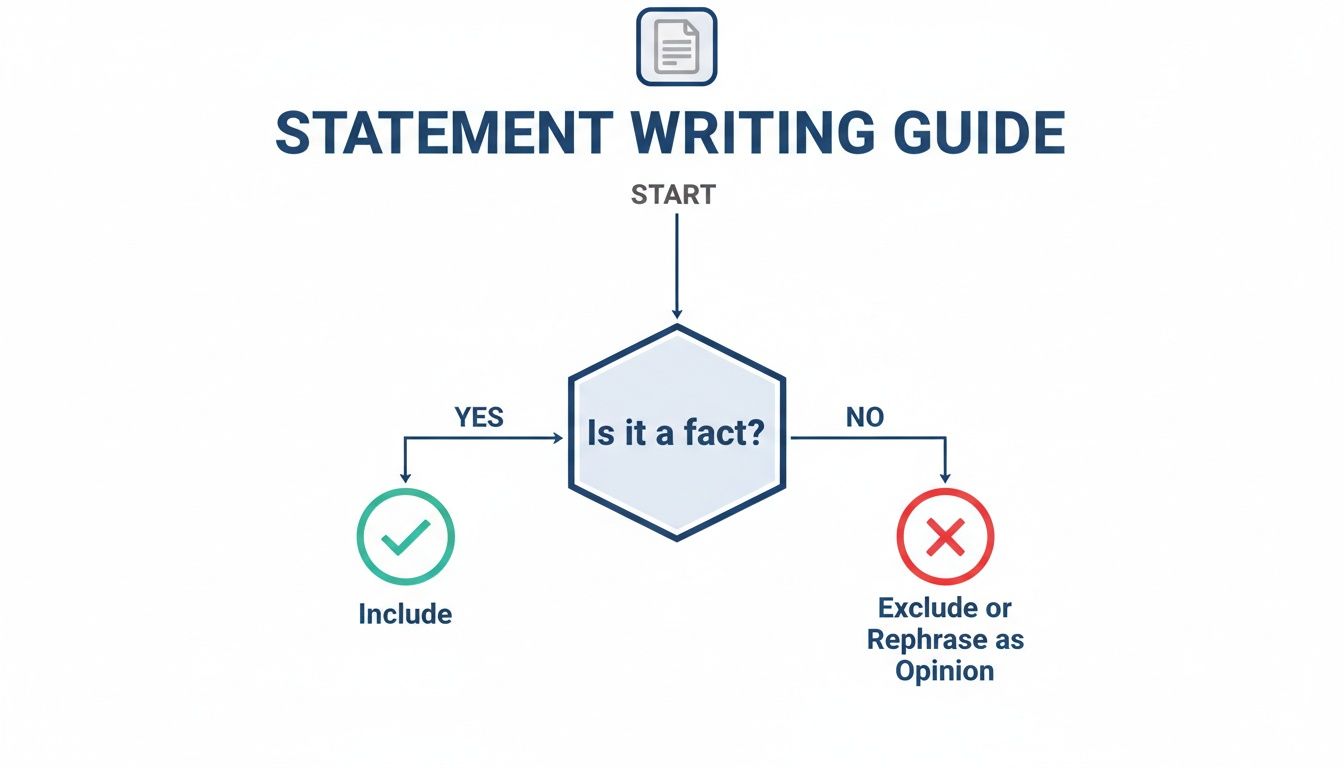
This is a great reminder that every single point in your declaration needs to be a verifiable fact, not just your personal opinion. That’s what gives the document its legal weight.
The Three Official Witnessing Methods
Since early 2024, the process for Commonwealth statutory declarations has had a much needed modern makeover to save everyone time and hassle. These changes were brought in to cut down the 9 million hours Australians collectively spent on the 3.8 million stat decs processed each year. If you’re interested, you can dive into the details of this legislative update and see how it helps both individuals and businesses.
So, what are your options? You’ve got three.
-
In Person Witnessing: This is the classic, traditional method. You physically take your unsigned declaration and your photo ID to an authorised witness. This could be anyone from a pharmacist or police officer to an accountant or a Justice of the Peace (JP). The Australian Government has a full list of authorised witnesses on their website.
-
Remote Witnessing via Video Link: This option lets you get your declaration witnessed over a video call on platforms like Teams or FaceTime. You still need to connect with an authorised witness, but you can do it from practically anywhere. It’s a real game changer if you’re in a remote area or have mobility issues.
-
Digital Execution (No Witness Needed): The newest and most streamlined option is to complete your statutory declaration digitally through myGov, using your Digital ID. This method automatically verifies who you are, which means no witness is required. For Commonwealth matters, it’s by far the fastest and easiest choice.
Getting Ready for Your Witnessing Appointment
Whether you’re meeting your witness face to face or online, a little bit of prep work will make the whole thing go smoothly.
First, and I can’t stress this enough, do not sign the document beforehand. The whole point is that the witness has to watch you sign it, either in person or on screen. If you show up with it already signed, they’ll have to reject it, and you’ll be printing out a fresh copy to start all over again.
Here’s what you should always have ready:
-
Your Unsigned Statutory Declaration: The complete document, printed and ready to go.
-
Valid Photo ID: A driver’s licence or passport is perfect. The witness’s main job is to confirm you are the person named in the document.
Remember, the witness isn’t there to proofread your statement or give you their opinion on it. Their role is strictly to confirm your identity, watch you sign, and then add their own signature to the document.
Navigating these official processes can feel draining. If you find yourself putting off important admin tasks because of the stress involved, remember that help is available. A free discovery call with Your Bro can help you develop strategies for follow through and clarity, turning overwhelm into confident action.
Common Mistakes and Why Honesty Is Critical
Mistakes happen. It’s part of life. But when you’re figuring out how to write statutory declarations, some slip ups can cause massive headaches, from having your document flat out rejected to landing you in serious legal trouble.
The best way to sidestep these issues is to know where the tripwires are from the start.
This isn’t just about ticking boxes on a form. It’s a powerful exercise in personal integrity. Taking the time to be precise and completely honest shows a commitment to your personal values, something we dive into more deeply in our article on the meaning of values and why they matter.
Dodging the Common Tripwires
Let’s walk through some of the classic mistakes that catch people out. They often feel like small details, but they can invalidate the whole document and send you right back to square one.
-
Signing Too Early: This is, by far, the biggest one I see. You must sign and date your stat dec in the physical (or virtual) presence of your authorised witness. If you sign it beforehand, it’s instantly invalid. No exceptions.
-
Using the Wrong Form: A Commonwealth stat dec isn’t the same as a Victorian one, and neither will work if you need one for NSW. Always double check which jurisdiction your document is for and download the correct, most up to date form from the official source.
-
Including Opinions Instead of Facts: A stat dec is no place for your feelings, assumptions, or what you think might have happened. Stick to what you know to be true. Don’t write, “He seemed angry.” Instead, describe what you saw: “His voice was raised, and he slammed the door.”
Getting these details right is a practical skill. A proper understanding of how to write statutory declarations will save you time and stress.
The Heavy Weight of Dishonesty
Now for the serious part. A statutory declaration is a legal document, and making a statement you know to be false is a criminal offence. I’m not saying this to scare you, but to drive home just how critical total honesty is.
Making a false statement is a major offence under section 11 of the Statutory Declarations Act 1959, carrying penalties that include hefty fines or even time in prison. This is precisely why the millions of Aussies who handle these documents every year have to do so with care. Even universities stress the document’s universal seriousness, as you can discover more about student obligations regarding statutory declarations here.
A statutory declaration is your word, bound by law. Its power comes from your commitment to the truth. Treating it with the seriousness it deserves is a direct reflection of your character and integrity.
The penalties are so severe because government agencies, courts, and other organisations rely on these documents being truthful. When you sign that paper, you’re not just telling a story; you are swearing that every single detail is accurate to the best of your knowledge. This is the most important part of learning how to write statutory declarations.
In this context, honesty isn’t just the best policy, it’s the only one.
Beyond the Form: Building Real World Confidence
Successfully knocking out a statutory declaration is a genuine win. Seriously. It proves you can navigate a clunky, formal system, sweat the small stuff, and see an important task through to the end. This is more than just paperwork. It’s a hands on demonstration of your own competence.
This is exactly the kind of administrative headache that can create a mountain of unnecessary stress. If you found this guide helpful for cutting through the confusion and taking back control, just imagine applying that same focused, step by step approach to other parts of your life that feel just as messy.
Building Momentum from Small Wins
Figuring out formal processes like this is one piece of a much larger puzzle. Here at Your Bro, we’re all about helping young men build the skills and the right mindset to handle whatever life throws at them with this same kind of confidence. Each small victory, like getting a stat dec right the first time, builds momentum for the next challenge.
That feeling of control you get from mastering a task like this can be applied everywhere, from sorting out your finances to chasing down your career goals. It’s all about swapping anxiety for a clear plan of action. Learning how to write statutory declaration documents is a skill, but the confidence it builds is a mindset. To dive deeper into building the internal tools to manage life’s pressures, check out our guide on how to improve your emotional intelligence.
The goal isn’t just to get the task done. It’s to prove to yourself that you have what it takes to handle complexity, follow the rules, and produce a result you can stand behind. That’s a powerful feeling.
If you’re ready to stop feeling steamrolled by life’s admin and start taking decisive action in every area, this is your next step. Book a free discovery call with me. We’ll map out how coaching can help you build the clarity and follow through you need to turn stressful obligations into opportunities for real growth. Let’s build on this win together.
Got Questions About Your Stat Dec?
When you’re drafting a legal document like this, a few questions are bound to pop up. It’s completely normal. To help you get your statutory declaration sorted with confidence, I’ve answered some of the most common queries I hear.
Can I Edit a Statutory Declaration After It’s Signed?
This is a hard no. Once your stat dec is signed and witnessed, think of it as being set in stone. Any scribbled changes, crossed out words, or last minute additions will render the whole thing invalid. It’s a security measure to protect the integrity of the document.
If you spot a mistake or remember something crucial you left out, you’ve got to start over with a fresh form. It’s a pain, I know, but it’s the only way. This is why a final, careful proofread right before you sign is absolutely essential.
How Do I Find an Authorised Witness Near Me?
Finding someone to witness your signature is usually easier than you think. Plenty of professionals you probably interact with regularly can do it, like pharmacists, police officers, and accountants.
If you specifically need a Justice of the Peace (JP), the best place to start is your state or territory’s online JP register. It’s a straightforward search.
-
For those in NSW, you can use the official NSW Justice of the Peace public register.
-
In Queensland, the government provides a handy JP search tool.
A quick Google search for “JP near me” is also a great trick. It often points you to signing desks at local libraries or community centres.
Is a Digital Stat Dec from myGov Accepted Everywhere?
A Commonwealth statutory declaration you complete digitally through myGov is legally sound for any Commonwealth government matter. It carries the exact same legal weight as one you’d sign on paper.
Here’s the catch, though: some state government bodies, private companies, or even specific courts might have their own old school rules and prefer a physical form. It’s always worth a quick phone call or email to the organisation you’re sending it to, just to confirm they’re happy with the digital myGov version. Better to check first than have it rejected later.
What if I Don’t Have a Fixed Address or Occupation?
The golden rule here is honesty. The whole point of a statutory declaration is to tell the truth. If you don’t have a permanent home, you can simply write “of no fixed place of abode” or provide a reliable care of address where you can be reached.
It’s the same for your occupation. Just state your current situation as it is. That might be “unemployed,” “student,” “retired,” or “home duties.” The witness isn’t there to judge your life circumstances; their job is simply to confirm your identity and watch you sign the document.
Navigating these processes is a skill, but if the stress of adulting admin feels overwhelming, you don’t have to handle it alone. At Your Bro, we help you build the clarity and confidence to tackle life’s challenges head on. Book a free, no obligation discovery call to see how coaching can work for you.