Googling “life coach in Australia” can feel a bit weird. The term gets thrown around a lot, and it’s easy to be sceptical. You see a lot of hype, vague promises, and guys who sound more like gurus than actual coaches.
If you’re feeling a bit lost or stuck but the whole “life coach” thing makes you cringe, that’s normal. Most of it isn’t aimed at you.
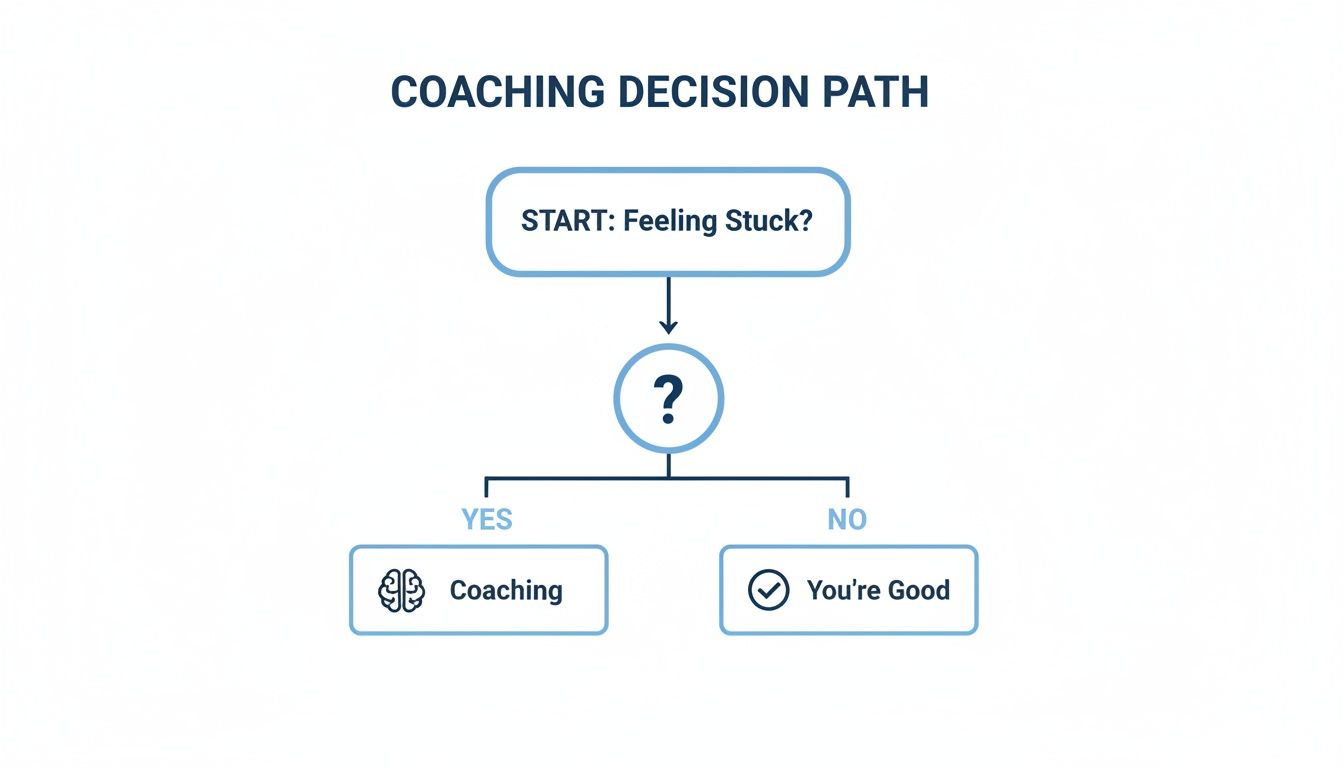
The truth is, not all coaching is the same. Good coaching isn’t about motivational quotes or magic fixes. It’s about getting practical, forward-focused support from someone who can help you get out of your own way. This page is here to help you figure out if it’s the right move for you, without any of the usual sales pressure.
What Does a Life Coach in Australia Actually Do?
Let’s cut through the jargon. A life coach is basically a thinking partner and an accountability source. Their job is to help you get clear on what you actually want and then build a simple, realistic plan to get there.
Think of it like having a personal trainer for your direction in life. They provide a structured, private space for you to sort through your thoughts and make decisions. A good Australian life coach helps you move from feeling stuck to taking consistent, meaningful action. It’s a partnership focused on building momentum.
This usually breaks down into a few key things:
Clarity: Cutting through the mental noise to figure out what you genuinely want. A new career path? Better habits? More confidence? A coach helps you nail it down.
Direction: Once you know what you want, they help you build a simple, step-by-step plan. No fluff, just practical moves.
Habits: Pinpointing the habits that are holding you back and helping you build new ones that actually stick.
Accountability: This is a big one. They’re the person who checks in and asks, “Did you do what you said you’d do?” That external support can make a huge difference.
It’s not about them giving you the answers. It’s about them asking the right questions so you can find your own. The goal is to build your ability to make better decisions for yourself, long after the coaching is done. It is forward-focused support, plain and simple.
How Is Life Coaching Different From Therapy?
This is a really important point. While both can be helpful, they do completely different jobs.
Therapy is a clinical practice. It often focuses on healing and processing past events, trauma, or managing mental health conditions like ongoing anxiety and depression. A therapist is a qualified mental health professional who helps you understand your past to improve your present wellbeing.
Life coaching is all about looking forward. It starts with where you are right now and focuses on where you want to go. A life coach for young men in Australia is less concerned with digging into your childhood and more focused on helping you build your future. It is not a substitute for therapy. Any decent coach will refer you to a therapist if your needs fall outside their scope of practice.
Who Life Coaching Is (and Isn’t) For
Alright, let’s be honest. Life coaching isn’t a magic pill, and it’s not for everyone. It’s important to be straight up about this, because the only thing that matters is getting the right kind of support for what you’re actually going through.
Coaching works best for a guy who’s generally doing okay but just feels stuck. Maybe you’re spinning your wheels, feeling a bit lost, or you know you’re capable of more but can’t figure out the next step. You need to be ready to take action, accept some honest feedback, and actually do the work between sessions.
Think of it this way: your coach can help you with the game plan, but you’re the one who has to get on the field and run the plays.
If you’re fundamentally okay but just can’t seem to get out of your own way, coaching is a solid option.
When Therapy Is the Right Call
Now for the other side of the coin. If you’re wrestling with deep-seated depression, serious anxiety, unresolved trauma, or addiction, a life coach in Australia is not the right person to talk to. These are serious mental health challenges that need the expertise of a qualified and registered therapist or psychologist. Full stop.
Choosing therapy isn’t a sign of weakness; it’s a sign of strength and self-awareness. It means you’re taking your mental health seriously and getting the proper clinical support you need. Any decent coach will respect this boundary and will refer you to a therapist if they see your needs are outside their scope. Your wellbeing comes first, always.
Common Reasons Young Men in Australia Seek a Life Coach
If you’ve landed here, chances are something just feels a bit off. That’s completely normal. Feeling stuck or unsure is a huge part of being in your twenties, but nobody really gives you a manual for it.
Most young men who look for a life coach in Australia aren’t broken. They’re just trying to figure things out in a world that can feel incredibly noisy and overwhelming. It’s not about needing to be fixed. It’s about wanting some guidance and a solid sounding board. The reasons are usually pretty simple and relatable.
Feeling stuck or directionless. This is the big one. That sense of spinning your wheels without getting any real traction. You know you’re capable of more, but the “what” and “how” feel blurry.
Struggling with discipline or consistency. You know what you should be doing, like hitting the gym or working on a side project. The problem isn’t the knowing; it’s the doing.
Overuse of phones/social media. It’s easy to lose hours every day to digital noise, leaving you feeling drained and like you’ve achieved nothing.
Career uncertainty. The old path of getting one job for 40 years is dead. This creates a lot of pressure to find the “perfect” career or some deep sense of purpose.
Confidence and identity issues. Your twenties are about figuring out who you are. A lack of confidence can hold you back from trying new things or going after what you want.
Lack of guidance or mentorship. Sometimes you just need an older, more experienced voice to give you some perspective.
What to Look for in a Life Coach in Australia
So, you’ve decided coaching might be the right move. Now for the tricky part: finding the right person. The coaching industry has exploded, which means there are a lot of people calling themselves a life coach in Australia. Here’s a simple checklist to help you find someone who actually gets you.
Experience vs credentials. Formal qualifications can be a good sign, but they don’t tell the whole story. The best guidance often comes from people who have real, lived experience with the same stuff you’re trying to figure out. Lived experience can bring a level of understanding you can’t learn from a textbook.
Coaching style. Some coaches are direct and will call you on your excuses. Others are gentler. Neither is right or wrong, but one will work better for you. You need to find a style you connect with.
Age/life-stage alignment. It’s hard to get advice on navigating your twenties from someone who hasn’t been there for decades. An Australian life coach who’s a bit older but not ancient can make a world of difference. They get the specific pressures you’re under.
Communication style. Their communication should be clear, simple, and practical. Do they talk like a real person or a corporate robot reading from a script?
Whether it feels safe and judgement-free. This is non-negotiable. You have to feel like you can be completely honest without being judged. During your first chat, ask yourself: Does it feel safe to be honest here? If not, they’re not the right person.
Australian context and relatability. Finding a coach who understands the local context matters. They’ll get the nuances of career paths, education, and the general culture here in Australia, which makes their guidance much more relevant.
Why Some Men Prefer Mentoring Over Traditional Life Coaching
Let’s be honest, the term “life coach” can feel a bit off. For a lot of young guys, it sounds a bit soft. This is where the difference between a traditional life coach and a mentor becomes really important.
A typical life coach in Australia is trained to be a neutral guide. They use specific questioning techniques to help you find your own answers. It’s an effective method for some people, but it’s not for everyone.
Mentoring is different. A mentor has walked a similar path and isn’t afraid to share what they’ve learned. Think of it as the difference between a facilitator and a straight-talking older brother. A mentor will still ask questions, but they’ll also give you direct, real-world advice based on their own mistakes and wins. For many young guys, this just feels more natural and practical.
This older-brother style of guidance often works better because it cuts through the noise. It’s not about finding some perfect answer buried deep inside you. It’s about getting an honest perspective from someone who’s already been through similar challenges and figured it out. It’s accountability without judgement.
Life Coaching for Young Men at Your Bro
At Your Bro, we don’t do hype. Our approach is grounded, practical guidance designed for young men in Australia (18–25) who feel stuck, overwhelmed, or directionless.
I work with guys one-on-one. The sessions are straightforward and focused on getting you results. No BS, just honest conversation aimed at building clarity, creating a solid plan, and holding you accountable.
What makes Your Bro different is the older-brother style of mentorship. I’m not a guru. I’m a guy in my early 30s who spent a lot of my twenties feeling exactly how you might be feeling now. I had to build discipline and direction from the ground up through lived experience. My approach is based on that.
We keep things simple and focus on what works:
Real-world Perspective: We talk about lived experience and hard-won lessons, not just textbook theories.
Action Over Talk: The goal is to help you build momentum and see real progress.
No Judgement, Ever: This is a safe space for you to be completely honest about what’s going on.
What you can expect is a calm, supportive partnership. We’ll work together to help you cut through the noise, make clear decisions, and take consistent action. If you’re looking for a life coach for young men in Australia who takes a no-nonsense mentoring approach, this might be for you.
Learn more about coaching with Your Bro.
Is Life Coaching Worth It?
So, is it worth the money?
The honest answer is: it depends entirely on you.
Life coaching isn’t a passive experience. A coach is a guide and an accountability partner, but they can’t do the work for you. The results you get are directly tied to the effort and honesty you bring to the table. If you show up ready to do the work, challenge your own excuses, and follow through between sessions, then yes, it can be a fantastic investment.
The real value of hiring an Australian life coach is in finding the right person at the right time.
Timing is key: Are you genuinely ready to make changes right now?
The right fit matters: Does the coach’s style and experience connect with you?
It’s a partnership: The coach provides the framework, but you’re the one who has to build with it.
Ultimately, you create the results. A great coach just helps you find the clearest path and holds you to account along the way.
If you’ve read this far and it resonates, you’re probably in the right headspace to get something out of it. There’s no pressure here. Feel free to have a look around the site.
Let’s be real for a moment. Being told to “just find your passion” is some of the most frustrating, unhelpful advice you can get. It makes it sound like your purpose is a single, mythical treasure buried somewhere, and if you just dig hard enough, you’ll have a life-changing epiphany.
For you, and for most of us, life just doesn’t work that way. It’s not a lightning strike of inspiration. This pressure to find the one thing often leaves you feeling stuck, guilty, or even broken because nothing seems to ignite that magical spark everyone talks about.
The problem isn’t you; it’s the whole premise. This guide is here to give you a practical, actionable plan that puts you back in control.
From Myth to Your Action Plan
Here’s the truth I’ve learned from years of coaching people through this exact struggle: Passions aren’t found, they’re built. They grow from a flicker of curiosity you already have, nurtured with a bit of effort and real-world experience.
It’s less of a sudden discovery and more of a slow burn that you develop over time.
So, let’s ditch the frustrating spiritual quest. Your real goal is much more practical and, honestly, much more achievable: to build a life that actually aligns with your values, strengths, and curiosities. When you frame it like that, it stops being this overwhelming search and becomes a manageable project you can start today.
“The moment you start viewing every interest through the lens of income, it becomes another task, another job, another performance. Passion doesn’t thrive under pressure, it needs breathing room.”
This shift in mindset is the key to your success. It gives you permission to explore, to play, and even to “fail” without the crushing weight of expectation that every interest needs to become a career. This creates the space you need for experimentation, which is where the real magic happens.
Before we dive into the ‘how’, let’s lock in this mindset shift. It’s the foundation that will make everything else possible for you.
The Mindset Shift That Unlocks Your Potential
The Old Way (Keeps You Stuck)
Your New Actionable Approach
Waiting for a lightning bolt of inspiration.
Actively following small sparks of your curiosity.
Searching for one perfect, lifelong “calling”.
Building multiple interests and skills over time.
Believing passion should feel easy and effortless.
Understanding that passion grows through your effort.
Fearing you’ll pick the “wrong” thing.
Running small experiments to see what sticks for you.
Needing to have it all figured out before you start.
Taking small, messy actions to gather real data.
Seeing the difference? One approach keeps you stuck in your head, while the other gets you out into the world, learning and growing. This is about empowering you to take action.
A Practical Framework for Your Discovery
To make this journey less abstract and more concrete for you, I’ve broken it down into a simple, three-part framework. This isn’t about vague encouragement; it’s an actionable path you can actually walk.
Here’s your game plan:
Look Inward (Self-Discovery): You’ll start by gathering data on the most important subject: you. This means getting brutally honest about where your energy goes, doing a proper audit of your skills (the ones you enjoy using!), and pinpointing the kinds of problems you genuinely get a kick out of solving.
Look Outward (Exploration): Next, you’ll take those internal insights and put them to the test in the real world. I’ll show you how to run tiny, low-risk “micro-experiments” to explore your interests without having to quit your job or blow up your life.
Take Action (Integration): Finally, you’ll connect the dots. This is where you learn how to turn a promising spark into something tangible, whether that’s a new hobby that lights you up, a side project, or even the beginnings of a career pivot that feels right for you.
This structured approach takes the guesswork out of the equation. It’s not about waiting around for inspiration to strike; it’s about giving you the tools to proactively build a more engaging and purposeful life, one intentional step at a time.
Doing a Personal Self-Audit to Uncover What Really Drives You
Before you can build a life that feels right, you first need to understand your own operating system. This isn’t about some woo-woo navel-gazing; it’s about gathering real, practical data on yourself so you can make smarter decisions.
Just like a business audits its finances to see where the money is really going, you need to audit your personal landscape. Where do your time, energy, and focus actually go each day? Answering this will give you the clarity you’ve been looking for.
This process moves you past the vague question of “what’s my passion?” and onto much more solid ground. You’re looking for patterns in what genuinely lights you up versus what leaves you feeling completely drained. Think of it as laying the foundation of self-awareness you’ll need before you start looking at career paths or new hobbies.
You can’t draw a map to where you’re going if you don’t even know where you are. This self-audit is your “You Are Here” pin on that map.
Uncover Clues with Targeted Journaling
Just writing in a journal is fine, but to get results, you need to be more strategic. You’re not just rambling about your day; you’re hunting for specific clues about what makes you tick. The goal is to get past the surface-level answers and discover what truly motivates you.
Instead of asking yourself massive, overwhelming questions, try these more pointed prompts. Just spend 10-15 minutes on one or two of them. Don’t censor yourself; the answers are for your eyes only, and they hold the key.
What kind of problems do I actually enjoy solving? Think beyond your job. Do you get a kick out of organising a messy garage, figuring out a complex video game strategy, or helping a mate untangle a personal drama? The answer reveals how your mind works.
What topics do I find myself reading about or watching videos on in my spare time, with no real goal in mind? This points directly to your natural, unfiltered curiosities.
When did I last lose track of time? What was I doing? This is a huge sign you were in a state of ‘flow,’ where the challenge you were facing was perfectly matched to your skills.
What do my friends or family always ask for my help with? This often points to skills you take for granted in yourself, but that others clearly see and value in you.
This isn’t a one-and-done thing. Revisit these questions weekly to see what new patterns emerge. You’re building a library of personal data that will start pointing you toward genuinely fulfilling activities.
Run a Personal Energy Audit
Passion isn’t just an idea in your head; it’s a feeling. It’s the energy you get from an activity. To find it, you need to become a detective of your own energy levels. A simple Energy Audit is a seriously powerful tool that will give you instant clarity.
For one week, track your main activities each day and give them a quick rating based on how they made you feel. You can use a notebook or a basic spreadsheet with three columns:
Activity
Time Spent
Energy Level (After)
Team meeting about budgets
1 hour
Drained (-2)
Helping a new team member
30 mins
Energised (+1)
Scrolling Instagram
45 mins
Numb (0)
Brainstorming a new project
1 hour
Excited (+2)
After a week, you’ll have a clear, data-driven picture of what gives you energy and what sucks it away. You might be shocked to find that a small, overlooked part of your day is actually the most rewarding bit.
Key Takeaway: Your energy is your most valuable currency in this search. By tracking where it goes, you can consciously start investing more of it in the things that fill your tank, not empty it.
This audit gives you concrete evidence, cutting through the confusion of what you think you should enjoy versus what you actually do.
Map Your Skills and Curiosities
The final piece of your self-audit is to create a simple inventory of your skills. This has nothing to do with polishing your resume; it’s about getting an honest look at what you can do and where you want to grow, helping you connect your interests to real-world actions.
Grab a piece of paper and divide it into two columns:
Skills I Have & Enjoy Using: List everything you’re good at that you genuinely like doing. This could be anything from ‘explaining complex ideas simply,’ to ‘building detailed spreadsheets,’ or ‘making people feel comfortable at a party.’ Be honest with yourself.
Skills I Want to Develop: What are you curious about? This could be anything. Maybe it’s ‘learning basic graphic design,’‘getting better at public speaking,’ or ‘understanding how to code.’
Looking at these two lists side-by-side will spark powerful connections. For example, if you enjoy explaining complex ideas and you’re curious about graphic design, perhaps creating educational infographics is a path worth exploring for you. This simple map turns your abstract interests into potential micro-experiments you can actually test.
If you’re a young bloke in Sydney, scrolling TikTok late at night and feeling a bit directionless, know that you’re far from alone. The Australia digital health coaching market, which includes services helping people find their purpose, hit USD 197.4 million in revenue in 2024. That number is projected to more than double to USD 409.6 million by 2030, driven by a massive demand from young Aussies just like you, wrestling with a lack of purpose in a world full of noise. It just shows how many people are out there actively looking for guidance. You can find out more about the rise of digital coaching in Australia.
Right, so all that soul-searching is great, but it’s pretty useless if it doesn’t lead to you actually doing something. The insights you’ve pulled together from your self-audit? They’re your starting line, not the finish. Now you get to move from thinking to doing. It’s time to take what you’ve uncovered and put it to the test in the real world.
Now, hold on. Forget any dramatic ideas about quitting your job tomorrow to become a potter or packing up and moving to Italy. That’s the kind of high-stakes pressure that leads straight to paralysis. Instead, you’re going to use what I call ‘micro-experiments’. These are small, low-risk, and almost always low-cost ways for you to take your curiosities for a test drive.
This whole approach is about one thing: gathering data. Every experiment, whether it feels like a “win” or a “flop,” is just information for you. It completely removes the fear of getting it wrong and reframes the entire process as pure exploration. You’re not committing to a new life path; you’re just trying something out for an afternoon.
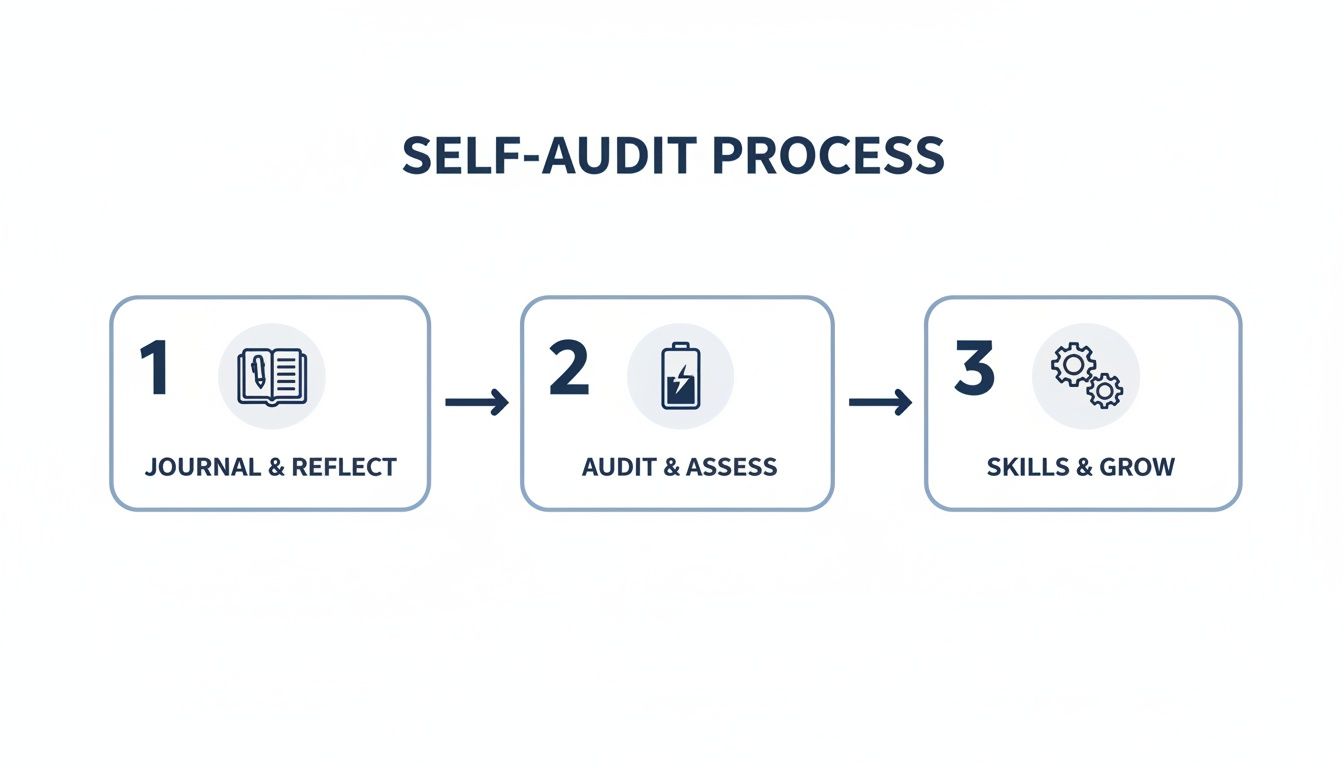
This is all about building on the foundation you’ve already laid. The simple process of journaling, auditing your energy, and analysing your skills gives you the raw material you need to design your first experiments.
This three-step flow: “Journal, Audit, and Analyse Skills” gives you everything you need to create targeted micro-experiments that actually line up with who you are.
Designing Your First Experiment
A solid micro-experiment for you needs to be specific, time-bound, and low-stakes. The goal is for you to get a genuine feel for an activity without needing a massive commitment of time, money, or ego. The trick is to take a big, vague interest and shrink it down to its smallest possible, actionable step.
Let’s look at how this works in practice. Notice how you can turn a fuzzy idea into a concrete, manageable task.
Your Vague Interest: “I think I might like coding.”
Your Micro-Experiment: Complete a free, two-hour ‘Introduction to Python’ tutorial on YouTube this Saturday afternoon.
Your Vague Interest: “Maybe digital marketing is for me.”
Your Micro-Experiment: Offer to run the social media for a local charity or a mate’s small business for one month, committing to just three posts a week.
Your Vague Interest: “I’ve always been curious about woodworking.”
Your Micro-Experiment: Sign up for a one-day beginner’s workshop at a local community centre to build a simple birdhouse.
Each of these experiments delivers a real, tangible experience. Trust me, you’ll learn far more from two hours of actually writing code than you will from 20 hours of watching videos about what it’s like to be a coder.
The Power of Data Collection
Think of yourself as a scientist studying a fascinating subject: you. The point of each micro-experiment isn’t to decide if this is your “one true passion” for life. It’s just to collect data that will guide your next step.
After you finish an experiment, give yourself just 15 minutes to reflect. Don’t overthink it. Just jot down some quick notes to these questions.
Questions to Ask Yourself After Your Experiment:
Energy Check: Did this activity leave me feeling more energised or more drained than when I started?
Flow State: Did I lose track of time at any point, or was I constantly watching the clock?
Problem-Solving: What specific bits of the activity did I enjoy most? Was it the creative brainstorming, the technical troubleshooting, or seeing the final result?
Curiosity Level: Am I more curious to learn more about this now, or has my interest kind of faded?
This process turns your vague feelings into usable insights. You might discover you loved the logical puzzle of coding but hated staring at a screen for hours. That’s a crucial piece of data for you! It tells you to look for other things that involve similar problem-solving skills but in a totally different environment.
You’re not looking for a perfect score on the first try. You’re looking for clues. A “failed” experiment that shows you what you don’t like is just as valuable as one that confirms an interest.
This approach keeps you moving forward, stopping that “analysis paralysis” that comes from trying to map out the perfect path from your armchair.
Creating a System for Your Exploration
To keep your momentum going, it really helps to build a simple system for your experiments. Don’t just do one and stop. Aim to run one small experiment every couple of weeks. This builds a powerful habit of curiosity and action that will lead you to a breakthrough.
Here’s a simple framework to organise your thoughts and keep you on track.
My Interest Area
My Micro-Experiment Idea
My Time/Cost Commitment
What I Hope to Learn About Myself
Graphic Design
Design a simple logo for a fictional brand using a free tool like Canva.
3 hours / $0
Do I enjoy the creative process of visual branding?
Writing
Write a 500-word blog post on a topic from my self-audit and post it on a free platform.
4 hours / $0
Does the process of structuring my thoughts and writing them down feel rewarding to me?
Public Speaking
Join a local Toastmasters club as a guest for one meeting.
2 hours / ~$20 guest fee
Can I handle the nerves, and do I enjoy the challenge of speaking to a group?
This structure makes your exploration intentional. It turns a chaotic search into a clear project with measurable steps and learning goals. Over time, you’ll build a rich portfolio of experiences that paint a clear picture of what truly engages you.
This is how you find your passion, not by waiting for a lightning bolt, but by actively building a life aligned with your curiosity, one small experiment at a time.
Overcoming the Fear and Paralysis Holding You Back
You’ve done the hard yards on the internal work. You’ve even got a few micro-experiments lined up, ready to go. Then, it hits you: a brick wall of fear.
It’s that little voice whispering, “What if I fail?” or “What will people think?” This is exactly where your journey to find your passion can grind to a screeching halt.
Let me tell you, this paralysis is completely normal. Stepping outside your comfort zone is bloody terrifying. The goal isn’t to get rid of the fear. Your real mission is to learn how to act despite it.
You need to treat these mental roadblocks just like any other problem, by breaking them down into smaller, more manageable pieces. And it all starts with getting brutally honest about what’s really holding you back.
Name Your Fears to Tame Them
A vague, undefined fear feels huge and insurmountable. But when you drag it kicking and screaming into the light, it often shrinks. This is the core idea behind a powerful technique called ‘fear-setting’. Instead of setting goals, you map out your fears in detail to regain control.
Grab a piece of paper and draw three columns. This simple exercise can be an absolute game-changer for you.
Define: What’s the absolute worst-case scenario if you try this new thing and it doesn’t work out? Get specific. Don’t just write “I’ll fail.” Write “I’ll spend $50 on a workshop and feel like I wasted a Saturday.”
Prevent: What small, practical steps could you take to stop that worst-case from happening, or at least reduce the odds? For the workshop example, you could read a few reviews or watch some free videos on the topic first to see if you’re genuinely interested.
Repair: If the worst does happen, what could you do to get back to where you are now? In this case, you’d be out $50 and a few hours, but you’d have gained solid data about what you don’t enjoy. The “damage” is tiny.
When you see it laid out like this, you start to realise most of your fears are temporary and reversible. It’s rarely the catastrophe your mind makes it out to be.
Breaking Free from Outside Expectations
Another huge source of paralysis is the weight of other people’s expectations. You worry about what your parents, partners, or mates will think if you stray from the “sensible” path. This pressure can be suffocating, making you second-guess your own gut feelings.
It’s absolutely critical for you to learn how to separate their definition of success from your own. Whose life are you actually living? Sometimes, your deepest fears aren’t about your own failure, but about disappointing others.
This journey is yours and yours alone. Giving yourself permission to pursue something just for you, not for status, not for a paycheque, but for the pure joy of it, is one of the most freeing things you can do.
This might mean having some tough conversations, or it might just mean quietly giving yourself permission to explore your interests without needing anyone else’s approval. Your future self will thank you for it.
Using Action to Defeat Analysis Paralysis
Sometimes the roadblock isn’t fear, but “analysis paralysis”, endlessly researching, planning, and thinking without ever actually doing anything. You get stuck trying to find the perfect first step. The best way for you to break this cycle is with ridiculously small actions.
Enter the ‘five-minute rule’.
Whatever it is you’re putting off, just commit to doing it for five minutes. That’s it. If you want to learn guitar, pick it up and watch one beginner tutorial for five minutes. Curious about writing? Open a document and just type for five minutes.
Often, starting is the hardest part. This tiny commitment tricks your brain into bypassing that initial resistance. More often than not, you’ll find you keep going long after the five minutes are up, building momentum effortlessly.
This principle of using discipline to build momentum is incredibly powerful. For instance, look at the rise of digital fitness coaching in Australia. The market soared to USD 242.42 million in 2024 and is projected to hit USD 437.88 million by 2033. This growth is partly driven by young men realising that the discipline gained from fitness gives them the mental toughness to pursue other passions.
Turning a Spark of Interest into a Tangible Plan
Alright, you’ve done a few micro-experiments and felt that genuine flicker of excitement. Don’t underestimate this moment. It’s a huge step, moving you from just being curious to knowing there’s something real there worth digging into.
But what now? This is the exact point where so many people get stuck. That tiny flame of interest feels great, but they have no idea how to stop it from fizzling out.
The trick is to shift gears from random exploration to intentional planning. It’s about building a solid bridge between a fleeting interest and an actual, tangible goal you can work towards. This isn’t about making a rash, life-changing decision overnight. It’s a methodical process of connecting the dots from your self-audit and experiments to create a realistic plan that actually fits your life.
Map Your Potential Pathways
Before you can build a plan, you need a destination. A newfound passion doesn’t automatically have to become your next career. You need to be brutally honest with yourself about what role you genuinely want this to play in your life.
Generally, you’ve got three main pathways to think about:
A Fulfilling Hobby: This is all about your pure enjoyment, with zero pressure to make a cent. It’s about carving out time for something that recharges you, whether that’s weekend woodworking, finally learning the guitar, or mastering landscape photography.
A Side Hustle: Here, you start exploring ways to earn a bit of income from your interest without quitting your day job. This could be anything from selling handmade goods online to offering freelance writing services or coaching the local footy team on weekends.
A New Career Trajectory: This is the big one, a deliberate pivot in your professional life. It requires the most research and planning, as you’ll need to understand the industry, what qualifications you might need, and what the job prospects really look like.
Getting clear on which path feels right for you right now is absolutely critical. It defines the scale of your plan and keeps your expectations in check, which stops a joyful hobby from being crushed under the weight of financial pressure.
Don’t fall into the trap of thinking every passion has to become a paycheque. Sometimes, the most valuable thing an interest gives you is a sense of joy and purpose that has nothing to do with your work life.
Build a Realistic Action Plan
Once you’ve got a potential pathway in mind, it’s time to break it down into small, achievable steps. A vague goal like “become a graphic designer” is completely overwhelming and just leads to paralysis. A proper, structured plan, on the other hand, builds the momentum you need.
Start by working backwards. If you want to end up at your chosen destination, what skills, knowledge, or resources would you need to get there?
Example Scenario: Your Interest in Podcasting
Let’s say your experiments with recording and editing audio felt amazing, and you’re thinking about turning it into a side hustle.
Define Your Next Milestone: Launch the first three episodes of your podcast. That’s specific and measurable.
Identify Necessary Skills: You’ll need to learn basic audio editing, how to structure an episode, and some marketing fundamentals to get it out there.
List Your Actionable Steps:
Research and buy a decent entry-level microphone.
Complete a 4-hour online course on the editing software Audacity.
Brainstorm and outline your first five episode ideas.
Record and edit episode one by the end of the month.
See how that works? A step-by-step approach turns a massive ambition into a simple to-do list, making your progress feel inevitable instead of impossible.
The Value of Accountability and Guidance
Making a plan is one thing; actually sticking to it when life gets in the way is another beast entirely. This is where accountability becomes a game-changer for your success.
Sharing your goals with a mate you trust, joining a community of people on a similar path, or working with a coach can give you the structure and support you need to stay on track.
There’s a reason the life coaching industry in Australia is booming. Oceania alone clocked $195 million in coaching revenue in 2023, which is part of a global $5.34 billion industry. Research consistently shows that coaching delivers a huge return on investment and can boost self-esteem by as much as 80% giving people like you the confidence to actually chase their goals. It just goes to show how valuable a bit of external guidance can be when you’re turning a spark into a real plan.
If you feel you need that external push and a solid framework to hold you accountable, exploring professional life coaching services can provide the personalised support to turn your plan into reality.
Got Questions About Finding Your Passion?
As you start making progress, it’s completely normal for a few nagging questions to pop up. These are the usual sticking points that can throw a spanner in the works just when you feel like you’re getting somewhere. Let’s tackle them head-on so you can keep moving forward.
Think of this as your no-nonsense guide to getting unstuck. The goal here isn’t just to throw information at you, but to help you navigate these mental roadblocks with confidence.
What if I Have Too Many Interests?
First off, this is a quality problem to have. It beats feeling like nothing excites you. The trick is to shift your mindset from “I have to pick just one” to “Which one will I explore first?”
Don’t let the sheer number of options freeze you in your tracks.
Find the Theme: Lay out all your interests. Is there a common thread tying them together? Maybe your interest in graphic design, woodworking, and creative writing all point to a deeper desire you have to build something from nothing.
Run an ‘Energy’ Check: Go back to your energy audit. Which of these interests gives you the biggest jolt of genuine excitement right now? Your gut knows. Trust it and start there. The others aren’t going anywhere.
Try a ‘Mash-Up’: Sometimes, your real magic happens where two interests collide. If you love fitness and writing, you could start a killer fitness blog. If you’re into tech and music, you could get lost in digital audio production.
Your aim isn’t to find the ‘one’ perfect thing for life. It’s simply to start with what’s pulling you in the most today. This isn’t a lifelong contract; it’s just your next step.
How Long Does This Whole Process Take?
This is probably the most common question I get, and the honest answer is there’s no set timeline for you. It’s different for everyone. Finding what truly clicks with who you are is a marathon, not a sprint. Some people have a lightbulb moment in a few months. For others, it’s a slow burn that unfolds over years.
Trying to rush the process is the fastest way to get frustrated and quit. Your only job is to stay curious, keep running small experiments, and pay attention to what the results are telling you.
Forget the deadline and focus on consistent, small actions instead. The journey of self-discovery is where you’ll find most of the good stuff, anyway. If you’re looking for more ideas on how to keep your momentum going, check out some of the other articles on our blog.
What if My Passion Doesn’t Become a Career?
This is a big one. You might get tripped up by the myth that every single passion needs to be monetised. Not only is that untrue, but it can also be incredibly destructive to your motivation.
Seriously, putting financial pressure on a new interest is the quickest way to suck all the joy out of it for yourself.
Protect Your Hobby: It is 100% okay to have a passion that is just for you. Its only job might be to bring you joy, slash your stress levels, and make your life richer. That’s more than enough of a return on your time.
Redefine ‘Success’ for Yourself: Success doesn’t always come with a paycheque. It could be the feeling of finishing a personal project, mastering a new skill, or simply having an outlet that recharges you after a tough week.
Sometimes, the most valuable role a passion can play is to make the rest of your life better, not to replace your job. Give your interests room to breathe without the crushing weight of expectation.
At Your Bro, we believe that finding your path is about taking consistent, intentional action, not waiting around for a magical answer. If you’re ready to move past the questions and start building a concrete plan with real accountability, a good first step is our free, no-BS discovery call. Find out more and book your spot at https://yourbro.com.au.
To provide the best experiences, we use technologies like cookies to store and/or access device information. Consenting to these technologies will allow us to process data such as browsing behavior or unique IDs on this site. Not consenting or withdrawing consent, may adversely affect certain features and functions.
Functional
Always active
The technical storage or access is strictly necessary for the legitimate purpose of enabling the use of a specific service explicitly requested by the subscriber or user, or for the sole purpose of carrying out the transmission of a communication over an electronic communications network.
Preferences
The technical storage or access is necessary for the legitimate purpose of storing preferences that are not requested by the subscriber or user.
Statistics
The technical storage or access that is used exclusively for statistical purposes.The technical storage or access that is used exclusively for anonymous statistical purposes. Without a subpoena, voluntary compliance on the part of your Internet Service Provider, or additional records from a third party, information stored or retrieved for this purpose alone cannot usually be used to identify you.
Marketing
The technical storage or access is required to create user profiles to send advertising, or to track the user on a website or across several websites for similar marketing purposes.