When we talk about the meaning of values, it comes down to a simple idea: they are the things that matter most to you. These aren’t rigid rules someone else forces on you, but your own internal compass for navigating life. Think of them as your personal guide for what is right or wrong, important or unimportant.
In short, your values are your personal ‘why’ behind what you do, especially when no one is looking. They are the bedrock of who you are.
What Are Values, Really?
Have you ever had a gut feeling about a decision that you just knew was right, even if you couldn’t logically explain it? That feeling is often your values kicking into gear. Put simply, personal values are the beliefs you hold as most important in guiding your life.
They’re not a strict set of rules dictating every single move. Instead, they act like a compass, not a rulebook, always pointing you toward your own ‘true north’. This internal compass influences everything, from massive life choices like changing careers to the tiny, everyday actions that make up your day. When you understand your values, you gain incredible clarity on what truly drives you.
Your Personal Compass For Life
At their core, values are the fundamental beliefs that help you figure out what’s right and wrong, or good and bad, for you. They’re the stable foundation you build your identity and make your choices on.
For example, if you deeply value security, you’ll likely prioritise a stable job with a solid retirement plan. But if you value adventure, you might choose to travel the world or start your own business, even if it feels less secure. Neither is right or wrong, they’re just different compasses pointing in different directions.
This is why getting to grips with your values is such a critical first step in figuring out your direction. They’re deeply connected to the bigger picture, which is why so many people exploring their values also find themselves wondering about the purpose and meaning of life and how it all fits together.
The Foundation For Decision-Making
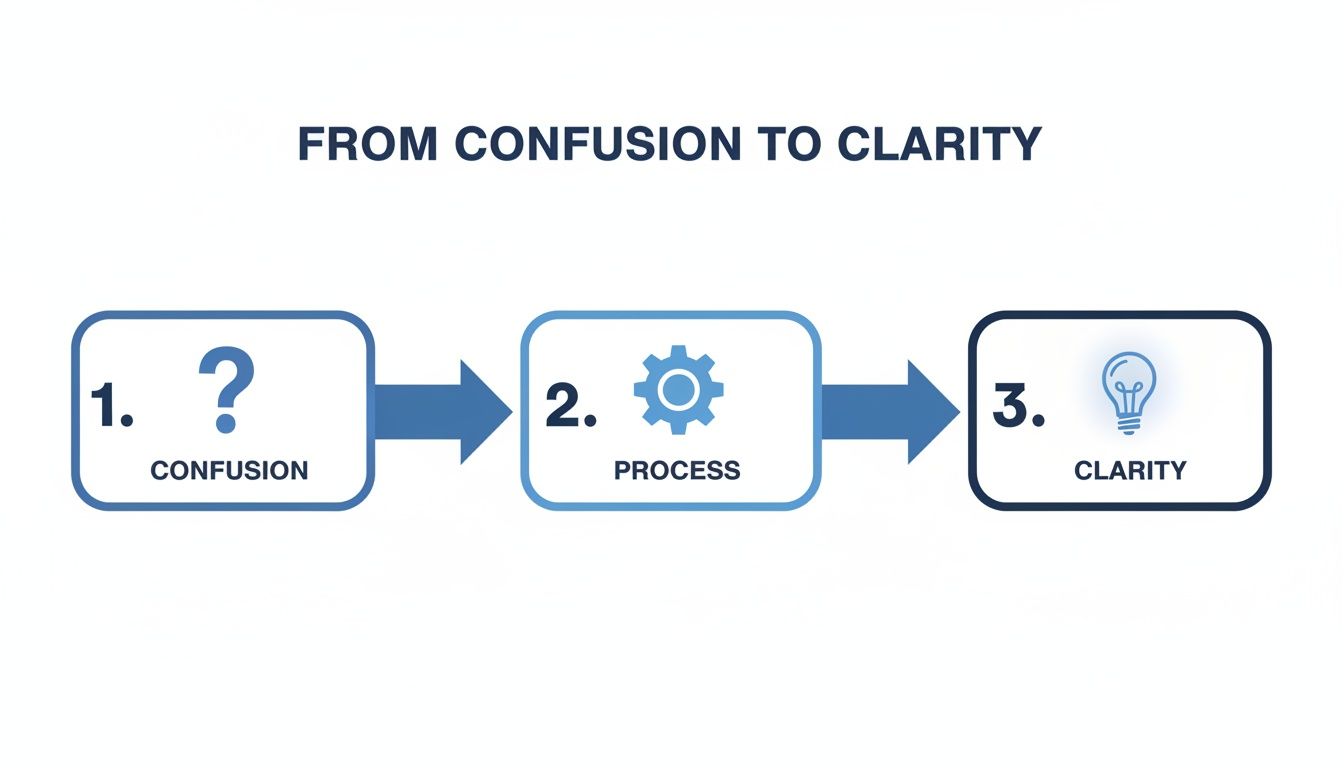
Without a clear set of values, life can feel confusing and inconsistent. You might find yourself saying ‘yes’ to things that drain your energy or chasing goals that leave you feeling hollow. This happens because your actions aren’t aligned with your inner compass.
Your values aren’t just nice ideas; they are the bedrock of your identity. They provide the discipline and direction needed to build a life that feels authentic and fulfilling, rather than accidental.
Living without this internal guidance is like trying to sail a ship without a rudder; you’re at the mercy of every passing current. You end up reacting to what life throws at you instead of acting from a place of genuine strength. Recognising the real meaning of values is the first step toward grabbing the wheel and building a life with intention.
Why Values Are Your Best Decision Making Tool

Ever found yourself stuck at a crossroads, paralysed by a tough choice? That feeling of being overwhelmed often comes from being disconnected from our core values. When you aren’t clear on what truly matters to you, every option can feel equally valid, or equally terrifying.
This is where understanding your values becomes a powerful tool. They act as your personal filter for life, simplifying even the most complicated decisions by giving you a clear benchmark to measure every potential path against.
Using Values as Your Decision Filter
Let’s play this out. Imagine you’re offered a new job. It comes with a massive pay rise and a fancy title, but it demands you work 70-hour weeks and adopt a ruthless, cutthroat attitude that just doesn’t sit right with you.
Then, another offer lands on your desk. It’s from a smaller company, the pay is less, but its mission genuinely inspires you and the culture is all about work-life balance.
Without clear values, this decision is agonising. You could spend weeks weighing up the pros and cons, lost in spreadsheets and what-if scenarios.
But what if you know, deep down, that freedom and integrity are two of your non-negotiables? Suddenly, the choice becomes remarkably simple. The high-paying job, despite its shiny perks, is a direct clash with what you hold most important. It’s asking you to sacrifice your freedom and compromise your integrity.
The second job, while maybe less glamorous on paper, aligns perfectly with your internal compass. This is the real power of using values for decision-making. They help you look past the surface-level stuff and focus on what will bring you genuine, long-term fulfilment.
Your values act as your personal compass, not a rigid rulebook. They don’t tell you exactly what to do, but they consistently point you toward your true north, ensuring your choices reflect the person you want to be.
How Values Create Consistency and Identity
When your decisions are guided by a consistent set of principles, you start to build a life that feels coherent and truly yours. Every choice reinforces who you are and strengthens your sense of self. This consistency is the bedrock of self-trust and discipline. It answers the question, “Who am I?”
Think about how values shape your identity across different parts of life:
- Career: If you value creativity, you’ll naturally build an identity around roles that let you innovate and express yourself, rather than getting stuck in repetitive work.
- Relationships: Someone who values deep connection will invest their energy in a few close friendships, shaping their identity as a loyal friend.
- Finances: A person who values security will focus on saving, reinforcing their identity as a responsible provider. Someone who values experience might prioritise spending on travel, building an identity as an adventurer.
Trying to live without this internal guidepost is a recipe for confusion and inconsistency. One day you might find yourself envious of a friend’s adventurous life, and the next, you’re desperately craving stability. This constant back-and-forth is exhausting because it’s not grounded in a solid identity.
By defining and applying your values, you stop reacting to what everyone else is doing and start making proactive choices that build a life of purpose; and a life with far fewer regrets.
How Values Build Discipline and a Stronger Identity
Let’s be honest, the word “discipline” gets a pretty bad rap. We picture it as gritting your teeth and forcing yourself through things you hate just because you “should.”
But real, sustainable discipline isn’t about brute force. It’s about making choices that align with what you genuinely care about, especially when it’s hard. This is where your values come in. They are the fuel for self-discipline because they connect your actions to your identity.
When your actions are plugged into your values, they stop feeling like chores. Instead, they become an expression of who you are.
From Action to Identity
Think of it this way: if you value your physical health, dragging yourself to the gym isn’t a punishment. It becomes an act that confirms your identity as a healthy, capable person. Every time you show up, you’re not just lifting weights; you’re reinforcing a fundamental part of yourself.
This creates a powerful positive feedback loop. You act according to a value, which strengthens your sense of who you are, which then makes it easier to act on that same value next time. Over time, these consistent actions build a rock-solid and authentic sense of self.
This inner alignment gives you the backbone to say no to temptation or push through when you feel like quitting. You’re not just following rules; you’re living out your personal truth. This is why getting clear on your values is so critical to building a stronger sense of self and its meaning.
Values as Your Internal Compass
A life without clear values is often chaotic and confusing. One day you’re all in on climbing the corporate ladder, the next you’re daydreaming about ditching it all to travel. This happens when you’re trying to navigate life without an internal compass.
Your values are your personal guide for how to act, not a rigid rulebook. They provide the ‘why’ behind your choices, making it so much easier to stay on track when things get hard or when you’re tempted by a quick fix.
When you know what you stand for, you have a built-in filter for every decision you face. This clarity is what separates a life lived with intention from one of reacting to whatever comes your way. It allows you to build momentum in a direction that actually matters to you.
- Decision-Making: You stop asking, “What should I do?” and start asking, “What choice lines up with my values?”
- Discipline: Motivation isn’t about forcing yourself anymore; it’s about expressing who you are.
- Identity: Your actions consistently reflect your character, creating a strong and stable sense of who you are.
This isn’t just theory. Research like the Australian Cohesion Index shows a direct link between shared values like trust and fairness and a person’s overall satisfaction with life. The report found a statistical tie between these values and the ability to persevere through tough times. You can explore the full report on Australian values and well-being to dig into the data for yourself.
Ultimately, by understanding what your values mean and living by them, you’re not just becoming more disciplined; you’re becoming more you.
The Real Cost of Ignoring Your Values
Ever feel like you’re drifting at sea without a rudder? That’s what it’s like living without a clear handle on your values. The lack of an internal compass leads directly to confusion and inconsistency. You end up reacting to whatever life throws at you, pulled in different directions by other people’s expectations and your own fleeting desires.
This sense of aimlessness has real consequences. You might say ‘yes’ to commitments that drain you, chase goals that leave you feeling hollow, or stay in a career that looks good on paper but chips away at your soul. It’s the perfect recipe for that nagging feeling of being lost.
The Cycle of Confusion and Inconsistency
When you don’t have a solid internal compass, your decisions feel erratic. One day, you might be all-in on financial security, only to be hit with a wave of regret the next when you see a friend pursuing a passion project with no guaranteed payday.
This internal tug-of-war creates a seriously draining cycle:
- Confusion: You aren’t sure what you truly want, so every choice feels overwhelming and riddled with doubt.
- Reactive Choices: You make decisions based on what you think you should do, not what feels right in your core.
- Empty Outcomes: You hit a target but feel no real satisfaction because it wasn’t tied to something that actually matters to you.
- Aimlessness: This lack of fulfilment just reinforces the feeling that you’re drifting through life with no real direction.
Struggling with this isn’t a personal failing. It’s a predictable outcome of trying to navigate a complex world without reliable principles to guide you. When your actions don’t line up with your inner truth, a sense of frustration and pessimism is almost guaranteed to follow.
Living against your values is like trying to swim against a strong current. You can thrash around and put in a massive amount of effort, but you’ll just end up exhausted and even farther from where you want to be.
When Your Values Clash With Reality
This internal confusion often gets cranked up to eleven by external pressures. It creates a deep tension between what you believe is important and the world you’re living in, a feeling that’s especially common for younger generations trying to find their footing.
Take this, for example: a 2023 survey found that 64% of young Australians believe they’ll be worse off than their parents’ generation. This shows a massive clash between the deeply held value of security and the harsh reality of an unstable economy.
At the same time, 78% believe the government should reduce income inequality, pointing to a strong community value for fairness. It’s a perfect snapshot of the frustration that comes from trying to live your values in a system that can feel stacked against you. You can read the full survey on the values of young Australians for some more insights.
When you ignore your values, you’re not just making a few bad decisions. You’re creating a fundamental disconnect between who you are and how you live. This gap is where burnout, resentment, and aimlessness take root, making it almost impossible to build a life that feels genuinely authentic and fulfilling.
A Practical Guide to Discovering Your Core Values
Theory is great, but the real meaning of values only comes to life when you put it into practice. This is where we shift from just understanding what values are to actually identifying the ones that drive you. Forget picking words from a generic list; this is a hands-on, no-fluff workshop to uncover the 3-5 core values that genuinely define who you are.
You’ll walk away from this with a solid list of personal values, your own decision-making compass, that you can start using straight away. To get there, we’re going to dig into your real-life experiences: the highs, the lows, and the people you look up to.
Start With Your Peak Experiences
Think back to a time in your life when you felt truly alive. A moment you were completely engaged, energised, and proud of yourself. It could be finishing a tough project, having a deep conversation with someone, or standing up for what you believe in. Don’t overthink it; just let the first memory that surfaces come to mind.
Now, ask yourself a few questions about that moment:
- What was I doing?
- Who was I with?
- What about that experience made me feel so damn good?
Your answers point directly to the values being honoured in that peak moment. Perhaps it was creativity, connection, courage, or achievement. Jot down any words that feel right.
Learn From Your Frustrations
Alright, let’s flip the script. Now, think about a time you felt angry, frustrated, or completely drained. This could be a situation at work, a clash with a mate, or even something you saw in the news. These negative emotions are powerful clues because they almost always signal that one of your core values has been stepped on.
What was it about that situation that got under your skin? Was it a blatant injustice? That points to a value of fairness. Was it a feeling of being controlled or boxed in? That highlights a deep need for freedom or autonomy. Write these down, too.
Your strongest emotions, both positive and negative, are like signposts pointing directly to your core values. Pay attention to what lights you up and what ticks you off, they are telling you what truly matters.
Identify Your Role Models
Think about the people you admire most. They could be people you know, historical figures, or even characters from a book or film. Just make a quick list of two or three individuals you genuinely respect.
For each person, pinpoint the specific qualities you admire in them. Is it their brutal honesty? Their boundless curiosity? Their quiet resilience? The traits you look up to in others often reflect the values you aspire to live by yourself. Add these to your growing list.
If you’re struggling to find the right words, exploring a comprehensive list of personal values examples can help you nail down the exact terms for the qualities you’ve identified.
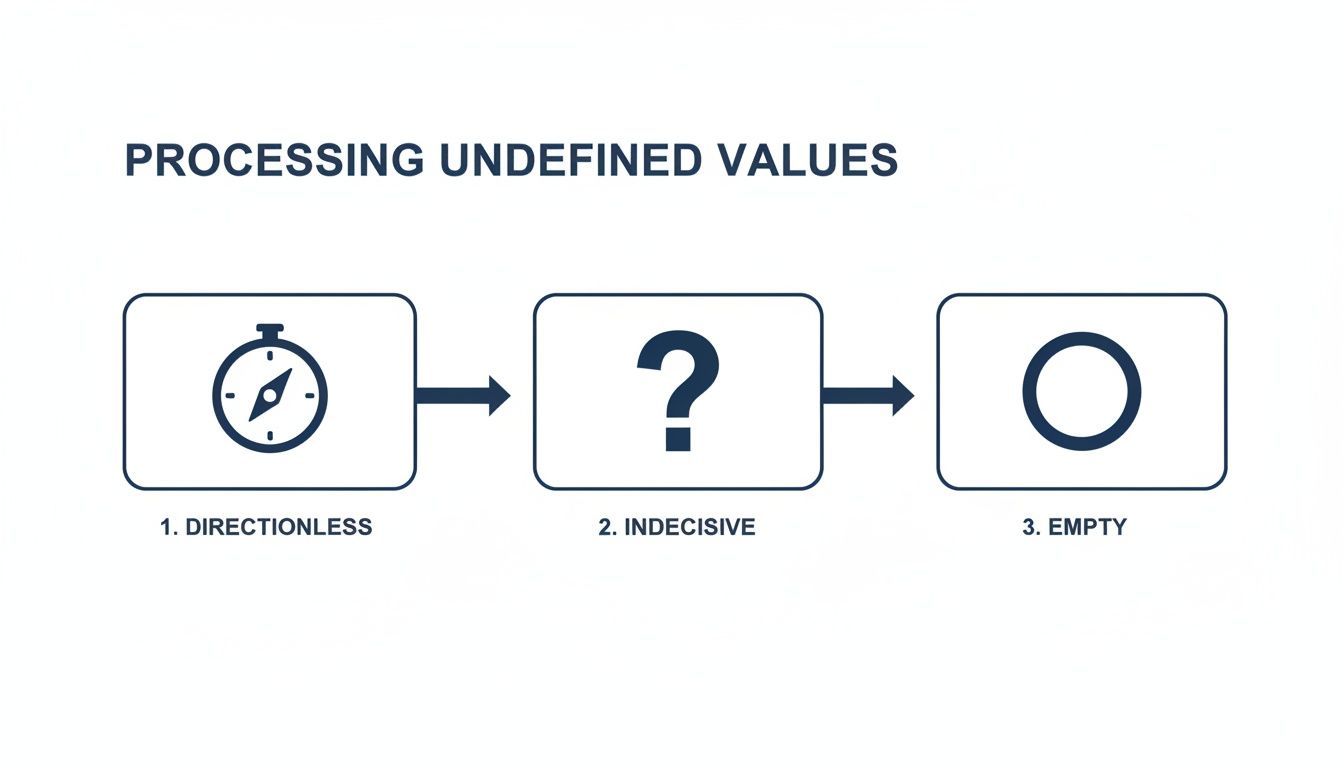
When we ignore this process, we end up lost. Ignoring your values is the fastest way to end up confused, chasing empty goals, and feeling a nagging sense of aimlessness.
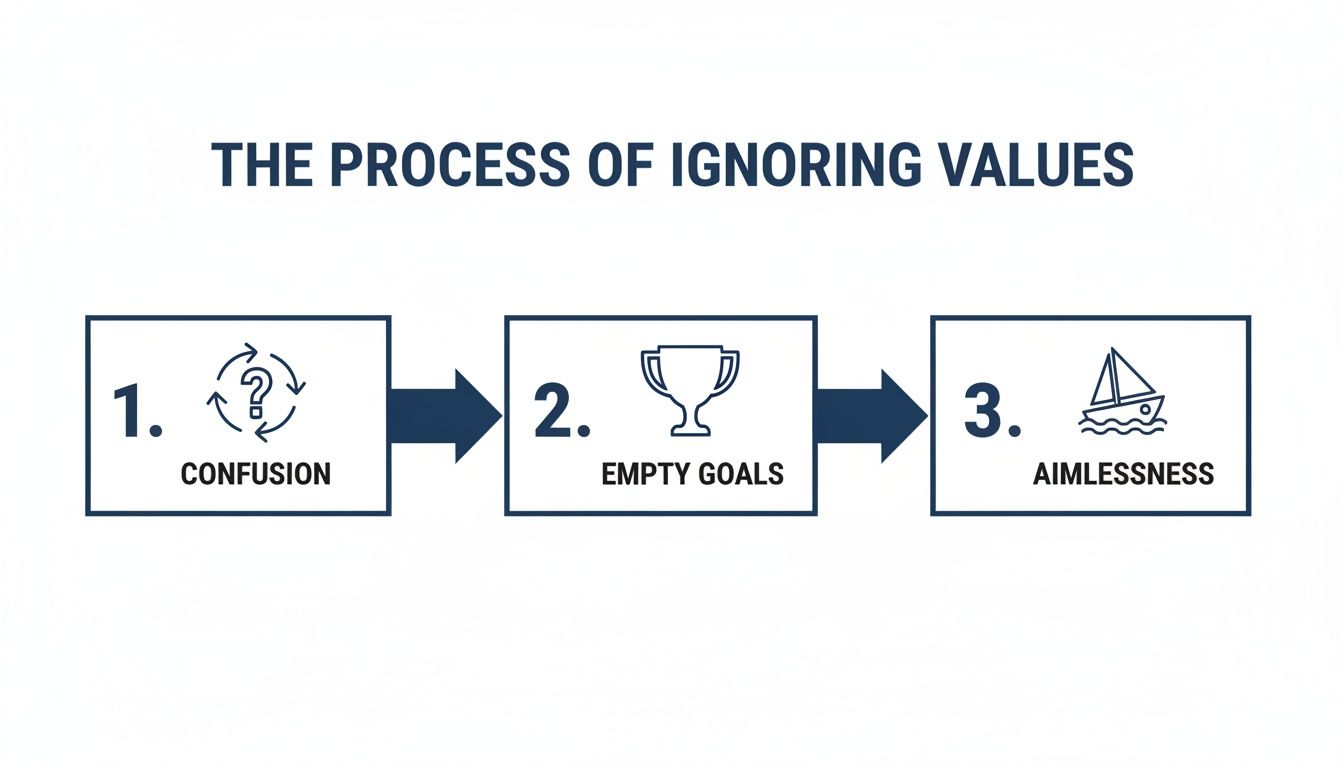
This flowchart nails it. Failing to connect with what’s important to you is the first step toward a life that feels directionless and unfulfilling.
Test Your Values for Authenticity
It’s time to bring it all together. The following table provides a structured way to dig deeper into the experiences you’ve just reflected on.
Your Personal Values Discovery Toolkit
Use these prompts to reflect on your experiences and uncover the values that are most important to you.
| Reflection Prompt | What This Reveals |
|---|---|
| Peak Moments: When did you feel most proud and alive? | The values being honoured when you’re at your best (e.g., achievement, connection). |
| Tough Times: What challenges have taught you the most? | The values you rely on for resilience and strength (e.g., perseverance, courage). |
| Frustrations: What really ticks you off or drains your energy? | The values that are being violated or ignored (e.g., fairness, freedom). |
| Role Models: Who do you admire and what qualities do you respect in them? | The values you aspire to embody in your own life (e.g., integrity, wisdom). |
Now, review everything you’ve written down and circle the top 3-5 that feel absolutely essential. These are your potential core values. But there’s one final, crucial step: test them against your real life. Are these values you genuinely live by, or just ideals you wish you had? Be honest with yourself.
This authenticity is your greatest asset. In a world where trust is low, your integrity is everything. Being a person whose actions consistently match their stated values is a powerful way to stand out and build a life with real intention. This is your working list; your compass.
Still Got Questions About Values?
It’s completely normal for a few questions to pop up when you start digging into this stuff. Let’s clear up some of the most common ones so you can move forward with confidence.
Can Your Values Change Over Time?
Absolutely. While your core values often have deep roots, they aren’t set in concrete for life. Big life moments, like becoming a parent, changing careers, or even just getting older, can totally shift what you prioritise.
This isn’t a sign you were wrong before; it’s a sign you’re growing. Think of it as recalibrating your internal compass. The goal is to make sure it’s pointing true for the person you are today, not the person you were five years ago.
What if My Values Conflict With Each Other?
Welcome to the human experience! It’s incredibly common to feel pulled in different directions. Maybe you value both adventure and security, which can feel like a real tug-of-war. This tension doesn’t mean you’re confused; it just means you’re a complex person.
The trick isn’t to ditch one value for the other. It’s about finding a smart balance. That could look like finding ways to build security into an adventurous life (like developing skills you can use anywhere) or making sure you carve out non-negotiable time for adventure within a stable routine.
How Many Core Values Should I Have?
There’s no magic number here, but I’ve found that landing on 3-5 core values is the sweet spot. Too few, and you might not have enough guidance. Too many, and you’ll just get stuck in decision paralysis, which defeats the whole purpose.
A short, powerful list is something you can actually remember and use when life gets complicated. Think of them as the handful of bright, reliable stars you navigate by, not the entire galaxy.
Keeping your list tight makes it a practical, everyday tool instead of some overwhelming philosophical project.
What’s the Difference Between Values and Principles?
This one’s subtle but super important for putting your values into practice. Here’s a simple way to think about it:
- Values are your ‘what’: They’re the big-picture concepts you care about, like honesty, freedom, or connection. They’re the destination.
- Principles are your ‘how’: They’re the personal rules or codes of conduct you create to actually live by those values. They’re the directions on the map.
So, if honesty is one of your core values, a guiding principle might be, “I will always speak my mind respectfully, even when it’s uncomfortable.” Your principles are what turn an abstract idea like ‘honesty’ into real-world action. They build the bridge from who you want to be to what you actually do every day.
Figuring out your values is the first step, but putting them into action is where the real magic happens. If you’re ready to stop feeling adrift and start building a life that truly feels like yours, Your Bro is here to help. One-on-one coaching can give you the clarity and accountability to close the gap between your values and your reality. Book a free discovery call and let’s get started.