A personal development plan template isn’t just another document you fill out and forget. Think of it as your personal roadmap, designed to pull your biggest ambitions out of the clouds and plant them firmly into your reality. This guide gives you the structure to cut through the daily noise, figure out what success actually looks like for you, and then lay down the practical steps to get there.
Why a Structured Plan Beats Drifting Aimlessly

Ever find yourself stuck in that loop of scrolling social media, looking at a to-do list that never seems to shrink? You’re not alone. ‘Winging it’ is a one-way ticket to burnout and that gut-wrenching feeling of being completely adrift. It’s a common trap, especially if you’re an aspiring entrepreneur buried under new pressures or a young dad trying to figure out your new role.
This is where a Personal Development Plan (PDP) will change the game for you. It’s your personal roadmap. Forget rigid corporate checklists; this is about building a framework so you can start living with intention.
From Vague Ideas to Concrete Action
When you don’t have a clear destination, it’s ridiculously easy to burn all your energy on things that just don’t matter in the long run. A plan helps you filter out the distractions and zero in on what will genuinely move the needle in your life. It turns those fuzzy, abstract desires into a clear, organised system for real growth.
Think about the difference this will make for you:
- Without a Plan: “I want to be more successful.” Mate, that’s a wish, not a strategy. You can’t measure it, and it’s the first thing you’ll drop when life gets hectic.
- With a Plan: “I will increase my freelance income by 20% in the next six months by landing three new clients and smashing out a sales skills course.” Now that is a specific, actionable goal you can start chipping away at every single day.
That simple shift from wishing to planning gives you back a sense of clarity and control over your own future.
A plan is the bridge between your current reality and the life you’re capable of building. It replaces passive hope with active, intentional effort, giving you the power to steer your own ship instead of being tossed around by the currents.
The Power of a Purpose-Driven Framework
A well-crafted plan does more than just list goals. It connects those goals to your deeper sense of purpose, making sure the path you’re carving out is one you actually want to be on. I know from my own experience how easy it is to chase what you think you should want, only to feel hollow when you get it. If you’re keen, you can read more about my own journey from aimlessness to clarity.
The numbers back this up, too. In Australia, the personal development market is booming, hitting USD 911.5 million in revenue. Coaching and structured programs make up a massive 42.53% of that. Why? Because people who get coaching actually achieve their goals 80% of the time, compared to just 40% for those trying to go it alone.
For young guys battling distractions or new fathers looking for a solid roadmap, those stats prove that a structured plan isn’t just nice to have, it’s a game-changer for your success.
Ultimately, this personal development plan template is your first solid step towards intentional action. It’s the structure you need to start building a life you’re genuinely proud of.
Defining Your Core Values and Purpose
Before you even touch a personal development plan, you and I need to get something straight. It’s easy to jump ahead and scribble down goals like ‘earn six figures’ or ‘get that promotion’, but those are just empty targets without a real ‘why’ driving you. You’ve got to lay your foundation first.
A plan without a clear purpose is nothing more than a glorified to-do list. It’s when you hook your goals into something much deeper that you find the kind of motivation that’ll drag you through the mud on the tough days. This isn’t about finding one perfect answer overnight; it’s about getting brutally honest with yourself about what actually makes you tick.
Uncovering Your Core Values
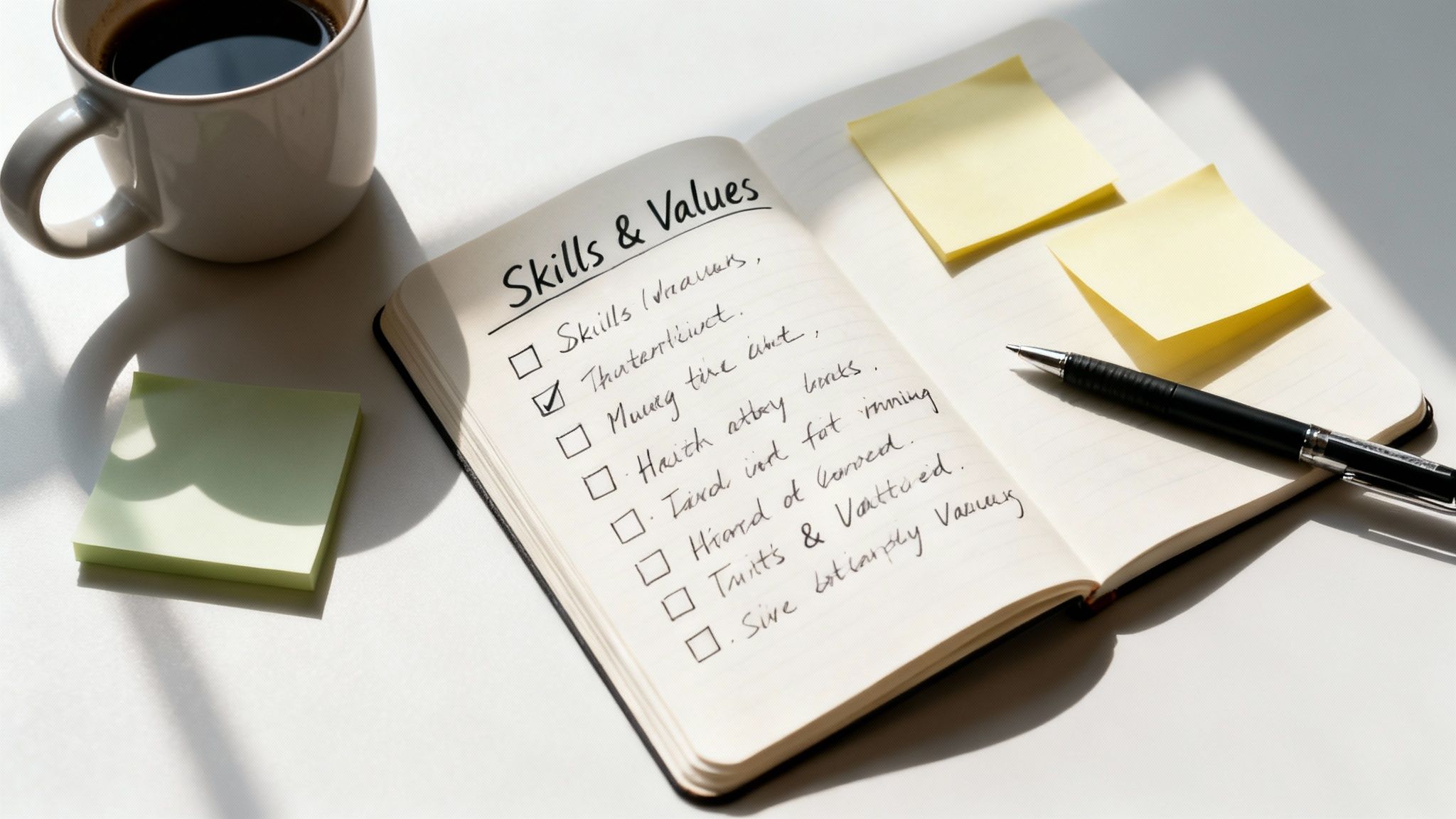
Think of your core values as your non-negotiables. They’re the internal compass guiding every decision you make, how you behave, and ultimately, your sense of fulfilment. When your day-to-day actions line up with your values, you feel solid, like you’re on the right track. When they don’t, you feel conflicted, drained, and out of whack.
To start digging these out, ask yourself a few questions:
- When did you feel most proud of yourself? What were you doing, and what deep-seated value did that moment honour?
- Think about a time you were properly pissed off or frustrated. What important value of yours was being ignored or trampled on?
- Who do you admire most in the world? What specific qualities do you respect in them? These are often a mirror of your own values.
And don’t just limit this to your 9-to-5. Look at everything: your relationships, your health, your community. Your values should hold true across the board. If ‘integrity’ is on your list, it has to apply to how you treat your partner just as much as how you close a business deal.
From Values to a Personal Mission Statement
Once you’ve got a handle on your values, you can shape them into your personal mission statement. Forget the stuffy corporate slogans you see on office walls; this is your short, punchy declaration of purpose and the dent you want to make in the world. It’s your North Star, the thing you look to when you’re at a crossroads.
A solid mission statement for you will nail three key questions:
- What do I do? (Your main actions or contributions)
- Who do I do it for? (The people or cause you give a damn about)
- What is the intended result? (The change or impact you want to create)
Let’s make this real. Imagine a young entrepreneur figures out his core values are creativity, independence, and community.
His mission statement could be something like: “To use my creative problem-solving skills to build an independent business that helps other small business owners in my community thrive.”
See how that works? It’s specific and completely driven by his values. Now, when a new opportunity comes his way, he can ask: “Does this actually align with my mission?” That simple check-in will keep him from chasing shiny objects and ensure his goals are meaningful.
Your personal mission statement is your filter for decision-making. It ensures that the goals you set aren’t just arbitrary targets but deliberate steps toward becoming the person you want to be.
Doing this foundational work is absolutely critical. It’s the difference between chasing fleeting achievements and building a life with real substance. Taking the time to figure out what’s going on under the hood is a massive part of learning how to find your passion and what gets you out of bed in the morning. Armed with this clarity, every single goal you add to your plan will feel more authentic and inspiring, making it far more likely you’ll actually see it through.
Alright, you’ve done the hard yards digging into your ‘why’ and you’ve got a much clearer picture of the person you want to become. Now it’s time to turn that vision into a real, tangible plan, to go from big ideas to daily actions. This is exactly where our downloadable personal development plan template comes in. Think of it as the bridge between your ambition and your reality.
A vision without a plan is really just a daydream. This template is your practical guide, designed to break your biggest goals down into steps you can actually manage and track. It gives you the structure you need to get organised and stay focused, making sure you’re not just busy, but genuinely productive.
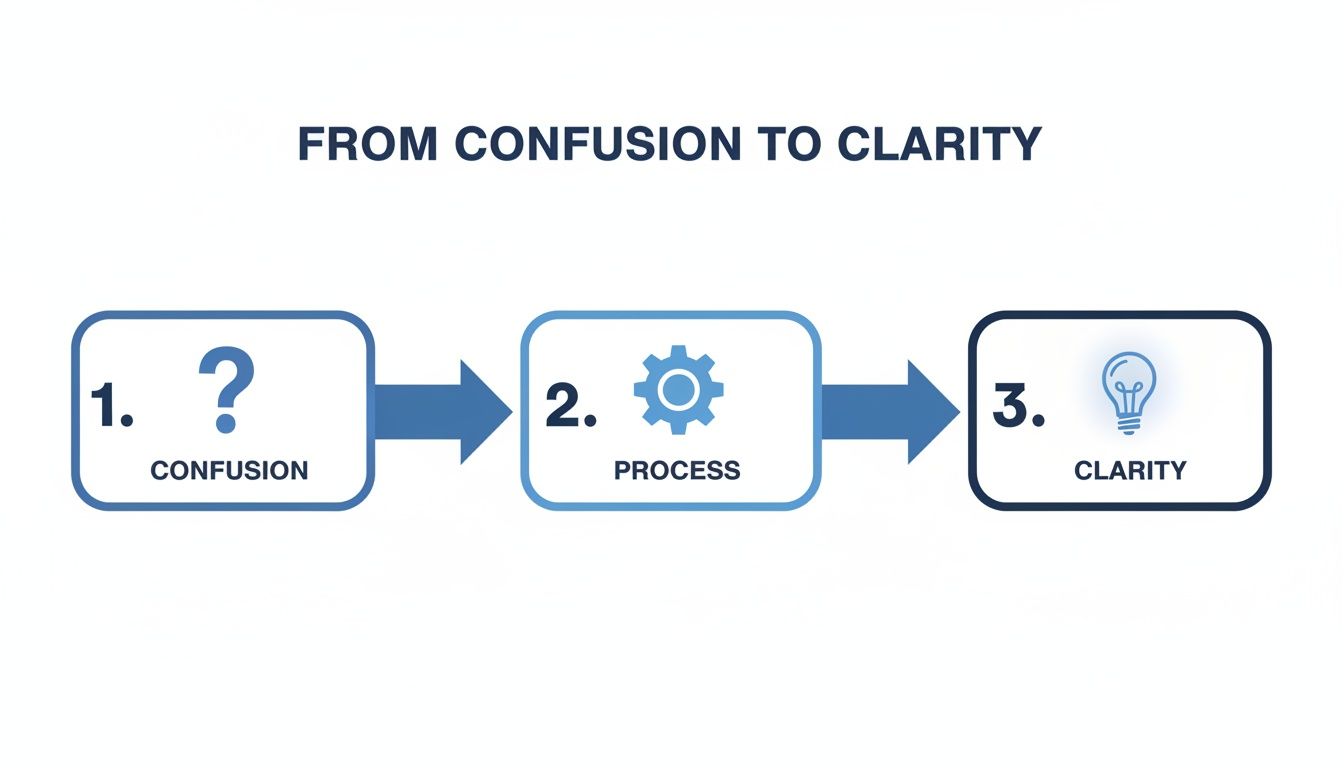
It all boils down to a simple process: reflecting on your purpose, defining your direction, and then aligning your actions. This is the engine that will drive your intentional growth.
This flow shows how self-reflection isn’t some one-off task. It’s the starting point that directly shapes the goals you set and, ultimately, the actions you take every single day.
Getting to Know the Template
Don’t worry, this isn’t some complicated spreadsheet built for a corporate boardroom. It’s a straightforward framework that’s all about giving you clarity and a path to action. We’ve organised it into key life areas so you can build a plan that feels balanced and whole. The best part? You don’t have to tackle everything at once. Just pick one or two areas that feel most important to you right now.
Here’s a quick look at the core components of the plan and what they will help you figure out.
Core Components of Your Personal Development Plan
| Section | What It Helps You Define | Example Question to Ask Yourself |
|---|---|---|
| Career & Business | Your professional ambitions and milestones. | “What specific skill could I learn this year that would lead to a promotion?” |
| Finances | Your money goals and financial health. | “What’s my target for my emergency fund, and how much do I need to save each month?” |
| Health & Fitness | Your physical and mental wellbeing priorities. | “What one habit, like a 20-minute walk daily, would have the biggest impact?” |
| Relationships | How you want to nurture your key connections. | “How can I be more present with my partner/family this week?” |
Each of these sections in the template prompts you to define a specific, measurable goal. Research backs this up time and again: vague goals get you vague results. The more specific you are, the more likely you are to actually do it.
A goal without a deadline is just a dream. The template forces you to attach timelines, quarterly milestones and weekly actions, turning your broad ambitions into a tangible, day-to-day action plan.
From Big Goals to Weekly Actions
Let’s make this super practical for you. A huge goal can feel completely overwhelming, and that feeling is what usually leads to procrastination. The trick is to chop it up into smaller, less scary pieces. Our template is built to help you do exactly that.
Say you’re a freelancer who wants to double your income in the next year. That’s a massive goal. Here’s how you’d use the template to make it feel achievable:
- Yearly Goal: Double freelance income from $50k to $100k.
- Quarterly Milestones: Now, break it down. Your Q1 milestone might be to land two new high-value clients and complete a sales negotiation course. For Q2, you could focus on launching a new service package.
- Weekly Actions: So, what do you need to do this week? Your list might look like: “Send 10 personalised outreach emails,” “Research and enrol in a sales course,” and “Update my portfolio with my latest project.”
All of a sudden, that intimidating $100k goal becomes a simple, clear list of tasks for the week. You’re no longer staring at the mountain; you’re just focused on taking the next few steps.
Planning for Roadblocks and What You’ll Need
Let’s be real: your growth is never a straight line. You will hit obstacles. A good plan doesn’t just ignore this, it prepares you for it. Our personal development plan template has sections for anticipating challenges and identifying the skills or resources you’ll need to overcome them.
Let’s take another real-world example: a new dad trying to get a better handle on his work-life balance.
- Goal: Leave work at 5 pm every day to be present for family dinner.
- Potential Obstacle: Last-minute client requests and a people-pleasing habit of saying ‘yes’ to everything.
- Skills/Resources Needed: The skill he needs to build is assertiveness and boundary setting. A resource could be a time-blocking app on his phone or even just a frank conversation with his boss to manage expectations.
By thinking through these potential hurdles beforehand, you shift from a reactive mindset to a proactive one. You’re not just hoping things go smoothly; you’re building a strategy to handle the inevitable bumps in the road. This kind of forward-thinking makes your plan far more resilient and drastically increases your chances of sticking with it.
Staying Accountable and Tracking Your Progress

Let’s be honest, a plan without action is just a document that gathers digital dust. You’ve done the hard work of figuring out your purpose and building your action plan; now comes the critical part, seeing it through. This is where you build the habits of consistency and resilience that drive real, lasting growth.
True momentum doesn’t come from one heroic effort. It’s born from creating simple, repeatable systems that keep you engaged with your goals, even when that first burst of motivation has faded. This is all about making your progress visible and holding yourself to a standard you’ve already committed to.
Creating a Rhythm of Review
The most effective way you can stay on track is to build a consistent review schedule. This isn’t about judging your performance; think of it more like checking your compass to make sure you’re still heading in the right direction.
A simple rhythm can make all the difference. Here’s a practical structure that really works:
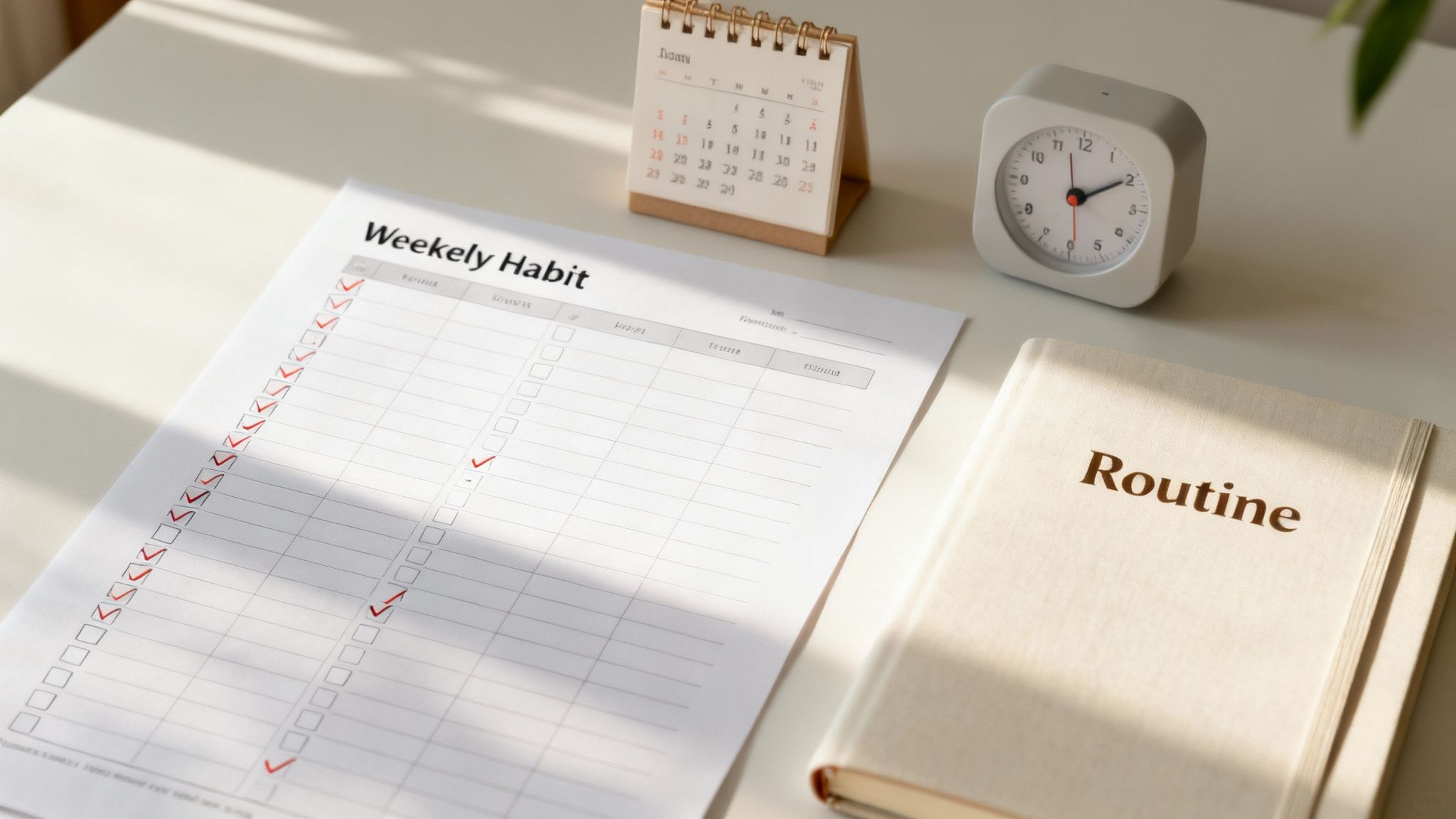
- Weekly Check-In: This is your quick, 15-minute alignment. Look at your weekly actions from your personal development plan template. What did you nail? What got pushed aside? This isn’t a chance to beat yourself up; it’s a practical check to adjust your focus for the week ahead.
- Monthly Review: Set aside a solid hour for this one. Zoom out and look at your quarterly milestones. Are you on pace? Celebrate your wins, no matter how small they seem. Acknowledging your progress is a massive motivator. This is also the time to be brutally honest about what isn’t working and pivot your strategy if you need to.
This structured review process transforms your plan from a static document into a living, breathing guide that evolves right along with you.
Choosing Metrics That Matter
To know if you’re actually moving forward, you need to measure your progress. Vague feelings of “doing better” just won’t cut it. You need concrete metrics tied directly to your goals so you can see your own success.
Think about it this way: if your goal is to get healthier, you wouldn’t just hope you feel better. You’d track things like workouts completed, hours slept, or healthy meals eaten.
Apply that same logic to your personal development goals:
- Career Goal: Improve public speaking skills.
- Metric: Number of times you contributed in team meetings this month.
- Financial Goal: Build an emergency fund.
- Metric: Percentage of your savings target achieved.
- Relationship Goal: Be more present with family.
- Metric: Number of tech-free dinners you had this week.
Tracking tangible metrics provides undeniable proof of your progress. It shifts your focus from effort to results, giving you the solid data you need to stay motivated and make informed adjustments to your plan.
The Power of Accountability
Self-discipline is powerful, but accountability is a force multiplier. Just knowing that someone else is in your corner, expecting you to show up, can be the single biggest factor in your success. It’s about creating a support structure that makes quitting harder than continuing.
One of the most effective forms of accountability is professional guidance. Young professionals and entrepreneurs are increasingly turning to personal development coaching for this exact reason. In fact, Australia’s leadership development market is projected to reach USD 3.22 billion by 2035, with major companies like Deloitte investing heavily in it. The data shows that coached professionals report 30% higher adaptability scores, delivering significantly better outcomes. You can get more details on how coaching drives market growth on futuremarketinsights.com.
There are a few ways you can build this into your life:
- Find an Accountability Partner: This could be a mate with similar ambitions. Set up a brief weekly call to share your wins, struggles, and what you commit to doing next week.
- Join a Community: Whether it’s an online forum or a local mastermind group, being around others on a similar path creates a powerful sense of shared purpose.
- Work with a Coach: For structured, expert support, consider professional guidance. A coach provides that unbiased perspective and a framework to keep you on track. Exploring options like one-on-one life coaching can provide the personalised accountability you need to truly accelerate your growth.
Right then, let’s be honest about something from the get-go: your personal growth is never a straight line. It’s messy. You’re going to have days where you hit a wall, moments where doubt creeps in, and times when your motivation completely packs its bags and leaves.
Expecting a perfectly smooth ride is the quickest way to get thrown off course. The real skill you’re building here isn’t trying to avoid the bumps, it’s learning how to handle them without packing it all in.
Think of your plan like a map for a big hike through the bush. You wouldn’t expect the track to be flat and paved the whole way, would you? You’d be ready for steep climbs, rocky bits, and maybe even taking a wrong turn that leads you somewhere unexpected. This part of the guide is all about getting you prepared for those rough patches, so a stumble doesn’t turn into a full-blown bail.
Dodging the Perfectionism Trap
One of the biggest hurdles you’ll face is the fear of not getting things exactly right. It’s a killer. This fear often shows up as procrastination, where you put off starting something because the “perfect” conditions just aren’t there, or you’re worried the result won’t be flawless. It’s a nasty little cycle of self-sabotage that keeps you completely stuck.
The way out? Embrace the idea of “good enough for now.”
Instead of waiting for the ideal moment to enrol in that online course or finally have that tricky conversation, just begin. Taking action, even clumsy, imperfect action, is what creates momentum. Remember, your personal development plan template is a living, breathing document, it’s not your final uni exam. It’s supposed to get a bit messy as you figure things out.
Perfectionism is the enemy of progress. Focus on making a consistent effort, not on flawless execution. A completed, imperfect step is worth infinitely more than a perfect plan that never leaves the page.
When Your Goals Feel Way Too Big
It’s incredibly easy to get swept up in the initial excitement and set these massive, life-changing goals. But when you’re in the day-to-day grind, a goal like “launch my own business” can feel so gigantic it’s completely paralysing. That feeling of being overwhelmed is a huge reason people ditch their plans.
When the finish line seems a million miles away, taking that first tiny step can feel pointless.
The trick is to break it down. And then break it down again. Your massive yearly goal gets chopped into quarterly milestones. Those get broken into weekly actions, and finally, into simple daily tasks. All you need to worry about is what you have to do today. This micro-focus makes overwhelming goals feel achievable and gives you a powerful hit of accomplishment with every small win. That’s how you build momentum that actually lasts.
Navigating the Inevitable Slump
Let’s face it, motivation is fickle. It’s a feeling, and like any feeling, it comes and goes. You’ll have weeks where you feel like you’re on fire, and you’ll have weeks where you feel totally flat, staring at your progress (or lack thereof) and feeling completely discouraged. If you rely only on motivation to get you through, you’re setting yourself up to fail.
This is where your systems and habits become your lifeline.
Your commitment to that weekly check-in, the accountability you have with a mate or a coach, the simple act of ticking off one small task on your list, these are the things that will pull you through the slumps.
Instead of trying to fight the feeling, just acknowledge it. Say to yourself, “Right, I’m not feeling it today, but I’m still going to do my 20 minutes of reading.” Discipline isn’t about wanting to do it; it’s about doing it anyway.
To help with this, it’s useful to spot common roadblocks and reframe them with a more productive mindset. You’ll likely see these pop up time and time again.
Common Roadblocks vs Productive Responses
| Common Roadblock | Unproductive Reaction | Productive Response |
|---|---|---|
| Feeling Overwhelmed | “This is just too much. I can’t do it.” | “Okay, what’s the one small thing I can do right now?” |
| Slow Progress | “I’m not getting anywhere. This is pointless.” | “Let me check my metrics. What small wins can I celebrate?” |
| Making a Mistake | “I’ve stuffed it up. Might as well give up now.” | “What can I learn from this? How can I tweak my plan?” |
When you know these pitfalls are coming, you can have a response ready instead of letting them knock you for six. Building this kind of resilience is every bit as important as setting your goals in the first place. It’s the grit and adaptability you develop along the way that will ultimately lead to your success, turning what could be dead ends into valuable learning experiences on your journey.
Your Personal Development Questions Answered
Look, even with the best template in the world, it’s totally normal for a few questions to pop up once you start digging in. Think of this as a quick chat to smooth out any last-minute uncertainties before you dive in and start making some real, tangible progress.
Let’s get into some of the most common things that come up.
How Often Should I Review My Plan?
The secret here isn’t intensity; it’s consistency. A plan you glance at once and then forget isn’t a plan at all, it’s just a wish list. To make it a living, breathing part of your life, you need to build a solid review rhythm.
Here’s a simple schedule that works wonders for you:
- A quick weekly check-in is your non-negotiable. This is how you stay on track with your day-to-day actions and it shouldn’t take more than 15-20 minutes. The goal here is simple course correction, making sure your weekly efforts are actually pushing you toward your bigger goals.
- A deeper monthly or quarterly review is where you zoom out. This is your time to really assess your progress against milestones, celebrate the wins, and tweak your strategy based on what you’ve learned along the way.
Seriously, block these review sessions out in your calendar like you would any important meeting. Treat them as unbreakable appointments with your future self.
What’s the Difference Between a PDP and Just Setting Goals?
This is a fantastic question because it gets right to the heart of what makes this whole process so powerful for you. While goal setting is a critical piece of a Personal Development Plan (PDP), the PDP itself is the entire strategic framework that holds all those goals together.
Think of it like building a house. A goal is like saying, “I want to build a wall.” A PDP, on the other hand, is the full architectural blueprint.
A goal is the ‘what’ (e.g., ‘get a promotion’), but your PDP covers the ‘why’ (how it connects to your core values), the ‘how’ (the specific skills you need and the actions you’ll take), and the ‘what if’ (your plan for smashing through roadblocks). It’s a complete system for growth, not just a to-do list.
This holistic approach is what turns your vague ambitions into a cohesive, actionable strategy for your life.
What if I Don’t Know My Purpose Yet?
It’s not just okay if you don’t have it all figured out, it’s completely normal. In fact, it’s the starting point for most people. Your personal development plan is a tool for discovery, not a final exam you have to pass before you’re allowed to start. Don’t let the pressure of finding some grand “purpose” paralyse you.
Your first plan can be entirely focused on exploration. Use the values exercises and reflection prompts from earlier to just get curious about what genuinely lights you up and what you want to learn more about.
Purpose isn’t usually something you find by sitting in a quiet room and thinking really hard. More often than not, it reveals itself to you through action and experience. Let your plan be your guide for taking that action, and give yourself permission for it to change and evolve as you learn more about yourself.
Need help finding your purpose? Your Bro can help. Book in your Free Discovery Call today!
At Your Bro, we know that building a life with intention is a journey, not a destination. Our downloadable personal development plan template is designed to give you the structure and clarity you need to start. For more personalised guidance and the accountability to see it through, explore our coaching options at https://yourbro.com.au.