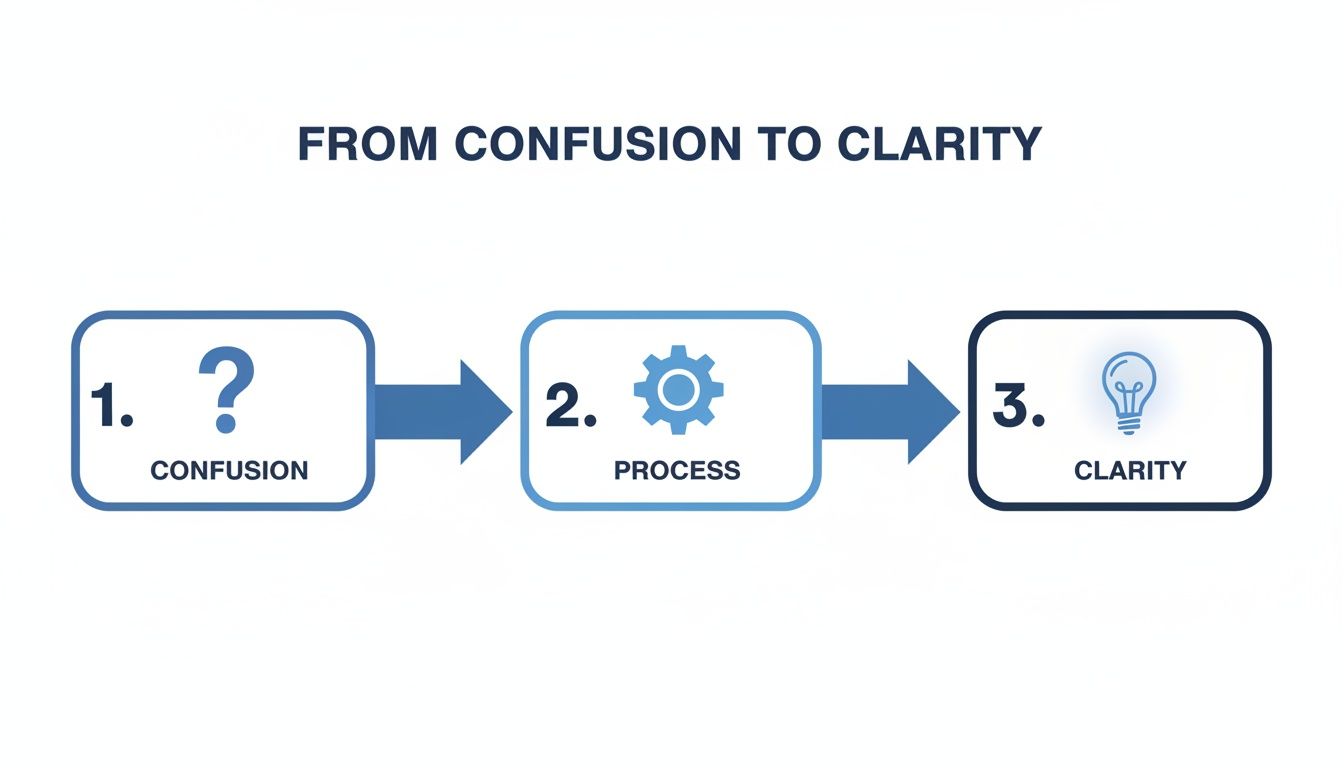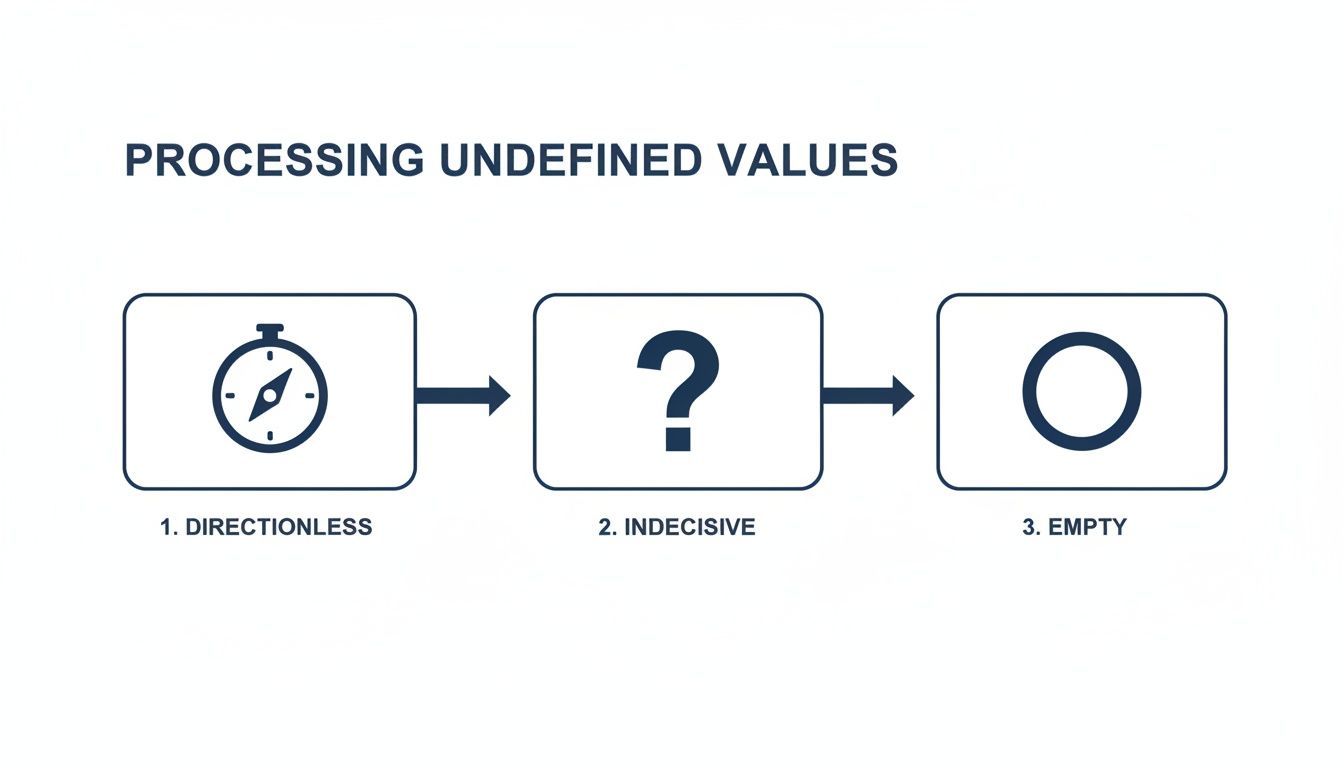
If you feel like you’re just winging it, making big life decisions based on gut feelings or what others expect, you’re not alone. The constant pressure to succeed, provide, and have it all figured out can leave you feeling adrift, chasing goals that don’t bring real satisfaction. This often happens when you don’t have a clear internal guidance system.
What if you had a simple, powerful tool to bring clarity and direction to every choice you make, from your career to your relationships? That tool is your set of personal values. They act as your internal compass, guiding you toward a life of purpose and integrity. When you’re clear on your values, you can navigate challenges with confidence, knowing you’re making choices that are true to you.
This article is more than just a list; it’s a practical guide to help you find and define your own personal values examples. We’ll explore ten core values, from integrity to resilience, breaking down what each one looks like in daily life. You’ll get tangible examples and clear statements to help you articulate what you stand for.
By the end, you won’t just have inspiring words. You’ll have a personal framework for making decisions that align with the person you truly want to be. This is your chance to turn aimless wandering into intentional progress and build a foundation for a more organised, meaningful, and purpose-driven life.
1. Integrity
Integrity is about aligning your actions with your words, especially when it’s tough or no one is watching. It means being honest and holding yourself to a high moral and ethical standard. For you, this isn’t just about being a “good person”; it’s the bedrock of self-trust. When you live with integrity, you build a life where your public self and your private self are one and the same, creating a powerful sense of inner peace and confidence.
How Integrity Can Show Up in Your Life
Choosing integrity as a core value helps you build trust with yourself and others, making it one of the most foundational personal values examples.
- In Your Career: You turn down a lucrative partnership because the other company’s unethical practices conflict with your commitment to fairness.
- At Work: You openly admit a mistake to your manager that caused a project delay, rather than blaming a teammate or hoping no one notices.
- In Your Personal Growth: You’re honest with your support group or coach about a recent struggle, knowing that vulnerability is the only path to real progress.
- In Your Family: You promised your son you’d go to the park on Saturday. Even though you’re exhausted, you follow through, showing him what reliability looks like.
How to Cultivate Integrity in Your Daily Life
Living with integrity isn’t about being perfect; it’s about consistently choosing what’s right over what’s easy and owning it when you fall short.
- Write It Down: Create a simple values statement. Review it weekly so it’s top-of-mind when you face a tough decision.
- Ask the Hard Question: Before you act, ask yourself, “Is this aligned with who I say I am, or am I just taking the easy way out?”
- Start Small: Practice integrity in small promises, like arriving on time for a coffee with a friend. This builds the muscle for high-stakes situations.
- Embrace Accountability: Find a coach or a trusted friend who will call you out when your actions and words don’t match.
- Own Your Mistakes: Integrity includes the humility to admit when you’ve messed up and take immediate steps to make it right.
2. Purpose & Long-Term Thinking
Purpose is your ‘why’—the deep reason behind your goals that gives your life meaning. It’s what gets you out of bed when motivation is low. Long-term thinking is the practical side of purpose, allowing you to make decisions today that set you up for success years from now. For you, combining these two means you’re no longer just chasing short-term wins. Instead, you’re building a life with direction, where your daily actions contribute to a future you’ve intentionally designed.
How Purpose & Long-Term Thinking Can Show Up in Your Life
This combination from our list of personal values examples gives you both the motivation and the roadmap to achieve what truly matters.
- In Your Family: As a new father, your purpose shifts from just career advancement to being a present dad. You apply long-term thinking by investing in that presence now, building a foundation of trust for their teenage years.
- In Your Business: You realize your ‘why’ isn’t just making money but solving a specific community problem. You focus on building strong business fundamentals instead of chasing trends.
- In Your Personal Growth: You find a new purpose in helping others through a journey you’ve already navigated. Your long-term thinking leads you to get certified as a peer support specialist, a multi-year process that will create lasting impact.
- At Work: You take unpaid online courses to build a specific skill. This short-term sacrifice is driven by your long-term plan to pivot into your dream role in five years.
How to Cultivate Purpose & Long-Term Thinking in Your Daily Life
Defining your purpose isn’t a one-time event; it’s an ongoing discovery. Here’s how you can start living with more intention today.
- Write It Down: Create a 5-10 year vision for your career, relationships, and health. This clarifies what you’re working toward.
- Ask the Hard Question: Continually ask, “If money were no object, what problem would I solve?” The answer often points to your true purpose. To go deeper, you can learn more about finding your passion.
- Start Small: Break your long-term vision into 1-2 year milestones, then into quarterly goals. This makes your big vision feel achievable.
- Embrace Accountability: Work with a coach to dig past your surface-level answers. An outside perspective can help you uncover your core motivation.
- Own Your Mistakes: If you get off track, don’t abandon your vision. Acknowledge it, reconnect with your ‘why,’ and adjust your strategy for the next quarter.
3. Accountability
Accountability is about taking full ownership of your actions and outcomes without making excuses or blaming others. It means being answerable for your commitments, first to yourself and then to others. For you, embracing accountability is the key to turning your intentions into reality. It provides the structure you need to stop feeling adrift and start making consistent progress on the goals that matter most to you.
How Accountability Can Show Up in Your Life
Of all the personal values examples, accountability is what transforms your goals from vague dreams into tangible achievements.
- In Your Business: You share your quarterly revenue targets with a coach and report the actual numbers—good or bad—to analyse what’s working and what isn’t.
- At Work: You meet weekly with a mentor to track progress on your career development plan, discussing both your wins and where you fell short.
- In Your Personal Growth: If you’re in recovery, you check in daily with an accountability partner, being honest about triggers to stay on track.
- In Your Family: You commit to being home for dinner three nights a week, phone-free. You review your progress with your partner each weekend to ensure you’re keeping your promise.
How to Cultivate Accountability in Your Daily Life
Living with accountability isn’t about perfection; it’s about being honest about your performance and committed to improving.
- Start with One Goal: Choose one clear, measurable commitment, like “I will exercise for 30 minutes, three times this week.” Specificity is key.
- Schedule Check-Ins: Find a coach or a trusted friend and schedule a regular, non-negotiable time to report your progress.
- Track Everything: Use a simple spreadsheet or a journal to log your actions. The data provides undeniable proof of your effort.
- Report Honestly: Share your successes and your failures. The goal is truth, not a perfect record. Honesty is what sparks real growth.
- Analyse Shortfalls: When you miss a commitment, analyse why without judgement. Was the goal unrealistic? What can you do differently? This analysis is far more productive than shame.
4. Self-Knowledge
Self-knowledge is the deep, honest understanding of your internal world—your strengths, weaknesses, emotional triggers, and core values. It’s the foundation for building a life that is genuinely yours, not one prescribed by society. Without knowing yourself, setting meaningful goals is like navigating without a map. Self-knowledge allows you to stop reacting to the world and start intentionally shaping your place in it by understanding what truly motivates you and what holds you back.

How Self-Knowledge Can Show Up in Your Life
Among the different personal values examples, self-knowledge empowers you to make authentic choices. It’s the difference between guessing what will make you happy and knowing for sure.
- In Your Daily Habits: You recognize that you compulsively scroll social media when you’re anxious, so you replace the habit with a 5-minute walk.
- In Your Career: You realize your “success” in a high-paying job conflicts with your need for creative expression, prompting you to explore a career that truly aligns with your values.
- In Your Relationships: As a father, you understand that your short temper with your kids often stems from how you were raised, allowing you to consciously choose a more patient approach.
- In Your Business: You identify that your perfectionism is both a strength (quality) and a weakness (procrastination), so you set firm deadlines to keep moving forward.
How to Cultivate Self-Knowledge in Your Daily Life
Developing self-knowledge is a continuous practice of curiosity and honesty. It’s about doing the inner work required for outer success, a journey I know all too well from my own story of hitting rock bottom.
- Take Validated Assessments: Use tools like Myers-Briggs or StrengthsFinder as starting points to get objective language for your personality.
- Journal with Purpose: After a strong emotional reaction, ask yourself, “What specifically triggered that? What past experience does this remind me of?” This helps you connect present feelings to past patterns.
- Seek Honest Feedback: Ask a trusted friend or mentor, “When you see me at my best, what am I doing? And what’s one blind spot you think I might have?”
- Notice Your Stress Response: Pay attention to what you do under pressure. Do you avoid conflict, become a people-pleaser, get aggressive, or retreat?
- Read Your Own History: Reflect on how your upbringing shaped your beliefs about money, success, and relationships. Understanding your origins is key to authoring your future.
5. Consistency
Consistency is the practice of showing up repeatedly, even when motivation fades. It’s about replacing fleeting inspiration with reliable habits that build momentum over time. For you, this means understanding that small, daily efforts are what lead to massive long-term results. Consistency is the unglamorous but powerful engine that separates your aspirations from your accomplishments.

How Consistency Can Show Up in Your Life
Choosing consistency from these personal values examples is how you turn your intentions into tangible reality.
- In Your Professional Development: You spend 30 minutes every day building a new skill, rather than cramming for a week before your performance review. This steady effort builds deep competence.
- In Your Family: You commit to one intentional, phone-free hour with each of your kids every week. This consistent presence builds a stronger bond than occasional grand gestures ever could.
- In Your Business: You ship small, valuable improvements to your product every single week, instead of planning massive, high-risk annual launches.
- In Your Personal Growth: If you’re in recovery, you attend your support meetings regularly, not just when you’re struggling. This builds a foundation that holds you steady during tough times.
How to Cultivate Consistency in Your Daily Life
A consistent life isn’t about being perfect; it’s about building systems that make showing up your default option.
- Design Tiny Habits: Start with an action so small you can’t say no, like doing two push-ups or reading one page. The goal is to build the habit of showing up.
- Anchor New Habits: Attach your desired new behavior to an existing routine. For example, “After I brush my teeth, I will meditate for two minutes.”
- Track It Visibly: Use a calendar to mark off every day you complete your habit. This “don’t break the chain” method creates visual proof of your progress.
- Focus on the Action, Not the Outcome: Prioritize showing up. A mediocre 20-minute workout done consistently is infinitely more valuable than the perfect one you never do.
- Plan for Failure: Expect to miss a day. The rule is to never miss twice in a row. Forgive yourself and get straight back on track the next day.
6. Emotional Intelligence
Emotional intelligence (EQ) is your ability to recognise, understand, and manage your own emotions while also perceiving the emotions of others. It’s the key to better relationships, clearer decision-making, and less reactivity under pressure. For you, developing EQ means you can navigate stressful situations—whether with your kids, at work, or in your personal growth—with calm and intention instead of frustration and impulse.

How Emotional Intelligence Can Show Up in Your Life
Of all the personal values examples, EQ is profoundly practical. It transforms how you interact with yourself and the world around you.
- In Your Family: As a new father, you feel overwhelmed by your crying baby. Instead of reacting with frustration, you recognise your feelings are due to stress and exhaustion. You pause, take a breath, and choose to soothe the baby calmly.
- At Work: You receive critical feedback. Instead of getting defensive, you manage your initial reaction, stay curious, and ask questions to understand how you can improve.
- In Your Personal Growth: You feel a powerful urge to fall back into an old, unhealthy habit. You identify the root emotion driving it—loneliness—and call a friend instead.
- In Your Relationships: During a tough conversation, you notice your partner shutting down. Using empathy, you stop making your point and ask, “It seems like this is hard to hear. What’s going on for you right now?”
How to Cultivate Emotional Intelligence in Your Daily Life
Developing your EQ is an active process of learning to respond with intention rather than instinct.
- Name Your Emotions: Get specific. Instead of just “a bad day,” identify if you feel disappointed, overwhelmed, or resentful. Precision is the first step to management.
- Use the STOP Technique: When triggered, Stop. Take a breath. Observe your emotions. Proceed with a conscious choice.
- Practise Active Empathy: When someone shares something difficult, resist offering advice. Instead, ask, “What has that been like for you?” and just listen.
- Create a Pause: The space between a trigger and your reaction is where your growth happens. Make a conscious effort to pause for three seconds before responding in a heated moment.
- Seek Honest Feedback: Ask a trusted partner or mentor, “What is it like to be on the other side of me when I’m stressed?” Be prepared to listen without defending yourself.
7. Resilience
Resilience is your ability to recover from setbacks, adapt to adversity, and keep moving toward your goals. It’s not about avoiding failure; it’s about how you respond when you get knocked down. For you, resilience is the core strength that allows you to face challenges—in your career, business, or personal life—and emerge stronger. It’s the engine that powers your progress through real-world difficulties.
How Resilience Can Show Up in Your Life
Among the many personal values examples, resilience is what ensures your long-term success, because it prepares you for the inevitable obstacles.
- In Your Business: Your first business fails. Instead of giving up, you objectively analyse what went wrong, learn from the mistakes, and apply those crucial lessons to your next venture.
- At Work: You get passed over for a promotion. You actively seek feedback, use the criticism to build a targeted development plan, and position yourself for the next opportunity.
- In Your Personal Growth: If you’re in recovery and have a relapse, you immediately reach out to your support network. You recommit to your program without getting trapped in shame, viewing it as a stumble, not a total failure.
- In Your Family: As a father, you realize your attempts to soothe your crying baby aren’t working. Instead of getting frustrated, you adapt and try different strategies until you find what works.
How to Cultivate Resilience in Your Daily Life
Building resilience is an active process of reinforcing your mental and emotional foundations, especially when things are tough.
- Reframe Setbacks: After a failure, immediately ask, “What did this experience teach me?” and “What will I do differently next time?” This shifts your focus from blame to learning.
- Build Your Support Network: You cannot be resilient alone. Intentionally cultivate relationships with mentors, friends, or a coach you can be honest with during difficult times.
- Practise Self-Compassion: Treat yourself with the same kindness you would offer a good friend who is struggling. Acknowledge the difficulty without harsh self-judgement.
- Review Your Wins: Keep a list of past challenges you’ve overcome. When facing a new obstacle, review this list to remind yourself of your own strength.
- Focus on Your Control: Separate what you can control from what you cannot. Pour your energy into your actions and responses, and practice acceptance for everything else.
8. Growth Mindset
A growth mindset is the core belief that you can develop your abilities through dedication and hard work. It reframes challenges not as roadblocks, but as opportunities to learn and expand your capabilities. For you, adopting a growth mindset is the powerful internal shift from “I can’t do this” to “I can’t do this yet.” It’s the foundation for lifelong learning and personal development, allowing you to see your potential as limitless.
How a Growth Mindset Can Show Up in Your Life
Choosing a growth mindset from these personal values examples is transformative because it unlocks your capacity for continuous improvement.
- In Overcoming Challenges: You struggle with social anxiety and reframe it as a skill you can improve, rather than a permanent flaw. You start with small social interactions to build confidence.
- In Your Business: Your first startup fails, but you don’t see it as a personal defeat. Instead, you view it as an invaluable education in what not to do next time.
- In Your Family: As a new father, you feel overwhelmed and recognise you don’t have all the answers. You actively seek out books and parenting groups to learn, knowing you can grow into the role.
- In Your Personal Habits: If you’re trying to overcome an addiction, you treat it as a deeply ingrained habit that can be rewired with new strategies, not as a sign of a fundamental character defect.
How to Cultivate a Growth Mindset in Your Daily Life
Developing a growth mindset is an active practice of challenging your own limiting beliefs.
- Reframe Your Inner Dialogue: Consciously replace “I can’t” with “I haven’t learned how yet.” This small shift opens the door to possibility.
- View Feedback as Fuel: Treat criticism not as a personal attack, but as high-value information showing you exactly where you can improve.
- Celebrate the Process: Reward yourself for the effort and consistency you put in, not just the final outcome. The work itself is the win.
- Break It Down: Deconstruct an intimidating skill into its smallest components. Focus on mastering one tiny piece at a time to build momentum.
- Ask “What’s Next?”: When you hit a wall, ask, “What strategy haven’t I tried yet?” instead of “Why am I failing?” This keeps you focused on solutions. To explore this further, you can learn more with our focused coaching.
9. Boundaries
Boundaries are the clear limits you set on what you will and won’t accept from others and yourself. Far from being selfish, setting boundaries is a profound act of self-respect that protects your time, energy, and mental well-being. For you, as an overwhelmed professional, father, or someone in recovery, defining these lines is critical. Healthy boundaries enable you to engage fully where it matters most, without letting resentment or burnout take over.
How Boundaries Can Show Up in Your Life
Among these personal values examples, boundaries are essential because they protect your capacity to live out all your other values.
- At Work: You create a rule to not check work emails after 6 p.m., protecting your evening for rest and family. This prevents burnout and improves your focus during work hours.
- In Your Family: You communicate to your extended family that weekends are reserved for your immediate family, politely declining other commitments to honour your role as a present parent.
- In Your Personal Growth: If you’re in recovery, you consciously avoid environments or relationships that trigger cravings, creating a safe space for your healing.
- In Your Relationships: You learn to say “no” to a friend’s request that would drain your energy, choosing your own well-being over automatic compliance.
How to Cultivate Boundaries in Your Daily Life
Setting boundaries isn’t about building walls; it’s about building a gate and choosing what you let in. It takes courage and practice.
- Identify Your Non-Negotiables: Write down what is absolutely essential for your mental and emotional health. What can you no longer tolerate?
- Start Small: Begin by setting a minor boundary, like declining one small social commitment that doesn’t align with your goals. This builds your confidence.
- Use Simple Language: Practice saying, “I’m not available for that” or “That doesn’t work for me” without over-explaining or apologizing. Clarity is kindness.
- Expect Pushback: People used to your old patterns may test your new limits. Stay calm and consistent; their reaction is about their needs, not your worth.
- Connect to Your Why: Frame your boundaries internally. Tell yourself, “I’m setting this boundary because my family time is my top priority.” This reinforces your commitment.
10. Humility
Humility is the quiet confidence to admit you don’t have all the answers. It’s not about thinking less of yourself, but thinking of yourself less. For you, this means being grounded in reality about your abilities and limitations, which creates the space for genuine growth, learning, and connection. In a world of ego-driven “gurus,” humility is the antidote that allows you to learn from anyone and connect with everyone.
How Humility Can Show Up in Your Life
Of all the personal values examples, humility is a quiet superpower that opens you up to true learning and stronger relationships.
- In Your Business: As a successful founder, you publicly share the story of a major business failure, detailing your mistakes and lessons learned, rather than only highlighting your wins.
- At Work: Instead of pretending to know everything, you openly ask your manager for help, saying, “I’m not sure how to approach this, can you guide me?”
- In Your Personal Growth: You actively seek feedback from your partner on your communication style, listening without defensiveness to understand your blind spots.
- In Your Family: After losing your temper, you apologize specifically to your children: “I was wrong to yell. I was frustrated and handled it poorly,” modelling true accountability.
How to Cultivate Humility in Your Daily Life
Living with humility means prioritizing learning over being right and connection over ego.
- Actively Seek Feedback: Regularly ask trusted friends or mentors, “What is one thing I could be doing better?” and listen only to understand.
- Admit Mistakes Quickly: When you realize you’re wrong, say the words “I was wrong about that” immediately. Don’t add justifications that dilute the apology.
- Credit Others and Circumstance: When you succeed, make a point to acknowledge the team members, mentors, and luck that contributed to your achievement.
- Become a Student: Find people you admire and approach them with genuine curiosity. Study their journey, recognizing you always have more to learn.
- Practise Gratitude: End each day by noting three things you’re grateful for. This shifts your focus from your own achievements to the good that exists outside of you.
10 Core Personal Values Comparison
| Value | 🔄 Implementation Complexity | ⚡ Resource Requirements | ⭐📊 Expected Outcomes | 💡 Ideal Use Cases | Key Advantages |
|---|---|---|---|---|---|
| Integrity | 🔄 Medium — ongoing honest behavior | ⚡ Low–Med (time, reflection, possible coach) | ⭐⭐⭐⭐ / 📊 High: trust, alignment | 💡 Foundational for coaching, relationships, recovery | Builds trust; reduces cognitive dissonance |
| Purpose & Long-Term Thinking | 🔄 High — deep reflection and planning | ⚡ Med (time, coaching, planning tools) | ⭐⭐⭐⭐⭐ / 📊 Very high: clarity, compound progress | 💡 Career planning, parenting, entrepreneurship | Provides motivation; simplifies decision-making |
| Accountability | 🔄 Medium — structured check-ins and tracking | ⚡ Med (partners, coach, simple tools) | ⭐⭐⭐⭐ / 📊 High: increased follow-through | 💡 Goal execution, recovery, startups | Boosts follow-through; accelerates learning |
| Self-Knowledge | 🔄 High — deep introspection and feedback work | ⚡ Low–Med (assessments, coaching, time) | ⭐⭐⭐⭐ / 📊 High: alignment, fewer repeated mistakes | 💡 Career change, personal development, recovery | Aligns goals with strengths; improves choices |
| Consistency | 🔄 Medium — systems and habit design | ⚡ High efficiency once systems exist | ⭐⭐⭐⭐ / 📊 High over time: compounding gains | 💡 Skill-building, health, parenting routines | Sustainable progress; reduces decision fatigue |
| Emotional Intelligence | 🔄 High — continuous practice and reflection | ⚡ Med (practice, possible therapy/coaching) | ⭐⭐⭐⭐ / 📊 High: relationship quality & regulation | 💡 Parenting, leadership, recovery, conflict resolution | Reduces reactivity; improves communication |
| Resilience | 🔄 Medium — experience plus intentional practices | ⚡ Med (support networks, self-care routines) | ⭐⭐⭐⭐ / 📊 High: bounce-back and adaptation | 💡 Entrepreneurship, setbacks, relapse prevention | Enables persistence; lessens mental-health impact |
| Growth Mindset | 🔄 Medium — mindset shifts and deliberate practice | ⚡ Med (time, coaching, learning resources) | ⭐⭐⭐⭐ / 📊 High: accelerated learning & persistence | 💡 Skill acquisition, overcoming limiting beliefs | Encourages learning; improves response to failure |
| Boundaries | 🔄 Medium — consistent assertion and enforcement | ⚡ Low–Med (clarity, practice, occasional conflict) | ⭐⭐⭐ / 📊 High: protects time/energy, prevents burnout | 💡 Recovery, parenting, overloaded professionals | Prevents burnout; clarifies expectations |
| Humility | 🔄 Low–Med — feedback uptake and self-awareness | ⚡ Low (practice, mentorship) | ⭐⭐⭐ / 📊 Moderate–High: trust and learning access | 💡 Leadership, mentorship, personal growth | Facilitates learning; reduces defensiveness |
From Knowing to Doing: How to Activate Your Values Today
You’ve just explored a powerful list of personal values examples, but reading about them is like looking at a map without taking the first step. The real change happens when you choose your values, own them, and let them guide your actions when life gets messy.
This list isn’t a test you need to ace. It’s a toolkit for building a more intentional life. Think of your values as the foundation for your decisions, goals, and relationships. Without a clear foundation, you’re just reacting to the world. With one, you start acting with purpose.
Your Values, Your Operating System
Think of your core values as your personal operating system. When you face a tough career choice, a difficult conversation, or the temptation to take the easy way out, this system helps you navigate.
- A value of Integrity helps you make the honest choice, even when it’s harder.
- A value of Boundaries empowers you to say ‘no’ to things that drain your energy.
- A value of Consistency pushes you to show up for your goals, especially on the days you don’t feel like it.
Choosing your values is like writing your own code. You decide what’s most important, ensuring your actions align with the person you genuinely want to be—not who you think you should be.
The Bridge from Abstract to Action
The biggest challenge is making an abstract concept like ‘Humility’ real. The key is to make it tangible and immediate. Your goal isn’t to be perfect overnight; it’s to take one small, deliberate step today.
Here’s how to make this real for you, right now:
- Select Your Core Few: Look back over the list and choose just 3-5 values that resonate most powerfully with you. Go with your gut—which ones feel essential to who you are or who you want to become?
- Define What They Mean to You: For each value, write one sentence defining it in your own words. For example, “For me, Accountability means I own my mistakes without blaming others and follow through on my promises.” This makes it personal.
- Brainstorm One Small Action: This is the most critical step. For each value you chose, identify one small, concrete behavior you can implement this week.
- Value: Growth Mindset -> Action: When I face a setback at work, I will ask, “What can I learn from this?” instead of thinking, “I’m a failure.”
- Value: Purpose -> Action: I will block out 30 minutes on Saturday morning, distraction-free, to journal about what I want my life to look like in five years.
- Value: Emotional Intelligence -> Action: In my next conversation with my partner, I will consciously listen to understand their perspective before I respond.
This process transforms your values from passive words into an active framework for living. It gives you a practical guide for making better decisions and building a life that feels authentic. Living by your values is a continuous practice, not a destination. Start today, start small, and build from there.
Navigating this process can be challenging, and a guide can help you stay accountable. At Your Bro, we specialise in helping men translate their chosen personal values examples into a clear, actionable life plan. If you’re ready to stop guessing and start building a life with intention, a free discovery call at Your Bro could be your most important next step.