If you feel like you're losing a daily battle with your phone, you're not alone. Most of us feel a bit guilty or frustrated with how much time we spend scrolling. It's a common feeling, and it’s not a personal failure.
This isn’t a lecture about willpower. It’s a practical guide to help you get a handle on your phone use. We'll look at how a screen time app can be a useful tool, but only as part of a realistic plan to get your time and focus back.
Why Screen Time Is So Hard to Control

It’s easy to blame yourself for spending too much time on your phone. You decide to cut back, but a few hours later, you find yourself scrolling again. This happens for a reason, and it has almost nothing to do with being lazy or undisciplined.
The truth is, your phone and the apps on it are designed by very smart people to hold your attention for as long as possible.
Think about opening Instagram or TikTok for a minute. Before you know it, 30 minutes have disappeared. That’s not an accident; it’s by design. These apps use powerful algorithms that learn exactly what you like, feeding you an endless stream of content to keep you hooked. Every like and swipe trains the algorithm to know you better.
This constant stimulation creates a strong habit loop in your brain.
-
The Cue: A moment of boredom, a notification buzz, or just waiting for the kettle to boil.
-
The Routine: You automatically unlock your phone and open an app.
-
The Reward: You get a small hit of satisfaction from a new post, a funny video, or a message.
This loop repeats hundreds of times a day until picking up your phone is an unconscious reflex, not a conscious choice. You're not choosing to get distracted; you're following a deeply ingrained pattern. Struggling with screen time is a normal response to the technology we use every day. It's not a personal failure.
What a Screen Time App Can (and Can’t) Do
So, you're thinking about getting a screen time app. That's a solid first step. But it's important to be clear about what these tools can and can't do.
Think of an app to reduce screen time like a good tool. It can help you build something better, but it can’t do the work for you. The app is there to support the changes you want to make, not replace the need to make them.
Good screen time apps create a bit of helpful friction. They make it slightly harder to mindlessly open Instagram or get lost in YouTube when you should be doing something else.
Their main benefits are straightforward:
-
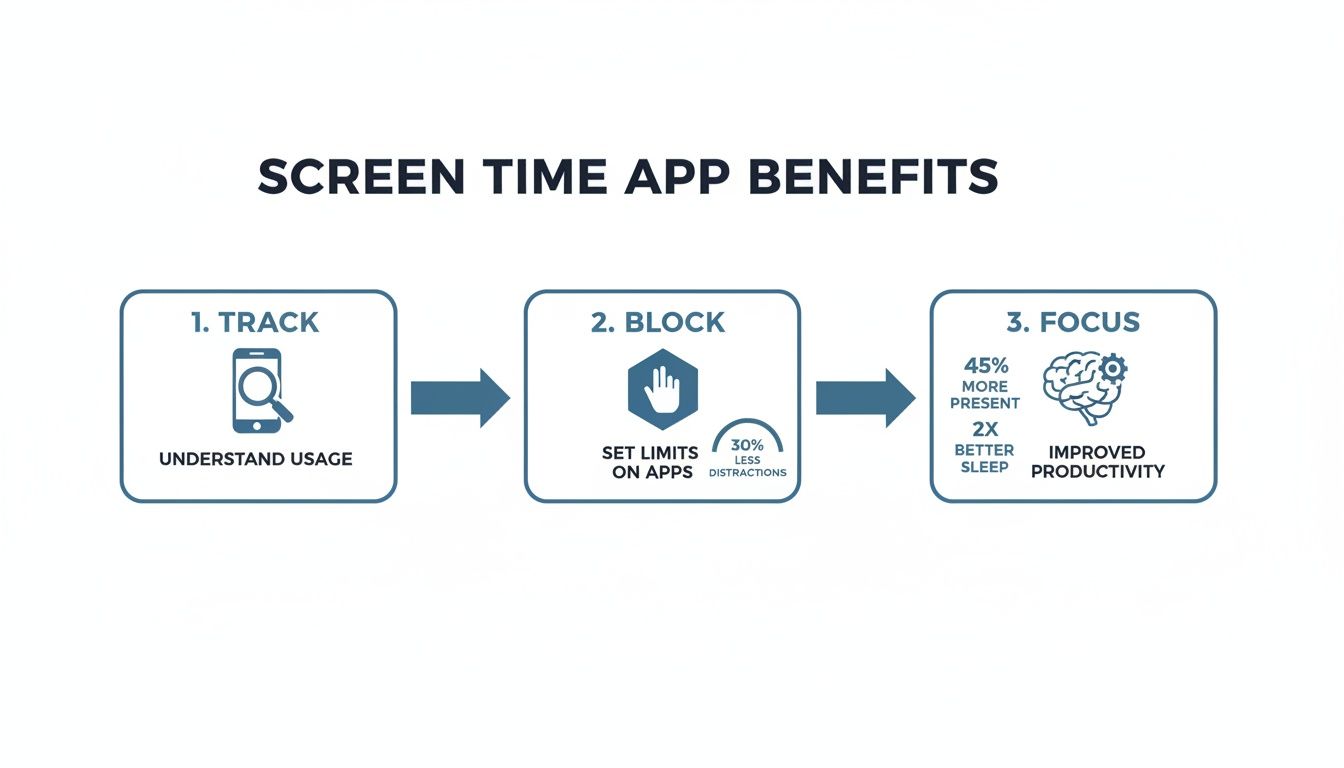
Blocking problem apps: You can set schedules to lock yourself out of your biggest time wasters during important parts of your day, like your morning routine or when you need to work.
-
Showing you the data: Most apps track your usage and show you exactly where your time is going. Seeing the numbers can be a real wake up call.
-
Scheduling focus time: If you need an hour of deep work, you can lock your phone down to remove the temptation to check it.
These features are great for interrupting autopilot behaviour. They create a moment of pause, giving you a chance to ask, "Do I really need to be doing this right now?"
But let's be realistic. An app can’t fix the reason you reach for your phone in the first place. It won’t solve boredom, reduce stress, or help you with the big task you’re avoiding.
A screen time app backs up the good decisions you’re already trying to make. It can't make those decisions for you. Without a plan for what you’ll do with your reclaimed time, you'll likely end up fighting the app's restrictions or just deleting it. The real work is in deciding what you want to do instead of scrolling. The app just helps you create the space for it.
A Structured Approach to Reducing Screen Time
Alright, let's get practical. Lasting change comes from building a simple, sustainable system, not from extreme measures that lead to burnout. A good screen time app is the tool that can help hold this system together. It provides the structure and friction needed to make more intentional choices.
First, Face the Numbers Without Judgement
The first step is always awareness. Before changing anything, you need an honest look at where your time is actually going. Your phone's built in tracker or your new app will show you this.
For the first week, just let it run. Don’t try to change your habits. The goal is to get a baseline, a clear picture of your current phone use. You might be surprised to see how much time you spend on certain apps.
This isn’t about feeling guilty. It’s just data. Seeing that you spend 25 hours a week on your phone is just the starting point on your map.
Remove Frictionless Access (Apps vs Browser Use)
Once you know where your time is going, you can start being strategic. The goal isn't to punish yourself; it's to make it slightly harder to access your biggest time wasting apps.
This is where your app to reduce screen time is a huge help. Use it to set up simple blocks during times you need to focus.
-
Protect your morning: Block social media and news apps until 9 AM. This gives you a couple of hours for yourself before the day’s distractions begin.
-
Create work or study zones: If you work from 9 to 5, lock down everything but essential apps. No more "quick scrolls" that turn into 30 minutes.
-
Set an evening wind down: Block endless scroll apps after 10 PM. This helps your brain switch off and prepare for sleep.
The idea is to interrupt the mindless "open and scroll" habit. Sometimes, even a 10 second delay is enough to make you stop and think about what you're doing.
Replace Phone Use with Intentional Alternatives
This is the most important part. You can't just create a void. If you free up two hours a day, you need a plan for that time. Otherwise, boredom will drive you right back to your phone.
Before your scheduled blocks start, decide what you'll do instead. You're not just stopping a bad habit; you're starting a better one.
Make a list of simple things: read a book, go for a walk without headphones, do some stretching, or work on a project you care about. When the urge to scroll hits, you'll have a ready made decision.
Review Progress Weekly Without Judgement
Finally, check in with yourself once a week. Look at your screen time report. Did your numbers go down? Where did you struggle?
There's no failure here, only learning. If you constantly overrode your blocks, maybe they were too aggressive. Ease them back. If you protected your mornings, that's a win. Acknowledge it.
This process is about small, consistent adjustments. Using a simple tool like our free habit tracker template can be useful for monitoring your progress.
My Experience Using a Screen Time App

I want to share my own story, not to sell you on anything, but to show you what’s possible when you become more intentional with your phone. This is an honest look at the struggle and what it took to make a change.
A few years ago, my screen time report regularly showed 4 to 5 hours a day. I felt drained, my focus was gone, and I was annoyed with myself for letting so much time disappear into mindless scrolling.
After trying and failing to "just use my phone less," I knew I needed to add some real friction. I found a screen time app called Opal. What worked for me was its ability to schedule strict, recurring blocking sessions that were difficult to override.
I started small. My biggest weakness was scrolling in the morning, which set a distracted tone for my day. My first move was to use Opal to block Instagram, news sites, and YouTube until 9 AM. The first few days were tough. But soon, that time became my own again. I started making coffee, reading, or planning my day in peace.
The biggest breakthrough wasn't the app itself, but the consistency it helped me build. The app was a guardrail that kept me on track long enough for better habits to form.
Progress wasn't a straight line. There were weeks my usage went up, especially during stressful times. But the app was always there, enforcing the boundaries I’d set for myself. It stopped small slip ups from turning back into old habits.
Today, my daily average is under 2 hours. I still use social media, but on my terms. Finding the right app to reduce screen time was key, not because it solved my problems, but because it gave me the structure I needed to solve them myself. Consistency was more important than perfection.
Other Simple Changes That Help Reduce Screen Time
While a good screen time app provides structure, you can boost its effectiveness with a few simple tweaks to your phone's environment. These are small changes that support your goal to reduce phone screen time. It’s about making your phone a less tempting and more intentional tool.
Widget Based Screen Time Visibility
Out of sight, out of mind. The reverse is also true. Most phones let you add a screen time widget to your home screen. Do it.
Seeing that number every time you unlock your phone is a powerful reminder of your goal. It keeps you honest with yourself throughout the day.
Deleting Apps and Using Browser Access
For social media apps that are particularly hard to resist, try deleting the app from your phone entirely. You can still access them through your phone's web browser.
This adds a significant layer of friction. Logging in through a browser is slower and less satisfying than opening a slick, optimised app. That small inconvenience is often enough to deter mindless checking.
Notification Control
Your phone's notifications are not your to do list. Most are just apps begging for your attention. It's time to be ruthless.
Go into your settings and turn off notifications for every app that isn't essential. Do you really need a banner when someone likes your photo? Or a buzz from a news app every hour?
Leave notifications on for texts, calls, and your calendar. Everything else is just noise designed to pull you back in. This one change can dramatically reduce how often you're tempted to pick up your phone.
Phone Free Zones or Times
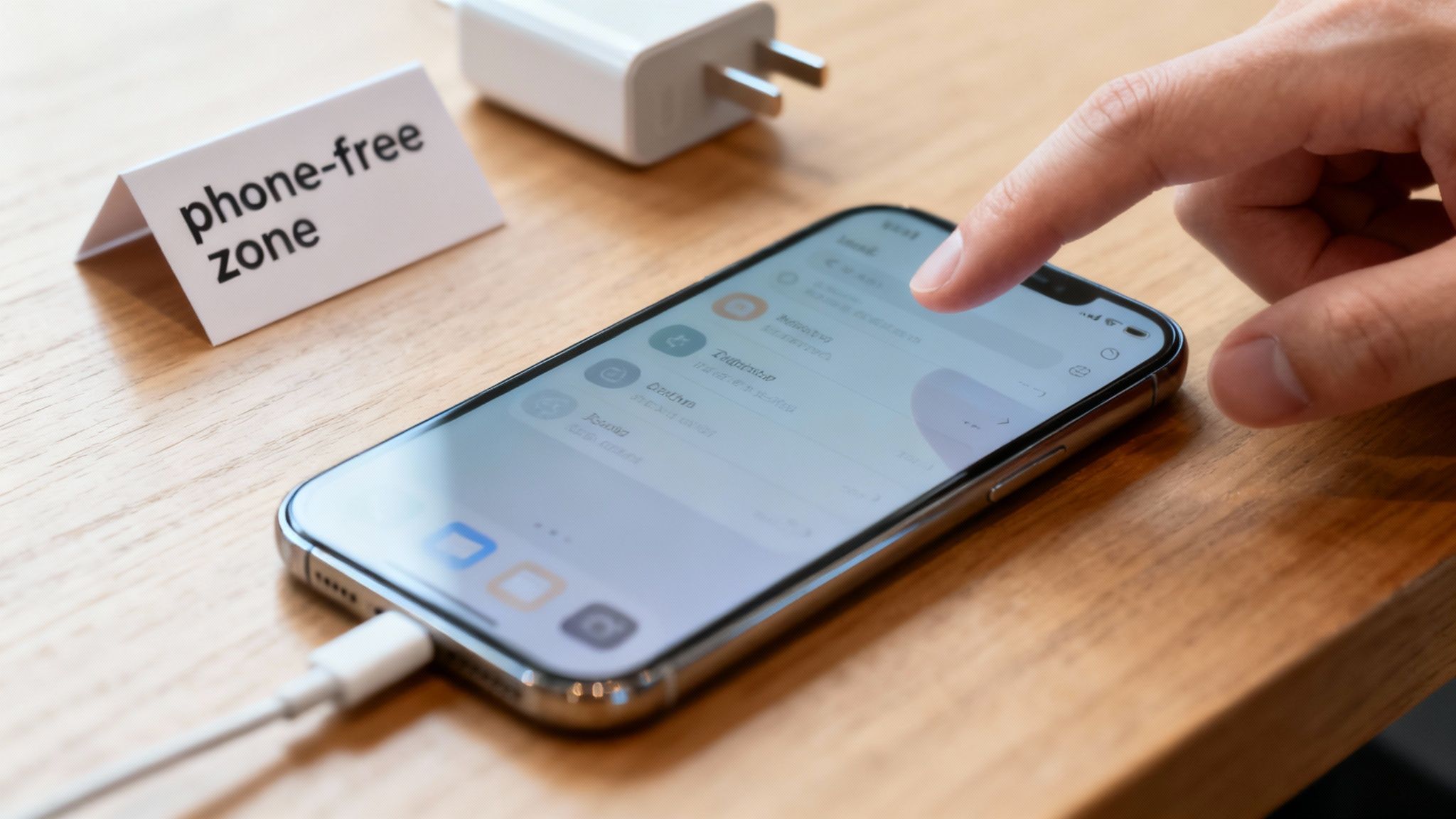
Your environment shapes your behaviour. A simple way to manage screen time is to create physical spaces and times where your phone isn't allowed.
Start with one or two powerful boundaries:
-
The Bedroom: Get your phone out of the bedroom. Buy a cheap alarm clock. This protects your sleep and stops you from starting and ending your day staring at a screen.
-
The Dinner Table: Make mealtimes a phone free zone, whether you're alone or with others.
These small rules help break the habit of having your phone constantly in your hand. They reintroduce moments of quiet and presence into your day.
When Apps Aren’t Enough
So you’ve tried it all. You have a good screen time app, you've set up blocks, and you've created phone free zones. But you still find yourself scrolling for hours.
If this is you, listen: this isn't a sign that you've failed. It’s a clue that your phone use might be a symptom of something deeper. This is more common than you might think.
Often, our phones are the easiest escape from things we don’t want to face, like boredom, loneliness, anxiety, or a lack of direction. The phone isn't the problem; it's just the way you're dealing with it.
For many of us, excessive screen time is tied to bigger issues. When you don’t have a clear sense of purpose or a good structure to your day, the endless feed provides an easy substitute. It fills a void.
Recognising this pattern is a huge first step. It shifts the problem from "I need to use my phone less" to "What am I avoiding, and what do I want to build instead?"
If your phone is your main source of stimulation or escape, fighting it will always be an uphill battle. The real goal is to build a life that’s more interesting and engaging than what's on your screen. This is where tools and apps can fall short, because they can’t address the underlying reasons for your behaviour.
Getting Help With Screen Time and Focus
If you've tried using a screen time app and other tools but still feel stuck, it might be time to consider getting some support. Sometimes, the problem isn't the phone itself, but the lack of structure, discipline, and focus in other areas of your life.
This is what we do at Your Bro. We provide online coaching and mentoring for young men who want to build a more intentional and disciplined life. It’s not about judgement or quick fixes. It’s about getting clear on what you want and building a practical plan to get there.
Working with someone can provide the accountability and guidance that tools alone can't offer. If you're ready to tackle the root causes of distraction and build lasting focus, we can help.
Learn more about coaching with Your Bro.
Conclusion
Reducing your screen time is completely possible. It’s not about finding the perfect screen time app or achieving some extreme digital detox. It’s about making small, consistent changes that put you back in control.
Focus on progress, not perfection. Be honest about what is and isn't working, and adjust your approach as you go. And remember, you don't have to figure it all out on your own. We're here to help. Book your Free Discovery Call today to learn about screen time apps and much, much more.