Self Meaning: What Is It and Why Is It Important?

Your sense of self meaning isn’t just a clinical term, it’s your internal compass. It’s that core understanding of who you are, what you value, and what truly drives you, completely separate from the noise of the outside world. It’s the bedrock you need to build a confident and intentional life you’re genuinely proud of.

What Does Sense Of Self Actually Mean For You

A person stands barefoot and glowing on a compass rose in an empty room, looking towards windows, looking for a sense of self meaning.

Let’s cut through the jargon. Understanding your sense of self is really about recognising the anchor within you. It’s the stable part of you that doesn’t change with your job title, your relationship status, or the number of likes on your latest post.

Think of it like the foundation of a house. When yours is solid, everything else you build on top like your career, relationships, and personal goals can actually withstand life’s inevitable storms.

Without that internal anchor, you end up feeling like you’re just drifting. You’re constantly reacting to what everyone else expects instead of acting from a place of personal conviction. You might find yourself chasing goals that society tells you are important, only to feel hollow and unfulfilled when you get there.

If you feel like a passenger in your own life, it’s a classic sign that your connection to your true self has grown weak. Reconnecting is the first step to taking back the wheel.

Your Internal Operating System

A strong sense of self is like a well-coded operating system for your life. It runs quietly in the background, guiding your decisions and reactions based on a consistent set of personal values and beliefs.

When you’re faced with a tough choice, this internal system helps you filter the options through the lens of what truly matters to you, not what others think you should do.

This inner framework is made up of a few key things you can develop:

  • Self-Awareness: The ability to honestly look at your own thoughts, feelings, and behaviours without judging them.
  • Core Values: The non-negotiable principles that define what’s most important to you, like integrity, freedom, or connection.
  • Personal Beliefs: Your unique take on the world, yourself, and your place in it, shaped by your experiences and reflections.
  • Identity Integration: The process of accepting all parts of yourself, the good and the not-so-good, as essential to who you are.

Moving Beyond External Validation

So many of us mistakenly build our sense of self on things that are completely outside of our control. We tie our worth to our professional success, the approval of our peers, or our role as a partner or parent. While these things are important parts of life, they aren’t the core of who you are.

A healthy sense of self provides the stability to navigate your life’s ups and downs without losing your footing. It’s the difference between knowing your worth and needing others to prove it to you.

When your job changes, a relationship ends, or you face criticism, a fragile sense of self crumbles because its foundation was built on shaky ground. In contrast, a robust sense of self allows you to weather these changes because your worth is internal and unshakable.

Developing this internal anchor is the first, most crucial step toward living a life that feels genuinely your own.

Why A Strong Sense Of Self Matters More Than Ever For You

In a world buzzing with digital noise and the endless scroll of social comparison, a solid sense of self isn’t just a nice-to-have, it’s your greatest advantage. This internal anchor dictates how you show up in every single area of your life, from your career path to your closest relationships.

Without a clear picture of your own values and purpose, you’re basically trying to get somewhere without a map. You become easily swayed by every distraction, every external expectation, and every passing trend that pops up on your feed.

This is exactly why building a strong sense of self is so crucial right now. It’s the one skill that lets you cut through all that noise and start building a life you actually want to live, on your own terms.

The Real-World Impact Of A Shaky Identity

When your internal framework is a bit wobbly, the consequences tend to show up in real, often frustrating, ways. You might even recognise some of these patterns in your own life.

  • Career Paralysis: You struggle to make any meaningful moves in your career because you honestly don’t know what you really want. Instead of chasing a path that aligns with your values, you end up chasing job titles or salaries that society tells you are impressive, which almost always leads to burnout and a deep sense of dissatisfaction.
  • Relationship Instability: You might find yourself becoming a chameleon, mirroring the personalities of your partners or mates and losing your own identity in the process. This reliance on others for validation makes it impossible to build healthy, solid relationships based on mutual respect.
  • Digital Distraction: A fragile sense of self makes you a prime target for the comparison trap on social media. You end up scrolling for hours, chasing validation through likes and comments because your self-worth is tied to what other people think, not what you know to be true about yourself.

These struggles are incredibly common, especially for young professionals and new dads navigating massive new responsibilities. It’s easy to feel lost when the pressure from the outside world is high and your internal anchor is weak. For many of us, the path back to ourselves starts by admitting these patterns exist; a journey I’ve shared in my own story.

Your ‘Why’ Is Your Ultimate Advantage

Knowing your personal “why” is what flips the switch from living a reactive life to a proactive one. When you finally get what truly drives you, you gain an incredible amount of clarity.

This is the very essence of understanding your sense of self; it’s about defining what success looks like on your own terms. Your “why” becomes the filter you run every choice through, making sure your actions line up with who you really are.

Building a strong internal framework isn’t about finding motivation; it’s about creating a sustainable source of it from within. It empowers you to set meaningful goals, build resilience when you hit a wall, and make decisions with unwavering confidence.

This kind of personal clarity is becoming so vital that people are actively looking for structured help to build it. The digital health coaching market has blown up recently, with mental wellbeing coaching being the fastest-growing bit of it. This trend shows just how much people, especially young men grappling with modern pressures, are investing in getting their identity back on track.

With 80% of coaching clients globally reporting a boost in their self-esteem, it’s pretty clear that guided self-discovery gets real results. You can explore the research on this growing trend in Australia if you’re keen.

Investing in knowing yourself isn’t a luxury; it’s a fundamental part of creating a life you actually want to wake up to every day.

Spotting a Fragile vs. a Healthy Sense of Self In Yourself

So, how do you actually know where you stand with all this? It’s one thing to get the theory behind ‘sense of self’, but it’s another thing entirely to see how it shows up in your day-to-day life. This isn’t about slapping on labels or judging yourself; it’s about recognising the real-world patterns that are either holding you back or propelling you forward.

The biggest clue is where you get your sense of worth and direction from. Is your anchor internal, built on a solid foundation of your own values and beliefs? Or is it external, swinging wildly depending on your job title, relationship status, or what you imagine other people are thinking of you?

Being brutally honest with yourself here is the first, most crucial step toward building a life that actually feels like your own.

The Internal Compass vs. The External Scorecard

Think of a healthy sense of self as a reliable internal compass. Even when life gets chaotic, and it always does, this compass keeps you pointed toward your personal true north. You can handle criticism, navigate setbacks, and make tough calls without completely losing your footing because you’re not looking outside for validation to tell you who you are.

On the flip side, a fragile sense of self is like keeping an external scorecard. Your self-worth shoots up and plummets based on your latest achievement, a compliment from a stranger, or hitting a certain career milestone. Living like this is exhausting. It leaves you feeling anxious, a bit lost, and like you’re constantly playing a part instead of just being yourself.

This is why building that internal compass is so important; it’s the foundation for so many other good things in your life.
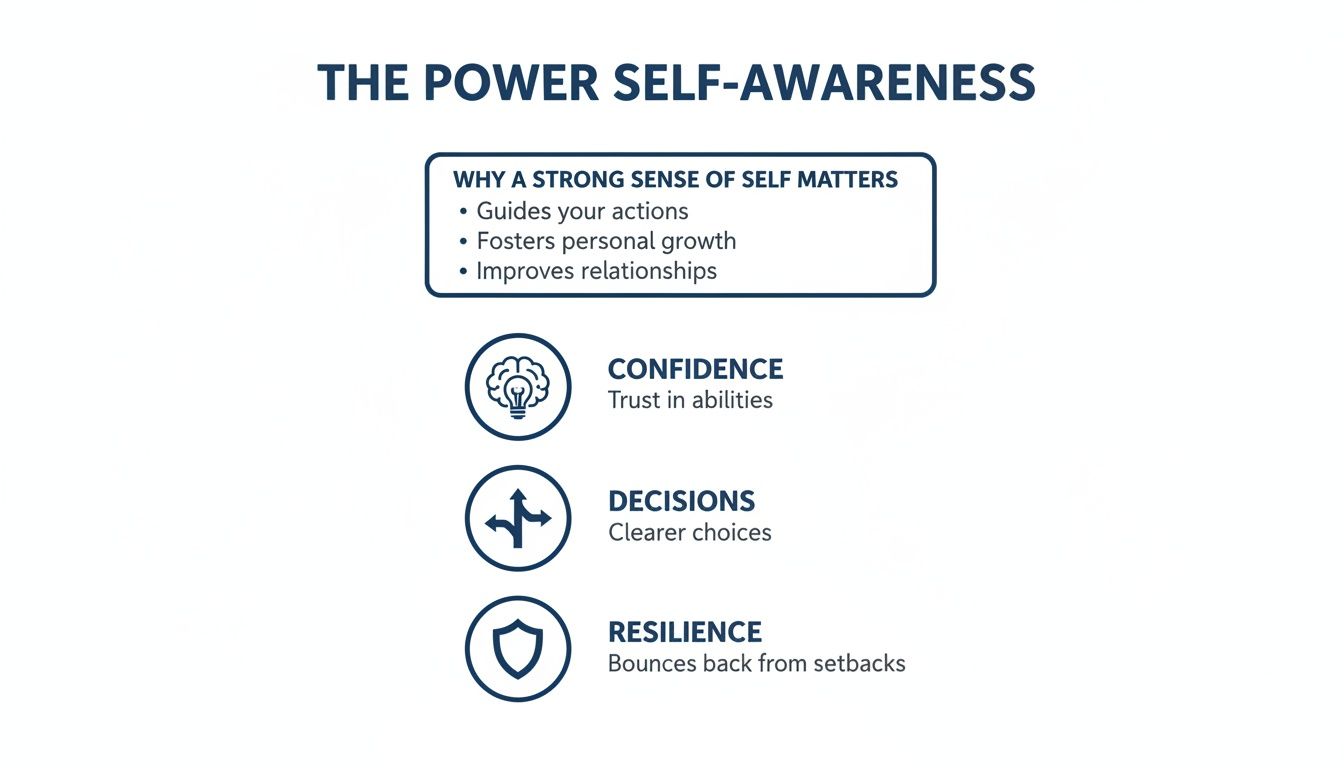
Infographic illustrating the power of self-awareness, explaining why it matters and its benefits like confidence, clearer decisions, and resilience.

As you can see, a strong sense of self is what fuels real confidence, helps you make sharper decisions, and builds the resilience you need to handle whatever curveballs life throws your way.

Healthy vs. Fragile Sense of Self: A Practical Comparison

To make this crystal clear, let’s break down what these two mindsets look like in action. The goal here isn’t to make you feel bad about yourself, but to give you the clarity to see where you might be getting in your own way. Sometimes, just recognising the pattern is the catalyst you need for a major shift.

Have a look at the table below as a quick self-check. Read through the different characteristics and see which column sounds more like you. This isn’t about keeping score; it’s simply about gaining awareness.

Characteristic Signs of a Healthy Sense of Self Signs of a Fragile Sense of Self
Decision Making You make choices based on your gut and internal values, even if it’s not the popular opinion. You trust yourself to know what’s right for you. You crowdsource opinions for every decision, terrified of making the “wrong” choice. Your default is to seek approval from others first.
Handling Criticism You can take on constructive feedback without it crushing your spirit. You’re able to separate a comment about your work from a comment about your worth. Even the slightest criticism feels like a full-blown personal attack, making you defensive, anxious, or causing you to shut down completely.
Personal Boundaries You’re comfortable saying “no” to things that don’t align with your priorities. You can set clear, healthy limits in your relationships without feeling guilty. You’re a chronic people-pleaser, saying “yes” to everything to avoid disappointing others, often at the expense of your own energy and well-being.
Source of Worth Your self-worth is stable and comes from within. You know your value isn’t tied to your job, your income, or whether you’re in a relationship. Your self-worth is a rollercoaster, soaring with praise and crashing with failure. It’s entirely dependent on external achievements and validation.
Authenticity You’re pretty much the same person no matter who you’re with. Your actions are a genuine reflection of your beliefs. What you see is what you get. You’re a social chameleon, changing your opinions, personality, or even your interests to fit in with whatever group you’re with at the moment.
Sense of Direction You have a clear idea of your personal “why.” You set goals that are actually meaningful to you, not just goals that look impressive to others. You often feel a bit empty, lost, or directionless. You find yourself chasing goals that society, your parents, or your peers told you were important.

Seeing these behaviours side-by-side gives you a snapshot of just how deeply your sense of self shapes your everyday experience.

If you found yourself nodding along more with the right-hand column, don’t panic. That’s not a sign of failure, it’s an opportunity. It’s a signal that it’s time to start the incredibly rewarding work of building your internal anchor.

Practical Steps You Can Take To Build Your Sense Of Self

Understanding the theory is one thing, but actually building a stronger sense of self takes real work. This isn’t some passive process you can just think your way into; it’s about rolling up your sleeves and getting your hands dirty. The framework below gives you tangible, coaching-inspired steps you can start taking today to build that solid internal anchor.

Each of these steps is designed to be straightforward but powerful, giving you a personal toolkit for real growth. Whether you’re a young professional trying to define success on your own terms or a new dad figuring out how to be a father without losing yourself, these exercises will create genuine momentum.

Start By Clarifying Your Core Values

Before you can build a life that feels authentic, you need to know what you’re building it on. Your core values are your non-negotiables; the fundamental principles that guide your decisions when no one is watching. They’re the absolute bedrock of a healthy sense of self.

But here’s the thing: most of us have never actually taken the time to define them. We just absorb values from family, mates, and society without ever stopping to ask if they’re truly our own. This exercise is your chance to change that.

To get started, have a crack at these prompts. Don’t overthink it, just write down whatever comes to mind:

  • Think about a time you felt genuinely proud and fulfilled. What were you doing, and what values were you honouring? (e.g., creativity, integrity, leadership).
  • Now, consider a time you felt angry, frustrated, or resentful. What important value of yours was being ignored or stepped on? (e.g., fairness, freedom, respect).
  • If you could change one thing about your community or the world, what would it be? This often points directly to a core value like justice, compassion, or innovation.

Look over your answers and circle the recurring themes and words. Try to boil it all down to a list of your top 5-7 core values. These are now your personal filters for making decisions.

Uncover Your Beliefs Through Journaling

Your beliefs are the stories you tell yourself about who you are and how the world works. A lot of these beliefs run on autopilot, shaping your reactions and choices without you even realising it. Journaling is a seriously powerful tool for bringing them to the surface so you can decide if they still serve you.

This isn’t about writing a perfect essay. It’s about having an honest conversation with yourself on paper.

The goal of journaling isn’t to find the right answers, but to ask yourself better questions. It’s the practice of observing your own mind without judgment, which is the cornerstone of self-awareness.

Use these prompts to get the ball rolling, dedicating a few minutes each day to one of them:

  1. “I should…” Statements: Finish the sentence “I should…” as many times as you can. Where did these “shoulds” even come from? Are they really yours?
  2. Defining Success: Forget about money or job titles for a second. What does a truly successful life look and feel like to you?
  3. Core Strengths: What’s something you’re naturally good at? How does it feel when you’re using that strength?
  4. Handling Failure: When was the last time you stuffed up or failed at something? What story did you tell yourself about it? Is that story helping you?

This practice helps you separate your own authentic voice from the internalised expectations of others, which is critical for strengthening your sense of self.

Set Goals That Are Genuinely Yours

Once you have a clearer picture of your values and beliefs, the next step is to align your actions with them. So many people set goals based on what they think they should want; the impressive career, the big house, the perfect family. This external focus is a classic sign of a fragile sense of self.

True fulfilment comes from chasing goals that actually resonate with your inner compass. A goal that’s aligned with your values provides its own motivation. For example, if “freedom” is a core value, a goal for you might be starting a side hustle rather than climbing the corporate ladder. If “connection” is key, a goal could be organising a weekly catch-up with your mates.

Building a stronger sense of self often involves learning how to find your passion by connecting your daily actions to what truly matters to you. This is where personal accountability becomes an absolute game-changer.

It’s no surprise the life coaching market is expanding as more people seek help to build intentional lives. Globally, 99% of coaching clients report being satisfied, and a massive 80% gain self-confidence, a crucial part of making this pivot. You can find out more by exploring the Australian market data on the rise of digital coaching. A structured approach turns those vague ambitions into a clear, actionable plan for your life.

How to Navigate Setbacks And Stay The Course

Building a solid sense of self isn’t some straight line from point A to B. It’s a messy, ongoing journey, and it’s full of real challenges. Trust me.

You’ll have days where that crippling self-doubt creeps back in. You’ll cop criticism from people who just don’t get what you’re doing. And you’ll feel that magnetic pull of old, comfortable habits trying to drag you back to where you started.

This is all a normal part of the process. The goal isn’t to be perfect; it’s to build resilience for the long haul. It’s about learning to see these moments as valuable data, not as proof that you’ve failed.

Think of this section as the straight-up, big brother advice you need right now. Growth is tough, no doubt about it, but it’s absolutely worth the effort. Let’s get into the mental tools you need to stay accountable to yourself and keep pushing forward.

Taming Your Inner Critic

One of the biggest hurdles you’ll face is your own negative self-talk. You know the one, that voice in your head telling you that you’re not good enough, that you’re going to fail. It’s an absolute expert at derailing your progress.

The trick isn’t to silence it completely, but to change your relationship with it.

When you catch yourself spiralling into negative thoughts, just pause and challenge them. Ask yourself, “Is this thought actually true, or is it just some old story I’m telling myself?” More often than not, you’ll realise this inner critic is just your fear talking.

A powerful technique is to give this voice a personality. Give it a ridiculous name, like ‘Nigel the Naysayer’. When Nigel starts chirping up, you can mentally say, “Alright, Nigel, I hear you, but I’m in charge here.” This simple act creates distance and helps you see the thought for what it is; just a thought, not a fact.

Setting And Defending Your Boundaries

As you start to strengthen your sense of self, you’ll begin making choices that actually line up with your values. This might mean saying “no” to things you used to agree to, or spending your time completely differently. Not everyone in your life is going to understand or support these changes straight away.

That’s why setting firm personal boundaries is non-negotiable. It’s all about protecting your energy and staying true to your own path, even when it feels bloody uncomfortable.

Here are a few practical ways you can do this:

  • Communicate Clearly and Simply: You don’t owe anyone a long-winded explanation. A simple, “Thanks for the invite, but I can’t make it,” is more than enough.
  • Anticipate Pushback: Some people are used to you being a people-pleaser. When they push back, just hold your ground calmly and repeat your boundary.
  • Protect Your Time: If you’ve committed to a new habit, like journaling or hitting the gym, treat that time like a non-negotiable appointment with yourself. Because that’s exactly what it is.

Setting boundaries is a massive act of self-respect. It sends a powerful message to both yourself and others that your needs matter.

Building Your Support Network

You can’t do this work in isolation. Trying to build a stronger sense of self while surrounded by people who drag you down is like trying to swim upstream in a storm. You need a crew that gets it and genuinely supports your growth.

This doesn’t mean you have to cut everyone out of your life. It just means being intentional about who you give your time and energy to.

Your environment is a powerful force. Curate a support network that reflects who you are becoming, not just who you have been. True support is about encouragement and accountability, not just agreement.

Look for mates who challenge you in a healthy way, mentors who have walked a similar path, or even a professional guide. Having someone to check in with can make all the difference, especially when you hit a rough patch. If you’re looking for that kind of structured support and accountability, exploring a coaching program can give you the framework to stay on track.

Ultimately, navigating setbacks is about learning to be your own staunchest ally. It’s about forgiving yourself when you slip up, celebrating the small wins, and remembering why you started this in the first place. This journey reinforces the very core of your sense of self, it proves that your worth isn’t based on flawless performance, but on your commitment to showing up for yourself, day after day.

Got Questions? Let’s Get Them Answered

Digging into your inner world and figuring out who you are can bring up a lot of questions. It’s only natural. Below, I’ve tackled some of the most common ones that come up, giving you direct, no-BS answers to help you on your journey.

How Long Does It Take To Build A Stronger Sense Of Self?

Look, there’s no magic timeline here. This is a deeply personal journey, and everyone moves at their own pace.

That said, with consistent effort and the right guidance, most people start to feel a real shift in their clarity and confidence within a few months. It’s less about hitting some final ‘destination’ and more about building a lifelong habit of checking in with yourself. The goal is progress, not perfection. Coaching can definitely speed things up by giving you a clear structure and a solid dose of accountability, helping you cut through all the frustrating trial-and-error.

Is ‘Sense Of Self’ Just Another Way Of Saying Self-Esteem Or Confidence?

Good question. They’re definitely related, but they’re not the same thing at all.

Think of your sense of self as the concrete foundation of a house. It’s that deep, solid, internal knowledge of who you are, what you stand for, and what your purpose is. It’s the unshakable bedrock that doesn’t crack under pressure.

Once that foundation is solid, you can build the rest of the house:

  • Self-esteem is how you feel about the house you’ve built on that foundation. It’s your sense of self-worth.
  • Confidence is your belief in your ability to live in that house and handle whatever life throws at it. It’s the trust you have in yourself to take action.

When your sense of self is strong, you create genuine self-esteem and confidence that lasts, the kind that doesn’t crumble the second you stop getting likes on Instagram or praise from your boss.

Can My Sense Of Self Change Over Time?

Absolutely. In fact, it should. A healthy sense of self isn’t some rigid thing you figure out once and lock away. It’s meant to evolve as you have new experiences, learn new things, and just plain grow as a person.

The key difference is that this evolution is driven by your internal compass and reflections, not by a desperate need to fit in or keep everyone else happy.

Your core identity should be both stable and adaptable. Think of it like a firm anchor that still allows your ship to navigate the changing tides of life without getting lost at sea.

Big life events like a career change, becoming a parent, or getting through a massive personal challenge will naturally sharpen your understanding of who you are. The goal is to build a core you can always come back to, even as you continue to grow.


Feeling like it’s time to stop winging it and start building a life with real intention? At Your Bro, we provide the practical, no-BS guidance to help you find your purpose and create an actionable plan. Book a free discovery call today and let’s get to work. https://yourbro.com.au


What is Eudaimonia?

Ever felt like you're stuck on a treadmill, chasing highs that disappear as soon as they arrive? It’s a common feeling, and it’s a clear sign that our modern pursuit of just 'feeling good' is fundamentally broken.

Real, lasting fulfilment isn't found in fleeting pleasure. It comes from something the ancient Greeks called eudaimonia: a life built not on feeling good, but on living well.

Tired of Chasing Temporary Happiness?

So you’re doing everything you’re “supposed” to do. You’re getting the likes, buying the new gear, chasing the next promotion… only to find the satisfaction vanishes almost instantly. Sound familiar?

This endless cycle of seeking short-term hits of pleasure is exhausting. More often than not, it leaves you feeling more empty than when you started. You are definitely not alone in feeling this way.

This sense of being adrift comes from a massive misunderstanding of what a good life actually is. We’ve been sold the idea that happiness is the same as momentary pleasure. A life built on that foundation is like a house built on sand; it’s unstable and crumbles at the first sign of a storm. The constant need for the next buzz just keeps you distracted, preventing you from building anything real and substantial.

Young man sitting on a treadmill, looking out a window with augmented reality overlays.

Shifting Focus from Feeling Good to Living Well

This is where eudaimonia stops being an old, dusty term and becomes a practical roadmap for your life. It offers a powerful alternative: stop chasing feelings and start building character.

Instead of asking, "What will make me feel good right now?" you start asking, "What action will make me a better, stronger person?"

This is a profound shift. It’s about moving your focus to the things you can actually control:

  • Your Actions: How you choose to respond to challenges and opportunities.

  • Your Values: The non-negotiable principles that guide your decisions.

  • Your Purpose: The 'why' that pulls you forward, especially on the tough days.

Eudaimonia is the deep satisfaction that comes from living a life of purpose and integrity, realising your potential through consistent effort and responsibility. It’s the difference between the fleeting joy of a great party and the profound pride of building the house yourself.

To put it simply, this is about building a life that feels genuinely meaningful from the inside out. It's not about being perfect. It’s about the consistent, daily practice of living with intention.

This guide will show you exactly how to get off that treadmill and start constructing a life of deep, sustainable wellbeing.

Chasing Happiness vs Living With Purpose

It's easy to confuse these two paths, but they lead to entirely different destinations. One is a rollercoaster of highs and lows; the other is a steady climb toward a meaningful summit.

Here’s a quick comparison to show you the fundamental differences between chasing temporary pleasure (feeling good) and building a meaningful life (living well).

Aspect Chasing Happiness (Feeling Good) Living With Purpose (Living Well)
Focus External pleasure, immediate gratification Internal growth, long-term fulfilment
Source Events, possessions, sensory experiences Values, character, personal potential
Timeframe Short-term, fleeting Long-term, sustainable
Motivation Seeking pleasure, avoiding pain Seeking meaning, embracing challenges
Response to Difficulty Avoidance, frustration, distraction Resilience, growth, learning
Outcome A rollercoaster of emotions Deep, stable sense of wellbeing and purpose

As you can see, one path is about consuming experiences, while the other is about creating a life of substance. The choice to move from the left column to the right is the first real step toward eudaimonia.

Understanding Eudaimonia In Plain English

Let's cut through the academic jargon. At its core, eudaimonia is about human flourishing. Think of it as the deep, stable kind of satisfaction you feel when you’re living as your best, most authentic self by striving to reach your full potential.

Forget the idea of a constant, euphoric state of happiness. That’s not what this is about. Eudaimonia isn't measured in smiles per hour; it’s measured in substance and character. It’s the quiet pride that comes from acting with integrity, even when no one’s watching.

Think of it like building a house. Chasing temporary happiness is like throwing a great housewarming party, fun for a night, but it’s over before you know it. Eudaimonia is the act of laying the foundation, raising the walls, and building a sturdy roof. It’s the hard, rewarding work that creates something that lasts.

Living Well vs Feeling Good

The critical difference here is between living well and just feeling good. Feeling good is temporary and often depends on external things: a compliment, a new purchase, or a good meal. Living well, however, is an internal achievement.

It's about the fulfilment that comes from pushing yourself to grow, mastering a difficult skill, or simply being the person you said you would be. This kind of satisfaction isn't a fleeting high; it’s a bedrock of self-respect that stays with you.

This is where discipline and responsibility come into the picture. Eudaimonia requires you to:

  • Act on your values: Your actions must line up with what you truly believe is right.

  • Embrace challenges: You see difficulties not as threats to your happiness, but as genuine opportunities for growth.

  • Take ownership: You are the architect of your life, responsible for the choices you make.

Living a life of eudaimonia means you stop asking, "What do I want to feel?" and start asking, "Who do I want to be?" The good feelings that follow are a byproduct of living with purpose, not the goal itself.

This shift in perspective is the foundation for a life with real meaning. It moves you from being a passenger, tossed around by fleeting emotions, to being the driver, intentionally navigating toward a worthy destination.

It’s not some abstract ideal; it’s a practical, daily commitment to becoming the strongest version of yourself. For a deeper look into this, you can explore our guide on finding what is the purpose and meaning of life and how it connects to your actions.

Why Living Well Beats Feeling Good

We're drowning in a culture obsessed with the quick fix. A 'like' on Instagram, the thrill of an online purchase, the mindless comfort of binge-watching a new series, they all give us a little buzz. This is the world of temporary pleasure. It's exciting, it's easy, and it's also incredibly shallow.

This constant chase for the next 'feel-good' moment is a massive source of the anxiety and distraction so many of us feel. It puts you on a hamster wheel, always needing another hit just to feel okay. But a life built on these fleeting highs is like building a house on sand. When the storms of life inevitably hit, there’s nothing solid underneath you.

This is where eudaimonia, or living well, offers a real alternative. It’s about trading the cheap thrill of a notification for the deep, lasting satisfaction that comes from mastering a difficult skill. It’s the difference between seeking flimsy validation from others and earning profound self-respect by conquering a personal challenge.

The Foundation of Real Fulfilment

Living well means showing up. It’s being a reliable partner, a present parent, or a disciplined professional, especially on the days you don't feel like it. This quiet commitment to your values and responsibilities builds something temporary pleasure never can: resilience.

When your sense of self is grounded in your character and your actions, you're not so easily shaken by things outside your control. You start to build genuine mental toughness and a strong identity that isn't dependent on the next dopamine hit.

This approach is a direct antidote to that feeling of aimlessness. Instead of just drifting from one distraction to the next, you begin to intentionally build a life you actually respect. That process alone creates a powerful sense of momentum and direction.

Eudaimonia isn't about feeling happy every second of the day. It's the quiet confidence that comes from knowing you're living a life of substance, guided by your own purpose and integrity.

Australian wellbeing research backs this up completely. Major studies make a clear distinction between happiness from pleasure (just feeling good) and eudaimonic wellbeing (actually living well). The long-running Australian Unity Wellbeing Index consistently finds that our national wellbeing is a stable state of flourishing, not just a temporary spike of positive emotion. This lines up perfectly with what the ancient thinkers were talking about all those years ago.

On top of that, a huge study of over 12,000 Australian adults discovered that making consistent, positive changes, like simply eating more fruit and veg each day, led to a jump in life satisfaction comparable to going from unemployed to having a job. This is huge. It shows that real wellbeing is forged in our daily routines and disciplined actions, not just our fleeting feelings. You can read more in the full research on lifestyle and life satisfaction.

This is the heart of eudaimonia: a robust, lasting fulfilment that cheap pleasures can't even begin to touch. It’s the profound satisfaction of building something meaningful, one disciplined choice at a time.

The Four Pillars of a Flourishing Life

So, how do we take this ancient idea of eudaimonia and actually use it? It's simpler than you might think. This isn't about grand gestures or becoming a monk on a mountaintop. It's about building your life around four practical pillars that anyone can start laying today.

These aren't quick fixes. Think of them as the foundations. When you practise them consistently, they create a life of substance, resilience, and genuine satisfaction.

This little concept map nails the core difference between chasing pleasure (a temporary fix) and building eudaimonia (lasting fulfilment).

Flowchart illustrating the pursuit of well-being, showing Hedonia leading to consumption, and Eudaimonia leading to growth and meaning.

As you can see, one path leads to endless consumption and dependency. The other leads to genuine growth and meaning. It's a clear choice.

1. Define Your Core Values

First things first: you need to know what you stand for. Your values are your personal, non-negotiable principles. They’re the compass for your decisions. Without them, you’re just reacting to life, getting pulled in whatever direction the wind blows.

When you know your values, things like integrity, family, or personal growth, making hard choices becomes simpler. You stop asking, "What's easiest?" and start asking, "What's right for me?" This alignment between what you believe and what you do is a massive source of personal power and self-respect. If you're a bit stuck, have a look at our list of personal values examples to find what resonates.

2. Take Full Responsibility

This is the pillar that separates the adults from the children. Taking full responsibility means owning your choices, your actions, and your outcomes. No blame, no excuses. It’s the raw understanding that while you can’t control everything that happens to you, you have 100% control over how you respond.

When you blame external factors, your boss, the economy, your past, you’re literally giving away your power to change things. True freedom only comes when you acknowledge your role in your own life. It’s tough, but it's the only way to build a future you actually want.

The moment you stop making excuses is the moment you reclaim control over your life. Responsibility isn't a burden; it's the ultimate tool for creating your own path.

3. Embrace Constructive Discipline

Discipline gets a bad rap. We often see it as punishment or restriction. But in the context of eudaimonia, it’s the exact opposite: discipline is the tool that creates freedom. It’s the structure you build that allows you to actually achieve your goals.

Think about it:

  • The discipline to wake up early gives you the freedom of a quiet, productive morning.

  • The discipline to manage your money gives you the freedom from financial stress.

  • The discipline of regular exercise gives you the freedom of a healthy, capable body.

Constructive discipline isn't about forcing yourself to do things you hate. It's about consistently doing the things your future self will thank you for.

4. Pursue a Worthy Purpose

The final pillar is having a 'why' that pulls you forward. A purpose doesn’t have to be some grand, world-changing mission (though it can be). For most of us, it’s a more personal reason for being, a direction that gives our daily grind meaning.

Your purpose could be being a great father. It could be building a small business that helps your community, or simply mastering a craft you love. It’s the reason you get out of bed on the hard days. It provides the fuel to push through challenges because you know your effort is contributing to something bigger than your own momentary comfort.

This is what truly drives a flourishing life.

How to Put Eudaimonia Into Action Today

Alright, knowing what eudaimonia is feels good, but living it? That’s a whole different game. The good news is you don’t need to flip your life upside down overnight. A flourishing life isn’t built with one grand gesture; it’s pieced together with small, consistent, and intentional actions. Progress, not perfection, is the name of the game here.

This isn’t about floating around in abstract theory. It’s about getting your hands dirty with practical steps that start building a more aligned and meaningful life, right now. Let's make this real.

Person writing 'VALUES' in a notebook with a pen, beside a cup of tea on a desk.

The Values Audit

Think of your values as the compass for your life. If you’re heading north but your actions are taking you south, you’re going to feel that friction, that nagging sense of conflict and dissatisfaction. Time for a quick audit.

  1. List Your Top 5 Values: Grab a pen and paper. No overthinking. Just jot down the five principles that matter most to you. Think honesty, family, growth, freedom, health, whatever they are for you.

  2. Assess Your Last 48 Hours: Now, look back at the last couple of days. Did the way you spent your time and energy actually reflect those values?

  3. Identify One Small Shift: Find one tiny action you can take tomorrow that brings you a step closer to alignment.

This simple exercise is incredibly powerful for snapping you out of autopilot and into intentional living. It's the first real step. If you want to build a bigger roadmap, you can start structuring your goals using a personal development plan template.

The Responsibility Check-in

Blame and excuses are the enemies of a flourishing life. Why? Because they hand your power over to someone or something else. Taking ownership is how you snatch it back.

  • Identify One Excuse: Be honest. Where in your life have you been blaming external factors for a lack of progress?

  • Decide on a New Action: What’s one small, concrete action you can take that represents 100% ownership? Maybe it’s a tough conversation, setting a boundary, or finally creating that budget.

This isn't about beating yourself up. It’s about empowering yourself to be the one who makes the change.

The core of eudaimonic living is recognising that your power lies in your response. By choosing responsibility over excuses, you move from being a victim of circumstance to the architect of your future.

The Discipline Starter

Discipline is the engine that drives a flourishing life. Forget the idea of it being punishment; it’s about consistently doing the things your future self will thank you for.

  • Choose One Habit: Pick one small, non-negotiable habit you can commit to for just seven days. A 10-minute walk. Reading 10 pages. Waking up 15 minutes earlier without hitting snooze. Keep it simple.

  • Track Your Progress: Mark off each day you do it. The goal isn’t a perfect streak; it’s to build a little momentum and prove to yourself that you’re someone who follows through.

Here in Australia, this whole idea of eudaimonia ties directly into what researchers often call “subjective wellbeing.” Data from the ABS backs this up, showing that stable, supportive relationships, a massive part of a flourishing life, are strongly linked to higher life satisfaction. For instance, 81% of married Australians report being satisfied, compared to just 60% of lone parents. It's a stark reminder that our connections and commitments are vital pillars of a well-lived life.

Stop Drifting and Start Building Your Life

The path to eudaimonia starts with a simple choice. It's the decision to stop being a passenger in your own life, just reacting to whatever comes your way. It’s about consciously picking up the tools to become the architect of your own fulfilment.

This isn’t some lofty idea reserved for ancient thinkers. It's a grounded, practical way to build a life of substance and meaning, one you can be genuinely proud of. You have everything you need to start right now.

Think of it like this: your life is built on a foundation of your personal values, fortified by constructive discipline, and guided by a purpose that actually matters to you. Every responsible choice, every moment you act with integrity, is another brick laid in a foundation of self-respect and lasting wellbeing.

Your Chance to Take Control

Making this shift from passive to active is more important than ever. Long-term Australian data shows that both happiness and eudaimonia aren't static; in fact, average happiness has been declining since 2009.

Ipsos data also reveals a fascinating generational gap: Baby Boomers report the highest levels of happiness (75%), while Gen X reports the lowest (65%). For the 62% of unhappy Australians, financial pressure is a huge driver, which really highlights the need to separate our sense of purpose from our paycheque. As you can learn more about Australian happiness trends, it becomes crystal clear that building an eudaimonic life is the most powerful way to reclaim a sense of control.

Eudaimonia is your chance to stop drifting and start building. The process itself, the effort, the growth, the alignment, is where true satisfaction is found.

Your best life isn't something you find; it's something you build. Let's start today.

Your Questions About Eudaimonia, Answered

Alright, let's get into the nitty-gritty. When you start exploring a concept like eudaimonia, a few practical questions always pop up about how it actually works in the real world. Here are some straight answers to the most common ones, without the academic fluff.

Can I Chase Eudaimonia and Still Have Fun?

One hundred percent. Let's clear this up right now: eudaimonia is not about turning into a joyless robot who meditates on a mountaintop and renounces all worldly pleasures. That's a common misconception.

A flourishing life absolutely includes a good laugh, great food, and kicking back with your mates. The difference is that those moments of pleasure aren't the only thing you're living for. They're part of a bigger picture, one that's framed by your values and your purpose. Think of it this way: pleasure is the seasoning, not the main course.

Is Eudaimonia Just Another Word for Stoicism?

They're definitely related, but they're not the same thing. It's simpler to think of it like this: eudaimonia is the destination – that state of genuine human flourishing you're aiming for. Stoicism, on the other hand, is one of the maps you can use to get there.

Stoicism offers a brilliant toolkit of practical strategies (like focusing only on what you can control) to build resilience, inner peace, and character. Many of its practices are incredibly powerful for living a eudaimonic life, but they are the path, not the end goal itself.

The core idea is simple: Eudaimonia is the 'what' (a flourishing life), while philosophies like Stoicism can be the 'how' (a practical framework to build it).

How Long Does It Take to 'Get' Eudaimonia?

This is probably the most common question, and answering it requires a bit of a mental shift. Eudaimonia isn't a trophy you win or a finish line you cross. It's a continuous process of living with intention, day in and day out.

It’s a practice, not a prize. You don’t just wake up one morning and find you've "achieved" it. Instead, you start feeling the benefits, a deeper sense of self-respect, stronger resilience when things go wrong, and a clear purpose, the moment you start aligning your daily actions with what truly matters to you. The journey itself is the reward.


Feeling like you're stuck in a rut or just winging it? If you're ready to stop drifting and start building a life you're genuinely proud of, Your Bro is here to back you up. We offer practical, no-BS life coaching to give you the clarity, tools, and accountability you need to get moving. Book a free discovery call and let's start mapping out your plan today.

How to Stop Being Lazy

How to stop being lazy, you ask? The first move is to reframe the problem. It’s not a character flaw; it’s usually a symptom of lacking clarity, energy, or structure in your life. The best way to start? Pick one tiny, physical action you can knock over in less than two minutes. Seriously. Put one dish in the sink. Write a single sentence for that assignment. This tiny win is all it takes to break the cycle of doing nothing and start building some real momentum.

Why You Are Not Actually Lazy

Let’s reject an idea from the start: that most young men are “lazy.” The label itself is a dead end. It’s a harsh judgment that suggests a deep, personal failing, and it doesn’t solve anything. If you’re a young man in Australia today, that feeling you’re calling “laziness” is probably a logical response to being overloaded.

That feeling of being stuck, choosing to scroll through TikTok instead of starting that assignment, or watching another YouTube clip instead of hitting the gym, isn’t a sign of weakness. It’s a signal. Your system is telling you something is off, and it’s almost certainly not a character defect.

Reframing the Feeling

Instead of self-criticism, it’s more practical to see this state as a symptom of a deeper issue. Consider these as the common culprits that often disguise themselves as laziness:

  • Lack of Clarity: You can’t start if you don’t know what “starting” looks like. A vague goal like “get fit” or “start a side hustle” is paralysing. Your brain, looking for the path of least resistance, defaults to doing nothing because the first step is a complete mystery.
  • Lack of Energy: You can’t run on an empty tank. Constant stress, poor sleep, a bad diet, and decision fatigue drain your physical and mental reserves. When your energy is at rock bottom, even simple tasks can feel monumental. Your brain isn’t being lazy; it’s conserving what little fuel it has left.
  • Lack of Structure: An unstructured day is an open invitation for distraction. Without a clear plan or routine, your time gets swallowed up by low-effort, high-dopamine hits like gaming or social media. This isn’t a moral failing; it’s just your brain following the easiest path laid out for it.

This shift in perspective is critical. You move from self-blame (“What’s wrong with me?”) to practical problem-solving (“What part of my system is failing?”). It’s the difference between trying to fix a faulty engine by yelling at it versus opening the bonnet to see what’s wrong.

The Real Problem Is Overload, Not Inaction

The notion that young men are inherently lazy is a myth. More often, you’re dealing with a world that demands constant attention and performance, which leads straight to burnout. Your brain seeks refuge in low-effort activities to cope. It’s an act of self-preservation, not a character defect.

This feeling of being stuck can also point to a deeper disconnect. When your daily actions don’t line up with what you truly value, it’s natural to feel a profound lack of drive. This is where getting a handle on your bigger picture becomes essential. If you want to dig deeper into this, our guide on discovering what is the purpose and meaning of life has some solid insights.

By rejecting the “lazy” label, you can investigate the real cause. Are you unclear on your goals? Are you physically or mentally exhausted? Is your environment a chaotic mess? These are all solvable problems. You don’t need more willpower. You need a better system, a clearer direction, and a practical starting point.

Diagnose the Real Problem: Clarity, Energy, or Structure?

Before you can build a system to move past procrastination, you need to know what you’re actually up against. That feeling of being “lazy” or stuck isn’t a single problem. It’s usually a symptom pointing to one of three root causes.

Pinpointing the real issue is the first practical step toward ditching the lazy label for good.

Is it a lack of clarity, leaving you unsure of what to do next? Maybe it’s a lack of energy, making simple tasks feel like climbing a mountain. Or is it a lack of structure, sending your day into a tailspin of disorganised chaos? Nine times out of ten, what you’re calling “laziness” is just one of these three culprits in disguise.

This isn’t just a personal feeling; it reflects broader trends. Here in Australia, what many young men call “laziness” is often a nervous system screaming for a break. Labour productivity has been flat or falling, yet many are working more. Since 1980, productivity gains should have allowed us to cut our work week by about 15 hours. Instead, we took 77% of that dividend as higher income, forcing us to work longer hours just to keep up.

For a young man in Sydney or Melbourne juggling study, work, a side hustle, and social pressure, it’s a recipe for burnout. When your brain is constantly overloaded, it defaults to energy-saving mode, that’s where the mindless scrolling and gaming comes in. It’s a survival mechanism, not a character flaw. You can dig into the full productivity bulletin to see the economic pressures for yourself.

The Three Core Issues

To solve this, you need to become a detective in your own life. Let’s take a common scenario.

An aspiring freelance web designer knows he should be finding clients. But instead of sending cold emails or updating his portfolio, he spends hours watching YouTube tutorials on new design trends. He even spends an entire evening tweaking his website’s font for the tenth time.

He feels “lazy,” but the real problem could easily be one of the three:

  • Clarity: He doesn’t have a specific, actionable plan. “Find clients” is way too vague. What’s the very first, smallest step he can take right now? His brain defaults to research, a classic form of productive procrastination, because it’s easier than facing the uncertainty of client outreach.
  • Energy: He’s just finished a full day at his main job, dealt with life admin, and tried to squeeze in a gym session. By the time he sits down to work on his freelance business, his decision-making tank is on empty. His brain craves the easy dopamine hit from YouTube over the high-effort task of crafting a compelling email.
  • Structure: He has no dedicated time or space for his freelance work. He just tries to “fit it in” whenever he feels like it, which is a recipe for inaction. Without a non-negotiable block of time in his calendar, distractions will always win.

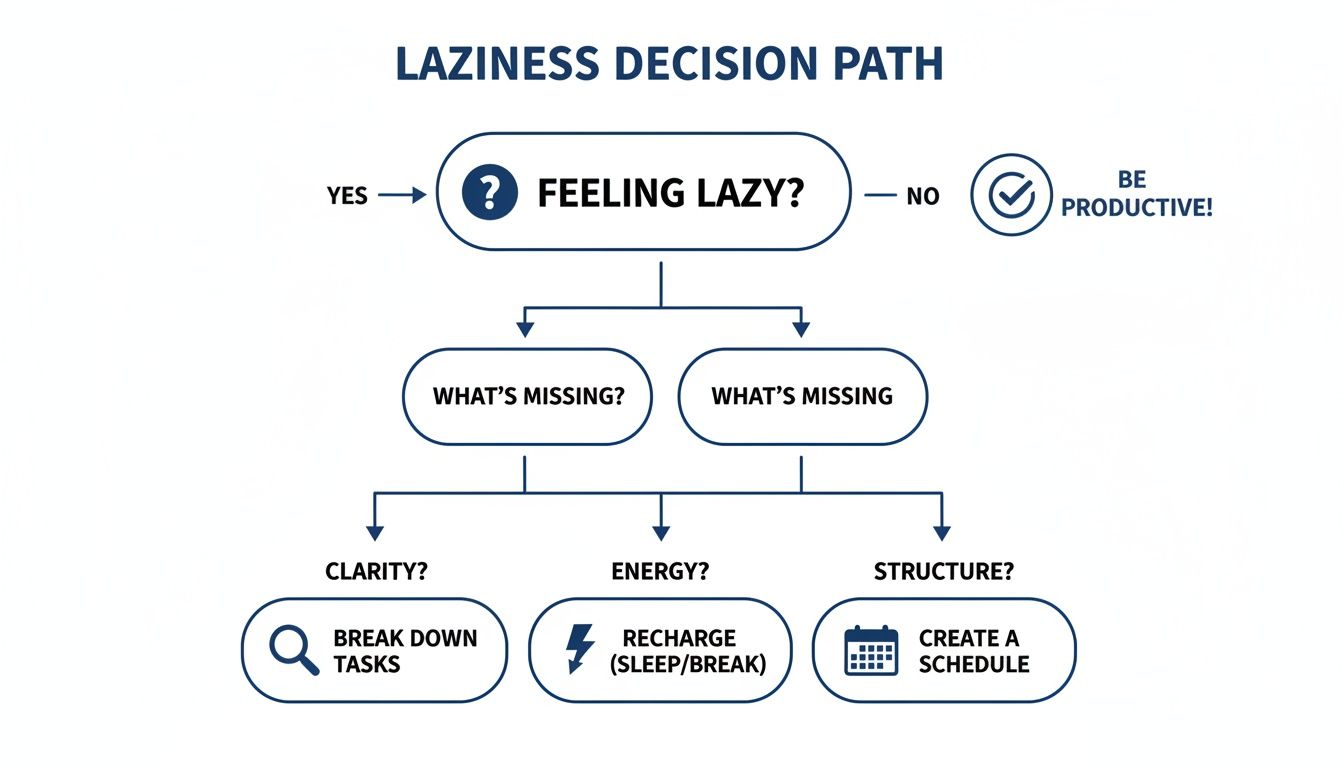
This flowchart gives you a simple way to visualise the decision path and figure out where you’re getting stuck.

How to stop being lazy. Flowchart illustrating a laziness decision path with solutions for clarity, energy, and structure.

As you can see, the path forward starts by asking the right question about why you feel stuck, which points you directly to the most likely cause.

How to Diagnose Your Specific Issue

You don’t need a therapist to figure this out. The key is to honestly connect how you feel with what you do (or don’t do). Being straight with yourself is the only way to make real progress.

Think about the last time you put off something important. What was the main feeling? What did you do instead?

Use this table to match your experience to the most likely cause. This quick exercise will give you a clear starting point.

Identifying Your Procrastination Trigger

Symptom You Feel Potential Cause: Clarity Potential Cause: Energy Potential Cause: Structure
Overwhelmed & Lost “I don’t even know where to begin, so I do nothing.” “The thought of starting is just too exhausting.” “I have so much to do, I just bounce between tasks.”
“Productive” Procrastination You spend hours researching or planning instead of doing the actual task. You choose easy, low-value tasks over the important, difficult ones. You get distracted by every notification or interruption that comes your way.
Physical Sensation A feeling of mental fog or confusion when you think about the task. A sense of physical heaviness, fatigue, or wanting to nap. A feeling of being scattered, restless, or unable to focus.
Your Go-To Excuse “I need to figure out the perfect plan first.” “I’m just not in the mood right now; I’ll do it later.” “I just got sidetracked; I’ll get back to it in a minute.”

Once you’ve identified your primary bottleneck, whether it’s clarity, energy, or structure, you can stop fighting a vague enemy like “laziness”. Now you can start using targeted, practical solutions for the real problem.

The following sections will give you the exact tools for each.

Build Momentum with Micro-Habits

A person's hand writes "Senteme" on lined paper, next to a sticky note saying "one sentence" and a coffee cup.

If you’ve figured out that a lack of clarity, energy, or structure is what’s holding you back, your first instinct might be to draft a massive, life-altering plan. Avoid this. That’s a classic recipe for feeling overwhelmed and doing nothing at all.

The practical way to get unstuck is to start so small it feels almost ridiculous.

Big goals are intimidating. They demand a huge amount of activation energy, something you might be running low on right now. The answer isn’t to rely on willpower; it’s to lower the bar for getting started so much that taking action is the easiest choice you can make.

This is where the simple power of micro-habits comes into play. We’re talking about actions so tiny, they’re almost impossible not to do.

The Non-Zero Day Philosophy

The core idea is simple: do one thing, no matter how small, that moves you toward your goal. This is the “non-zero day” principle. Its only purpose is to break the cycle of doing nothing. You end the day having done something, anything, to avoid a zero.

This isn’t about achieving a grand outcome. It’s about shattering the inertia that keeps you stuck. Every day you do nothing, that “zero” mindset digs in a little deeper. A single, tiny action proves to you that you can start.

The goal isn’t to write the book; it’s to write one sentence. The goal isn’t to get a six-pack; it’s to do one push-up. The goal isn’t to clean the whole house; it’s to put one dish in the sink.

This approach shifts your focus from the overwhelming finish line to the single, manageable step right in front of you. It’s a practical mental tool that rebuilds trust in yourself, one tiny win at a time.

Why Starting Small Works

Perfectionism is often just procrastination in disguise. We don’t start because we’re afraid we won’t do it perfectly. A micro-habit completely sidesteps that trap. The goal isn’t perfection; it’s just completion.

When the entire task is “do one push-up,” you can’t really fail. This creates a positive feedback loop. You do the thing, you get a small sense of accomplishment, and your brain starts to link action with a reward instead of stress.

Think of it like getting a heavy train moving. That first nudge requires the most force. A micro-habit is the lever that makes that first push feel almost effortless. Once the wheels are turning, even slowly, it takes far less energy to keep them going.

Putting Micro-Habits Into Practice

So, what does this look like in the real world? Here are some extremely small actions you can take, based on what you might be avoiding. The key is to make it so easy you can’t talk yourself out of it.

  • For Fitness:
    • Put on your running shoes and stand by the front door. That’s it.
    • Do a single bodyweight squat while you wait for the kettle to boil.
    • Unroll your yoga mat and leave it on the floor.
  • For Work or Study:
    • Open the document you need to work on. Just open it.
    • Read one paragraph of the textbook chapter.
    • Write one bullet point on your to-do list for tomorrow.
  • For Organisation and Life Admin:
    • Pick up one piece of clothing off the floor and put it away.
    • Take one dirty dish from your room and put it in the kitchen.
    • Open that email you’ve been avoiding. You don’t have to reply, just open it.

The momentum often builds after the micro-habit. Once you’ve done one squat, a few more feel much easier. Once you’ve written one sentence, the next one doesn’t seem so daunting. You’re just tricking your brain into getting over that initial hurdle.

Keeping a visual record of these small wins is a game-changer for building consistency. Seeing your progress, no matter how small, reinforces the habit. You can find a straightforward framework in our free habit tracker template to get you going.

The point is to rebuild the habit of doing. By stringing together these tiny, consistent wins, you slowly build unstoppable momentum. Over time, these almost laughably easy actions naturally grow into the bigger, more significant efforts you were aiming for all along. This isn’t about a sudden transformation; it’s about making progress so accessible that you simply can’t fail to begin.

Engineer Your Environment for Action

A tidy wooden desk with a laptop, headphones, a plant, and a phone in an open drawer.

Relying on willpower alone to force yourself to do things is a losing battle. Willpower is a finite resource. After a long day of making decisions and dealing with people, it’s depleted. The practical way to change what you do isn’t to fight yourself harder, but to change the space you do it in.

Your environment constantly sends signals that trigger your behaviour. That phone on your desk is begging to be checked. The PlayStation in plain sight is calling out for “just one quick game.” By consciously designing your surroundings, you make the actions you want to take the path of least resistance.

Make Good Habits Easy

The core principle is simple: increase the friction for unhelpful habits and decrease it for helpful ones. It’s about making productive choices almost automatic and destructive ones a genuine inconvenience. You’re not trying to become a better person through sheer force; you’re just making it easier to do the right thing.

Figure out what you want to achieve, then work backwards to set up your environment for that specific outcome.

  • Want to go to the gym in the morning? The night before, lay out your gym clothes, shoes, socks, and water bottle. When you wake up, the path is already cleared. All you have to do is get dressed and go.
  • Need to focus on an assignment? Switch your phone off and put it in another room. Close every browser tab that isn’t essential. The five seconds it takes to walk to the other room is often enough friction to stop you from mindlessly scrolling Instagram.
  • Trying to drink more water? Don’t rely on memory. Place a full water bottle on your desk first thing in the morning. Every time you glance at it, you’re prompted to take a sip.

Your environment will win over your willpower almost every time. Stop trying to out-discipline your surroundings and start making your surroundings support your discipline.

Design a Workspace That Invites Focus

Your desk or workspace is ground zero for productivity. If it’s a chaotic mess of old coffee mugs and random papers, your brain will feel just as cluttered. A clean, organised space reduces mental noise and signals to your brain that it’s time to get down to business.

Take 10 minutes at the end of each day to reset your space. Put things away, wipe down the surface, and set out what you need for your first task tomorrow. This small ritual not only tidies your desk but also clears your head, making it far easier to start fresh the next day.

If this feels like a personal failing, it’s not just you. This is a pattern across the country. The Australian Bureau of Statistics found that by mid-2025, our national labour productivity had barely moved since late 2019, that’s five years of running in place. A key reason is that we’re throwing more hours at the same old inefficient habits. For a young man stuck between TikTok and a half-finished project, this is a perfect mirror. When your environment is built for distraction, your personal productivity will also flatline. You can dive deeper into the ABS findings on labour productivity and see the bigger picture.

Tame Your Digital Environment

Your physical space is only half the battle. Your digital environment is just as critical, and your phone is engineered to steal your attention. You need to engineer it back.

Here are a few practical tweaks you can make right now to reclaim your focus:

  • Curate Your Home Screen: Move all distracting apps (social media, games, news) off your home screen and into a folder on the second or third page. Your home screen should only have utility apps like maps, your calendar, and notes. This adds a crucial layer of friction.
  • Turn Off Notifications: Go into your settings and disable notifications for every non-essential app. A notification is an interruption. Take back control.
  • Use Grayscale Mode: It may sound extreme, but switching your phone to grayscale makes it instantly less appealing. Those bright, flashy colours are designed to trigger dopamine hits. Without them, your phone becomes a boring tool rather than an exciting toy.

By deliberately engineering your physical and digital spaces, you remove the constant need for decision-making. You make your desired actions the default, which is how you stop being lazy without ever having to rely on motivation.

Implement a Simple Weekly Framework

Forget complicated productivity systems with endless rules. They often create more work than they solve. When you’re already feeling stuck, the last thing you need is another complex project to manage.

The solution isn’t a fancy new app; it’s a simple, sustainable structure for your week.

This is about shifting from being reactive to being intentional. Instead of waking up each day wondering what you should do, you’ll have a basic roadmap ready to go. This stops the constant mental drain of making decisions on the fly, freeing up your energy to actually get things done.

The Sunday Sit-Down

The cornerstone of this approach is a short, non-negotiable planning session. Let’s call it the ‘Sunday Sit-down’. It’s a 20-minute ritual that sets the entire tone for your week ahead. No spreadsheets or complex software, just you, a pen, and a piece of paper.

The goal is to answer one simple question: “What are the 1–3 most important things I need to accomplish this week to feel like I’ve made progress?”

You’re not trying to plan every minute of every day. You’re just identifying your main priorities.

Here’s how it works:

  • Brain Dump: Spend 5 minutes writing down everything you think you need to do this week. Don’t filter or organise; just get it all out of your head and onto the page.
  • Identify the Critical Few: Now, look at your list and circle the 1 to 3 items that will have the biggest positive impact. These are your weekly priorities. Everything else is secondary.
  • Block the Time: Open your calendar and schedule specific, realistic blocks of time to work on these priorities. Be honest with yourself about your energy levels. If you’re exhausted after work, don’t schedule your hardest task for 7 PM.

This simple habit directly solves the ‘lack of structure’ problem. It gives your week a skeleton, so you’re not just floating from one distraction to the next.

A week without a plan is just seven days of reacting. A week with even a basic plan is seven days of intentional action. You decide where your energy goes, not your impulses.

From Vague Goals to Concrete Actions

This weekly framework forces you to get specific. A goal like “work on my side hustle” is useless because it’s not actionable. During your Sunday Sit-down, you’d translate that into a concrete task like, “Draft three cold emails to potential clients” or “Spend two hours coding the landing page.” See the difference?

Breaking down your big goals into these weekly chunks is a massive step forward. If you’re looking for a more structured way to build this out over the long term, our personal development plan template can help you connect these weekly actions to your bigger vision.

This structured approach might feel boring, but it’s effective. You can see this play out on a national scale. The Australian Treasury had to lower its long-run labour productivity growth forecast because “winging it” has proven so ineffective.

The 2023 Intergenerational Report showed that even a small drop in productivity growth could cost the average person over $10,000 in real income in 40 years. It’s a perfect analogy for your own life: small, consistent investments in structure compound into huge differences in outcome. You can read more about how these small gains add up in the Treasury’s productivity overview.

Be Flexible and Forgive Yourself

This isn’t about creating a rigid, military-style schedule. Life happens.

You’ll get sick, unexpected tasks will pop up, and some days you just won’t have it in you. That’s fine.

The framework is a guide, not a cage. If you miss a scheduled block, don’t write off the whole day or week. Just look at your calendar, find the next available slot, and reschedule it. The goal is progress, not perfection.

By investing just 20 minutes each week, you create a simple system that tells you exactly where to focus. This small dose of structure is often all you need to stop feeling stuck and start building real, sustainable momentum.

Frequently Asked Questions

Even with a good plan, you’re going to hit a wall. It’s normal. The trick is to see these moments not as failures, but as chances to tweak your approach. Let’s cover some of the most common hurdles you’ll likely face.

What If I Try These Steps and Still Feel Lazy?

First, let’s ditch the “lazy” label for good. That feeling isn’t a verdict on your character; it’s a signal flare telling you something in your system needs adjusting. If you’ve put these steps into action and you’re still stuck, it’s time to put your mechanic’s hat back on.

Flick back to the diagnosis section. Did you misidentify the root cause? It’s an easy mistake to make. Maybe you focused on building a better schedule (structure) when the real issue was that you’re just constantly knackered (energy). Or perhaps you have plenty of energy but feel aimless because your goals are too vague (clarity).

Treat it like a puzzle, not a personal failing. If one adjustment doesn’t work, you don’t blame the engine. You just calmly look for the next thing to tweak. The problem is always in the system you’ve built, not in who you are.

How Long Does It Take for These Habits to Stick?

Forget the old “21 days to form a habit” myth; the real answer is, it’s different for everyone and for every single habit. Instead of staring at an imaginary finish line, shift your focus to consistency over speed. The goal isn’t to magically wake up one day as a different person. It’s to build a reliable system that supports you every day, good or bad.

Acknowledge the small wins. Did you stick to your micro-habit for seven days straight? That’s a significant victory. Some new routines will feel natural in a month, while others might take longer. The most important change here is your perspective: this is about building a new, more effective way of operating for the long haul. Focus on the process, and the results will take care of themselves.

I Have Zero Motivation. What Is the Absolute First Step?

This is the most critical question. Do not wait for motivation to show up. It’s an unreliable feeling that rarely arrives when you need it. The good news is, you don’t need it.

Action creates momentum, which can then lead to motivation, not the other way around.

Your absolute first step is the smallest, most laughably easy physical action you can take right now. Use the ‘2-minute rule’: find one task related to your goal that you can complete in less than 120 seconds.

  • Want to start writing? Open a blank document and just write a single title.
  • Need to clean your room? Pick up one dirty shirt and chuck it in the laundry basket.
  • Thinking about a run? Just find your running shoes and put them by the door.

Make the barrier to entry so ridiculously low that it feels harder not to do it. That tiny action is a spark. Your only job today is to create that one spark. The next tiny step will feel easier from there.


If you’re tired of piecing this all together on your own and want a practical, no-BS guide to build a life with clear direction, Your Bro is here to help. I offer one-on-one coaching to give you the personalised structure and accountability you need to finally move forward. Book a free discovery call today and let’s build a plan that actually works for you. Find out more at https://yourbro.com.au/coaching.

What is Intrinsic vs Extrinsic Motivation?

Let’s cut through the noise. The difference between intrinsic and extrinsic motivation is all about why you do what you do. Are you driven by the fire in your belly, or by the prize at the finish line?

Intrinsic motivation is your internal drive. You do something, hit the gym, work on a project, learn a skill, because you genuinely enjoy the process. It’s rewarding in and of itself.

Extrinsic motivation, on the other hand, comes from the outside. It’s the chase for a reward or the avoidance of a punishment. Think money, trophies, praise from others, or not getting chewed out by your boss.

Understanding which one is fuelling you is key to building a life that feels like yours, not one you’re just enduring.

Understanding Your Core Drive

Young Asian woman journaling on a sunny wooden floor, dressed in comfortable, natural clothing, pondering Intrinsic vs Extrinsic Motivation.

Every decision you make, from grinding at your job to your fitness routine, is powered by one of these forces. Figuring out which one is in the driver’s seat is the first step toward a more fulfilling life.

Think of it like this:

  • A guy driven intrinsically goes to the gym because he loves the challenge, the feeling of getting stronger, and the mental clarity it gives him. The workout itself is the win.

  • A guy driven extrinsically goes to the gym to get a six-pack to impress others, to rack up likes on Instagram, or because his partner told him to. The workout is just a means to an end.

While those external rewards can give you a powerful kickstart, relying on them alone is a fast track to burnout. When the validation fades or the money isn’t enough, your motivation disappears with it.

Intrinsic vs Extrinsic Motivation at a Glance

So, how do these two drives stack up in the real world? This table cuts through the jargon and lays out the core differences, helping you get a clearer picture of what’s really pushing you.

Key Aspect Intrinsic Motivation (Internal Drive) Extrinsic Motivation (External Reward)
Source of Drive Comes from within; personal satisfaction, curiosity, or pure passion. Comes from the outside world; rewards like money, grades, or praise.
Main Focus The enjoyment and challenge found in the process or activity itself. The outcome or prize you get after you’ve done the thing.
Example Getting a promotion because you’re obsessed with mastering your craft and solving bigger problems. Getting a promotion just for the pay bump and the fancy new title to impress people.
Long-Term Effect Far more sustainable. Leads to genuine mastery, creativity, and resilience. Can fade over time. The satisfaction often disappears once the reward is gone.

Now, let’s be realistic. This isn’t about demonising extrinsic motivation. We all need to pay the bills, and getting recognised for your hard work feels damn good. A paycheque is a powerful motivator to show up on Monday morning, and that’s perfectly fine.

The key is to build a life where your main fuel source comes from within. Intrinsic motivation is the sustainable, powerful drive that doesn’t fizzle out when the applause stops or the bonus doesn’t hit. It’s about connecting what you do with who you are at your core, helping you explore what is the purpose and meaning of life on your own terms.

How Your Motivation Type Shapes Your Ambitions

The kind of motivation you’re running on has a massive say in the goals you set and, frankly, your odds of hitting them. It’s the difference between chasing something that lights you up inside versus a goal that feels like a soul-crushing grind.

Picture two mates trying to get into shape. One is driven by the sheer satisfaction of pushing his limits and feeling healthier and more energetic (intrinsic motivation). His ambition is about personal growth and discipline; looking better is just a welcome side effect.

The other guy? He’s all about getting validation on social media and looking good for a holiday (extrinsic motivation). His ambition is completely tied to what other people think. Sure, that can give you a powerful kick up the arse for a few weeks, but it often makes the day-to-day work feel like an obstacle you have to endure, not a challenge you actually enjoy.

The Ambition Gap

This isn’t just about how you feel; it shapes the very nature of the goals you go after. When you’re intrinsically motivated, you’re far more likely to set challenging goals that are all about building a skill. You’ll aim to become a better leader, a stronger athlete, or a more skilled craftsman because the process, the journey itself, is the real reward.

Extrinsically motivated goals, on the other hand, tend to revolve around metrics that everyone else can see and judge; a certain salary, a specific job title, or a particular car in the driveway. There’s nothing inherently wrong with wanting those things, but when they’re the only thing driving you, your ambition becomes totally dependent on stuff that’s outside of your direct control.

When your ‘why’ is internal, your ambition becomes about who you are becoming. When it’s external, your ambition is often about what you are acquiring. The first builds character; the second just builds a collection.

You can see this distinction play out everywhere, especially in uni and at work. A detailed study of Australian engineering students, for instance, found that the intrinsically motivated ones set much higher grade aspirations for themselves. They were more likely to shoot for high distinctions purely for the satisfaction of nailing it. You can get into the weeds of the research on student motivation if you’re interested.

Aligning Goals with Your Core Drive

Getting your head around this is massive for your long-term success and fulfilment. If your career goals feel a bit hollow, or your fitness journey feels like a complete chore, that’s a huge red flag. It’s a sign of a major mismatch between what you’re chasing and what actually drives you.

The trick is to connect your external goals back to an internal driver.

  • Chasing a promotion? Stop focusing on just the title. Instead, think about the new skills you’ll get to build and the bigger impact you’ll have.

  • Want to make more money? Frame it as gaining the freedom and resources to chase projects you’re genuinely passionate about.

  • Aiming for a fitness milestone? Concentrate on that feeling of strength and the discipline you’re building every single day in the gym.

When you consciously link your ambitions to what truly gets you out of bed in the morning, you’re not just setting goals, you’re building a sustainable engine to go out and smash them. This is how you stop ticking boxes and start building a life that actually feels meaningful.

The Hidden Costs of Chasing External Rewards

Tired businessman rests head on desk, looking at phone displaying emojis, money and trophy nearby.

Our culture loves to glorify the hustle. It’s impossible to ignore the constant barrage of success stories tied to money, status, and social media validation. Chasing these external rewards, the extrinsic motivators, feels like the default setting for ambition these days. But running on this fuel source alone comes with some serious hidden costs.

Let’s be balanced: extrinsic motivation isn’t the enemy. We all need to pay the bills, and there’s nothing wrong with the buzz of being recognised for your hard work. The problem starts when your life is built solely on chasing the next reward. That’s a direct path to burnout.

Why? Because the satisfaction from these external wins is almost always fleeting. It leaves you feeling hollow, wondering why that massive achievement didn’t deliver the lasting fulfilment you were banking on.

The Cycle of Diminishing Returns

Picture the guy who grinds for years to hit a certain income goal. He finally gets there, buys the nice watch, gets the flood of congratulatory messages, but a week later, he feels just as restless and unfulfilled as before. The goalpost simply moves further away, and the chase begins all over again.

This is the classic trap of extrinsic motivation. The high you get from an external reward wears off fast, forcing you to seek a bigger, better prize just to feel the same buzz. It’s a psychological treadmill that can leave you exhausted and completely disconnected from your original purpose.

We see a similar pattern in fitness. A guy might start hitting the gym for the social media praise and validation he gets. But what happens when the ‘likes’ slow down, or when he hits a plateau? His motivation evaporates because it was never tied to the actual process of getting stronger or healthier. It was always dependent on external approval.

When the reward becomes the sole reason for the effort, the effort itself loses all meaning. You’re no longer building a skill or a business; you’re just a hamster on a wheel, running faster and faster for a pellet that never truly satisfies.

Recognising the Signs of Burnout

Living an extrinsically-focused life isn’t just unsustainable; it’s draining. Over time, it takes a massive toll on your mental and emotional well-being. Spotting the warning signs is the first step toward reclaiming your drive and finding a more durable source of motivation.

Here are a few red flags to watch out for:

  • Constant Need for Validation: Your sense of accomplishment is completely tied to what others think. Without praise, you feel like a failure.

  • Loss of Enjoyment: The activities you once genuinely enjoyed now feel like chores. The focus has shifted from the process to the outcome.

  • Feeling Empty After a Win: You smash a major goal but feel a sense of hollowness instead of lasting pride or satisfaction.

  • Motivation Dries Up: As soon as an external reward is removed or even just delayed, your desire to continue the work disappears entirely.

These symptoms point to a fundamental disconnect between your daily actions and your internal values. This mismatch is the core difference in the intrinsic vs extrinsic motivation debate.

Chasing external rewards exclusively forces you to outsource your sense of self-worth. It’s a dangerous and exhausting way to live. The long-term cost isn’t just burnout; it’s the slow erosion of your purpose and personal fulfilment.

Building a Sustainable Drive for Long-Term Success

While external rewards like a pay rise or a shout-out on social media feel good for a moment, they aren’t the fuel for a genuinely successful and fulfilling life. Lasting success, the kind that weathers storms and outlasts trends, is built on a different kind of energy. This is where cultivating your intrinsic motivation becomes your ultimate superpower.

Think of it as the difference between a drag racer and a four-wheel drive. The drag racer (extrinsic motivation) is all about explosive, short-term power. It’s a hell of a ride, but it burns out fast and needs constant refuelling. The 4WD (intrinsic motivation), on the other hand, has an engine built for endurance, rough terrain, and the long haul. It’s more sustainable.

Why Your Internal Engine Matters Most

When your drive comes from within, it’s not at the mercy of things you can’t control, like your boss’s mood or the stock market. You become the source of your own momentum. This internal engine is what truly fuels long-term success in your career, your fitness, and your relationships.

This internal drive is directly linked to:

  • Resilience: When you genuinely love the process, a setback isn’t a dead end; it’s just another problem to solve. You get back up because the work itself is the reward, not because you’re chasing applause.

  • Creativity: Intrinsic motivation frees your mind to explore and innovate. You’re not just trying to tick a box or meet a quota; you’re driven by curiosity and the desire to build something great, which always leads to better, more original ideas.

  • Consistency: The daily grind feels a lot less like a grind when you actually find satisfaction in the act of doing. This makes it easier to show up day after day, which is the real secret to mastering any skill.

The Real-World Impact of an Internal Drive

This isn’t just fluffy theory; the evidence is solid. Take a look at demanding professions. Research into Australian healthcare specialists found that internal drivers, like the desire for professional development, were the strongest predictors of higher job performance. It just goes to show that your personal commitment is what really moves the needle. You can read more about the findings on performance and motivation for a deeper look.

Lasting success isn’t about chasing the next reward. It’s about building an internal engine that runs on its own, so you can thrive no matter what’s happening on the outside.

Think about the entrepreneur who pushes through a failed launch because he’s obsessed with solving the customer’s problem, not just the potential payday. Or the father who patiently teaches his kid a new skill, driven by the pure joy of connection rather than the need to post a “proud dad” photo online.

That’s the power of intrinsic motivation. It’s a sustainable, reliable source of energy that doesn’t vanish when the praise fades or the money gets tight. It ensures you’re not just surviving the journey but genuinely thriving in it. By focusing on what lights you up from the inside, you build a foundation for success that no one can ever take away from you. To start putting this into practice, try using a simple tool like a habit tracker template to consistently build actions aligned with that inner drive.

Actionable Steps to Discover Your Intrinsic Motivation

Knowing the difference between intrinsic and extrinsic motivation is a solid start, but learning how to actively build that internal drive? That’s the real game-changer.

This isn’t about some abstract psychological theory. It’s about getting your hands dirty and figuring out what truly lights you up from the inside, so you can start building a life that’s authentically yours, not one dictated by others.

Let’s get out of the textbook and into the real world with a few practical exercises designed to help you find and strengthen that inner fire.

Run a Curiosity Audit

Your genuine interests are the purest source of intrinsic motivation. But over time, we tend to bury our curiosities under a massive pile of obligations, expectations, and straight-up adulting. This exercise is all about digging them back up.

Grab a notebook and answer these questions with total, unfiltered honesty. Don’t worry about what’s practical, profitable, or what anyone else might think. Just write.

  • What problems do you actually enjoy solving? (Even the small, weird ones that seem insignificant.)

  • What topics do you find yourself Googling late at night when you should be sleeping?

  • If you had a completely free Saturday with zero obligations, what would you actually do?

The patterns that pop up here will point you straight towards the activities that naturally fuel you. Think of this as the first step in figuring out how to find your passion without the soul-crushing pressure of needing to turn it into a side hustle.

This decision path shows just how critical that internal focus is. Get it right, and you’re on the road to sustainable success. Get it wrong, and you’re heading straight for burnout.

The insight here is simple but powerful: lining up your actions with what drives you internally is the most direct route to long-term fulfilment and genuine achievement.

Conduct a Values Check

Your core values are the compass for your intrinsic motivation. When your career, relationships, or daily grind clashes with those values, it creates a constant, draining friction that no amount of money or praise can ever truly fix.

What would you do if money and judgment were not factors? The answer to this question is a raw, unfiltered look into your intrinsic drivers.

This isn’t just a thought exercise; it has massive real-world implications for how satisfied you are with your life. A study of Australian teaching students found that intrinsic factors, like a desire to make a real difference and a genuine love of learning, were the main reasons they chose their career path.

This shows that when your work aligns with your values, your commitment runs deep.

To do your own values check, grab that notebook again and list your top five personal values (e.g., freedom, mastery, community, security, creativity). Now, score your current job or major life pursuits from 1 to 10 on how well they align with each value.

The areas with low scores are where you’re likely running on extrinsic fuel, and are at the greatest risk of burnout. This simple audit gives you a clear map of where you need to start making meaningful changes.

A Few Common Questions

Alright, let’s get down to the brass tacks. Understanding the theory is one thing, but making it work in the messy reality of your life is another game entirely. Here are some straight answers to the questions that come up most often when guys try to build a more lasting, internal drive.

Is It Bad to Be Motivated by Money?

Not at all. Let’s be real: money, recognition, a nice house… these things matter. The trap isn’t being motivated by them; it’s being motivated only by them. When your entire sense of drive is hitched to external rewards, you’re essentially handing over the keys to your own satisfaction. You become dependent on things you can’t always control.

A much stronger way to play it is to see those external rewards as outcomes, maybe even milestones, but not the actual fuel for the journey. Let the genuine enjoyment of the work, the buzz you get from mastering a skill, your intrinsic motivation, be what powers you day-to-day. Think of it this way: money might be the destination on the map, but your internal drive is the engine that actually gets you there and makes the trip worthwhile.

How Can I Stay Motivated in a Job I Dislike?

When you’re stuck in a soul-crushing job, the game becomes about finding and reclaiming small pockets of autonomy and purpose. This is sometimes called ‘job crafting,’ where you actively reshape your role, even in small ways, to connect with what actually drives you.

Look for opportunities hiding in plain sight:

  • Could you mentor a new guy on the team? Tapping into that desire to guide and help others can be surprisingly powerful.

  • Is there a small project you could take the lead on, something that genuinely sparks a bit of curiosity?

  • Can you find a way to streamline a mind-numbingly boring task? The satisfaction of mastering efficiency can be its own reward.

Crucially, you need to carve out time outside of work for a passion or hobby that has zero pressure to make a single cent. This is how you rebuild your intrinsic motivation ‘muscle’. It gives you the clarity and energy needed to eventually find, or create, work that doesn’t feel like a prison sentence.

What if My Passion Doesn’t Pay the Bills?

This is a real and completely valid problem. The goal isn’t always to turn your passion into your 9-to-5. In fact, sometimes the pressure of forcing a passion to be profitable is the quickest way to kill the very enjoyment that made it special in the first place.

Instead of trying to force it, think in terms of alignment and balance. Find a career that gives you stability, meets your financial needs, and doesn’t completely drain your soul. This creates a solid foundation from which you have the mental space and financial freedom to chase your passions purely for the love of it.

That balanced approach means you can have both security and fulfilment. It’s a powerful, sustainable strategy for the long haul.

How Does This Motivation Stuff Apply to Fatherhood or Relationships?

These concepts are massively relevant in your personal life. As a dad, extrinsic motivation might look like pushing your kids to get top grades just so you can look good in front of other parents. Intrinsic motivation, on the other hand, is about focusing on building a genuine, rock-solid connection with them, celebrating their effort, their character, and their curiosity, not just the report card.

It’s the same in a relationship. Extrinsic drivers are all about status, what she looks like on your arm, or what other people think. But a relationship built on intrinsic factors? That’s grounded in shared values, mutual respect, and simply enjoying the hell out of each other’s company. When you prioritise those internal drivers, you build relationships that are stronger, more resilient, and a hell of a lot more fulfilling.


Ready to stop drifting and start building a life with intention? At Your Bro, we provide the no-BS guidance and practical frameworks to help you find your purpose and create a plan that works for you. Start with a free discovery call to see how we can help. Learn more at https://yourbro.com.au/coaching.

15 Books for Men Who Want to Get Unstuck

If you feel like you’re drifting, distracted, or just a bit behind where you thought you’d be, you’re not alone. I’ve been there. For a lot of my 20s, I was just going through the motions, unsure of what I was even aiming for. It’s a tough spot to be in, and it’s easy to feel like you’re the only one without a map.

That’s where this list of books for men comes in. Think of these books not as magic fixes, but as mentors in paperback form. They won’t do the work for you, nothing can, but they can offer the clarity, tools, and direction you need to start building a life with intention. They are written by people who have walked hard paths, faced difficult realities, and learned valuable lessons along the way.

Reading them with purpose is one of the most powerful first steps you can take to get your life together. But a book won’t fix your life just by sitting on your shelf. You have to read it with intention, reflect on it, and then, most importantly, apply what you’ve learned. The goal here is to give you a starting point, a guide to a handful of mentors who can help you move forward.

Why Books Matter for Men Today

A lot of young men today are figuring things out on their own. The traditional sources of guidance, strong mentors, clear community roles, straightforward paths, aren’t as common as they used to be. It can leave you feeling like you’re building your life without a blueprint.

This is why books are so valuable. They are a low-cost, low-pressure way to learn from people who’ve already walked the path you’re on. You can get inside the heads of thinkers, warriors, psychologists, and entrepreneurs who have figured out a piece of the puzzle. It’s like having a direct line to a mentor without having to ask for their time.

But the real power isn’t in how many books you read; it’s in how you read them. It’s not about consumption. It’s about reflection and application. A single idea from one book, genuinely applied, is worth more than a hundred books read and forgotten.

Novels are a great way to relax. A young man reading a book outdoors.

15 Books for Men Who Want to Get Their Life Together

Here are 15 books for men that offer practical guidance. They’re not ranked in any order of “best” because the right book for you depends entirely on where you are right now.

12 Rules for Life: An Antidote to Chaos
$21.66


Buy Now
We earn a commission if you make a purchase, at no additional cost to you.
02/09/2026 07:03 am GMT


This book is about taking responsibility for your own life, starting with the small things. Peterson combines psychology, philosophy, and personal anecdotes to argue that meaning is found in adopting responsibility, not in pursuing happiness directly. The rules are practical, like “Clean up your room” and “Stand up straight with your shoulders back.”

  • Why it’s useful for men: It offers a strong, direct call to personal accountability, which can be a powerful antidote to feeling like a victim of your circumstances. It frames order and discipline not as restrictive, but as the foundation for a meaningful life.
  • Best for: The man who feels his life is chaotic and lacks structure, and who is looking for a logical, philosophical framework to start making sense of it all.
  • Who it might not be for yet: If you’re just looking for quick productivity hacks, this might be too philosophical. Peterson’s style is dense and requires focus.

 If you would like to buy this book, click here.


Atomic Habits: An Easy & Proven Way to Build Good Habits & Break Bad Ones
$18.67
Buy Now
We earn a commission if you make a purchase, at no additional cost to you.
02/08/2026 12:09 pm GMT

This is probably the most practical book ever written on how to build good habits and break bad ones. Clear’s core idea is that you don’t rise to the level of your goals; you fall to the level of your systems. He provides a simple, four-step framework for creating small, incremental habits that compound over time into massive results.

  • Why it’s useful for men: It demystifies discipline. Instead of relying on willpower, it gives you an engineering-like approach to behaviour change. This is perfect for building consistency in the gym, with your work, or in your relationships.
  • Best for: Anyone who knows what they should be doing but struggles with consistency. It’s the ultimate “how-to” guide for implementation.
  • Who it might not be for yet: If you’re still trying to figure out your larger goals or the purpose and meaning of life, this book might feel like optimising a car without knowing the destination.

If you would like to buy this book, click here.


The Subtle Art of Not Giving a Fck: A Counterintuitive Approach to Living a Good Life
$20.87
Buy Now
We earn a commission if you make a purchase, at no additional cost to you.
02/08/2026 12:10 pm GMT

Despite the title, this book isn’t about being indifferent. It’s about choosing what to care about. Manson argues that life is full of problems, and the key to a good life is not avoiding problems, but finding better problems to solve. It’s a reality check that cuts through the “positive thinking” hype.

  • Why it’s useful for men: It gives you permission to stop trying to be perfect and to accept that some things will suck. It encourages you to define your own meaning of values and to only spend your limited energy on what truly matters to you.
  • Best for: The young man who is tired of trying to live up to everyone else’s expectations and wants a more honest, grounded approach to life.
  • Who it might not be for yet: If you are in a genuinely dark place, Manson’s blunt, tough-love approach might feel dismissive rather than empowering.

If you would like to buy this book, click here.


Can't Hurt Me: Master Your Mind and Defy the Odds
$29.25
Buy Now
We earn a commission if you make a purchase, at no additional cost to you.
02/09/2026 05:05 am GMT

This is part memoir, part raw motivational boot camp. Goggins tells the story of his transformation from an overweight, depressed young man into a US Armed Forces icon and endurance athlete. His core message is that we all have a reserve of untapped potential, and the only way to access it is by embracing pain and discomfort.

  • Why it’s useful for men: It’s a powerful testament to the limits of the human mind and body. Goggins’ story is a brutal, inspiring reminder that you are capable of far more than you think. It’s a shot of pure, undiluted mental toughness.
  • Best for: The man who feels he’s been making excuses and needs a hard reset on his mindset. It’s for when you’re ready to stop feeling sorry for yourself and start doing the work.
  • Who it might not be for yet: The approach is extreme. If you’re just starting out, trying to emulate Goggins could lead to burnout or injury. It’s better to take the principles, not the prescription.

If you would like to buy this book, click here.


The 7 Habits of Highly Effective People: 30th Anniversary Edition
$19.68


Buy Now
We earn a commission if you make a purchase, at no additional cost to you.
02/08/2026 12:09 pm GMT

This is a classic for a reason. It’s a principle-centred framework for personal and professional effectiveness. Covey moves from independence (“Be Proactive,” “Begin with the End in Mind”) to interdependence (“Think Win-Win,” “Synergize”). It’s a blueprint for building a life of character and integrity.

  • Why it’s useful for men: It provides a timeless, structured approach to leadership, starting with leading yourself. The habits are about building a solid personal foundation before you try to influence or lead others.
  • Best for: The man who is thinking long-term about his career, relationships, and legacy. It’s foundational stuff for building a solid life.
  • Who it might not be for yet: The language can feel a bit corporate and dated for some. If you need something with more modern edge, Manson or Clear might be a better starting point.

If you would like to buy this book, click here.


Man's Search For Meaning: The classic tribute to hope from the Holocaust
$11.90
Buy Now
We earn a commission if you make a purchase, at no additional cost to you.
02/09/2026 07:03 am GMT

Frankl was a psychiatrist who survived the Nazi concentration camps. In this short but profound book, he observes that the inmates who survived were often not the strongest physically, but those who found a sense of purpose, a reason to live, even in the midst of unimaginable suffering.

  • Why it’s useful for men: It puts your own problems into perspective. It powerfully argues that your attitude is the one thing that can never be taken from you. It forces you to ask one of life’s most important questions: What is my “why”?
  • Best for: Anyone going through a hard time, or feeling like their life lacks meaning. This book provides a deep, philosophical anchor in a storm.
  • Who it might not be for yet: The subject matter is heavy. If you’re not in the right headspace to confront the darkest aspects of human existence, it might be one to save for later.

If you would like to buy this book, click here.


Discipline Equals Freedom: Field Manual: Mk1 MOD1
$27.67
Buy Now
We earn a commission if you make a purchase, at no additional cost to you.
02/09/2026 05:05 am GMT

Written by a former Navy SEAL commander, this book is exactly what the title says it is. It’s a direct, no-excuses field manual for developing self-discipline. Willink’s message is simple: the path to freedom, financial, physical, and mental, is paved with daily discipline.

  • Why it’s useful for men: The message is clear, direct, and unapologetically masculine. It cuts through all the life-hack nonsense and gets back to the simple truth that you have to do the work, especially when you don’t feel like it.
  • Best for: The man who needs to stop thinking and start doing. If you’re struggling with procrastination or a lack of motivation, this is a kick in the pants.
  • Who it might not be for yet: Like Goggins, the tone is intense. If you respond better to a gentler, more systematic approach, Atomic Habits is a better fit.

If you would like to buy this book, click here.


The Psychology of Money: Timeless Lessons on Wealth, Greed, and Happiness
$19.00
Buy Now
We earn a commission if you make a purchase, at no additional cost to you.
02/09/2026 05:05 am GMT

This book isn’t about how to invest; it’s about how to think about money. Housel uses stories to show that our relationship with money is more about psychology, our biases, fears, and ego, than it is about spreadsheets. The main takeaway is that building wealth has more to do with your behaviour than your intelligence.

  • Why it’s useful for men: It teaches you the soft skills of money management that are often overlooked. It helps you understand the difference between being rich (high income) and being wealthy (having freedom and options).
  • Best for: The young man who is starting to earn money and wants to build a healthy, long-term financial foundation without getting bogged down in technical jargon.
  • Who it might not be for yet: If you’re looking for specific “get rich quick” schemes or detailed investment advice, this isn’t it. This is about mindset and principles.

If you would like to buy this book, click here.


The Almanack of Naval Ravikant: A Guide to Wealth and Happiness
$24.99
Buy Now
We earn a commission if you make a purchase, at no additional cost to you.
02/09/2026 07:03 am GMT

This book is a collection of the wisdom of entrepreneur and investor Naval Ravikant, curated from his tweets and interviews. It covers wealth, happiness, and philosophy in short, digestible sections. Naval’s core idea is that wealth, health, and happiness are skills that can be learned.

  • Why it’s useful for men: It offers a modern, philosophical approach to building a successful and fulfilling life. Naval’s thinking is clear, principled, and focused on long-term leverage, a powerful concept for any young man building his career and life.
  • Best for: The intellectually curious man who enjoys thinking about big ideas but wants them delivered in a practical, concise way. It’s a book you can pick up and read any page for a dose of insight.
  • Who it might not be for yet: It’s more of a philosophical guide than a step-by-step plan. If you need a strict, structured system, this might feel too abstract.

If you would like to buy this book, click here.


The 4-Hour Work Week: Escape the 9-5, Live Anywhere and Join the New Rich
$24.21
Buy Now
We earn a commission if you make a purchase, at no additional cost to you.
02/09/2026 05:05 am GMT

This book became famous for its ideas on “lifestyle design,” automation, and escaping the 9-to-5. It’s important to read it with a grounded perspective. Don’t focus on the literal “4-hour” promise; focus on the principles: efficiency (80/20 rule), eliminating waste, and using systems to free up your time for what matters.

  • Why it’s useful for men: It challenges the default script of working for 40 years to retire at 65. It will make you think critically about how you spend your time and what you truly want out of your life and career, beyond just a paycheck.
  • Best for: The man with an entrepreneurial spirit who wants to think differently about work and life. It’s great for questioning assumptions.
  • Who it might not be for yet: Some of the tactics are dated, and the tone can feel a bit “hustle culture.” Take the principles, not the specific hacks. It’s not a magic bullet for avoiding hard work.

If you would like to buy this book, click here.


Awaken The Giant Within
$11.94
Buy Now
We earn a commission if you make a purchase, at no additional cost to you.
02/09/2026 05:05 am GMT

This is a classic in the personal development space. It’s a dense, comprehensive guide to mastering your emotions, your body, your relationships, and your finances. Robbins’ core philosophy is about changing your state and your core beliefs to change your life.

  • Why it’s useful for men: It’s a full toolkit for self-mastery. If you feel like your emotions or limiting beliefs are holding you back, this book provides concrete techniques to start taking control of your inner world.
  • Best for: The man who is ready for a deep dive into personal change and wants a structured, high-energy system to follow.
  • Who it might not be for yet: The style is very high-energy and “guru-like,” which can be a turn-off for some. It’s also a long, dense book that requires commitment.

If you would like to buy this book, click here.


The 5 Second Rule: Transform your Life, Work, and Confidence with Everyday Courage
0
Buy Now
We earn a commission if you make a purchase, at no additional cost to you.
02/09/2026 05:05 am GMT

The premise is incredibly simple: if you have an impulse to act on a goal, you must physically move within 5 seconds or your brain will kill the idea. It’s a tool to overcome hesitation, overthinking, and fear. You count “5-4-3-2-1-GO” and move.

  • Why it’s useful for men: It’s a practical, immediate tool for taking action. It’s not a deep philosophy; it’s a simple mechanism to get you to do the things you know you should be doing, from getting out of bed to making a difficult phone call. It helps bridge the gap between knowing and doing.
  • Best for: The chronic procrastinator or overthinker. If your biggest problem is just getting started, this rule is for you.
  • Who it might not be for yet: It’s a starting mechanism, not a complete system for life change. You’ll need other books on this list to figure out what to do once you’ve started moving.

If you would like to buy this book, click here.


The Comfort Crisis: Embrace Discomfort To Reclaim Your Wild, Happy, Healthy Self
$35.17
Buy Now
We earn a commission if you make a purchase, at no additional cost to you.
02/09/2026 05:05 am GMT

Easter argues that our modern, comfortable lives have made us physically and mentally weaker. He explores the benefits of intentionally seeking out challenges, discomfort, and boredom (like spending extended time in nature). The book is a compelling case for stepping outside your comfort zone to become more resilient and fulfilled.

  • Why it’s useful for men: It taps into a primal need for challenge and adventure that many modern men are missing. It provides a scientific and philosophical argument for why you should do hard things.
  • Best for: The man who feels restless, bored, or unfulfilled by a safe, predictable life. It will inspire you to get outside and test your limits.
  • Who it might not be for yet: If you’re currently overwhelmed with the basic demands of life, the idea of adding more discomfort might feel like too much.

If you would like to buy this book, click here.


The Way of the Superior Man: A Spiritual Guide to Mastering the Challenges of Women, Work, and Sexual Desire (20th Anniversary Edition)
$24.00
Buy Now
We earn a commission if you make a purchase, at no additional cost to you.
02/09/2026 07:03 am GMT

This book is a guide to living a life of purpose, integrity, and authenticity as a man. It explores masculine and feminine energy, relationships, and finding your deeper purpose. It’s a spiritual and philosophical take on what it means to be a man in the modern world.

  • Why it’s useful for men: It addresses aspects of masculinity and relationships that are often ignored. It encourages you to find your core purpose and align your life with it. It should be read with nuance; it’s not a rulebook, but a collection of ideas to reflect on.
  • Best for: The man who is exploring his identity, his relationships with women, and what his purpose is beyond his career. It’s for when you’re ready for deeper, more spiritual questions.
  • Who it might not be for yet: The language can be very abstract and “new age” for some. Some of the concepts are also dated and can be misinterpreted. Read it with an open but critical mind.

If you would like to buy this book, click here.


Deep Work: Rules for Focused Success in a Distracted World
$22.98
Buy Now
We earn a commission if you make a purchase, at no additional cost to you.
02/09/2026 05:05 am GMT

Newport argues that the ability to focus without distraction on a cognitively demanding task (deep work) is becoming increasingly rare and valuable. He provides a framework and strategies for cultivating this skill in a world full of distractions like social media and email.

  • Why it’s useful for men: In a distracted world, the man who can focus has a superpower. This book gives you a practical roadmap to reclaim your attention, produce high-quality work, and find more satisfaction in your craft.
  • Best for: The student, knowledge worker, or creative who feels their productivity and focus are being eroded by constant distraction.
  • Who it might not be for yet: If your job is inherently reactive and collaborative, implementing some of the stricter strategies might be difficult. But the principles of focus are universal.

If you would like to buy this book, click here.

How to Choose the Right Book for Where You’re At

Don’t try to read all of these at once. That’s a recipe for overwhelm and inaction. The goal is to pick one book that addresses your single biggest challenge right now.

  • If you lack discipline and consistency: Start with Atomic Habits or Discipline Equals Freedom.
  • If you feel lost and lack meaning: Start with Man’s Search for Meaning or 12 Rules for Life.
  • If you’re struggling with money: Start with The Psychology of Money.
  • If you lack confidence or feel stuck in your comfort zone: Start with Can’t Hurt Me or The Comfort Crisis.
  • If you can’t focus: Start with Deep Work.

Once you’ve chosen one, read it slowly. Keep a notebook handy. Don’t just consume the words; reflect on them. Ask yourself: “How does this apply to my life right now? What is one small thing I can do differently today based on this idea?”

Conclusion

These books are tools, not magic solutions. The smartest guy in the room isn’t the one who has read the most books; it’s the one who has applied the lessons from the few he has read.

The real work doesn’t happen when you’re turning the pages. It starts the moment you close the book and decide to act. Pick one book. Find one idea. And put it into practice. That’s how you start getting your life together. Not by reading about it, but by doing it.

If you’re struggling to decide, we can help. Visit yourbro.com.au/coaching to book your free discovery call today.

The Meaning of Values and Their Importance

When we talk about the meaning of values, it comes down to a simple idea: they are the things that matter most to you. These aren’t rigid rules someone else forces on you, but your own internal compass for navigating life. Think of them as your personal guide for what is right or wrong, important or unimportant.

In short, your values are your personal ‘why’ behind what you do, especially when no one is looking. They are the bedrock of who you are.

What Are Values, Really?

Have you ever had a gut feeling about a decision that you just knew was right, even if you couldn’t logically explain it? That feeling is often your values kicking into gear. Put simply, personal values are the beliefs you hold as most important in guiding your life.

They’re not a strict set of rules dictating every single move. Instead, they act like a compass, not a rulebook, always pointing you toward your own ‘true north’. This internal compass influences everything, from massive life choices like changing careers to the tiny, everyday actions that make up your day. When you understand your values, you gain incredible clarity on what truly drives you.

Your Personal Compass For Life

At their core, values are the fundamental beliefs that help you figure out what’s right and wrong, or good and bad, for you. They’re the stable foundation you build your identity and make your choices on.

For example, if you deeply value security, you’ll likely prioritise a stable job with a solid retirement plan. But if you value adventure, you might choose to travel the world or start your own business, even if it feels less secure. Neither is right or wrong, they’re just different compasses pointing in different directions.

This is why getting to grips with your values is such a critical first step in figuring out your direction. They’re deeply connected to the bigger picture, which is why so many people exploring their values also find themselves wondering about the purpose and meaning of life and how it all fits together.

The Foundation For Decision-Making

Without a clear set of values, life can feel confusing and inconsistent. You might find yourself saying ‘yes’ to things that drain your energy or chasing goals that leave you feeling hollow. This happens because your actions aren’t aligned with your inner compass.

Your values aren’t just nice ideas; they are the bedrock of your identity. They provide the discipline and direction needed to build a life that feels authentic and fulfilling, rather than accidental.

Living without this internal guidance is like trying to sail a ship without a rudder; you’re at the mercy of every passing current. You end up reacting to what life throws at you instead of acting from a place of genuine strength. Recognising the real meaning of values is the first step toward grabbing the wheel and building a life with intention.

Why Values Are Your Best Decision Making Tool

A lone figure stands at a fork in a sunlit path, contemplating which way to go, pondering the meaning of values.

Ever found yourself stuck at a crossroads, paralysed by a tough choice? That feeling of being overwhelmed often comes from being disconnected from our core values. When you aren’t clear on what truly matters to you, every option can feel equally valid, or equally terrifying.

This is where understanding your values becomes a powerful tool. They act as your personal filter for life, simplifying even the most complicated decisions by giving you a clear benchmark to measure every potential path against.

Using Values as Your Decision Filter

Let’s play this out. Imagine you’re offered a new job. It comes with a massive pay rise and a fancy title, but it demands you work 70-hour weeks and adopt a ruthless, cutthroat attitude that just doesn’t sit right with you.

Then, another offer lands on your desk. It’s from a smaller company, the pay is less, but its mission genuinely inspires you and the culture is all about work-life balance.

Without clear values, this decision is agonising. You could spend weeks weighing up the pros and cons, lost in spreadsheets and what-if scenarios.

But what if you know, deep down, that freedom and integrity are two of your non-negotiables? Suddenly, the choice becomes remarkably simple. The high-paying job, despite its shiny perks, is a direct clash with what you hold most important. It’s asking you to sacrifice your freedom and compromise your integrity.

The second job, while maybe less glamorous on paper, aligns perfectly with your internal compass. This is the real power of using values for decision-making. They help you look past the surface-level stuff and focus on what will bring you genuine, long-term fulfilment.

Your values act as your personal compass, not a rigid rulebook. They don’t tell you exactly what to do, but they consistently point you toward your true north, ensuring your choices reflect the person you want to be.

How Values Create Consistency and Identity

When your decisions are guided by a consistent set of principles, you start to build a life that feels coherent and truly yours. Every choice reinforces who you are and strengthens your sense of self. This consistency is the bedrock of self-trust and discipline. It answers the question, “Who am I?”

Think about how values shape your identity across different parts of life:

  • Career: If you value creativity, you’ll naturally build an identity around roles that let you innovate and express yourself, rather than getting stuck in repetitive work.
  • Relationships: Someone who values deep connection will invest their energy in a few close friendships, shaping their identity as a loyal friend.
  • Finances: A person who values security will focus on saving, reinforcing their identity as a responsible provider. Someone who values experience might prioritise spending on travel, building an identity as an adventurer.

Trying to live without this internal guidepost is a recipe for confusion and inconsistency. One day you might find yourself envious of a friend’s adventurous life, and the next, you’re desperately craving stability. This constant back-and-forth is exhausting because it’s not grounded in a solid identity.

By defining and applying your values, you stop reacting to what everyone else is doing and start making proactive choices that build a life of purpose; and a life with far fewer regrets.

How Values Build Discipline and a Stronger Identity

Let’s be honest, the word “discipline” gets a pretty bad rap. We picture it as gritting your teeth and forcing yourself through things you hate just because you “should.”

But real, sustainable discipline isn’t about brute force. It’s about making choices that align with what you genuinely care about, especially when it’s hard. This is where your values come in. They are the fuel for self-discipline because they connect your actions to your identity.

When your actions are plugged into your values, they stop feeling like chores. Instead, they become an expression of who you are.

From Action to Identity

Think of it this way: if you value your physical health, dragging yourself to the gym isn’t a punishment. It becomes an act that confirms your identity as a healthy, capable person. Every time you show up, you’re not just lifting weights; you’re reinforcing a fundamental part of yourself.

This creates a powerful positive feedback loop. You act according to a value, which strengthens your sense of who you are, which then makes it easier to act on that same value next time. Over time, these consistent actions build a rock-solid and authentic sense of self.

This inner alignment gives you the backbone to say no to temptation or push through when you feel like quitting. You’re not just following rules; you’re living out your personal truth. This is why getting clear on your values is so critical to building a stronger sense of self and its meaning.

Values as Your Internal Compass

A life without clear values is often chaotic and confusing. One day you’re all in on climbing the corporate ladder, the next you’re daydreaming about ditching it all to travel. This happens when you’re trying to navigate life without an internal compass.

Your values are your personal guide for how to act, not a rigid rulebook. They provide the ‘why’ behind your choices, making it so much easier to stay on track when things get hard or when you’re tempted by a quick fix.

When you know what you stand for, you have a built-in filter for every decision you face. This clarity is what separates a life lived with intention from one of reacting to whatever comes your way. It allows you to build momentum in a direction that actually matters to you.

  • Decision-Making: You stop asking, “What should I do?” and start asking, “What choice lines up with my values?”
  • Discipline: Motivation isn’t about forcing yourself anymore; it’s about expressing who you are.
  • Identity: Your actions consistently reflect your character, creating a strong and stable sense of who you are.

This isn’t just theory. Research like the Australian Cohesion Index shows a direct link between shared values like trust and fairness and a person’s overall satisfaction with life. The report found a statistical tie between these values and the ability to persevere through tough times. You can explore the full report on Australian values and well-being to dig into the data for yourself.

Ultimately, by understanding what your values mean and living by them, you’re not just becoming more disciplined; you’re becoming more you.

The Real Cost of Ignoring Your Values

Ever feel like you’re drifting at sea without a rudder? That’s what it’s like living without a clear handle on your values. The lack of an internal compass leads directly to confusion and inconsistency. You end up reacting to whatever life throws at you, pulled in different directions by other people’s expectations and your own fleeting desires.

This sense of aimlessness has real consequences. You might say ‘yes’ to commitments that drain you, chase goals that leave you feeling hollow, or stay in a career that looks good on paper but chips away at your soul. It’s the perfect recipe for that nagging feeling of being lost.

The Cycle of Confusion and Inconsistency

When you don’t have a solid internal compass, your decisions feel erratic. One day, you might be all-in on financial security, only to be hit with a wave of regret the next when you see a friend pursuing a passion project with no guaranteed payday.

This internal tug-of-war creates a seriously draining cycle:

  • Confusion: You aren’t sure what you truly want, so every choice feels overwhelming and riddled with doubt.
  • Reactive Choices: You make decisions based on what you think you should do, not what feels right in your core.
  • Empty Outcomes: You hit a target but feel no real satisfaction because it wasn’t tied to something that actually matters to you.
  • Aimlessness: This lack of fulfilment just reinforces the feeling that you’re drifting through life with no real direction.

Struggling with this isn’t a personal failing. It’s a predictable outcome of trying to navigate a complex world without reliable principles to guide you. When your actions don’t line up with your inner truth, a sense of frustration and pessimism is almost guaranteed to follow.

Living against your values is like trying to swim against a strong current. You can thrash around and put in a massive amount of effort, but you’ll just end up exhausted and even farther from where you want to be.

When Your Values Clash With Reality

This internal confusion often gets cranked up to eleven by external pressures. It creates a deep tension between what you believe is important and the world you’re living in, a feeling that’s especially common for younger generations trying to find their footing.

Take this, for example: a 2023 survey found that 64% of young Australians believe they’ll be worse off than their parents’ generation. This shows a massive clash between the deeply held value of security and the harsh reality of an unstable economy.

At the same time, 78% believe the government should reduce income inequality, pointing to a strong community value for fairness. It’s a perfect snapshot of the frustration that comes from trying to live your values in a system that can feel stacked against you. You can read the full survey on the values of young Australians for some more insights.

When you ignore your values, you’re not just making a few bad decisions. You’re creating a fundamental disconnect between who you are and how you live. This gap is where burnout, resentment, and aimlessness take root, making it almost impossible to build a life that feels genuinely authentic and fulfilling.

A Practical Guide to Discovering Your Core Values

Theory is great, but the real meaning of values only comes to life when you put it into practice. This is where we shift from just understanding what values are to actually identifying the ones that drive you. Forget picking words from a generic list; this is a hands-on, no-fluff workshop to uncover the 3-5 core values that genuinely define who you are.

You’ll walk away from this with a solid list of personal values, your own decision-making compass, that you can start using straight away. To get there, we’re going to dig into your real-life experiences: the highs, the lows, and the people you look up to.

Start With Your Peak Experiences

Think back to a time in your life when you felt truly alive. A moment you were completely engaged, energised, and proud of yourself. It could be finishing a tough project, having a deep conversation with someone, or standing up for what you believe in. Don’t overthink it; just let the first memory that surfaces come to mind.

Now, ask yourself a few questions about that moment:

  • What was I doing?
  • Who was I with?
  • What about that experience made me feel so damn good?

Your answers point directly to the values being honoured in that peak moment. Perhaps it was creativity, connection, courage, or achievement. Jot down any words that feel right.

Learn From Your Frustrations

Alright, let’s flip the script. Now, think about a time you felt angry, frustrated, or completely drained. This could be a situation at work, a clash with a mate, or even something you saw in the news. These negative emotions are powerful clues because they almost always signal that one of your core values has been stepped on.

What was it about that situation that got under your skin? Was it a blatant injustice? That points to a value of fairness. Was it a feeling of being controlled or boxed in? That highlights a deep need for freedom or autonomy. Write these down, too.

Your strongest emotions, both positive and negative, are like signposts pointing directly to your core values. Pay attention to what lights you up and what ticks you off, they are telling you what truly matters.

Identify Your Role Models

Think about the people you admire most. They could be people you know, historical figures, or even characters from a book or film. Just make a quick list of two or three individuals you genuinely respect.

For each person, pinpoint the specific qualities you admire in them. Is it their brutal honesty? Their boundless curiosity? Their quiet resilience? The traits you look up to in others often reflect the values you aspire to live by yourself. Add these to your growing list.

If you’re struggling to find the right words, exploring a comprehensive list of personal values examples can help you nail down the exact terms for the qualities you’ve identified.

When we ignore this process, we end up lost. Ignoring your values is the fastest way to end up confused, chasing empty goals, and feeling a nagging sense of aimlessness.

Flowchart titled 'The Process of Ignoring Values' showing three steps: Confusion, Empty Goals, and Aimlessness.

This flowchart nails it. Failing to connect with what’s important to you is the first step toward a life that feels directionless and unfulfilling.

Test Your Values for Authenticity

It’s time to bring it all together. The following table provides a structured way to dig deeper into the experiences you’ve just reflected on.

Your Personal Values Discovery Toolkit
Use these prompts to reflect on your experiences and uncover the values that are most important to you.

Reflection Prompt What This Reveals
Peak Moments: When did you feel most proud and alive? The values being honoured when you’re at your best (e.g., achievement, connection).
Tough Times: What challenges have taught you the most? The values you rely on for resilience and strength (e.g., perseverance, courage).
Frustrations: What really ticks you off or drains your energy? The values that are being violated or ignored (e.g., fairness, freedom).
Role Models: Who do you admire and what qualities do you respect in them? The values you aspire to embody in your own life (e.g., integrity, wisdom).

Now, review everything you’ve written down and circle the top 3-5 that feel absolutely essential. These are your potential core values. But there’s one final, crucial step: test them against your real life. Are these values you genuinely live by, or just ideals you wish you had? Be honest with yourself.

This authenticity is your greatest asset. In a world where trust is low, your integrity is everything. Being a person whose actions consistently match their stated values is a powerful way to stand out and build a life with real intention. This is your working list; your compass.

Still Got Questions About Values?

It’s completely normal for a few questions to pop up when you start digging into this stuff. Let’s clear up some of the most common ones so you can move forward with confidence.

Can Your Values Change Over Time?

Absolutely. While your core values often have deep roots, they aren’t set in concrete for life. Big life moments, like becoming a parent, changing careers, or even just getting older, can totally shift what you prioritise.

This isn’t a sign you were wrong before; it’s a sign you’re growing. Think of it as recalibrating your internal compass. The goal is to make sure it’s pointing true for the person you are today, not the person you were five years ago.

What if My Values Conflict With Each Other?

Welcome to the human experience! It’s incredibly common to feel pulled in different directions. Maybe you value both adventure and security, which can feel like a real tug-of-war. This tension doesn’t mean you’re confused; it just means you’re a complex person.

The trick isn’t to ditch one value for the other. It’s about finding a smart balance. That could look like finding ways to build security into an adventurous life (like developing skills you can use anywhere) or making sure you carve out non-negotiable time for adventure within a stable routine.

How Many Core Values Should I Have?

There’s no magic number here, but I’ve found that landing on 3-5 core values is the sweet spot. Too few, and you might not have enough guidance. Too many, and you’ll just get stuck in decision paralysis, which defeats the whole purpose.

A short, powerful list is something you can actually remember and use when life gets complicated. Think of them as the handful of bright, reliable stars you navigate by, not the entire galaxy.

Keeping your list tight makes it a practical, everyday tool instead of some overwhelming philosophical project.

What’s the Difference Between Values and Principles?

This one’s subtle but super important for putting your values into practice. Here’s a simple way to think about it:

  • Values are your ‘what’: They’re the big-picture concepts you care about, like honesty, freedom, or connection. They’re the destination.
  • Principles are your ‘how’: They’re the personal rules or codes of conduct you create to actually live by those values. They’re the directions on the map.

So, if honesty is one of your core values, a guiding principle might be, “I will always speak my mind respectfully, even when it’s uncomfortable.” Your principles are what turn an abstract idea like ‘honesty’ into real-world action. They build the bridge from who you want to be to what you actually do every day.


Figuring out your values is the first step, but putting them into action is where the real magic happens. If you’re ready to stop feeling adrift and start building a life that truly feels like yours, Your Bro is here to help. One-on-one coaching can give you the clarity and accountability to close the gap between your values and your reality. Book a free discovery call and let’s get started.

What is the purpose and meaning of life?

Let’s be real for a moment. That giant, looming question, “what is the purpose and meaning of life?” can feel absolutely crushing. You’re constantly told you need to find your purpose, as if it’s this singular, magnificent passion just waiting to be discovered. But honestly, that’s the very advice that keeps so many of us spinning our wheels.

This guide is different. It’s a grounded, philosophical-but-practical approach to help you stop searching and start building a life that feels solid and significant.

Why ‘Finding Your Purpose’ Is The Wrong Approach

The whole idea of “finding” your purpose makes it sound like a lost set of keys. You’re told to look under every rock, chase every fleeting passion, and hope that one day, you’ll just stumble across it. This myth is especially damaging for young men, who scroll through social media highlight reels and feel this insane pressure to have it all figured out, right now.

This endless search for a sudden epiphany usually creates more anxiety than it does clarity. It frames purpose as some kind of destination, a pass/fail test for your entire life. If you haven’t “found it” yet, it’s easy to feel like you’re already falling behind.

The truth is, a meaningful life isn’t something you discover; it’s something you build. It’s forged in the small, consistent, and often difficult choices you make, day in and day out.

The Shift from Finding to Building

So, how do you actually build this life? Instead of searching for some magical feeling of enlightenment, the real work is in building a solid foundation. And that foundation is built brick by brick with responsibility; responsibility to yourself, to the promises you make, and to the people who are counting on you.

Meaning doesn’t come from some grand, overnight achievement. You forge it in the mundane, the everyday actions that actually shape who you are as a man.

  • Waking up early to work on a skill, even when you’d rather hit snooze.
  • Keeping your word to a mate, even when it’s a massive inconvenience.
  • Delivering your best work, even when you know no one is looking over your shoulder.

These aren’t glamorous, Instagram-worthy moments. They are the bricks. They are what you use to build a life of substance. Every single act of responsibility, no matter how small, adds another layer to your foundation, making it stronger and more reliable over time.

The Power of Deliberate Action

Switching your mindset from a passive search to active, deliberate building is incredibly empowering. It puts you back in the driver’s seat. You don’t have to wait for an epiphany to start living a life that matters. You can start right now, with the very next choice you make.

This shift is something we’re seeing more of in the broader coaching industry in Australia, as more people are looking for structured, no-nonsense guidance. It’s not surprising that 99% of individuals who hire a coach report being ‘satisfied’ or ‘very satisfied’. What’s even more telling is the median ROI of 7x the initial investment, which shows this structured approach genuinely delivers in building clarity and direction. If you’re curious, you can get more insights on life coaching statistics and their impact on personal growth.

Getting Clear on Meaning vs. Purpose

To build a life that actually feels like your own, you need to know the difference between two words that get thrown around a lot: meaning and purpose. Most guys use them interchangeably, which is a massive mistake. It’s like trying to navigate with a broken compass.

Getting this distinction right is the first real step toward clarity. In plain English, it’s the difference between wandering aimlessly and moving with conviction.

Let’s think about it like building a house. You wouldn’t start throwing up walls and slapping on a roof without first pouring a solid foundation, would you? Of course not. The whole thing would be unstable, ready to crumble under the slightest pressure.

Chasing a ‘purpose’ without first establishing your ‘meaning’ is exactly the same. It’s building on sand.

Meaning Is Your Foundation

Meaning is your ‘Why’. It’s the concrete slab your entire life is built on. This foundation is made up of your deepest, non-negotiable core values; the things you stand for, no matter what. It’s that internal gut feeling that guides your decisions and tells you what truly matters.

You don’t just stumble upon meaning one day. You build it, piece by piece, by taking responsibility for your actions, figuring out your personal ethics, and living with integrity. It’s the answer to the fundamental question: “What do I stand for?”

Purpose Is the House You Build

Purpose, on the other hand, is your ‘How’. It’s the structure you build on top of that solid foundation, the walls, the rooms, the roof. Your purpose is the set of actions you take, the goals you chase, and the direction you move in the world.

It’s how you bring your values to life. This could be through your career, how you show up as a father or a partner, a creative project, or your contribution to your community. Purpose answers the question: “What am I building?”

The frustration so many men feel comes from trying to build the structure (a high-paying job, a certain lifestyle) on shaky, undefined ground. They get so obsessed with the ‘How’ that they completely ignore the foundational ‘Why’.

This diagram breaks down the two paths most people take when trying to figure this stuff out.

A flowchart illustrating two approaches to life's meaning: endless search versus building value and purposeful action. What is the purpose and meaning of life?

As you can see, the endless, frantic search for a grand purpose often just leads to more confusion. The smarter path is to build your meaning first through solid values and consistent action, which then gives you a clear direction.

Meaning vs Purpose: A Practical Comparison

This table breaks down the core differences between meaning and purpose to help you understand how they relate and where to focus your energy first.

Concept Meaning (Your ‘Why’) Purpose (Your ‘How’)
Nature Internal, stable, and deeply personal. External, active, and can evolve over time.
Focus Being (who you are, what you stand for). Doing (what you do, the goals you pursue).
Question “What values guide my life?” “What mission am I on?”
Analogy The foundation of a house. The structure built on top of the foundation.
Example A core value of ‘integrity’. A purpose of ‘building an honest business’.

Putting it all together, your meaning is the anchor, while your purpose is the ship you steer. You need both to get anywhere worthwhile.

Without that strong foundation of meaning, any purpose you chase will feel hollow. You might hit a goal, get the promotion, buy the car, but feel empty afterwards, wondering why it didn’t deliver the fulfilment you expected. That’s because the achievement wasn’t connected to anything real inside you.

But when your purpose is a direct expression of your core values, every action you take feels significant. Understanding your sense of self and meaning is the essential first step. Get that right, and building a purposeful life becomes a whole lot simpler.

Forget the frantic search. Focus on building your foundation of meaning first through responsibility, clear values, and consistent daily actions. Your purpose will emerge as a natural, authentic result.

How to Build Meaning Through Daily Responsibility

Forget the mountaintop epiphany. That profound sense of meaning you’re chasing isn’t something you find on a silent retreat or in a flash of sudden insight.

The truth is a lot more grounded. A meaningful life is built, brick by brick, through the daily grind of just showing up.

Overhead shot of running shoes, clasped hands, a notebook, and a pen on a white surface.

This is where theory hits the road. The vague, confusing search for a grand purpose ends the moment you start focusing on the tangible responsibilities right in front of you. By reframing everyday tasks as powerful acts of character-building, you can start constructing meaning today, right where you are.

Let’s break down the three practical arenas where you can immediately start this work. These aren’t abstract ideas; they’re the real-world battlegrounds where a meaningful life is forged.

Take Responsibility for Yourself

The first and most critical arena is the one you have the most control over: yourself. Building meaning starts with the non-negotiable commitment to mastering your own domain; your mind, your body, and your daily habits. It’s about becoming the kind of man who can be relied upon, starting with yourself.

This is the very bedrock of self-respect. When you consistently keep the promises you make to yourself, you build an unshakeable inner confidence. Each small victory hammers home the belief that you are capable and disciplined.

Here’s what this looks like in action:

  • Mastering your health: This isn’t just about looking good. It’s about honouring the physical vessel you inhabit through consistent exercise, good nutrition, and proper sleep. Every workout is a deposit into your discipline account.
  • Owning your discipline: Waking up at a set time, sticking to a schedule, and doing what you said you would do, especially when you don’t feel like it, builds immense character.
  • Controlling your routines: Your daily routines dictate your future. Deliberately designing your mornings and evenings creates a framework for productivity and mental clarity.

The rise of digital fitness coaching in Australia, a market that hit USD 242.42 million in 2024, points to a growing recognition of this link. More and more people are realising that physical discipline is directly tied to mental clarity and a sense of direction. This growth proves that purpose isn’t some abstract concept; it’s built through tangible, trackable habits.

You cannot build a meaningful life on a foundation of broken promises to yourself. Your relationship with your own word is the most important one you have.

Take Responsibility for Others

Once you start mastering yourself, the next layer of meaning comes from your commitments to others. This is about being a man of your word in your relationships with family, friends, and your community. It’s where your internal values meet the real world.

Being reliable isn’t a passive trait; it’s an active choice. Every single time you follow through on a promise, you strengthen your relationships and build a reputation for integrity. This is how you create a life of substance that goes beyond your own self-interest.

Seemingly small actions carry immense weight:

  • Showing up for family: This means being present and engaged, not just physically in the room.
  • Keeping your word to friends: If you tell a mate you’ll help him move, you’re there. No excuses.
  • Fulfilling your commitments: Whether it’s a promise to your partner or a commitment to a local group, your reliability becomes a source of stability for others.

Each of these actions says, “You can count on me.” This isn’t about grand gestures; it’s about the quiet consistency of being dependable. It’s in these small, everyday acts of service that we find a deep and lasting sense of connection and worth.

Take Responsibility in Your Work

Finally, you build meaning through your work, no matter what that work is. It’s easy to get caught in the trap of thinking that purpose can only be found in a “dream job,” but that’s a dead end. Meaning is found in the how, not just the what. It’s all about the standard of excellence you bring to your craft, day in and day out.

Delivering value and mastering your skills is an act of responsibility to your employer, your clients, and ultimately, to your own potential. It’s about taking pride in a job well done, whether you’re a tradesman, an office worker, or an entrepreneur.

This means:

  • Mastering your craft: Dedicate yourself to getting better at what you do. Seek out knowledge, practise your skills, and strive for excellence.
  • Delivering real value: Focus on solving problems and making a genuine contribution. Don’t just go through the motions; aim to leave things better than you found them.
  • Working with integrity: Be honest, show up on time, and finish what you start. Your work ethic is a direct reflection of your character.

When you view your daily tasks through this lens, even the most repetitive job becomes an opportunity to build discipline, skill, and integrity. This is how you turn a paycheque into a source of genuine pride. For those looking to build this kind of consistency, using a tool like this habit tracker template can be a powerful first step in making these responsibilities stick.

A Simple Framework to Uncover Your Core Values

If meaning is built on taking responsibility, that immediately begs the question: which responsibilities actually matter to you? A meaningful life isn’t just about being busy; it’s about pouring your energy into the right things. To figure that out, you need to get clear on your core values; your personal ‘Why’.

Forget those generic lists of values you find online. Real values aren’t chosen from a menu; they’re uncovered from within. They’re already part of you, proven by your past actions and emotional reactions. This simple framework is designed to help you dig them up and build a reliable ‘Personal Compass’.

This compass is easily the most powerful tool for navigating life. It helps you make those tough decisions, filter out the noise, and find your way back when you inevitably feel lost.

Look for Emotional Peaks and Troughs

Your strongest emotions are like big, flashing signposts pointing directly to your core values. By looking closely at moments of intense feeling, both the good and the bad, you can start to decode what truly drives you. We’ll focus on three key areas: fulfillment, pride, and anger.

Grab a notebook or open a new document. The goal here is raw honesty, not a perfectly polished essay. Just get your unfiltered thoughts down as we work through a few powerful self-reflection questions.

A person writes in a notebook on a wooden desk, surrounded by sticky notes with integrity, growth, and loyalty.

Question 1: When Did You Feel Most Alive and Fulfilled?

Think back to a specific moment when you felt completely absorbed and alive. It doesn’t have to be some monumental achievement. It could be solving a tricky problem at work, coaching a kids’ soccer team, or getting lost in a deep conversation with a close mate.

Describe that moment in detail.

  • What were you doing?
  • Who were you with?
  • What about it felt so significant?

Now, look at your answer and ask: What core value was I honouring in that moment? Maybe it was Growth, as you stretched your skills to a new level. Perhaps it was Connection, as you built a genuine bond with others. Or maybe it was Creativity, as you brought a new idea into the world.

Question 2: What Achievement Made You Genuinely Proud?

Next, bring to mind a specific accomplishment that filled you with a deep, quiet sense of pride. This isn’t about what looked impressive to others, but what felt genuinely good to you. It could be finishing a brutal fitness challenge, keeping a difficult promise, or finally mastering a skill after months of practice.

Again, write down the specifics of this experience. What did you have to push through to achieve it? What part of it made you feel the proudest?

Now, analyse your response: What value does this achievement represent? Perhaps it was Discipline, the pride you felt from sticking to the plan. It might have been Integrity, the quiet satisfaction of doing the right thing when no one was looking. Or it could have been Resilience, for pushing through when you really wanted to quit.

Your proudest moments are almost always a direct reflection of your deepest values in action. They reveal the character traits you admire most in yourself and others.

Question 3: What Makes You Truly Angry or Frustrated?

This last question can be the most revealing of all. Think about a time you felt a surge of genuine anger or frustration. I don’t mean mild annoyance, but that deep, gut-level anger that boils up when you witness an injustice, a betrayal, or just plain laziness.

Maybe you saw someone take credit for a colleague’s work. Perhaps you witnessed a friend being treated unfairly. Or maybe you felt frustrated by sloppy work or a lack of honesty.

Describe what happened. Why did it get under your skin so much?

Now, flip the coin: What value was being violated in that situation? The anger you felt when someone lied was your value of Honesty being defended. The frustration you felt seeing laziness was your value of Excellence or Hard Work being trampled on. Your anger is a protective instinct for your principles.

Creating Your Personal Compass

Look over your answers. You should start to see a few themes or specific words popping up again and again (e.g., Growth, Integrity, Connection, Discipline). This is the raw material for your Personal Compass.

Select your top 3-5 core values. These are your non-negotiables, the principles that will guide your life from here on out. For a deeper dive into this process, our guide on how to discover your personal values offers more exercises to help you gain absolute clarity.

With this compass in hand, the abstract question of “what is the purpose and meaning of life” becomes a practical, daily exercise. Instead of searching for a single, far-off destination, you simply ask: “Does this next step align with my values?”

Finding Your Direction, Not Your Destination

We’ve already covered that meaning isn’t something you stumble upon; it’s something you build, day by day. It’s anchored in responsibility and guided by the core values you hold dear. Now, it’s time to pull these ideas together into a mindset shift that will lift the crushing weight of trying to figure out your entire life in one go.

Let’s just ditch the whole idea of finding a single, fixed ‘destination’. Life isn’t a treasure hunt where ‘X’ marks the spot. Chasing that imaginary finish line is a surefire recipe for anxiety, comparison, and the constant feeling that you’re falling behind.

Instead, let’s get focused on defining your direction.

Your Compass, Not Your Map

Think about it. A map gives you one rigid path to a single endpoint. If a road is closed or you take a wrong turn, the map is suddenly useless. You’re lost. This is exactly what it feels like when you pin your entire identity on one specific outcome, a certain job title, a number in your bank account, or a particular lifestyle.

A compass, on the other hand, is infinitely more useful. It doesn’t dictate the path; it just gives you a direction, your True North. The core values we worked on earlier? That’s your compass. With it, you can navigate any terrain, find your way around any obstacle, and always get back on track, no matter how lost you feel.

This simple shift changes the entire game. The question is no longer the big, stressful, unanswerable one: “What is my ultimate, grand purpose in life?”

It becomes something practical and immediate:

“Is this next step I’m about to take aligned with my values and moving me in the right direction?”

This reframe puts you back in the driver’s seat. It pulls you into the present moment and focuses your energy on what you can actually do right now. Progress is no longer measured by how close you are to some mythical finish line, but by whether you’re consistently moving toward what actually matters to you.

What ‘Direction’ Looks Like in Real Life

This isn’t just some nice theory; it’s a practical way to operate at any stage of life. The search for the “purpose and meaning of life” can feel different for everyone, but the solution, choosing a direction, is universal.

Let’s look at a few real-world examples:

  • The Young Bloke Feeling Lost (18-25): He’s swamped with options and feels immense pressure to have his life sorted. Instead of trying to pick the one “perfect” career (the destination), he focuses on his core value of Growth. His direction is simply to build skills and get experience. He takes a job that isn’t his dream but teaches him a trade. Every day he shows up, he’s moving in the right direction.
  • The New Dad Navigating Responsibility (25-35): His world has just been turned upside down and his old goals feel a million miles away. Instead of stressing about his career ladder (the destination), he focuses on his value of Connection. His new direction is to be a present, reliable father and partner. He makes a point of leaving work on time for dinner, even if it means his career moves a bit slower. That action is perfectly aligned with his compass.
  • The Man at a Career Crossroads (35+): He’s ticked all the boxes of success but feels completely empty. The destination he reached wasn’t what he thought it would be. He takes a step back and identifies a core value of Contribution. His new direction is to use his skills to help others. He starts mentoring junior colleagues or volunteers his expertise for a local not-for-profit. He hasn’t quit his job, but he’s already moving in a more meaningful direction.

In every case, the focus is on taking small, value-aligned steps. The meaning is found in the movement, not in the arrival. This approach is gaining serious ground, which is reflected in the growing demand for structured personal guidance here in Australia. The Australian digital health coaching market is set to hit USD 409.6 million by 2030, with mental wellbeing coaching as the fastest-growing part of it.

This shows a clear trend: men are realising they need support to define their direction first, knowing it’s the key to building a life that actually feels fulfilling. You can read more about these insights on the future of personal development coaching in Australia.

Alright, let’s tackle some of the tough questions that always pop up when you start doing this work.

It’s completely normal for the path to building a meaningful life to throw up some roadblocks. You’ll hit moments of self-doubt and run into practical frustrations. That’s just part of the process.

This section is all about those common sticking points. The idea is to give you some clear, grounded advice to back up what we’ve already covered and give you the confidence to keep putting one foot in front of the other.

“But What If My Day-to-Day Job Feels Meaningless?”

This is probably the most common one I hear, especially from guys stuck in a job that feels a million miles away from a grand ‘calling’. The trick here is to shift your focus. Stop looking at the task itself and start looking at the character you are building by doing it.

See, meaning isn’t always in the what you do; it’s in the how you do it. When you show up on time, do your work to a high standard, and keep your word, even when the tasks are mind-numbingly boring, you are actively building discipline, integrity, and reliability.

Fulfilling your commitment, no matter how small, is a powerful act of personal responsibility. Each time you do, you add another brick to the foundation of a meaningful life, proving to yourself that you are a man who can be counted on.

Think about it like this: a professional athlete doesn’t find deep, soulful meaning in every single push-up. The meaning comes from the discipline of showing up and doing the work, knowing that each rep contributes to a much larger goal. Your daily responsibilities? That’s your training ground for character.

“Okay, So How Long Does This Take? When Do I Find My Direction?”

Let’s just kill this idea right now: there is no finish line. This isn’t like finding a destination on a map. Defining your direction is an ongoing, lifelong process of steering and re-steering your ship.

The good news is you can start making value-aligned decisions today. The clarity and confidence you’re looking for won’t hit you in a single lightning-bolt moment. Instead, it grows steadily over time, bit by bit, as you consistently practice living by your ‘Personal Compass’.

The journey looks a lot more like this:

  • Initial Clarity: You figure out your core values and start making small, conscious choices based on them.
  • Growing Confidence: As you start seeing the positive ripple effects of these choices, your trust in that internal compass gets stronger.
  • Lifelong Practice: You keep checking in, refining your understanding of your values, and adjusting your course as you move through the different seasons of your life.

All the pressure to “get it right” disappears the moment you realise it’s a practice, not a one-time exam.

“What Happens When My Values Clash With Each Other?”

Value conflicts aren’t just normal; they’re a guarantee in a well-lived life. For instance, you might deeply value both Security (providing a stable home for your family) and Adventure (taking risks and exploring the unknown). At some point, those two are going to feel like they’re pulling you in opposite directions.

The goal isn’t to get rid of the conflict. The goal is to make conscious, deliberate choices instead of feeling torn apart and paralysed by indecision.

This is where your values framework becomes a powerful tool. It helps you understand the trade-offs. When a conflict comes up, you can ask yourself:

  • In this specific season of my life, which value needs to take the front seat?
  • Is there a creative way I can honour both of these values, even if it’s in a small way?
  • Based on my most important commitments right now, what’s the wisest decision?

Just acknowledging the conflict allows you to choose your path with intention, rather than feeling like a victim of your circumstances. It’s the difference between being yanked around by the currents and actively steering your ship. Every time you navigate one of these conflicts, you get better at it, strengthening your ability to lead a life that is genuinely yours.


Building a life of meaning and direction is a skill. Like any skill, it gets stronger with practice and the right guidance. If you’re ready to stop wandering and start building, Your Bro is here to help you create a practical, no-nonsense plan.

Book a free, no-obligation discovery call to see how we can work together to define your compass and start moving forward with real confidence. Learn more at https://yourbro.com.au.

Personal Development Plan Template: Practical Path to Growth

A personal development plan template isn’t just another document you fill out and forget. Think of it as your personal roadmap, designed to pull your biggest ambitions out of the clouds and plant them firmly into your reality. This guide gives you the structure to cut through the daily noise, figure out what success actually looks like for you, and then lay down the practical steps to get there.

Why a Structured Plan Beats Drifting Aimlessly

Young man reaches for his smartphone on a sunlit desk with a notebook and plant.

Ever find yourself stuck in that loop of scrolling social media, looking at a to-do list that never seems to shrink? You’re not alone. ‘Winging it’ is a one-way ticket to burnout and that gut-wrenching feeling of being completely adrift. It’s a common trap, especially if you’re an aspiring entrepreneur buried under new pressures or a young dad trying to figure out your new role.

This is where a Personal Development Plan (PDP) will change the game for you. It’s your personal roadmap. Forget rigid corporate checklists; this is about building a framework so you can start living with intention.

From Vague Ideas to Concrete Action

When you don’t have a clear destination, it’s ridiculously easy to burn all your energy on things that just don’t matter in the long run. A plan helps you filter out the distractions and zero in on what will genuinely move the needle in your life. It turns those fuzzy, abstract desires into a clear, organised system for real growth.

Think about the difference this will make for you:

  • Without a Plan: “I want to be more successful.” Mate, that’s a wish, not a strategy. You can’t measure it, and it’s the first thing you’ll drop when life gets hectic.
  • With a Plan: “I will increase my freelance income by 20% in the next six months by landing three new clients and smashing out a sales skills course.” Now that is a specific, actionable goal you can start chipping away at every single day.

That simple shift from wishing to planning gives you back a sense of clarity and control over your own future.

A plan is the bridge between your current reality and the life you’re capable of building. It replaces passive hope with active, intentional effort, giving you the power to steer your own ship instead of being tossed around by the currents.

The Power of a Purpose-Driven Framework

A well-crafted plan does more than just list goals. It connects those goals to your deeper sense of purpose, making sure the path you’re carving out is one you actually want to be on. I know from my own experience how easy it is to chase what you think you should want, only to feel hollow when you get it. If you’re keen, you can read more about my own journey from aimlessness to clarity.

The numbers back this up, too. In Australia, the personal development market is booming, hitting USD 911.5 million in revenue. Coaching and structured programs make up a massive 42.53% of that. Why? Because people who get coaching actually achieve their goals 80% of the time, compared to just 40% for those trying to go it alone.

For young guys battling distractions or new fathers looking for a solid roadmap, those stats prove that a structured plan isn’t just nice to have, it’s a game-changer for your success.

Ultimately, this personal development plan template is your first solid step towards intentional action. It’s the structure you need to start building a life you’re genuinely proud of.

Defining Your Core Values and Purpose

Before you even touch a personal development plan, you and I need to get something straight. It’s easy to jump ahead and scribble down goals like ‘earn six figures’ or ‘get that promotion’, but those are just empty targets without a real ‘why’ driving you. You’ve got to lay your foundation first.

A plan without a clear purpose is nothing more than a glorified to-do list. It’s when you hook your goals into something much deeper that you find the kind of motivation that’ll drag you through the mud on the tough days. This isn’t about finding one perfect answer overnight; it’s about getting brutally honest with yourself about what actually makes you tick.

Uncovering Your Core Values

Think of your core values as your non-negotiables. They’re the internal compass guiding every decision you make, how you behave, and ultimately, your sense of fulfilment. When your day-to-day actions line up with your values, you feel solid, like you’re on the right track. When they don’t, you feel conflicted, drained, and out of whack.

To start digging these out, ask yourself a few questions:

  • When did you feel most proud of yourself? What were you doing, and what deep-seated value did that moment honour?
  • Think about a time you were properly pissed off or frustrated. What important value of yours was being ignored or trampled on?
  • Who do you admire most in the world? What specific qualities do you respect in them? These are often a mirror of your own values.

And don’t just limit this to your 9-to-5. Look at everything: your relationships, your health, your community. Your values should hold true across the board. If ‘integrity’ is on your list, it has to apply to how you treat your partner just as much as how you close a business deal.

From Values to a Personal Mission Statement

Once you’ve got a handle on your values, you can shape them into your personal mission statement. Forget the stuffy corporate slogans you see on office walls; this is your short, punchy declaration of purpose and the dent you want to make in the world. It’s your North Star, the thing you look to when you’re at a crossroads.

A solid mission statement for you will nail three key questions:

  1. What do I do? (Your main actions or contributions)
  2. Who do I do it for? (The people or cause you give a damn about)
  3. What is the intended result? (The change or impact you want to create)

Let’s make this real. Imagine a young entrepreneur figures out his core values are creativity, independence, and community.

His mission statement could be something like: “To use my creative problem-solving skills to build an independent business that helps other small business owners in my community thrive.”

See how that works? It’s specific and completely driven by his values. Now, when a new opportunity comes his way, he can ask: “Does this actually align with my mission?” That simple check-in will keep him from chasing shiny objects and ensure his goals are meaningful.

Your personal mission statement is your filter for decision-making. It ensures that the goals you set aren’t just arbitrary targets but deliberate steps toward becoming the person you want to be.

Doing this foundational work is absolutely critical. It’s the difference between chasing fleeting achievements and building a life with real substance. Taking the time to figure out what’s going on under the hood is a massive part of learning how to find your passion and what gets you out of bed in the morning. Armed with this clarity, every single goal you add to your plan will feel more authentic and inspiring, making it far more likely you’ll actually see it through.

Alright, you’ve done the hard yards digging into your ‘why’ and you’ve got a much clearer picture of the person you want to become. Now it’s time to turn that vision into a real, tangible plan, to go from big ideas to daily actions. This is exactly where our downloadable personal development plan template comes in. Think of it as the bridge between your ambition and your reality.

A vision without a plan is really just a daydream. This template is your practical guide, designed to break your biggest goals down into steps you can actually manage and track. It gives you the structure you need to get organised and stay focused, making sure you’re not just busy, but genuinely productive.

It all boils down to a simple process: reflecting on your purpose, defining your direction, and then aligning your actions. This is the engine that will drive your intentional growth.

This flow shows how self-reflection isn’t some one-off task. It’s the starting point that directly shapes the goals you set and, ultimately, the actions you take every single day.

Getting to Know the Template

Don’t worry, this isn’t some complicated spreadsheet built for a corporate boardroom. It’s a straightforward framework that’s all about giving you clarity and a path to action. We’ve organised it into key life areas so you can build a plan that feels balanced and whole. The best part? You don’t have to tackle everything at once. Just pick one or two areas that feel most important to you right now.

Here’s a quick look at the core components of the plan and what they will help you figure out.

Core Components of Your Personal Development Plan

Section What It Helps You Define Example Question to Ask Yourself
Career & Business Your professional ambitions and milestones. “What specific skill could I learn this year that would lead to a promotion?”
Finances Your money goals and financial health. “What’s my target for my emergency fund, and how much do I need to save each month?”
Health & Fitness Your physical and mental wellbeing priorities. “What one habit, like a 20-minute walk daily, would have the biggest impact?”
Relationships How you want to nurture your key connections. “How can I be more present with my partner/family this week?”

Each of these sections in the template prompts you to define a specific, measurable goal. Research backs this up time and again: vague goals get you vague results. The more specific you are, the more likely you are to actually do it.

A goal without a deadline is just a dream. The template forces you to attach timelines, quarterly milestones and weekly actions, turning your broad ambitions into a tangible, day-to-day action plan.

From Big Goals to Weekly Actions

Let’s make this super practical for you. A huge goal can feel completely overwhelming, and that feeling is what usually leads to procrastination. The trick is to chop it up into smaller, less scary pieces. Our template is built to help you do exactly that.

Say you’re a freelancer who wants to double your income in the next year. That’s a massive goal. Here’s how you’d use the template to make it feel achievable:

  1. Yearly Goal: Double freelance income from $50k to $100k.
  2. Quarterly Milestones: Now, break it down. Your Q1 milestone might be to land two new high-value clients and complete a sales negotiation course. For Q2, you could focus on launching a new service package.
  3. Weekly Actions: So, what do you need to do this week? Your list might look like: “Send 10 personalised outreach emails,” “Research and enrol in a sales course,” and “Update my portfolio with my latest project.”

All of a sudden, that intimidating $100k goal becomes a simple, clear list of tasks for the week. You’re no longer staring at the mountain; you’re just focused on taking the next few steps.

Planning for Roadblocks and What You’ll Need

Let’s be real: your growth is never a straight line. You will hit obstacles. A good plan doesn’t just ignore this, it prepares you for it. Our personal development plan template has sections for anticipating challenges and identifying the skills or resources you’ll need to overcome them.

Let’s take another real-world example: a new dad trying to get a better handle on his work-life balance.

  • Goal: Leave work at 5 pm every day to be present for family dinner.
  • Potential Obstacle: Last-minute client requests and a people-pleasing habit of saying ‘yes’ to everything.
  • Skills/Resources Needed: The skill he needs to build is assertiveness and boundary setting. A resource could be a time-blocking app on his phone or even just a frank conversation with his boss to manage expectations.

By thinking through these potential hurdles beforehand, you shift from a reactive mindset to a proactive one. You’re not just hoping things go smoothly; you’re building a strategy to handle the inevitable bumps in the road. This kind of forward-thinking makes your plan far more resilient and drastically increases your chances of sticking with it.

Staying Accountable and Tracking Your Progress

A desk with a small calendar showing checkmarks, a Personal Development Plan Template, and a black pen in sunlight.

Let’s be honest, a plan without action is just a document that gathers digital dust. You’ve done the hard work of figuring out your purpose and building your action plan; now comes the critical part, seeing it through. This is where you build the habits of consistency and resilience that drive real, lasting growth.

True momentum doesn’t come from one heroic effort. It’s born from creating simple, repeatable systems that keep you engaged with your goals, even when that first burst of motivation has faded. This is all about making your progress visible and holding yourself to a standard you’ve already committed to.

Creating a Rhythm of Review

The most effective way you can stay on track is to build a consistent review schedule. This isn’t about judging your performance; think of it more like checking your compass to make sure you’re still heading in the right direction.

A simple rhythm can make all the difference. Here’s a practical structure that really works:

  • Weekly Check-In: This is your quick, 15-minute alignment. Look at your weekly actions from your personal development plan template. What did you nail? What got pushed aside? This isn’t a chance to beat yourself up; it’s a practical check to adjust your focus for the week ahead.
  • Monthly Review: Set aside a solid hour for this one. Zoom out and look at your quarterly milestones. Are you on pace? Celebrate your wins, no matter how small they seem. Acknowledging your progress is a massive motivator. This is also the time to be brutally honest about what isn’t working and pivot your strategy if you need to.

This structured review process transforms your plan from a static document into a living, breathing guide that evolves right along with you.

Choosing Metrics That Matter

To know if you’re actually moving forward, you need to measure your progress. Vague feelings of “doing better” just won’t cut it. You need concrete metrics tied directly to your goals so you can see your own success.

Think about it this way: if your goal is to get healthier, you wouldn’t just hope you feel better. You’d track things like workouts completed, hours slept, or healthy meals eaten.

Apply that same logic to your personal development goals:

  • Career Goal: Improve public speaking skills.
    • Metric: Number of times you contributed in team meetings this month.
  • Financial Goal: Build an emergency fund.
    • Metric: Percentage of your savings target achieved.
  • Relationship Goal: Be more present with family.
    • Metric: Number of tech-free dinners you had this week.

Tracking tangible metrics provides undeniable proof of your progress. It shifts your focus from effort to results, giving you the solid data you need to stay motivated and make informed adjustments to your plan.

The Power of Accountability

Self-discipline is powerful, but accountability is a force multiplier. Just knowing that someone else is in your corner, expecting you to show up, can be the single biggest factor in your success. It’s about creating a support structure that makes quitting harder than continuing.

One of the most effective forms of accountability is professional guidance. Young professionals and entrepreneurs are increasingly turning to personal development coaching for this exact reason. In fact, Australia’s leadership development market is projected to reach USD 3.22 billion by 2035, with major companies like Deloitte investing heavily in it. The data shows that coached professionals report 30% higher adaptability scores, delivering significantly better outcomes. You can get more details on how coaching drives market growth on futuremarketinsights.com.

There are a few ways you can build this into your life:

  • Find an Accountability Partner: This could be a mate with similar ambitions. Set up a brief weekly call to share your wins, struggles, and what you commit to doing next week.
  • Join a Community: Whether it’s an online forum or a local mastermind group, being around others on a similar path creates a powerful sense of shared purpose.
  • Work with a Coach: For structured, expert support, consider professional guidance. A coach provides that unbiased perspective and a framework to keep you on track. Exploring options like one-on-one life coaching can provide the personalised accountability you need to truly accelerate your growth.

Right then, let’s be honest about something from the get-go: your personal growth is never a straight line. It’s messy. You’re going to have days where you hit a wall, moments where doubt creeps in, and times when your motivation completely packs its bags and leaves.

Expecting a perfectly smooth ride is the quickest way to get thrown off course. The real skill you’re building here isn’t trying to avoid the bumps, it’s learning how to handle them without packing it all in.

Think of your plan like a map for a big hike through the bush. You wouldn’t expect the track to be flat and paved the whole way, would you? You’d be ready for steep climbs, rocky bits, and maybe even taking a wrong turn that leads you somewhere unexpected. This part of the guide is all about getting you prepared for those rough patches, so a stumble doesn’t turn into a full-blown bail.

Dodging the Perfectionism Trap

One of the biggest hurdles you’ll face is the fear of not getting things exactly right. It’s a killer. This fear often shows up as procrastination, where you put off starting something because the “perfect” conditions just aren’t there, or you’re worried the result won’t be flawless. It’s a nasty little cycle of self-sabotage that keeps you completely stuck.

The way out? Embrace the idea of “good enough for now.”

Instead of waiting for the ideal moment to enrol in that online course or finally have that tricky conversation, just begin. Taking action, even clumsy, imperfect action, is what creates momentum. Remember, your personal development plan template is a living, breathing document, it’s not your final uni exam. It’s supposed to get a bit messy as you figure things out.

Perfectionism is the enemy of progress. Focus on making a consistent effort, not on flawless execution. A completed, imperfect step is worth infinitely more than a perfect plan that never leaves the page.

When Your Goals Feel Way Too Big

It’s incredibly easy to get swept up in the initial excitement and set these massive, life-changing goals. But when you’re in the day-to-day grind, a goal like “launch my own business” can feel so gigantic it’s completely paralysing. That feeling of being overwhelmed is a huge reason people ditch their plans.

When the finish line seems a million miles away, taking that first tiny step can feel pointless.

The trick is to break it down. And then break it down again. Your massive yearly goal gets chopped into quarterly milestones. Those get broken into weekly actions, and finally, into simple daily tasks. All you need to worry about is what you have to do today. This micro-focus makes overwhelming goals feel achievable and gives you a powerful hit of accomplishment with every small win. That’s how you build momentum that actually lasts.

Navigating the Inevitable Slump

Let’s face it, motivation is fickle. It’s a feeling, and like any feeling, it comes and goes. You’ll have weeks where you feel like you’re on fire, and you’ll have weeks where you feel totally flat, staring at your progress (or lack thereof) and feeling completely discouraged. If you rely only on motivation to get you through, you’re setting yourself up to fail.

This is where your systems and habits become your lifeline.

Your commitment to that weekly check-in, the accountability you have with a mate or a coach, the simple act of ticking off one small task on your list, these are the things that will pull you through the slumps.

Instead of trying to fight the feeling, just acknowledge it. Say to yourself, “Right, I’m not feeling it today, but I’m still going to do my 20 minutes of reading.” Discipline isn’t about wanting to do it; it’s about doing it anyway.

To help with this, it’s useful to spot common roadblocks and reframe them with a more productive mindset. You’ll likely see these pop up time and time again.

Common Roadblocks vs Productive Responses

Common Roadblock Unproductive Reaction Productive Response
Feeling Overwhelmed “This is just too much. I can’t do it.” “Okay, what’s the one small thing I can do right now?”
Slow Progress “I’m not getting anywhere. This is pointless.” “Let me check my metrics. What small wins can I celebrate?”
Making a Mistake “I’ve stuffed it up. Might as well give up now.” “What can I learn from this? How can I tweak my plan?”

When you know these pitfalls are coming, you can have a response ready instead of letting them knock you for six. Building this kind of resilience is every bit as important as setting your goals in the first place. It’s the grit and adaptability you develop along the way that will ultimately lead to your success, turning what could be dead ends into valuable learning experiences on your journey.

Your Personal Development Questions Answered

Look, even with the best template in the world, it’s totally normal for a few questions to pop up once you start digging in. Think of this as a quick chat to smooth out any last-minute uncertainties before you dive in and start making some real, tangible progress.

Let’s get into some of the most common things that come up.

How Often Should I Review My Plan?

The secret here isn’t intensity; it’s consistency. A plan you glance at once and then forget isn’t a plan at all, it’s just a wish list. To make it a living, breathing part of your life, you need to build a solid review rhythm.

Here’s a simple schedule that works wonders for you:

  • A quick weekly check-in is your non-negotiable. This is how you stay on track with your day-to-day actions and it shouldn’t take more than 15-20 minutes. The goal here is simple course correction, making sure your weekly efforts are actually pushing you toward your bigger goals.
  • A deeper monthly or quarterly review is where you zoom out. This is your time to really assess your progress against milestones, celebrate the wins, and tweak your strategy based on what you’ve learned along the way.

Seriously, block these review sessions out in your calendar like you would any important meeting. Treat them as unbreakable appointments with your future self.

What’s the Difference Between a PDP and Just Setting Goals?

This is a fantastic question because it gets right to the heart of what makes this whole process so powerful for you. While goal setting is a critical piece of a Personal Development Plan (PDP), the PDP itself is the entire strategic framework that holds all those goals together.

Think of it like building a house. A goal is like saying, “I want to build a wall.” A PDP, on the other hand, is the full architectural blueprint.

A goal is the ‘what’ (e.g., ‘get a promotion’), but your PDP covers the ‘why’ (how it connects to your core values), the ‘how’ (the specific skills you need and the actions you’ll take), and the ‘what if’ (your plan for smashing through roadblocks). It’s a complete system for growth, not just a to-do list.

This holistic approach is what turns your vague ambitions into a cohesive, actionable strategy for your life.

What if I Don’t Know My Purpose Yet?

It’s not just okay if you don’t have it all figured out, it’s completely normal. In fact, it’s the starting point for most people. Your personal development plan is a tool for discovery, not a final exam you have to pass before you’re allowed to start. Don’t let the pressure of finding some grand “purpose” paralyse you.

Your first plan can be entirely focused on exploration. Use the values exercises and reflection prompts from earlier to just get curious about what genuinely lights you up and what you want to learn more about.

Purpose isn’t usually something you find by sitting in a quiet room and thinking really hard. More often than not, it reveals itself to you through action and experience. Let your plan be your guide for taking that action, and give yourself permission for it to change and evolve as you learn more about yourself.

Need help finding your purpose? Your Bro can help. Book in your Free Discovery Call today!


At Your Bro, we know that building a life with intention is a journey, not a destination. Our downloadable personal development plan template is designed to give you the structure and clarity you need to start. For more personalised guidance and the accountability to see it through, explore our coaching options at https://yourbro.com.au.

Your Ultimate Habit Tracker Template for Life

Ever feel like you’re just a passenger in your own life, reacting to whatever the day throws at you instead of actually steering the ship? It’s a common feeling, that sense of drifting without a real map. This is where you can drop anchor and start charting your own course.

A habit tracker template isn’t just another app or a fancy to-do list; it’s your personal tool for taking back control and building the life you truly want to live, one day at a time.

It gives you a dead-simple, visual answer to one crucial question: “Did I do what I promised myself I would do today?” That simple moment of truth is where your change begins. It’s about turning your vague wishes into concrete, daily actions.

Why This Simple System Can Spark Massive Change in Your Life

A good tracker does more than just let you tick off boxes. It empowers you to be honest with yourself and fundamentally changes how you approach your own growth. Think of it as making small, consistent deposits into the bank account of the man you want to become.

Here’s how you’ll start seeing the benefits:

  • It turns your blurry goals into sharp actions: “Get healthier” is a wish. “Walk for 20 minutes” and “Drink 2 litres of water” are actions you can take today to make that wish a reality.
  • It builds momentum you can actually see: Watching a row of ticks grow is a huge psychological win. It’s visual proof that you’re showing up for yourself, which makes you want to keep that streak alive.
  • It gives you instant feedback: You’ll know immediately if you’re on track. No more waiting weeks to realise you’ve completely fallen off the wagon.

This kind of structure is a game-changer for tackling modern problems that might be holding you back. Here in Australia, a lot of young blokes are using trackers to break the grip of social media and porn addiction. In fact, simple templates have shown a 40% better stick rate for goals like cutting down screen time. It’s proof that a bit of structure is all you need to build the discipline you want. You can dig into more of these habit formation trends over at Dataintelo.

The real power of a habit tracker isn’t in hitting a perfect streak. It’s in the self-awareness you gain when you miss a day and have to ask yourself why. That’s where your real growth happens.

Ultimately, this whole process is about aligning your daily actions with the man you want to be. If you’re struggling to even know what that is, you’re not alone. It might be worth checking out our guide on how to find your passion. Getting that sorted makes choosing the right habits to track a hell of a lot easier and way more meaningful for you.

Finding the Right Habit Tracker Template for You

The best habit tracker is the one you’ll actually use. Period.

There’s no single “perfect” template out there, only the one that genuinely fits into your life right now. The key to your success is matching the tool to your goals, not forcing your life to fit some ridiculously complicated spreadsheet you’ll just abandon in a week.

Think of it like packing for a trip. You wouldn’t lug a massive hiking pack around for a quick jog around the block, would you? It’s the same deal with your tracker; its structure should match the scale and frequency of the habits you’re trying to build.

Let’s break down the main types you’ll come across so you can choose the best one for your life.

Daily, Weekly, or Monthly: Which One’s for You?

So, how do you decide which format to go with? It really comes down to what you’re trying to achieve.

A daily habit tracker template is your go-to for building those non-negotiable, foundational actions. These are the small, repetitive tasks that create massive compound interest in your life over time, think a 10-minute walk, reading one chapter of a book, or a five-minute meditation session. It’s all about helping you nail that consistency and make the action automatic.

Then you’ve got the weekly tracker. This format is perfect for goals that don’t need to happen every single day but still need your regular attention. If you’re an entrepreneur, this might look like making five sales calls per week or publishing two blog posts. It gives you flexibility while still holding you accountable to a weekly target.

Finally, the monthly view gives you that powerful, big-picture perspective. It’s ideal for tracking your progress on larger projects or habits with a less frequent rhythm, like reviewing your budget or finishing a major report. Seeing a whole month at a glance is brilliant for spotting patterns and keeping your eyes on the long-term prize.

This simple decision tree can help you visualise which path to take if you’re feeling a bit stuck on where to begin.

A habit tracking decision tree flowchart asking 'Feeling Lost?'. If yes, 'Use a Tracker'; if no, 'Stay Course'.

As you can see, if you’re feeling lost, a tracker provides immediate structure. But if you’re already on course, the goal is simply to maintain that direction.

To help you decide, I’ve put together a quick comparison of the three main tracking frequencies.

Daily vs Weekly vs Monthly Habit Trackers

This table breaks down which habit tracker template might be the best fit for your goals and lifestyle.

Tracker Type Best For Example Habit Key Benefit
Daily Building core, non-negotiable routines. Drink 2L of water Creates automaticity and consistency.
Weekly Flexible goals that need regular, but not daily, effort. Go to the gym 3 times Allows for flexibility and weekly planning.
Monthly Big-picture goals and less frequent check-ins. Complete one professional development course Highlights long-term progress and patterns.

Ultimately, the goal is for you to pick the format that feels the least like a chore and the most like a genuine tool for your own progress.

Choosing the right template is an act of self-awareness. It’s about being honest with yourself about your capacity and what you truly need to succeed, not what you think you should be doing.

Let’s apply this to a couple of real-world scenarios.

A new dad isn’t trying to become a productivity guru; he’s in survival mode. His daily tracker might just focus on getting six hours of sleep, spending 20 minutes of uninterrupted time with his partner, and squeezing in one quick workout. For him, the outcome is finding stability in the chaos.

Contrast that with someone starting a side hustle. Their focus is completely different. Their weekly template might track client outreach, hours spent on deep work, and networking events attended. Here, the tool serves a totally different purpose; it’s all about supporting growth and hitting business milestones.

Your template should feel like your ally, not just another damn chore to tick off a list.

Right then, let’s get your hands dirty. A downloadable habit tracker template is a fantastic launching pad, but the real magic happens when you build one that’s genuinely yours. This isn’t about becoming a spreadsheet guru; it’s about crafting a simple, effective tool that speaks your language and tracks what actually moves the needle for you. You can do this with tools you probably already use, like Google Sheets, a simple app, or even a good old-fashioned notebook and pen.

The whole point is to create something you’ll want to use every day, not another chore to feel guilty about ignoring. It should feel less like a rigid set of rules and more like your own personal coach, keeping you honest. Think of it as your personal feedback system, a mirror showing you whether your daily actions are lining up with your bigger goals.

Overhead view of a laptop, tea, and a habit tracker template on a notebook with a pen on a wooden desk.

Nail Your Keystone Habits First

Before you even think about columns and checkboxes, you need to know what you’re tracking to get the best results. The single biggest mistake people make is trying to track everything at once. It’s a recipe for burnout. Instead, lock in on your keystone habits, these are the big dominoes that create a positive ripple effect across your entire life.

Think about it: for many of us, a morning workout isn’t just about fitness. It sparks more energy for the day, leads to better food choices, sharpens your focus at work, and just generally puts you in a better mood. That’s a keystone habit in action.

To find yours, ask yourself a few honest questions:

  • Which one or two habits, if I nailed them consistently, would make the biggest positive difference in my life right now?
  • What tiny action would build momentum for the rest of my day?
  • What’s the bottleneck that’s currently holding me back from feeling my best?

Start with just three to five habits. Seriously. You can always add more later, but overwhelming yourself from the get-go is the fastest way to quit.

How to Structure Your Template for Success

Once you’ve got your keystone habits sorted, it’s time to build your framework. Your custom habit tracker template only needs a few essential bits and pieces to be incredibly effective.

Here’s a dead-simple structure you can use for a digital spreadsheet or a physical journal:

  • Habit Columns: Give each of your chosen habits its own column. Keep the descriptions short and punchy, like “Read 10 Pages” or “15-Min Walk“. Make it an action you can take.
  • Daily Checkboxes: Create a row for each day of the month (or week, if you prefer). This is where you get the dopamine hit of ticking the box and seeing your streak build.
  • A Notes Section: This is crucial and so often overlooked. Add a small space next to each day to jot down a quick insight. Why did you miss a habit? What felt particularly easy or tough? This turns your tracker from a simple log into a powerful tool for self-awareness.
  • Weekly Review Space: At the end of each week, leave room to summarise your progress. Note your win rate (e.g., “Walked 5/7 days”), spot any patterns, and set a small, actionable goal for the week ahead.

A tracker without a review process is just a data-entry chore. Your real growth happens when you pause, reflect on what the data is telling you, and tweak your approach for the next week.

This simple design transforms your to-do list into a dynamic feedback loop. It stops being about perfection and starts being about your honest, messy, real-world progress. To give you a head start, we’ve created a simple but powerful starter template you can grab and customise straight away. It has all these elements built-in, so you can jump straight into tracking.

Real-World Templates for Your Specific Life Challenges

A generic habit tracker is like a one-size-fits-all t-shirt, sure, it technically fits, but it never feels right. Your real progress doesn’t come from a cookie-cutter solution; it comes from having a tool that’s built for the specific battle you’re fighting right now.

The challenges you face as a new dad are worlds apart from those of a bloke climbing the career ladder or someone fighting to break a destructive cycle. That’s why your tracker needs to be more than just a grid of checkboxes. It has to be a focused framework that speaks directly to your current situation.

Let’s ditch the theory and look at some practical, downloadable examples designed for the real stuff your life throws at you.

For the Young Father Navigating Burnout

Being a new dad is a brutal mix of unbelievable joy and relentless exhaustion. Your old routines are gone, and “personal time” feels like a distant memory. A habit tracker at this stage isn’t about peak performance; it’s about your survival and stability.

The focus here is purely on the fundamentals that keep you grounded. For young dads juggling everything, a dedicated tracker can help you log sleep, workouts, and proper family time, helping you fight the overwhelm that leads to burnout. This is a massive issue, with studies showing that around 25% of new fathers report experiencing burnout. You can discover more insights about these trends and see just how common this struggle is.

Your template should track the absolute essentials, like:

  • Minimum Sleep: Just aiming for at least 6 hours a night to function well.
  • Quality Partner Time: 15 minutes of screen-free, genuine connection to stay strong together.
  • Quick Workout: A 10-minute walk or a few push-ups. Anything to get you moving.
  • Hydration: Simply tracking water intake to fight off fatigue.

This approach gives you small, achievable wins that build your resilience right when you need it most.

For the Early-Career Professional Building Momentum

When you’re starting out in your career, the pressure to perform, learn, and connect can feel immense. A generic template focused on “drinking more water” just won’t cut it. You need a tool built for your professional growth and managing stress.

Your custom habit tracker template should be a strategic asset, focusing on actions that directly fuel your career while protecting your mental health. It’s your way to make sure you’re investing in yourself consistently, not just when you feel motivated.

Your career momentum is built on the small, unseen efforts you make every day. A tracker makes those efforts visible and proves to you that you’re laying the foundation for future success.

Consider tracking habits such as:

  • Skill Development: 30 minutes of industry reading or a course module to get ahead.
  • Networking: Reaching out to one new contact per week to build your circle.
  • Mindful Disconnect: 30 minutes of no work-related screens before bed to recharge properly.

This structure helps you balance the hustle with essential recovery, stopping burnout before it even gets a foothold.

For the Man Overcoming Addiction

When you’re fighting addiction, every single day is a victory. That journey is intensely personal, and your tracker must reflect that. As I’ve shared in my own story of overcoming addiction, having a system to stay accountable to yourself is an absolute game-changer.

A habit tracker for recovery is less about productivity and more about your self-awareness and celebrating your progress. It’s a private record of your strength and your commitment to a better path.

Key things to include in this template are:

  • Tracking ‘Clean’ Days: A simple, powerful visual of your streak to see how far you’ve come.
  • Logging Triggers: A notes section to help you identify patterns in cravings.
  • Celebrating Small Wins: A space to acknowledge your resilience for the day.
  • Practising a Healthy Alternative: Logging the positive habit you used instead, like going for a walk or calling a mate.

This kind of template gives you the daily structure you need to make consistent, meaningful progress where it truly matters.

Making Your Habit Tracker a Lasting Ritual

Let’s be honest, a perfectly designed habit tracker is completely useless if it just gathers dust in a notebook or sits unopened in your browser bookmarks. I’ve been there. The real challenge isn’t just creating the tool; it’s weaving the act of using it into the fabric of your daily life.

This is where you turn a simple logbook into a powerful ritual of self-awareness and genuine progress.

The goal is to make checking in with your tracker as automatic as grabbing your morning coffee. This is a concept known as habit stacking, where you link a new behaviour (updating your tracker) to something you already do without thinking (like brewing that coffee or brushing your teeth). By anchoring the new habit to an old one, you essentially trick your brain into doing it without relying on your finite willpower.

Person holding coffee, an open planner with habit tracking, and a smartphone displaying a calendar.

Conduct an Honest Weekly Review

Your tracker’s true value is unlocked during your weekly review. This is your moment to step back, look at the cold, hard data you’ve collected, and adjust your game plan for the week ahead. It’s not about judging yourself for the days you missed; it’s about getting curious.

Set aside 15 minutes every Sunday. No distractions. Just you and your tracker. Ask yourself:

  • What patterns do I see? Did I consistently bail on my workout every Wednesday? Why?
  • Where was the friction? What made that daily meditation feel like pulling teeth?
  • What was one clear win? Acknowledge the progress you made, no matter how small it seems. Celebrate it.

This process transforms your tracker from a simple list of ticks and crosses into a dynamic tool for your real, continuous improvement. I’ve seen it work for guys navigating career changes, using their tracker to log daily wins like networking or skill-building. Amid economic pressures, many blokes are looking for this kind of structure to get ahead. You can even see this trend reflected in broader consumer spending on things like productivity apps.

Perfectionism is the enemy of your progress. You will miss a day. The goal isn’t an unbroken chain; it’s how quickly you bounce back and get on with it the next day.

How to Bounce Back From a Missed Day

Let’s be real: you are going to have an off day. Life happens. A sick kid, a brutal day at work, or just pure exhaustion. The all-or-nothing mindset is a trap that derails more good intentions than anything else. A missed checkbox isn’t a failure; it’s just a data point.

The most important rule I live by is this: never miss twice in a row.

If you skip the gym on Tuesday, make it a non-negotiable to get back there on Wednesday, even if it’s just for 10 minutes to walk on the treadmill. This simple principle prevents one slip-up from snowballing into a week of inactivity and self-loathing.

If you’re finding it tough to stay consistent and need a more hands-on approach to accountability, exploring options like personal coaching can provide the structure and support to keep you on track when life inevitably tries to knock you off it.

Got questions? Good. When you’re trying to build a new system for yourself, a bit of uncertainty is totally normal. Let’s tackle some of the most common hurdles you might run into when you first start using a habit tracker.

How Many Habits Should I Track at Once?

Look, the single biggest mistake you can make right out of the gate is trying to track everything. It’s the fastest way I know to get overwhelmed and just throw in the towel before you’ve even given yourself a fighting chance.

It’s counterintuitive, but start with less than you think you need. Seriously. Aim for just 3-5 core habits, the ones that are going to create the biggest positive ripple effect in your life. Your success here is all about the quality and consistency of your effort, not how many boxes you can tick off.

Once those first few habits start feeling like second nature, then you can think about adding another one to the list.

What if I Miss a Day or a Week of Tracking?

A missed day is just a data point, mate. It’s not a personal failure. The goal isn’t some impossible standard of perfection; it’s about making progress over the long haul, and your progress is never a straight line. Life happens. You get sick, the kids keep you up all night, work throws a curveball. It’s part of the game.

Instead of beating yourself up, get curious. Ask yourself why you missed it. Was the habit a bit too ambitious for that particular day? Were you just completely wrecked? Use that insight to make a small tweak for next time.

The most important rule to burn into your brain is this: never miss twice in a row. Getting back on track the very next day is how you build real, lasting consistency. It’s not about chasing some mythical perfect streak.

This simple idea stops one little slip-up from completely killing your momentum.

How Long Until a Habit Becomes Automatic?

First up, forget that ’21 days’ myth you’ve probably heard a million times. It’s a massive oversimplification that just doesn’t stack up in the real world.

Proper research shows it can take anywhere from 18 to 254 days for a new behaviour to become genuinely automatic for you. The average tends to land somewhere around the 66-day mark. There’s no magic number here; it all depends on you, the habit’s complexity, and what else is going on in your life.

Your habit tracker is simply the tool that gives you the structure and motivation to stay in the fight during that critical period. Just focus on the daily process of showing up for yourself. The results will take care of themselves.


Ready to stop drifting and start living with intention? The Your Bro approach is all about practical, real-world guidance to help you build the life you actually want. If you’re ready for a no-BS framework for personal growth and accountability, start your journey with a free discovery call.

10 Potent Personal Values Examples to Guide You

If you feel like you’re just winging it, making big life decisions based on gut feelings or what others expect, you’re not alone. The constant pressure to succeed, provide, and have it all figured out can leave you feeling adrift, chasing goals that don’t bring real satisfaction. This often happens when you don’t have a clear internal guidance system.

What if you had a simple, powerful tool to bring clarity and direction to every choice you make, from your career to your relationships? That tool is your set of personal values. They act as your internal compass, guiding you toward a life of purpose and integrity. When you’re clear on your values, you can navigate challenges with confidence, knowing you’re making choices that are true to you.

This article is more than just a list; it’s a practical guide to help you find and define your own personal values examples. We’ll explore ten core values, from integrity to resilience, breaking down what each one looks like in daily life. You’ll get tangible examples and clear statements to help you articulate what you stand for.

By the end, you won’t just have inspiring words. You’ll have a personal framework for making decisions that align with the person you truly want to be. This is your chance to turn aimless wandering into intentional progress and build a foundation for a more organised, meaningful, and purpose-driven life.

1. Integrity

Integrity is about aligning your actions with your words, especially when it’s tough or no one is watching. It means being honest and holding yourself to a high moral and ethical standard. For you, this isn’t just about being a “good person”; it’s the bedrock of self-trust. When you live with integrity, you build a life where your public self and your private self are one and the same, creating a powerful sense of inner peace and confidence.

How Integrity Can Show Up in Your Life

Choosing integrity as a core value helps you build trust with yourself and others, making it one of the most foundational personal values examples.

  • In Your Career: You turn down a lucrative partnership because the other company’s unethical practices conflict with your commitment to fairness.
  • At Work: You openly admit a mistake to your manager that caused a project delay, rather than blaming a teammate or hoping no one notices.
  • In Your Personal Growth: You’re honest with your support group or coach about a recent struggle, knowing that vulnerability is the only path to real progress.
  • In Your Family: You promised your son you’d go to the park on Saturday. Even though you’re exhausted, you follow through, showing him what reliability looks like.

How to Cultivate Integrity in Your Daily Life

Living with integrity isn’t about being perfect; it’s about consistently choosing what’s right over what’s easy and owning it when you fall short.

  • Write It Down: Create a simple values statement. Review it weekly so it’s top-of-mind when you face a tough decision.
  • Ask the Hard Question: Before you act, ask yourself, “Is this aligned with who I say I am, or am I just taking the easy way out?”
  • Start Small: Practice integrity in small promises, like arriving on time for a coffee with a friend. This builds the muscle for high-stakes situations.
  • Embrace Accountability: Find a coach or a trusted friend who will call you out when your actions and words don’t match.
  • Own Your Mistakes: Integrity includes the humility to admit when you’ve messed up and take immediate steps to make it right.

2. Purpose & Long-Term Thinking

Purpose is your ‘why’—the deep reason behind your goals that gives your life meaning. It’s what gets you out of bed when motivation is low. Long-term thinking is the practical side of purpose, allowing you to make decisions today that set you up for success years from now. For you, combining these two means you’re no longer just chasing short-term wins. Instead, you’re building a life with direction, where your daily actions contribute to a future you’ve intentionally designed.

How Purpose & Long-Term Thinking Can Show Up in Your Life

This combination from our list of personal values examples gives you both the motivation and the roadmap to achieve what truly matters.

  • In Your Family: As a new father, your purpose shifts from just career advancement to being a present dad. You apply long-term thinking by investing in that presence now, building a foundation of trust for their teenage years.
  • In Your Business: You realize your ‘why’ isn’t just making money but solving a specific community problem. You focus on building strong business fundamentals instead of chasing trends.
  • In Your Personal Growth: You find a new purpose in helping others through a journey you’ve already navigated. Your long-term thinking leads you to get certified as a peer support specialist, a multi-year process that will create lasting impact.
  • At Work: You take unpaid online courses to build a specific skill. This short-term sacrifice is driven by your long-term plan to pivot into your dream role in five years.

How to Cultivate Purpose & Long-Term Thinking in Your Daily Life

Defining your purpose isn’t a one-time event; it’s an ongoing discovery. Here’s how you can start living with more intention today.

  • Write It Down: Create a 5-10 year vision for your career, relationships, and health. This clarifies what you’re working toward.
  • Ask the Hard Question: Continually ask, “If money were no object, what problem would I solve?” The answer often points to your true purpose. To go deeper, you can learn more about finding your passion.
  • Start Small: Break your long-term vision into 1-2 year milestones, then into quarterly goals. This makes your big vision feel achievable.
  • Embrace Accountability: Work with a coach to dig past your surface-level answers. An outside perspective can help you uncover your core motivation.
  • Own Your Mistakes: If you get off track, don’t abandon your vision. Acknowledge it, reconnect with your ‘why,’ and adjust your strategy for the next quarter.

3. Accountability

Accountability is about taking full ownership of your actions and outcomes without making excuses or blaming others. It means being answerable for your commitments, first to yourself and then to others. For you, embracing accountability is the key to turning your intentions into reality. It provides the structure you need to stop feeling adrift and start making consistent progress on the goals that matter most to you.

How Accountability Can Show Up in Your Life

Of all the personal values examples, accountability is what transforms your goals from vague dreams into tangible achievements.

  • In Your Business: You share your quarterly revenue targets with a coach and report the actual numbers—good or bad—to analyse what’s working and what isn’t.
  • At Work: You meet weekly with a mentor to track progress on your career development plan, discussing both your wins and where you fell short.
  • In Your Personal Growth: If you’re in recovery, you check in daily with an accountability partner, being honest about triggers to stay on track.
  • In Your Family: You commit to being home for dinner three nights a week, phone-free. You review your progress with your partner each weekend to ensure you’re keeping your promise.

How to Cultivate Accountability in Your Daily Life

Living with accountability isn’t about perfection; it’s about being honest about your performance and committed to improving.

  • Start with One Goal: Choose one clear, measurable commitment, like “I will exercise for 30 minutes, three times this week.” Specificity is key.
  • Schedule Check-Ins: Find a coach or a trusted friend and schedule a regular, non-negotiable time to report your progress.
  • Track Everything: Use a simple spreadsheet or a journal to log your actions. The data provides undeniable proof of your effort.
  • Report Honestly: Share your successes and your failures. The goal is truth, not a perfect record. Honesty is what sparks real growth.
  • Analyse Shortfalls: When you miss a commitment, analyse why without judgement. Was the goal unrealistic? What can you do differently? This analysis is far more productive than shame.

4. Self-Knowledge

Self-knowledge is the deep, honest understanding of your internal world—your strengths, weaknesses, emotional triggers, and core values. It’s the foundation for building a life that is genuinely yours, not one prescribed by society. Without knowing yourself, setting meaningful goals is like navigating without a map. Self-knowledge allows you to stop reacting to the world and start intentionally shaping your place in it by understanding what truly motivates you and what holds you back.

A pensive man looks at his blurred reflection in a steamy mirror. Personal Values Examples.

How Self-Knowledge Can Show Up in Your Life

Among the different personal values examples, self-knowledge empowers you to make authentic choices. It’s the difference between guessing what will make you happy and knowing for sure.

  • In Your Daily Habits: You recognize that you compulsively scroll social media when you’re anxious, so you replace the habit with a 5-minute walk.
  • In Your Career: You realize your “success” in a high-paying job conflicts with your need for creative expression, prompting you to explore a career that truly aligns with your values.
  • In Your Relationships: As a father, you understand that your short temper with your kids often stems from how you were raised, allowing you to consciously choose a more patient approach.
  • In Your Business: You identify that your perfectionism is both a strength (quality) and a weakness (procrastination), so you set firm deadlines to keep moving forward.

How to Cultivate Self-Knowledge in Your Daily Life

Developing self-knowledge is a continuous practice of curiosity and honesty. It’s about doing the inner work required for outer success, a journey I know all too well from my own story of hitting rock bottom.

  • Take Validated Assessments: Use tools like Myers-Briggs or StrengthsFinder as starting points to get objective language for your personality.
  • Journal with Purpose: After a strong emotional reaction, ask yourself, “What specifically triggered that? What past experience does this remind me of?” This helps you connect present feelings to past patterns.
  • Seek Honest Feedback: Ask a trusted friend or mentor, “When you see me at my best, what am I doing? And what’s one blind spot you think I might have?”
  • Notice Your Stress Response: Pay attention to what you do under pressure. Do you avoid conflict, become a people-pleaser, get aggressive, or retreat?
  • Read Your Own History: Reflect on how your upbringing shaped your beliefs about money, success, and relationships. Understanding your origins is key to authoring your future.

5. Consistency

Consistency is the practice of showing up repeatedly, even when motivation fades. It’s about replacing fleeting inspiration with reliable habits that build momentum over time. For you, this means understanding that small, daily efforts are what lead to massive long-term results. Consistency is the unglamorous but powerful engine that separates your aspirations from your accomplishments.

A spiral notebook with many 'L' shaped checkmarks on its pages, next to a wooden pencil on a sunlit desk.

How Consistency Can Show Up in Your Life

Choosing consistency from these personal values examples is how you turn your intentions into tangible reality.

  • In Your Professional Development: You spend 30 minutes every day building a new skill, rather than cramming for a week before your performance review. This steady effort builds deep competence.
  • In Your Family: You commit to one intentional, phone-free hour with each of your kids every week. This consistent presence builds a stronger bond than occasional grand gestures ever could.
  • In Your Business: You ship small, valuable improvements to your product every single week, instead of planning massive, high-risk annual launches.
  • In Your Personal Growth: If you’re in recovery, you attend your support meetings regularly, not just when you’re struggling. This builds a foundation that holds you steady during tough times.

How to Cultivate Consistency in Your Daily Life

A consistent life isn’t about being perfect; it’s about building systems that make showing up your default option.

  • Design Tiny Habits: Start with an action so small you can’t say no, like doing two push-ups or reading one page. The goal is to build the habit of showing up.
  • Anchor New Habits: Attach your desired new behavior to an existing routine. For example, “After I brush my teeth, I will meditate for two minutes.”
  • Track It Visibly: Use a calendar to mark off every day you complete your habit. This “don’t break the chain” method creates visual proof of your progress.
  • Focus on the Action, Not the Outcome: Prioritize showing up. A mediocre 20-minute workout done consistently is infinitely more valuable than the perfect one you never do.
  • Plan for Failure: Expect to miss a day. The rule is to never miss twice in a row. Forgive yourself and get straight back on track the next day.

6. Emotional Intelligence

Emotional intelligence (EQ) is your ability to recognise, understand, and manage your own emotions while also perceiving the emotions of others. It’s the key to better relationships, clearer decision-making, and less reactivity under pressure. For you, developing EQ means you can navigate stressful situations—whether with your kids, at work, or in your personal growth—with calm and intention instead of frustration and impulse.

Two solemn Asian people sit at a table, holding hands, offering comfort during a difficult conversation.

How Emotional Intelligence Can Show Up in Your Life

Of all the personal values examples, EQ is profoundly practical. It transforms how you interact with yourself and the world around you.

  • In Your Family: As a new father, you feel overwhelmed by your crying baby. Instead of reacting with frustration, you recognise your feelings are due to stress and exhaustion. You pause, take a breath, and choose to soothe the baby calmly.
  • At Work: You receive critical feedback. Instead of getting defensive, you manage your initial reaction, stay curious, and ask questions to understand how you can improve.
  • In Your Personal Growth: You feel a powerful urge to fall back into an old, unhealthy habit. You identify the root emotion driving it—loneliness—and call a friend instead.
  • In Your Relationships: During a tough conversation, you notice your partner shutting down. Using empathy, you stop making your point and ask, “It seems like this is hard to hear. What’s going on for you right now?”

How to Cultivate Emotional Intelligence in Your Daily Life

Developing your EQ is an active process of learning to respond with intention rather than instinct.

  • Name Your Emotions: Get specific. Instead of just “a bad day,” identify if you feel disappointed, overwhelmed, or resentful. Precision is the first step to management.
  • Use the STOP Technique: When triggered, Stop. Take a breath. Observe your emotions. Proceed with a conscious choice.
  • Practise Active Empathy: When someone shares something difficult, resist offering advice. Instead, ask, “What has that been like for you?” and just listen.
  • Create a Pause: The space between a trigger and your reaction is where your growth happens. Make a conscious effort to pause for three seconds before responding in a heated moment.
  • Seek Honest Feedback: Ask a trusted partner or mentor, “What is it like to be on the other side of me when I’m stressed?” Be prepared to listen without defending yourself.

7. Resilience

Resilience is your ability to recover from setbacks, adapt to adversity, and keep moving toward your goals. It’s not about avoiding failure; it’s about how you respond when you get knocked down. For you, resilience is the core strength that allows you to face challenges—in your career, business, or personal life—and emerge stronger. It’s the engine that powers your progress through real-world difficulties.

How Resilience Can Show Up in Your Life

Among the many personal values examples, resilience is what ensures your long-term success, because it prepares you for the inevitable obstacles.

  • In Your Business: Your first business fails. Instead of giving up, you objectively analyse what went wrong, learn from the mistakes, and apply those crucial lessons to your next venture.
  • At Work: You get passed over for a promotion. You actively seek feedback, use the criticism to build a targeted development plan, and position yourself for the next opportunity.
  • In Your Personal Growth: If you’re in recovery and have a relapse, you immediately reach out to your support network. You recommit to your program without getting trapped in shame, viewing it as a stumble, not a total failure.
  • In Your Family: As a father, you realize your attempts to soothe your crying baby aren’t working. Instead of getting frustrated, you adapt and try different strategies until you find what works.

How to Cultivate Resilience in Your Daily Life

Building resilience is an active process of reinforcing your mental and emotional foundations, especially when things are tough.

  • Reframe Setbacks: After a failure, immediately ask, “What did this experience teach me?” and “What will I do differently next time?” This shifts your focus from blame to learning.
  • Build Your Support Network: You cannot be resilient alone. Intentionally cultivate relationships with mentors, friends, or a coach you can be honest with during difficult times.
  • Practise Self-Compassion: Treat yourself with the same kindness you would offer a good friend who is struggling. Acknowledge the difficulty without harsh self-judgement.
  • Review Your Wins: Keep a list of past challenges you’ve overcome. When facing a new obstacle, review this list to remind yourself of your own strength.
  • Focus on Your Control: Separate what you can control from what you cannot. Pour your energy into your actions and responses, and practice acceptance for everything else.

8. Growth Mindset

A growth mindset is the core belief that you can develop your abilities through dedication and hard work. It reframes challenges not as roadblocks, but as opportunities to learn and expand your capabilities. For you, adopting a growth mindset is the powerful internal shift from “I can’t do this” to “I can’t do this yet.” It’s the foundation for lifelong learning and personal development, allowing you to see your potential as limitless.

How a Growth Mindset Can Show Up in Your Life

Choosing a growth mindset from these personal values examples is transformative because it unlocks your capacity for continuous improvement.

  • In Overcoming Challenges: You struggle with social anxiety and reframe it as a skill you can improve, rather than a permanent flaw. You start with small social interactions to build confidence.
  • In Your Business: Your first startup fails, but you don’t see it as a personal defeat. Instead, you view it as an invaluable education in what not to do next time.
  • In Your Family: As a new father, you feel overwhelmed and recognise you don’t have all the answers. You actively seek out books and parenting groups to learn, knowing you can grow into the role.
  • In Your Personal Habits: If you’re trying to overcome an addiction, you treat it as a deeply ingrained habit that can be rewired with new strategies, not as a sign of a fundamental character defect.

How to Cultivate a Growth Mindset in Your Daily Life

Developing a growth mindset is an active practice of challenging your own limiting beliefs.

  • Reframe Your Inner Dialogue: Consciously replace “I can’t” with “I haven’t learned how yet.” This small shift opens the door to possibility.
  • View Feedback as Fuel: Treat criticism not as a personal attack, but as high-value information showing you exactly where you can improve.
  • Celebrate the Process: Reward yourself for the effort and consistency you put in, not just the final outcome. The work itself is the win.
  • Break It Down: Deconstruct an intimidating skill into its smallest components. Focus on mastering one tiny piece at a time to build momentum.
  • Ask “What’s Next?”: When you hit a wall, ask, “What strategy haven’t I tried yet?” instead of “Why am I failing?” This keeps you focused on solutions. To explore this further, you can learn more with our focused coaching.

9. Boundaries

Boundaries are the clear limits you set on what you will and won’t accept from others and yourself. Far from being selfish, setting boundaries is a profound act of self-respect that protects your time, energy, and mental well-being. For you, as an overwhelmed professional, father, or someone in recovery, defining these lines is critical. Healthy boundaries enable you to engage fully where it matters most, without letting resentment or burnout take over.

How Boundaries Can Show Up in Your Life

Among these personal values examples, boundaries are essential because they protect your capacity to live out all your other values.

  • At Work: You create a rule to not check work emails after 6 p.m., protecting your evening for rest and family. This prevents burnout and improves your focus during work hours.
  • In Your Family: You communicate to your extended family that weekends are reserved for your immediate family, politely declining other commitments to honour your role as a present parent.
  • In Your Personal Growth: If you’re in recovery, you consciously avoid environments or relationships that trigger cravings, creating a safe space for your healing.
  • In Your Relationships: You learn to say “no” to a friend’s request that would drain your energy, choosing your own well-being over automatic compliance.

How to Cultivate Boundaries in Your Daily Life

Setting boundaries isn’t about building walls; it’s about building a gate and choosing what you let in. It takes courage and practice.

  • Identify Your Non-Negotiables: Write down what is absolutely essential for your mental and emotional health. What can you no longer tolerate?
  • Start Small: Begin by setting a minor boundary, like declining one small social commitment that doesn’t align with your goals. This builds your confidence.
  • Use Simple Language: Practice saying, “I’m not available for that” or “That doesn’t work for me” without over-explaining or apologizing. Clarity is kindness.
  • Expect Pushback: People used to your old patterns may test your new limits. Stay calm and consistent; their reaction is about their needs, not your worth.
  • Connect to Your Why: Frame your boundaries internally. Tell yourself, “I’m setting this boundary because my family time is my top priority.” This reinforces your commitment.

10. Humility

Humility is the quiet confidence to admit you don’t have all the answers. It’s not about thinking less of yourself, but thinking of yourself less. For you, this means being grounded in reality about your abilities and limitations, which creates the space for genuine growth, learning, and connection. In a world of ego-driven “gurus,” humility is the antidote that allows you to learn from anyone and connect with everyone.

How Humility Can Show Up in Your Life

Of all the personal values examples, humility is a quiet superpower that opens you up to true learning and stronger relationships.

  • In Your Business: As a successful founder, you publicly share the story of a major business failure, detailing your mistakes and lessons learned, rather than only highlighting your wins.
  • At Work: Instead of pretending to know everything, you openly ask your manager for help, saying, “I’m not sure how to approach this, can you guide me?”
  • In Your Personal Growth: You actively seek feedback from your partner on your communication style, listening without defensiveness to understand your blind spots.
  • In Your Family: After losing your temper, you apologize specifically to your children: “I was wrong to yell. I was frustrated and handled it poorly,” modelling true accountability.

How to Cultivate Humility in Your Daily Life

Living with humility means prioritizing learning over being right and connection over ego.

  • Actively Seek Feedback: Regularly ask trusted friends or mentors, “What is one thing I could be doing better?” and listen only to understand.
  • Admit Mistakes Quickly: When you realize you’re wrong, say the words “I was wrong about that” immediately. Don’t add justifications that dilute the apology.
  • Credit Others and Circumstance: When you succeed, make a point to acknowledge the team members, mentors, and luck that contributed to your achievement.
  • Become a Student: Find people you admire and approach them with genuine curiosity. Study their journey, recognizing you always have more to learn.
  • Practise Gratitude: End each day by noting three things you’re grateful for. This shifts your focus from your own achievements to the good that exists outside of you.

10 Core Personal Values Comparison

Value 🔄 Implementation Complexity ⚡ Resource Requirements ⭐📊 Expected Outcomes 💡 Ideal Use Cases Key Advantages
Integrity 🔄 Medium — ongoing honest behavior ⚡ Low–Med (time, reflection, possible coach) ⭐⭐⭐⭐ / 📊 High: trust, alignment 💡 Foundational for coaching, relationships, recovery Builds trust; reduces cognitive dissonance
Purpose & Long-Term Thinking 🔄 High — deep reflection and planning ⚡ Med (time, coaching, planning tools) ⭐⭐⭐⭐⭐ / 📊 Very high: clarity, compound progress 💡 Career planning, parenting, entrepreneurship Provides motivation; simplifies decision-making
Accountability 🔄 Medium — structured check-ins and tracking ⚡ Med (partners, coach, simple tools) ⭐⭐⭐⭐ / 📊 High: increased follow-through 💡 Goal execution, recovery, startups Boosts follow-through; accelerates learning
Self-Knowledge 🔄 High — deep introspection and feedback work ⚡ Low–Med (assessments, coaching, time) ⭐⭐⭐⭐ / 📊 High: alignment, fewer repeated mistakes 💡 Career change, personal development, recovery Aligns goals with strengths; improves choices
Consistency 🔄 Medium — systems and habit design ⚡ High efficiency once systems exist ⭐⭐⭐⭐ / 📊 High over time: compounding gains 💡 Skill-building, health, parenting routines Sustainable progress; reduces decision fatigue
Emotional Intelligence 🔄 High — continuous practice and reflection ⚡ Med (practice, possible therapy/coaching) ⭐⭐⭐⭐ / 📊 High: relationship quality & regulation 💡 Parenting, leadership, recovery, conflict resolution Reduces reactivity; improves communication
Resilience 🔄 Medium — experience plus intentional practices ⚡ Med (support networks, self-care routines) ⭐⭐⭐⭐ / 📊 High: bounce-back and adaptation 💡 Entrepreneurship, setbacks, relapse prevention Enables persistence; lessens mental-health impact
Growth Mindset 🔄 Medium — mindset shifts and deliberate practice ⚡ Med (time, coaching, learning resources) ⭐⭐⭐⭐ / 📊 High: accelerated learning & persistence 💡 Skill acquisition, overcoming limiting beliefs Encourages learning; improves response to failure
Boundaries 🔄 Medium — consistent assertion and enforcement ⚡ Low–Med (clarity, practice, occasional conflict) ⭐⭐⭐ / 📊 High: protects time/energy, prevents burnout 💡 Recovery, parenting, overloaded professionals Prevents burnout; clarifies expectations
Humility 🔄 Low–Med — feedback uptake and self-awareness ⚡ Low (practice, mentorship) ⭐⭐⭐ / 📊 Moderate–High: trust and learning access 💡 Leadership, mentorship, personal growth Facilitates learning; reduces defensiveness

From Knowing to Doing: How to Activate Your Values Today

You’ve just explored a powerful list of personal values examples, but reading about them is like looking at a map without taking the first step. The real change happens when you choose your values, own them, and let them guide your actions when life gets messy.

This list isn’t a test you need to ace. It’s a toolkit for building a more intentional life. Think of your values as the foundation for your decisions, goals, and relationships. Without a clear foundation, you’re just reacting to the world. With one, you start acting with purpose.

Your Values, Your Operating System

Think of your core values as your personal operating system. When you face a tough career choice, a difficult conversation, or the temptation to take the easy way out, this system helps you navigate.

  • A value of Integrity helps you make the honest choice, even when it’s harder.
  • A value of Boundaries empowers you to say ‘no’ to things that drain your energy.
  • A value of Consistency pushes you to show up for your goals, especially on the days you don’t feel like it.

Choosing your values is like writing your own code. You decide what’s most important, ensuring your actions align with the person you genuinely want to be—not who you think you should be.

The Bridge from Abstract to Action

The biggest challenge is making an abstract concept like ‘Humility’ real. The key is to make it tangible and immediate. Your goal isn’t to be perfect overnight; it’s to take one small, deliberate step today.

Here’s how to make this real for you, right now:

  1. Select Your Core Few: Look back over the list and choose just 3-5 values that resonate most powerfully with you. Go with your gut—which ones feel essential to who you are or who you want to become?
  2. Define What They Mean to You: For each value, write one sentence defining it in your own words. For example, “For me, Accountability means I own my mistakes without blaming others and follow through on my promises.” This makes it personal.
  3. Brainstorm One Small Action: This is the most critical step. For each value you chose, identify one small, concrete behavior you can implement this week.
    • Value: Growth Mindset -> Action: When I face a setback at work, I will ask, “What can I learn from this?” instead of thinking, “I’m a failure.”
    • Value: Purpose -> Action: I will block out 30 minutes on Saturday morning, distraction-free, to journal about what I want my life to look like in five years.
    • Value: Emotional Intelligence -> Action: In my next conversation with my partner, I will consciously listen to understand their perspective before I respond.

This process transforms your values from passive words into an active framework for living. It gives you a practical guide for making better decisions and building a life that feels authentic. Living by your values is a continuous practice, not a destination. Start today, start small, and build from there.


Navigating this process can be challenging, and a guide can help you stay accountable. At Your Bro, we specialise in helping men translate their chosen personal values examples into a clear, actionable life plan. If you’re ready to stop guessing and start building a life with intention, a free discovery call at Your Bro could be your most important next step.


What Are My Values and How Do I Find Them?

Ever feel like you’re just going through the motions? That’s a classic sign your day-to-day life isn’t wired into a deeper ‘why’. Your personal values are the core beliefs that steer your choices and actions; think of them as your internal compass for building a life that actually feels like your own. By the end of this guide, you’ll have the tools to define that compass and start using it immediately.

Why Your Values Are Your Ultimate Life Hack

A person with a compass at a crossroads, symbolizing direction and decision. What Are My Values?

Imagine trying to use a GPS without plugging in a destination. You’d just drive around aimlessly, right? That’s what life feels like without clear values. You might grab a job purely for the money or follow a path because it’s what others expect, only to end up feeling totally drained and wondering, “Is this it?”

This is exactly why figuring out “what are my values” stops being some fluffy, abstract idea and becomes a seriously practical tool for you to live with intention.

Your Personal Operating System

Think of your values as your personal operating system; the code running in the background of your mind that influences every single decision you make. When you live in sync with that code, your life just flows. It feels authentic. But when your actions clash with it, you create awful internal friction.

This friction shows up in your life as:

  • Constant frustration, whether it’s at work or in your relationships.
  • That nagging sense that you’re not really living up to your potential.
  • Finding it impossible to make decisions, from the big life-changers to the small stuff.

Defining your values is the first step you can take to shift from a reactive life, where circumstances dictate your mood, to a proactive one, where you are in control of your direction.

From Drifting to Driving

Once you know your core principles, you gain a powerful filter to run every opportunity through. A high-paying job might look brilliant on paper, but if you value “freedom” and the role comes with rigid hours and a boss breathing down your neck, you can now recognize it’s a guaranteed recipe for misery. You’ll avoid that trap.

On the flip side, when you know you value “connection,” you’ll consciously make time for your family and mates, even when life gets chaotic, because you understand it’s what truly fills your cup.

This clarity makes your complex choices simple. It helps you build a career, relationships, and daily habits that genuinely feel right for you. It’s the difference between being a passenger and finally getting into the driver’s seat of your own life.

The Real-World Impact of Living by Your Values

When you truly get to know your values, they stop being fuzzy ideas and become a practical, powerful filter you can run your entire life through. This is where your inner work pays off in a massive way; in your confidence, your career, and your overall peace of mind.

Once you’re crystal clear on what you stand for, your decisions suddenly get a whole lot simpler. It becomes so much easier for you to give a full-bodied ‘yes’ to the opportunities that genuinely light you up and a firm ‘no’ to the distractions that just drain your battery and pull you off course.

Honestly, this clarity is your best defence against a life spent chasing goals that aren’t even yours to begin with.

For you as a professional, it’s the difference between grabbing a job for the title and choosing a career that actually feels fulfilling. For you as a father, it’s about consciously deciding what kind of man you want your kids to see when they look up to you.

From Inner Work to Outer Results

If you’re feeling lost in the constant noise of modern life, defining your values is how you start to reclaim your focus. It’s no surprise so many of us are searching for this kind of direction. You only need to look at the booming coaching industry in our region to see this powerful shift toward doing the inner work.

While specific figures for Australia’s life coaching scene are still coming into focus, the momentum mirrors the wider Asia-Pacific region’s impressive USD 1.6 billion valuation. This growth points to a values revolution, where a staggering 80% of clients report a boost in self-esteem, a game-changer you can experience when navigating tough life transitions.

With a potential 221% return on investment, the message couldn’t be clearer: investing in your internal clarity delivers real, tangible rewards in your outer world.

But let’s be real, this isn’t about finding a quick fix. It’s about giving you a rock-solid foundation for the rest of your life.

Living by your values means you stop asking for permission to live the life you want. You give it to yourself because you know your direction is sound, built on principles you’ve chosen for yourself.

A Foundation for Real Change

Getting this alignment right creates a ripple effect in your life. Your confidence soars because you’re no longer second-guessing every move you make. Your actions start to feel authentic, like they’re coming from a place of genuine integrity. You begin to trust yourself more.

This was a massive piece of the puzzle in my own journey from feeling completely adrift to finding my purpose. When you finally start operating from a place of core conviction, you build a life that feels solid, intentional, and most importantly, like your own.

That persistent frustration you feel? That nagging sense you’re stuck in a rut, or the slow, creeping burnout that’s stealing your energy? That’s rarely a random occurrence. More often than not, it’s a direct symptom of a life lived out of sync with your core values.

Think of that dissatisfaction not as a personal failure, but as priceless data. It’s your internal compass screaming at you that you’ve taken a wrong turn somewhere.

When your daily actions consistently clash with what you truly believe in, it creates a kind of internal friction. This is the root cause of that gut feeling that something just isn’t right, even when everything on the surface looks perfectly fine.

The Telltale Signs of Value Misalignment

Recognising the signs is the first step to getting yourself back on course. This isn’t about beating yourself up; it’s about becoming a detective in your own life. Once you start asking, “what are my values?” and then take a hard look at your daily reality, you can begin to connect the dots.

You might see this playing out in your life as:

  • Chasing a prestigious job that impresses everyone else but leaves you feeling hollow on the drive home.
  • Staying in draining relationships or friendships because it just feels easier than making a change, even though they consistently leave you feeling completely depleted.
  • Habitually numbing out with distractions like endless scrolling or binge-watching, simply because your current reality feels unfulfilling or meaningless.

Your dissatisfaction is a signal. It’s a powerful indicator telling you that the life you are currently living is not the one you are meant to lead. It’s a call for you to recalibrate.

Your Dissatisfaction Is Your Diagnostic Tool

This table can help you pinpoint where the friction is in your own life. Use it as a quick self-assessment to see where things might be out of whack.

Are You Living in Alignment With Your Values?

Life Area Signs of Alignment (Your actions feel purposeful) Signs of Misalignment (You feel drained or conflicted)
Career/Work You feel engaged, motivated, and that your work has meaning, even on tough days. Your job uses your strengths. You dread Mondays, feel constantly bored or stressed, and fantasise about quitting. Your work feels pointless.
Relationships You feel supported, understood, and energised by the people you spend time with. You can be your authentic self. You often feel drained, misunderstood, or like you have to wear a mask around certain people. You avoid difficult conversations.
Health & Wellbeing You make choices that nourish your body and mind. Self-care feels natural and necessary, not like a chore. You neglect your physical health, feel constantly exhausted, and rely on unhealthy coping mechanisms to get through the day.
Finances Your spending and saving habits reflect your long-term goals and what’s important to you. You feel in control. You find yourself making impulsive purchases to feel better, or you feel constantly anxious and stressed about money.
Personal Growth You’re curious, learning new things, and feel like you are evolving as a person. You feel stagnant, uninspired, and like you’re just going through the motions day after day.

Don’t panic if you see a lot of your life in the “misalignment” column. This isn’t a report card; it’s a map. It shows you exactly where to start making changes.

These feelings of conflict and emptiness are powerful diagnostic tools. They shine a spotlight on the gap between who you truly are and what you’re spending your life doing. For instance, if you deeply value ‘Freedom’ but are stuck in a micro-managed job where you have no autonomy, the stress and resentment you feel are direct symptoms of that value clash.

Similarly, if ‘Connection’ is one of your core values but your weeks are filled with surface-level chit-chat and very little genuine time with your mates or family, a soul-crushing sense of loneliness is the inevitable result. The key is for you to stop ignoring these feelings and start listening to what they’re trying to tell you. By paying attention, you can finally identify which parts of your life need a serious overhaul to bring them back into alignment with what truly matters to you.

Right then, knowing something feels off is one thing, but actually fixing it? That’s another beast altogether. It’s time to roll up your sleeves and move from thinking to doing. Think of this section as your personal workshop, designed to help you cut through the generic lists of values you find online and dig deep to uncover the principles that are truly yours.

These aren’t some complex psychological deep dives. They’re simple, powerful exercises designed to turn this article into a proper discovery session for you. Each one gives you a different way to look at your life, revealing your values from the inside out.

Start With Your Peak Experiences

Cast your mind back to a time you felt properly alive, totally engaged, and just completely fulfilled. This is what we call a peak experience. It could be the moment you nailed a tough project, a deep chat with a mate, or that time you stood up for something you believed in.

Don’t just remember it; really try to relive it for a second. What were you doing? Who were you with? And most importantly, what was it about that moment that made you feel so damn good?

Jot down the feelings and what was going on. Was it the buzz of achievement? The solid connection with others? The feeling of freedom or creativity? Your core values are always hiding in plain sight in your proudest moments. They’re the ingredients that make those memories stick. This little exercise can often uncover surprising truths, helping you understand not just what you do, but how to find your passion.

Conduct a Frustration Audit

Alright, let’s flip the script. Think about the things that consistently get under your skin. What really ticks you off, makes you frustrated, or leaves you feeling let down? Is it when people are dishonest? When you see massive inefficiency or wasted potential? Or maybe when you feel controlled or disrespected?

Your frustrations are a massive clue. They point directly to the principles you’re fiercely protective of.

When something infuriates you, it’s often because one of your core values is being trampled on. Your anger is a signpost pointing directly at what you believe is right.

If seeing someone take credit for another bloke’s hard work makes your blood boil, you probably have a strong value of ‘Fairness’ or ‘Integrity’. If a chaotic, disorganised environment drives you up the wall, you likely value ‘Order’ and ‘Clarity’. List three things that consistently wind you up and see if you can spot the value hiding behind each one.

Moving from the symptom (the frustration) to taking action is a critical part of self-awareness. It’s about recognising a feeling, figuring out the value conflict causing it, and then deciding what you’re going to do about it.

This just reinforces that those feelings of frustration or emptiness aren’t just background noise. They are valuable signals telling you to have a look under the hood and get your actions back in line with your principles.

Write a Letter From Your Future Self

Last one: a powerful visualisation exercise. Picture yourself ten years from now, living a life you’re genuinely proud of. Now, write a letter from this future version of you to your current self.

In this letter, describe what your life is like. What are you most proud of? What decisions did you make that led you here? What principles did you refuse to compromise on, no matter what?

This isn’t about trying to predict the future. It’s about defining the code your ideal self lives by. It cuts through all the day-to-day noise and connects you to your long-term vision. The advice your future self gives you is a direct line to the values you need to start living by today to become that person.

Turning Your Values Into Daily Actions

A person's hand with a pen checks off 'Evening walk' on a weekly to-do list.

Alright, you’ve done the hard yards. You’ve dug deep and pinpointed the principles that actually matter to you. But the words ‘Freedom,’ ‘Growth,’ ‘Connection’ on a notepad are pretty useless until you breathe some life into them.

This is where the real work begins. It’s time to close the gap between knowing your values and actually living them.

The secret is to stop seeing your values as vague, lofty ideals and start seeing them as the architects of your daily schedule. They become the ‘why’ behind your to-do list, turning mundane tasks into meaningful steps forward. Without that link, you’re just ticking boxes. With it, every single action becomes a vote for the person you want to become.

From Abstract Idea to Concrete Action

Think of it like this: your value is the destination, and your daily actions are the specific turns you make on the map to get there. It’s all about translating the big picture into small, consistent steps you can take every single day.

Let’s get practical. Here’s how you can turn a core value into a real, repeatable behaviour:

  • If you value ‘Growth’: You can swap 30 minutes of mindless scrolling for 30 minutes with a book that actually challenges you.
  • If you value ‘Health’: Instead of caving to last-minute takeaways, you can block out an hour on Sunday to prep a few healthy meals for the week.
  • If you value ‘Connection’: You can schedule a non-negotiable weekly call with a mate or family member, and make a point to put your phone away while you chat.

The goal isn’t perfection; it’s intention. It’s about you consciously choosing actions that honour your principles, moving you closer to a life of genuine integrity one small decision at a time.

This proactive approach is catching on, big time. In Australia, the digital fitness coaching market is predicted to hit USD 437.88 million by 2033. This isn’t just a random trend; it’s driven by young entrepreneurs and professionals who are rediscovering core principles like discipline and resilience to navigate startup chaos or career pivots.

Without clear values, even 99% satisfaction rates from coaching would be hollow. But they aren’t, because that structured support is what helps you turn overwhelm into genuine progress. You can read more about this trend over on imarcgroup.com.

A Simple Framework for Value-Driven Goals

To make sure your efforts are always pulling you in the right direction, you need a simple framework. This isn’t about piling more onto your plate; it’s about making sure what’s on your plate actually matters.

Here’s a dead-simple, three-step process you can use to get started:

  1. Choose One Value to Focus On: Don’t try to overhaul your entire life overnight. Just pick one core value for the week, like ‘Discipline’ or ‘Presence’.
  2. Define a ‘Micro-Action’: What’s one tiny, achievable thing you can do each day that honours this value? If ‘Discipline’ is your focus, the action could be as simple as making your bed the second you get out of it.
  3. Review and Reflect: At the end of the week, ask yourself: “Did my actions line up with my chosen value? How did it feel?” This feedback loop is what builds your momentum.

This process ensures your goals aren’t just random targets but are deeply connected to answering the question, “what are my values?” It’s a powerful shift, and while it requires ongoing effort, the clarity and purpose it brings you are more than worth it.

For anyone looking for structured support to make this a permanent habit, exploring personalised coaching programs can provide the accountability needed to turn good intentions into lasting change.

Common Questions About Finding Your Values

Starting the journey to figure out “what are my values?” usually throws up a few common hurdles. If you’re hitting these, you’re not alone. Think of them less as dead ends and more as signposts pointing you toward a deeper level of clarity.

Let’s break down some of the most frequent questions that pop up. Getting these sorted will help you push forward with a bit more confidence, making this whole process feel less like a confusing puzzle and more like a practical path to a better life.

How Many Core Values Should I Have?

There’s no magic number, but the sweet spot for you is usually between three and five core values. Why so few? Because a smaller, tighter list forces you to be brutally honest about what is truly non-negotiable in your life.

Think of them as the main pillars holding up the whole structure of who you are. If you’ve got ten or fifteen values, their power gets diluted, and it becomes a hell of a lot harder to use them to make clear decisions. If your list is getting long, try grouping similar ideas together to find the foundational principle underneath. For instance, ‘honesty’, ‘truth’, and ‘integrity’ could all fall under the core value of Integrity.

What if My Values Seem to Conflict?

Good. This is actually a great sign. It means you’re doing the real work and thinking deeply, not just picking words that sound nice. Values like ‘Adventure’ and ‘Security’ or ‘Freedom’ and ‘Connection’ can often feel like they’re pulling you in opposite directions.

Life isn’t about getting rid of this tension; it’s about learning how to manage it. The real goal is to find a healthy, conscious balance that works for you.

Acknowledging these dynamics allows you to make more intentional choices. Instead of seeing ‘Adventure’ and ‘Security’ as mutually exclusive, you could build a secure career that actively funds your adventurous travel and hobbies.

This kind of thinking shifts you from an “either/or” mindset to a “both/and” approach, which is where real-life solutions are found. It’s about designing a life that honours all the different parts of who you are.

Is It Okay for My Values to Change Over Time?

Absolutely. In fact, they should change. Your values are meant to evolve as you collect new experiences, face different challenges, and grow as a person. The principles that guided you at 20 will likely be different from the ones that matter most to you as a father, a leader, or a partner down the track.

Major life events like a career change, starting a family, or overcoming a massive obstacle, will naturally shift your priorities. It’s a smart move to check in with your values every year or so. This isn’t a sign of being inconsistent; it’s a reflection of your ongoing growth and self-awareness. It’s a sign you’re paying attention.

What if My Actions Don’t Match My Desired Values?

This is where the rubber meets the road. Finding a gap between what you do and what you say you value isn’t a reason to beat yourself up; it’s a powerful opportunity for growth.

It helps to think about your ‘current values’ (what your daily actions actually reflect) and your ‘aspirational values’ (the principles you truly want to live by). That gap between the two? That’s your personal roadmap for development.

For example, if your actions show you value ‘Comfort’ but you aspire to live with ‘Courage,’ you now have a clear mission. You can start by taking small, intentional steps outside your comfort zone each day. This isn’t about becoming a different person overnight. It’s about consciously and consistently choosing who you want to become, one small action at a time.


Figuring out your values is the foundation, but turning them into a life you’re proud of takes consistent effort and a solid game plan. If you’re ready to stop drifting and start building a life with intention, Your Bro is here to help. I offer no-BS, practical coaching to give you the clarity and tools you need. Book a free, no-obligation discovery call today and let’s get to work.

https://yourbro.com.au
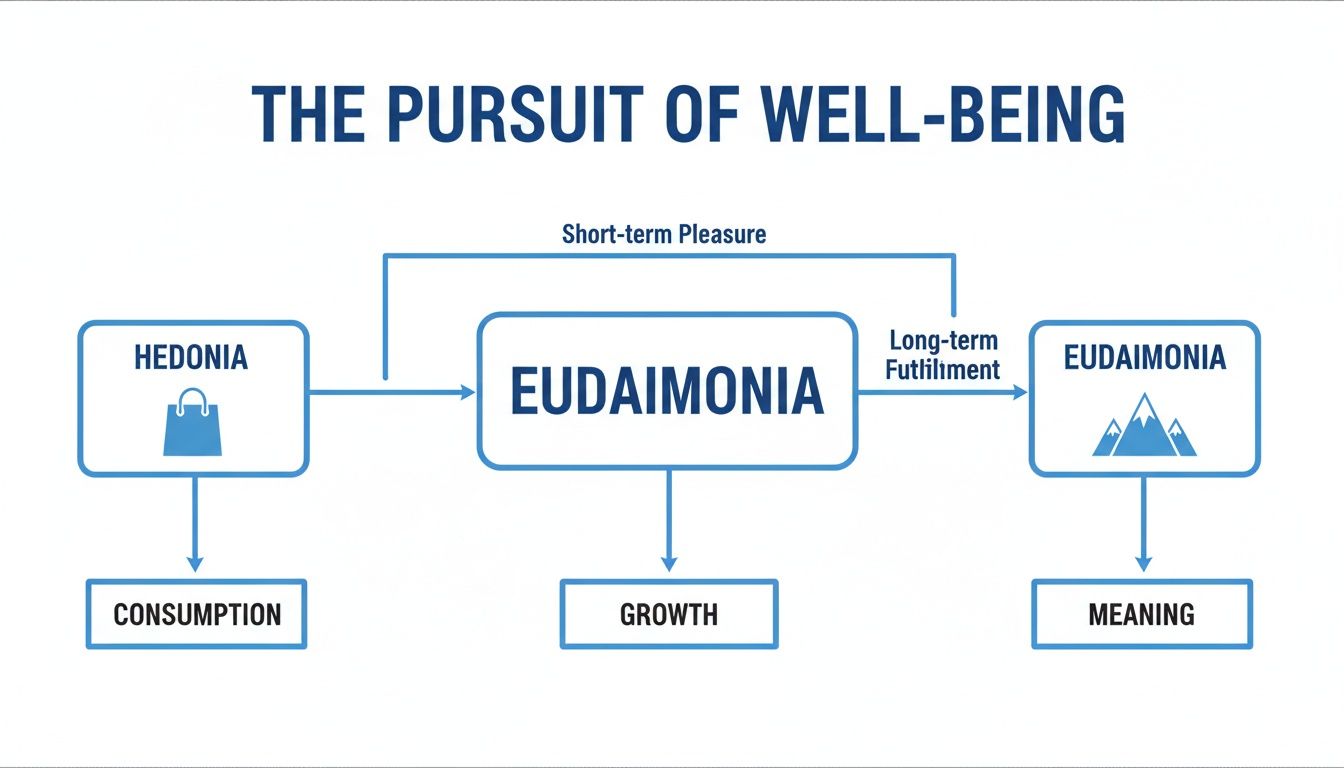
No more posts to show