Ever feel like you’re just going through the motions? That’s a classic sign your day-to-day life isn’t wired into a deeper ‘why’. Your personal values are the core beliefs that steer your choices and actions; think of them as your internal compass for building a life that actually feels like your own. By the end of this guide, you’ll have the tools to define that compass and start using it immediately.
Why Your Values Are Your Ultimate Life Hack

Imagine trying to use a GPS without plugging in a destination. You’d just drive around aimlessly, right? That’s what life feels like without clear values. You might grab a job purely for the money or follow a path because it’s what others expect, only to end up feeling totally drained and wondering, “Is this it?”
This is exactly why figuring out “what are my values” stops being some fluffy, abstract idea and becomes a seriously practical tool for you to live with intention.
Your Personal Operating System
Think of your values as your personal operating system; the code running in the background of your mind that influences every single decision you make. When you live in sync with that code, your life just flows. It feels authentic. But when your actions clash with it, you create awful internal friction.
This friction shows up in your life as:
- Constant frustration, whether it’s at work or in your relationships.
- That nagging sense that you’re not really living up to your potential.
- Finding it impossible to make decisions, from the big life-changers to the small stuff.
Defining your values is the first step you can take to shift from a reactive life, where circumstances dictate your mood, to a proactive one, where you are in control of your direction.
From Drifting to Driving
Once you know your core principles, you gain a powerful filter to run every opportunity through. A high-paying job might look brilliant on paper, but if you value “freedom” and the role comes with rigid hours and a boss breathing down your neck, you can now recognize it’s a guaranteed recipe for misery. You’ll avoid that trap.
On the flip side, when you know you value “connection,” you’ll consciously make time for your family and mates, even when life gets chaotic, because you understand it’s what truly fills your cup.
This clarity makes your complex choices simple. It helps you build a career, relationships, and daily habits that genuinely feel right for you. It’s the difference between being a passenger and finally getting into the driver’s seat of your own life.
The Real-World Impact of Living by Your Values
When you truly get to know your values, they stop being fuzzy ideas and become a practical, powerful filter you can run your entire life through. This is where your inner work pays off in a massive way; in your confidence, your career, and your overall peace of mind.
Once you’re crystal clear on what you stand for, your decisions suddenly get a whole lot simpler. It becomes so much easier for you to give a full-bodied ‘yes’ to the opportunities that genuinely light you up and a firm ‘no’ to the distractions that just drain your battery and pull you off course.
Honestly, this clarity is your best defence against a life spent chasing goals that aren’t even yours to begin with.
For you as a professional, it’s the difference between grabbing a job for the title and choosing a career that actually feels fulfilling. For you as a father, it’s about consciously deciding what kind of man you want your kids to see when they look up to you.
From Inner Work to Outer Results
If you’re feeling lost in the constant noise of modern life, defining your values is how you start to reclaim your focus. It’s no surprise so many of us are searching for this kind of direction. You only need to look at the booming coaching industry in our region to see this powerful shift toward doing the inner work.
While specific figures for Australia’s life coaching scene are still coming into focus, the momentum mirrors the wider Asia-Pacific region’s impressive USD 1.6 billion valuation. This growth points to a values revolution, where a staggering 80% of clients report a boost in self-esteem, a game-changer you can experience when navigating tough life transitions.
With a potential 221% return on investment, the message couldn’t be clearer: investing in your internal clarity delivers real, tangible rewards in your outer world.
But let’s be real, this isn’t about finding a quick fix. It’s about giving you a rock-solid foundation for the rest of your life.
Living by your values means you stop asking for permission to live the life you want. You give it to yourself because you know your direction is sound, built on principles you’ve chosen for yourself.
A Foundation for Real Change
Getting this alignment right creates a ripple effect in your life. Your confidence soars because you’re no longer second-guessing every move you make. Your actions start to feel authentic, like they’re coming from a place of genuine integrity. You begin to trust yourself more.
This was a massive piece of the puzzle in my own journey from feeling completely adrift to finding my purpose. When you finally start operating from a place of core conviction, you build a life that feels solid, intentional, and most importantly, like your own.
That persistent frustration you feel? That nagging sense you’re stuck in a rut, or the slow, creeping burnout that’s stealing your energy? That’s rarely a random occurrence. More often than not, it’s a direct symptom of a life lived out of sync with your core values.
Think of that dissatisfaction not as a personal failure, but as priceless data. It’s your internal compass screaming at you that you’ve taken a wrong turn somewhere.
When your daily actions consistently clash with what you truly believe in, it creates a kind of internal friction. This is the root cause of that gut feeling that something just isn’t right, even when everything on the surface looks perfectly fine.
The Telltale Signs of Value Misalignment
Recognising the signs is the first step to getting yourself back on course. This isn’t about beating yourself up; it’s about becoming a detective in your own life. Once you start asking, “what are my values?” and then take a hard look at your daily reality, you can begin to connect the dots.
You might see this playing out in your life as:
- Chasing a prestigious job that impresses everyone else but leaves you feeling hollow on the drive home.
- Staying in draining relationships or friendships because it just feels easier than making a change, even though they consistently leave you feeling completely depleted.
- Habitually numbing out with distractions like endless scrolling or binge-watching, simply because your current reality feels unfulfilling or meaningless.
Your dissatisfaction is a signal. It’s a powerful indicator telling you that the life you are currently living is not the one you are meant to lead. It’s a call for you to recalibrate.
Your Dissatisfaction Is Your Diagnostic Tool
This table can help you pinpoint where the friction is in your own life. Use it as a quick self-assessment to see where things might be out of whack.
Are You Living in Alignment With Your Values?
| Life Area | Signs of Alignment (Your actions feel purposeful) | Signs of Misalignment (You feel drained or conflicted) |
|---|---|---|
| Career/Work | You feel engaged, motivated, and that your work has meaning, even on tough days. Your job uses your strengths. | You dread Mondays, feel constantly bored or stressed, and fantasise about quitting. Your work feels pointless. |
| Relationships | You feel supported, understood, and energised by the people you spend time with. You can be your authentic self. | You often feel drained, misunderstood, or like you have to wear a mask around certain people. You avoid difficult conversations. |
| Health & Wellbeing | You make choices that nourish your body and mind. Self-care feels natural and necessary, not like a chore. | You neglect your physical health, feel constantly exhausted, and rely on unhealthy coping mechanisms to get through the day. |
| Finances | Your spending and saving habits reflect your long-term goals and what’s important to you. You feel in control. | You find yourself making impulsive purchases to feel better, or you feel constantly anxious and stressed about money. |
| Personal Growth | You’re curious, learning new things, and feel like you are evolving as a person. | You feel stagnant, uninspired, and like you’re just going through the motions day after day. |
Don’t panic if you see a lot of your life in the “misalignment” column. This isn’t a report card; it’s a map. It shows you exactly where to start making changes.
These feelings of conflict and emptiness are powerful diagnostic tools. They shine a spotlight on the gap between who you truly are and what you’re spending your life doing. For instance, if you deeply value ‘Freedom’ but are stuck in a micro-managed job where you have no autonomy, the stress and resentment you feel are direct symptoms of that value clash.
Similarly, if ‘Connection’ is one of your core values but your weeks are filled with surface-level chit-chat and very little genuine time with your mates or family, a soul-crushing sense of loneliness is the inevitable result. The key is for you to stop ignoring these feelings and start listening to what they’re trying to tell you. By paying attention, you can finally identify which parts of your life need a serious overhaul to bring them back into alignment with what truly matters to you.
Right then, knowing something feels off is one thing, but actually fixing it? That’s another beast altogether. It’s time to roll up your sleeves and move from thinking to doing. Think of this section as your personal workshop, designed to help you cut through the generic lists of values you find online and dig deep to uncover the principles that are truly yours.
These aren’t some complex psychological deep dives. They’re simple, powerful exercises designed to turn this article into a proper discovery session for you. Each one gives you a different way to look at your life, revealing your values from the inside out.
Start With Your Peak Experiences
Cast your mind back to a time you felt properly alive, totally engaged, and just completely fulfilled. This is what we call a peak experience. It could be the moment you nailed a tough project, a deep chat with a mate, or that time you stood up for something you believed in.
Don’t just remember it; really try to relive it for a second. What were you doing? Who were you with? And most importantly, what was it about that moment that made you feel so damn good?
Jot down the feelings and what was going on. Was it the buzz of achievement? The solid connection with others? The feeling of freedom or creativity? Your core values are always hiding in plain sight in your proudest moments. They’re the ingredients that make those memories stick. This little exercise can often uncover surprising truths, helping you understand not just what you do, but how to find your passion.
Conduct a Frustration Audit
Alright, let’s flip the script. Think about the things that consistently get under your skin. What really ticks you off, makes you frustrated, or leaves you feeling let down? Is it when people are dishonest? When you see massive inefficiency or wasted potential? Or maybe when you feel controlled or disrespected?
Your frustrations are a massive clue. They point directly to the principles you’re fiercely protective of.
When something infuriates you, it’s often because one of your core values is being trampled on. Your anger is a signpost pointing directly at what you believe is right.
If seeing someone take credit for another bloke’s hard work makes your blood boil, you probably have a strong value of ‘Fairness’ or ‘Integrity’. If a chaotic, disorganised environment drives you up the wall, you likely value ‘Order’ and ‘Clarity’. List three things that consistently wind you up and see if you can spot the value hiding behind each one.
Moving from the symptom (the frustration) to taking action is a critical part of self-awareness. It’s about recognising a feeling, figuring out the value conflict causing it, and then deciding what you’re going to do about it.
This just reinforces that those feelings of frustration or emptiness aren’t just background noise. They are valuable signals telling you to have a look under the hood and get your actions back in line with your principles.
Write a Letter From Your Future Self
Last one: a powerful visualisation exercise. Picture yourself ten years from now, living a life you’re genuinely proud of. Now, write a letter from this future version of you to your current self.
In this letter, describe what your life is like. What are you most proud of? What decisions did you make that led you here? What principles did you refuse to compromise on, no matter what?
This isn’t about trying to predict the future. It’s about defining the code your ideal self lives by. It cuts through all the day-to-day noise and connects you to your long-term vision. The advice your future self gives you is a direct line to the values you need to start living by today to become that person.
Turning Your Values Into Daily Actions

Alright, you’ve done the hard yards. You’ve dug deep and pinpointed the principles that actually matter to you. But the words ‘Freedom,’ ‘Growth,’ ‘Connection’ on a notepad are pretty useless until you breathe some life into them.
This is where the real work begins. It’s time to close the gap between knowing your values and actually living them.
The secret is to stop seeing your values as vague, lofty ideals and start seeing them as the architects of your daily schedule. They become the ‘why’ behind your to-do list, turning mundane tasks into meaningful steps forward. Without that link, you’re just ticking boxes. With it, every single action becomes a vote for the person you want to become.
From Abstract Idea to Concrete Action
Think of it like this: your value is the destination, and your daily actions are the specific turns you make on the map to get there. It’s all about translating the big picture into small, consistent steps you can take every single day.
Let’s get practical. Here’s how you can turn a core value into a real, repeatable behaviour:
- If you value ‘Growth’: You can swap 30 minutes of mindless scrolling for 30 minutes with a book that actually challenges you.
- If you value ‘Health’: Instead of caving to last-minute takeaways, you can block out an hour on Sunday to prep a few healthy meals for the week.
- If you value ‘Connection’: You can schedule a non-negotiable weekly call with a mate or family member, and make a point to put your phone away while you chat.
The goal isn’t perfection; it’s intention. It’s about you consciously choosing actions that honour your principles, moving you closer to a life of genuine integrity one small decision at a time.
This proactive approach is catching on, big time. In Australia, the digital fitness coaching market is predicted to hit USD 437.88 million by 2033. This isn’t just a random trend; it’s driven by young entrepreneurs and professionals who are rediscovering core principles like discipline and resilience to navigate startup chaos or career pivots.
Without clear values, even 99% satisfaction rates from coaching would be hollow. But they aren’t, because that structured support is what helps you turn overwhelm into genuine progress. You can read more about this trend over on imarcgroup.com.
A Simple Framework for Value-Driven Goals
To make sure your efforts are always pulling you in the right direction, you need a simple framework. This isn’t about piling more onto your plate; it’s about making sure what’s on your plate actually matters.
Here’s a dead-simple, three-step process you can use to get started:
- Choose One Value to Focus On: Don’t try to overhaul your entire life overnight. Just pick one core value for the week, like ‘Discipline’ or ‘Presence’.
- Define a ‘Micro-Action’: What’s one tiny, achievable thing you can do each day that honours this value? If ‘Discipline’ is your focus, the action could be as simple as making your bed the second you get out of it.
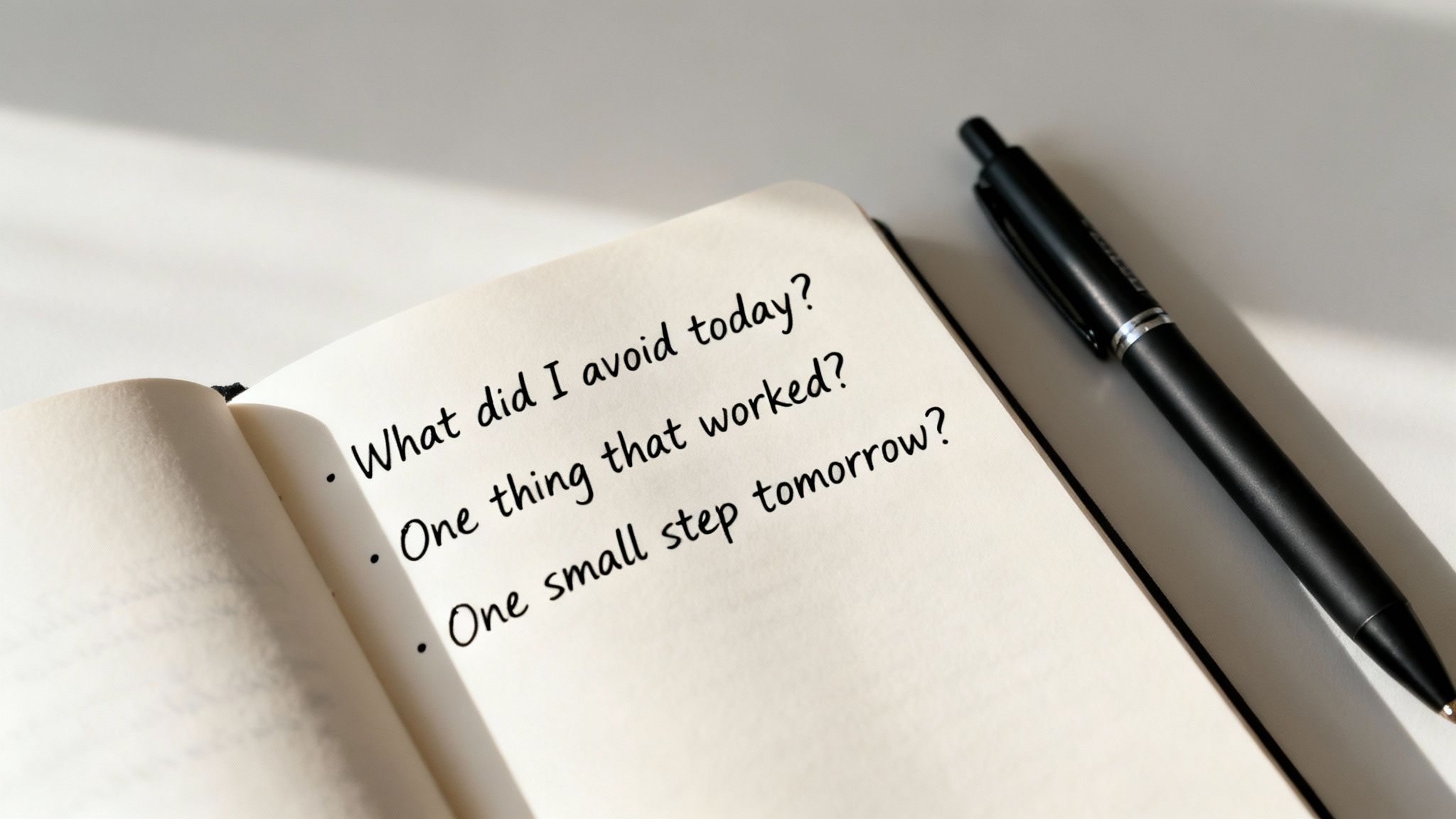
- Review and Reflect: At the end of the week, ask yourself: “Did my actions line up with my chosen value? How did it feel?” This feedback loop is what builds your momentum.
This process ensures your goals aren’t just random targets but are deeply connected to answering the question, “what are my values?” It’s a powerful shift, and while it requires ongoing effort, the clarity and purpose it brings you are more than worth it.
For anyone looking for structured support to make this a permanent habit, exploring personalised coaching programs can provide the accountability needed to turn good intentions into lasting change.
Common Questions About Finding Your Values
Starting the journey to figure out “what are my values?” usually throws up a few common hurdles. If you’re hitting these, you’re not alone. Think of them less as dead ends and more as signposts pointing you toward a deeper level of clarity.
Let’s break down some of the most frequent questions that pop up. Getting these sorted will help you push forward with a bit more confidence, making this whole process feel less like a confusing puzzle and more like a practical path to a better life.
How Many Core Values Should I Have?
There’s no magic number, but the sweet spot for you is usually between three and five core values. Why so few? Because a smaller, tighter list forces you to be brutally honest about what is truly non-negotiable in your life.
Think of them as the main pillars holding up the whole structure of who you are. If you’ve got ten or fifteen values, their power gets diluted, and it becomes a hell of a lot harder to use them to make clear decisions. If your list is getting long, try grouping similar ideas together to find the foundational principle underneath. For instance, ‘honesty’, ‘truth’, and ‘integrity’ could all fall under the core value of Integrity.
What if My Values Seem to Conflict?
Good. This is actually a great sign. It means you’re doing the real work and thinking deeply, not just picking words that sound nice. Values like ‘Adventure’ and ‘Security’ or ‘Freedom’ and ‘Connection’ can often feel like they’re pulling you in opposite directions.
Life isn’t about getting rid of this tension; it’s about learning how to manage it. The real goal is to find a healthy, conscious balance that works for you.
Acknowledging these dynamics allows you to make more intentional choices. Instead of seeing ‘Adventure’ and ‘Security’ as mutually exclusive, you could build a secure career that actively funds your adventurous travel and hobbies.
This kind of thinking shifts you from an “either/or” mindset to a “both/and” approach, which is where real-life solutions are found. It’s about designing a life that honours all the different parts of who you are.
Is It Okay for My Values to Change Over Time?
Absolutely. In fact, they should change. Your values are meant to evolve as you collect new experiences, face different challenges, and grow as a person. The principles that guided you at 20 will likely be different from the ones that matter most to you as a father, a leader, or a partner down the track.
Major life events like a career change, starting a family, or overcoming a massive obstacle, will naturally shift your priorities. It’s a smart move to check in with your values every year or so. This isn’t a sign of being inconsistent; it’s a reflection of your ongoing growth and self-awareness. It’s a sign you’re paying attention.
What if My Actions Don’t Match My Desired Values?
This is where the rubber meets the road. Finding a gap between what you do and what you say you value isn’t a reason to beat yourself up; it’s a powerful opportunity for growth.
It helps to think about your ‘current values’ (what your daily actions actually reflect) and your ‘aspirational values’ (the principles you truly want to live by). That gap between the two? That’s your personal roadmap for development.
For example, if your actions show you value ‘Comfort’ but you aspire to live with ‘Courage,’ you now have a clear mission. You can start by taking small, intentional steps outside your comfort zone each day. This isn’t about becoming a different person overnight. It’s about consciously and consistently choosing who you want to become, one small action at a time.
Figuring out your values is the foundation, but turning them into a life you’re proud of takes consistent effort and a solid game plan. If you’re ready to stop drifting and start building a life with intention, Your Bro is here to help. I offer no-BS, practical coaching to give you the clarity and tools you need. Book a free, no-obligation discovery call today and let’s get to work.