Let’s be real for a moment. That giant, looming question, “what is the purpose and meaning of life?” can feel absolutely crushing. You’re constantly told you need to find your purpose, as if it’s this singular, magnificent passion just waiting to be discovered. But honestly, that’s the very advice that keeps so many of us spinning our wheels.
This guide is different. It’s a grounded, philosophical-but-practical approach to help you stop searching and start building a life that feels solid and significant.
Why ‘Finding Your Purpose’ Is The Wrong Approach
The whole idea of “finding” your purpose makes it sound like a lost set of keys. You’re told to look under every rock, chase every fleeting passion, and hope that one day, you’ll just stumble across it. This myth is especially damaging for young men, who scroll through social media highlight reels and feel this insane pressure to have it all figured out, right now.
This endless search for a sudden epiphany usually creates more anxiety than it does clarity. It frames purpose as some kind of destination, a pass/fail test for your entire life. If you haven’t “found it” yet, it’s easy to feel like you’re already falling behind.
The truth is, a meaningful life isn’t something you discover; it’s something you build. It’s forged in the small, consistent, and often difficult choices you make, day in and day out.
The Shift from Finding to Building
So, how do you actually build this life? Instead of searching for some magical feeling of enlightenment, the real work is in building a solid foundation. And that foundation is built brick by brick with responsibility; responsibility to yourself, to the promises you make, and to the people who are counting on you.
Meaning doesn’t come from some grand, overnight achievement. You forge it in the mundane, the everyday actions that actually shape who you are as a man.
- Waking up early to work on a skill, even when you’d rather hit snooze.
- Keeping your word to a mate, even when it’s a massive inconvenience.
- Delivering your best work, even when you know no one is looking over your shoulder.
These aren’t glamorous, Instagram-worthy moments. They are the bricks. They are what you use to build a life of substance. Every single act of responsibility, no matter how small, adds another layer to your foundation, making it stronger and more reliable over time.
The Power of Deliberate Action
Switching your mindset from a passive search to active, deliberate building is incredibly empowering. It puts you back in the driver’s seat. You don’t have to wait for an epiphany to start living a life that matters. You can start right now, with the very next choice you make.
This shift is something we’re seeing more of in the broader coaching industry in Australia, as more people are looking for structured, no-nonsense guidance. It’s not surprising that 99% of individuals who hire a coach report being ‘satisfied’ or ‘very satisfied’. What’s even more telling is the median ROI of 7x the initial investment, which shows this structured approach genuinely delivers in building clarity and direction. If you’re curious, you can get more insights on life coaching statistics and their impact on personal growth.
Getting Clear on Meaning vs. Purpose
To build a life that actually feels like your own, you need to know the difference between two words that get thrown around a lot: meaning and purpose. Most guys use them interchangeably, which is a massive mistake. It’s like trying to navigate with a broken compass.
Getting this distinction right is the first real step toward clarity. In plain English, it’s the difference between wandering aimlessly and moving with conviction.
Let’s think about it like building a house. You wouldn’t start throwing up walls and slapping on a roof without first pouring a solid foundation, would you? Of course not. The whole thing would be unstable, ready to crumble under the slightest pressure.
Chasing a ‘purpose’ without first establishing your ‘meaning’ is exactly the same. It’s building on sand.
Meaning Is Your Foundation
Meaning is your ‘Why’. It’s the concrete slab your entire life is built on. This foundation is made up of your deepest, non-negotiable core values; the things you stand for, no matter what. It’s that internal gut feeling that guides your decisions and tells you what truly matters.
You don’t just stumble upon meaning one day. You build it, piece by piece, by taking responsibility for your actions, figuring out your personal ethics, and living with integrity. It’s the answer to the fundamental question: “What do I stand for?”
Purpose Is the House You Build
Purpose, on the other hand, is your ‘How’. It’s the structure you build on top of that solid foundation, the walls, the rooms, the roof. Your purpose is the set of actions you take, the goals you chase, and the direction you move in the world.
It’s how you bring your values to life. This could be through your career, how you show up as a father or a partner, a creative project, or your contribution to your community. Purpose answers the question: “What am I building?”
The frustration so many men feel comes from trying to build the structure (a high-paying job, a certain lifestyle) on shaky, undefined ground. They get so obsessed with the ‘How’ that they completely ignore the foundational ‘Why’.
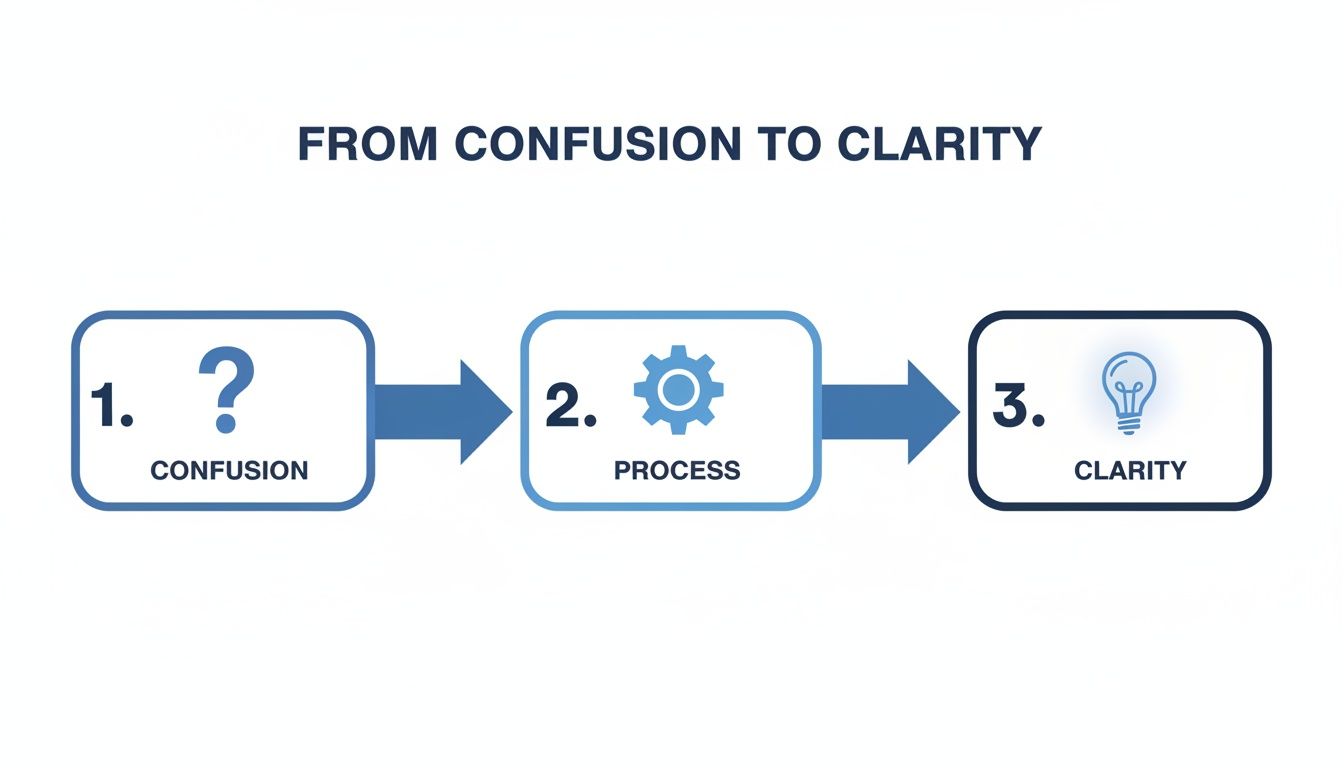
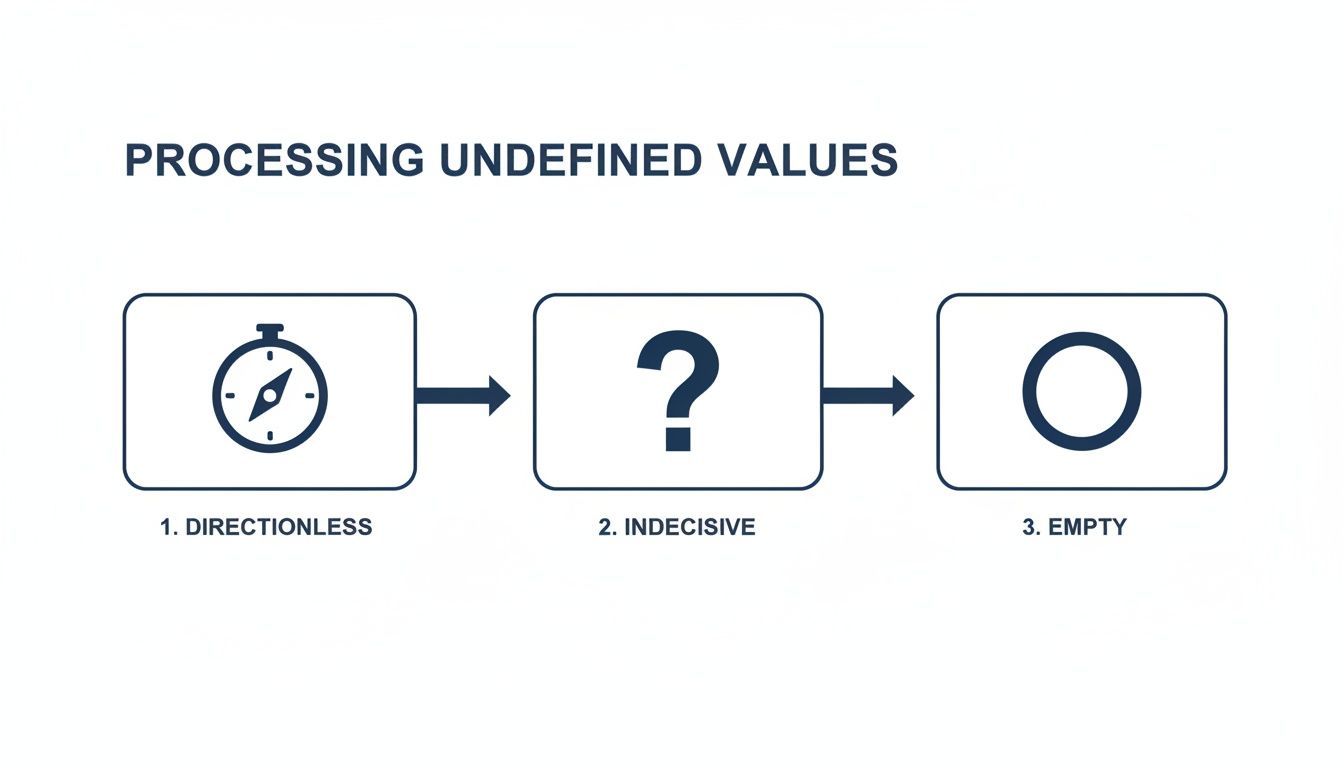
This diagram breaks down the two paths most people take when trying to figure this stuff out.
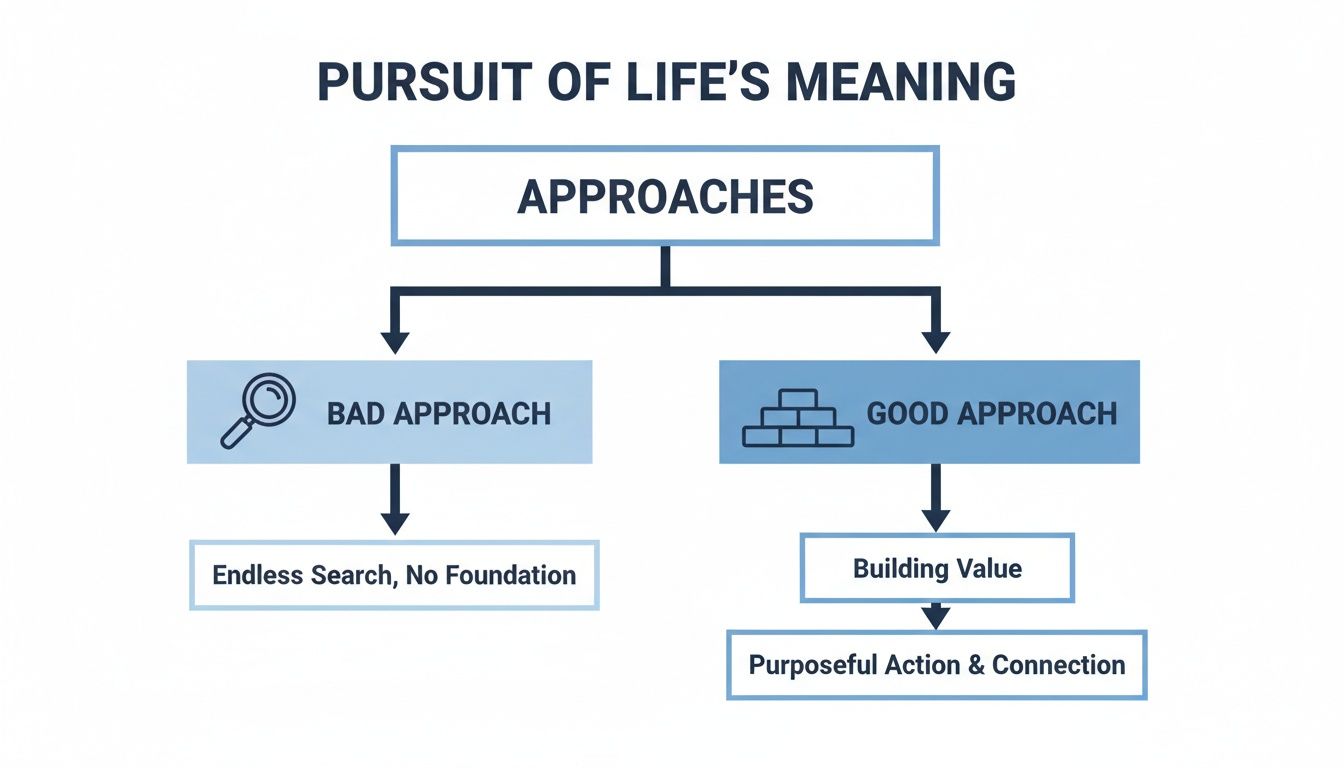
As you can see, the endless, frantic search for a grand purpose often just leads to more confusion. The smarter path is to build your meaning first through solid values and consistent action, which then gives you a clear direction.
Meaning vs Purpose: A Practical Comparison
This table breaks down the core differences between meaning and purpose to help you understand how they relate and where to focus your energy first.
| Concept | Meaning (Your ‘Why’) | Purpose (Your ‘How’) |
|---|---|---|
| Nature | Internal, stable, and deeply personal. | External, active, and can evolve over time. |
| Focus | Being (who you are, what you stand for). | Doing (what you do, the goals you pursue). |
| Question | “What values guide my life?” | “What mission am I on?” |
| Analogy | The foundation of a house. | The structure built on top of the foundation. |
| Example | A core value of ‘integrity’. | A purpose of ‘building an honest business’. |
Putting it all together, your meaning is the anchor, while your purpose is the ship you steer. You need both to get anywhere worthwhile.
Without that strong foundation of meaning, any purpose you chase will feel hollow. You might hit a goal, get the promotion, buy the car, but feel empty afterwards, wondering why it didn’t deliver the fulfilment you expected. That’s because the achievement wasn’t connected to anything real inside you.
But when your purpose is a direct expression of your core values, every action you take feels significant. Understanding your sense of self and meaning is the essential first step. Get that right, and building a purposeful life becomes a whole lot simpler.
Forget the frantic search. Focus on building your foundation of meaning first through responsibility, clear values, and consistent daily actions. Your purpose will emerge as a natural, authentic result.
How to Build Meaning Through Daily Responsibility
Forget the mountaintop epiphany. That profound sense of meaning you’re chasing isn’t something you find on a silent retreat or in a flash of sudden insight.
The truth is a lot more grounded. A meaningful life is built, brick by brick, through the daily grind of just showing up.

This is where theory hits the road. The vague, confusing search for a grand purpose ends the moment you start focusing on the tangible responsibilities right in front of you. By reframing everyday tasks as powerful acts of character-building, you can start constructing meaning today, right where you are.
Let’s break down the three practical arenas where you can immediately start this work. These aren’t abstract ideas; they’re the real-world battlegrounds where a meaningful life is forged.
Take Responsibility for Yourself
The first and most critical arena is the one you have the most control over: yourself. Building meaning starts with the non-negotiable commitment to mastering your own domain; your mind, your body, and your daily habits. It’s about becoming the kind of man who can be relied upon, starting with yourself.
This is the very bedrock of self-respect. When you consistently keep the promises you make to yourself, you build an unshakeable inner confidence. Each small victory hammers home the belief that you are capable and disciplined.
Here’s what this looks like in action:
- Mastering your health: This isn’t just about looking good. It’s about honouring the physical vessel you inhabit through consistent exercise, good nutrition, and proper sleep. Every workout is a deposit into your discipline account.
- Owning your discipline: Waking up at a set time, sticking to a schedule, and doing what you said you would do, especially when you don’t feel like it, builds immense character.
- Controlling your routines: Your daily routines dictate your future. Deliberately designing your mornings and evenings creates a framework for productivity and mental clarity.
The rise of digital fitness coaching in Australia, a market that hit USD 242.42 million in 2024, points to a growing recognition of this link. More and more people are realising that physical discipline is directly tied to mental clarity and a sense of direction. This growth proves that purpose isn’t some abstract concept; it’s built through tangible, trackable habits.
You cannot build a meaningful life on a foundation of broken promises to yourself. Your relationship with your own word is the most important one you have.
Take Responsibility for Others
Once you start mastering yourself, the next layer of meaning comes from your commitments to others. This is about being a man of your word in your relationships with family, friends, and your community. It’s where your internal values meet the real world.
Being reliable isn’t a passive trait; it’s an active choice. Every single time you follow through on a promise, you strengthen your relationships and build a reputation for integrity. This is how you create a life of substance that goes beyond your own self-interest.
Seemingly small actions carry immense weight:
- Showing up for family: This means being present and engaged, not just physically in the room.
- Keeping your word to friends: If you tell a mate you’ll help him move, you’re there. No excuses.
- Fulfilling your commitments: Whether it’s a promise to your partner or a commitment to a local group, your reliability becomes a source of stability for others.
Each of these actions says, “You can count on me.” This isn’t about grand gestures; it’s about the quiet consistency of being dependable. It’s in these small, everyday acts of service that we find a deep and lasting sense of connection and worth.
Take Responsibility in Your Work
Finally, you build meaning through your work, no matter what that work is. It’s easy to get caught in the trap of thinking that purpose can only be found in a “dream job,” but that’s a dead end. Meaning is found in the how, not just the what. It’s all about the standard of excellence you bring to your craft, day in and day out.
Delivering value and mastering your skills is an act of responsibility to your employer, your clients, and ultimately, to your own potential. It’s about taking pride in a job well done, whether you’re a tradesman, an office worker, or an entrepreneur.
This means:
- Mastering your craft: Dedicate yourself to getting better at what you do. Seek out knowledge, practise your skills, and strive for excellence.
- Delivering real value: Focus on solving problems and making a genuine contribution. Don’t just go through the motions; aim to leave things better than you found them.
- Working with integrity: Be honest, show up on time, and finish what you start. Your work ethic is a direct reflection of your character.
When you view your daily tasks through this lens, even the most repetitive job becomes an opportunity to build discipline, skill, and integrity. This is how you turn a paycheque into a source of genuine pride. For those looking to build this kind of consistency, using a tool like this habit tracker template can be a powerful first step in making these responsibilities stick.
A Simple Framework to Uncover Your Core Values
If meaning is built on taking responsibility, that immediately begs the question: which responsibilities actually matter to you? A meaningful life isn’t just about being busy; it’s about pouring your energy into the right things. To figure that out, you need to get clear on your core values; your personal ‘Why’.
Forget those generic lists of values you find online. Real values aren’t chosen from a menu; they’re uncovered from within. They’re already part of you, proven by your past actions and emotional reactions. This simple framework is designed to help you dig them up and build a reliable ‘Personal Compass’.
This compass is easily the most powerful tool for navigating life. It helps you make those tough decisions, filter out the noise, and find your way back when you inevitably feel lost.
Look for Emotional Peaks and Troughs
Your strongest emotions are like big, flashing signposts pointing directly to your core values. By looking closely at moments of intense feeling, both the good and the bad, you can start to decode what truly drives you. We’ll focus on three key areas: fulfillment, pride, and anger.
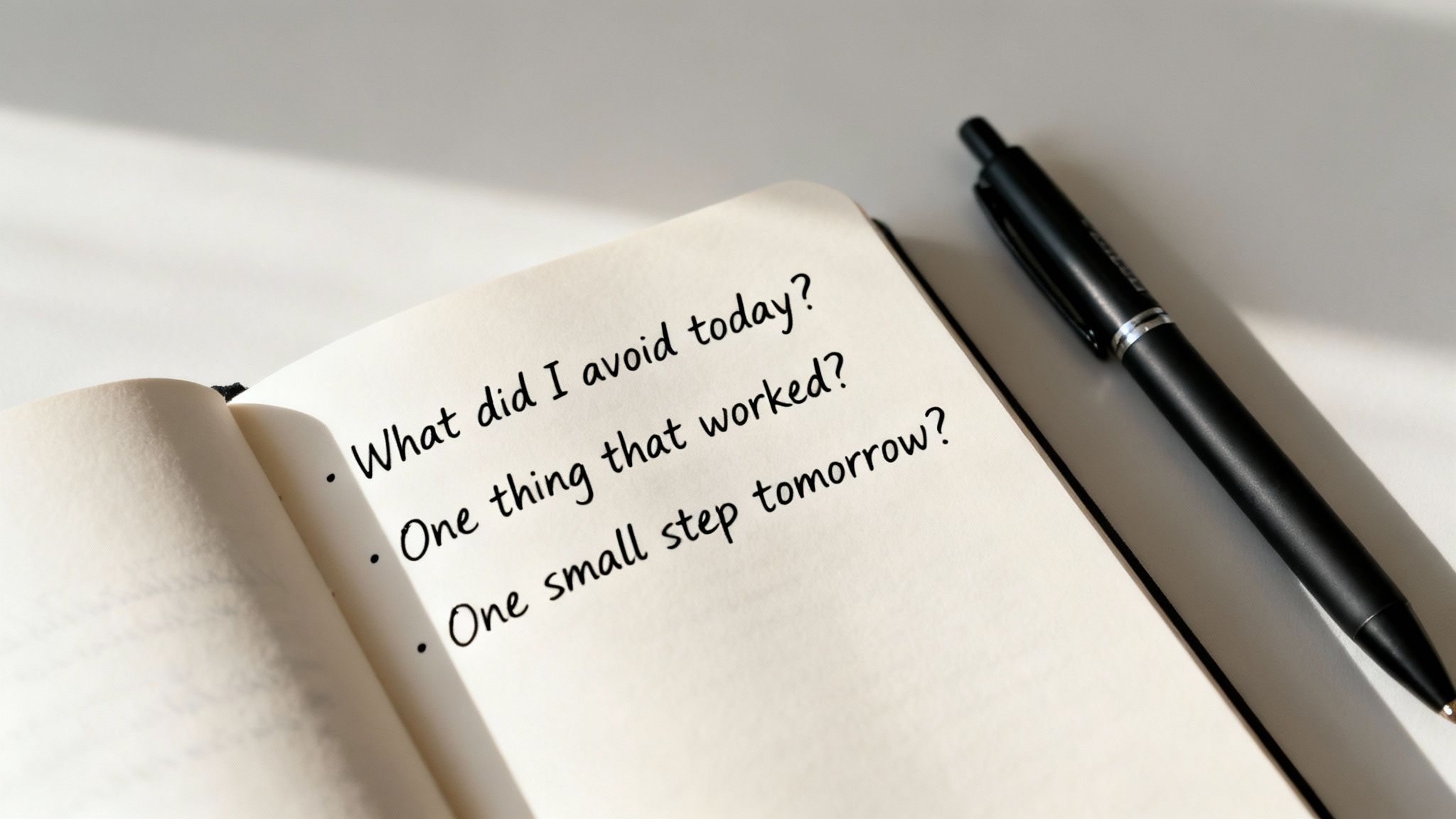
Grab a notebook or open a new document. The goal here is raw honesty, not a perfectly polished essay. Just get your unfiltered thoughts down as we work through a few powerful self-reflection questions.

Question 1: When Did You Feel Most Alive and Fulfilled?
Think back to a specific moment when you felt completely absorbed and alive. It doesn’t have to be some monumental achievement. It could be solving a tricky problem at work, coaching a kids’ soccer team, or getting lost in a deep conversation with a close mate.
Describe that moment in detail.
- What were you doing?
- Who were you with?
- What about it felt so significant?
Now, look at your answer and ask: What core value was I honouring in that moment? Maybe it was Growth, as you stretched your skills to a new level. Perhaps it was Connection, as you built a genuine bond with others. Or maybe it was Creativity, as you brought a new idea into the world.
Question 2: What Achievement Made You Genuinely Proud?
Next, bring to mind a specific accomplishment that filled you with a deep, quiet sense of pride. This isn’t about what looked impressive to others, but what felt genuinely good to you. It could be finishing a brutal fitness challenge, keeping a difficult promise, or finally mastering a skill after months of practice.
Again, write down the specifics of this experience. What did you have to push through to achieve it? What part of it made you feel the proudest?
Now, analyse your response: What value does this achievement represent? Perhaps it was Discipline, the pride you felt from sticking to the plan. It might have been Integrity, the quiet satisfaction of doing the right thing when no one was looking. Or it could have been Resilience, for pushing through when you really wanted to quit.
Your proudest moments are almost always a direct reflection of your deepest values in action. They reveal the character traits you admire most in yourself and others.
Question 3: What Makes You Truly Angry or Frustrated?
This last question can be the most revealing of all. Think about a time you felt a surge of genuine anger or frustration. I don’t mean mild annoyance, but that deep, gut-level anger that boils up when you witness an injustice, a betrayal, or just plain laziness.
Maybe you saw someone take credit for a colleague’s work. Perhaps you witnessed a friend being treated unfairly. Or maybe you felt frustrated by sloppy work or a lack of honesty.
Describe what happened. Why did it get under your skin so much?
Now, flip the coin: What value was being violated in that situation? The anger you felt when someone lied was your value of Honesty being defended. The frustration you felt seeing laziness was your value of Excellence or Hard Work being trampled on. Your anger is a protective instinct for your principles.
Creating Your Personal Compass
Look over your answers. You should start to see a few themes or specific words popping up again and again (e.g., Growth, Integrity, Connection, Discipline). This is the raw material for your Personal Compass.
Select your top 3-5 core values. These are your non-negotiables, the principles that will guide your life from here on out. For a deeper dive into this process, our guide on how to discover your personal values offers more exercises to help you gain absolute clarity.
With this compass in hand, the abstract question of “what is the purpose and meaning of life” becomes a practical, daily exercise. Instead of searching for a single, far-off destination, you simply ask: “Does this next step align with my values?”
Finding Your Direction, Not Your Destination
We’ve already covered that meaning isn’t something you stumble upon; it’s something you build, day by day. It’s anchored in responsibility and guided by the core values you hold dear. Now, it’s time to pull these ideas together into a mindset shift that will lift the crushing weight of trying to figure out your entire life in one go.
Let’s just ditch the whole idea of finding a single, fixed ‘destination’. Life isn’t a treasure hunt where ‘X’ marks the spot. Chasing that imaginary finish line is a surefire recipe for anxiety, comparison, and the constant feeling that you’re falling behind.
Instead, let’s get focused on defining your direction.
Your Compass, Not Your Map
Think about it. A map gives you one rigid path to a single endpoint. If a road is closed or you take a wrong turn, the map is suddenly useless. You’re lost. This is exactly what it feels like when you pin your entire identity on one specific outcome, a certain job title, a number in your bank account, or a particular lifestyle.
A compass, on the other hand, is infinitely more useful. It doesn’t dictate the path; it just gives you a direction, your True North. The core values we worked on earlier? That’s your compass. With it, you can navigate any terrain, find your way around any obstacle, and always get back on track, no matter how lost you feel.
This simple shift changes the entire game. The question is no longer the big, stressful, unanswerable one: “What is my ultimate, grand purpose in life?”
It becomes something practical and immediate:
“Is this next step I’m about to take aligned with my values and moving me in the right direction?”
This reframe puts you back in the driver’s seat. It pulls you into the present moment and focuses your energy on what you can actually do right now. Progress is no longer measured by how close you are to some mythical finish line, but by whether you’re consistently moving toward what actually matters to you.
What ‘Direction’ Looks Like in Real Life
This isn’t just some nice theory; it’s a practical way to operate at any stage of life. The search for the “purpose and meaning of life” can feel different for everyone, but the solution, choosing a direction, is universal.
Let’s look at a few real-world examples:
- The Young Bloke Feeling Lost (18-25): He’s swamped with options and feels immense pressure to have his life sorted. Instead of trying to pick the one “perfect” career (the destination), he focuses on his core value of Growth. His direction is simply to build skills and get experience. He takes a job that isn’t his dream but teaches him a trade. Every day he shows up, he’s moving in the right direction.
- The New Dad Navigating Responsibility (25-35): His world has just been turned upside down and his old goals feel a million miles away. Instead of stressing about his career ladder (the destination), he focuses on his value of Connection. His new direction is to be a present, reliable father and partner. He makes a point of leaving work on time for dinner, even if it means his career moves a bit slower. That action is perfectly aligned with his compass.
- The Man at a Career Crossroads (35+): He’s ticked all the boxes of success but feels completely empty. The destination he reached wasn’t what he thought it would be. He takes a step back and identifies a core value of Contribution. His new direction is to use his skills to help others. He starts mentoring junior colleagues or volunteers his expertise for a local not-for-profit. He hasn’t quit his job, but he’s already moving in a more meaningful direction.
In every case, the focus is on taking small, value-aligned steps. The meaning is found in the movement, not in the arrival. This approach is gaining serious ground, which is reflected in the growing demand for structured personal guidance here in Australia. The Australian digital health coaching market is set to hit USD 409.6 million by 2030, with mental wellbeing coaching as the fastest-growing part of it.
This shows a clear trend: men are realising they need support to define their direction first, knowing it’s the key to building a life that actually feels fulfilling. You can read more about these insights on the future of personal development coaching in Australia.
Alright, let’s tackle some of the tough questions that always pop up when you start doing this work.
It’s completely normal for the path to building a meaningful life to throw up some roadblocks. You’ll hit moments of self-doubt and run into practical frustrations. That’s just part of the process.
This section is all about those common sticking points. The idea is to give you some clear, grounded advice to back up what we’ve already covered and give you the confidence to keep putting one foot in front of the other.
“But What If My Day-to-Day Job Feels Meaningless?”
This is probably the most common one I hear, especially from guys stuck in a job that feels a million miles away from a grand ‘calling’. The trick here is to shift your focus. Stop looking at the task itself and start looking at the character you are building by doing it.
See, meaning isn’t always in the what you do; it’s in the how you do it. When you show up on time, do your work to a high standard, and keep your word, even when the tasks are mind-numbingly boring, you are actively building discipline, integrity, and reliability.
Fulfilling your commitment, no matter how small, is a powerful act of personal responsibility. Each time you do, you add another brick to the foundation of a meaningful life, proving to yourself that you are a man who can be counted on.
Think about it like this: a professional athlete doesn’t find deep, soulful meaning in every single push-up. The meaning comes from the discipline of showing up and doing the work, knowing that each rep contributes to a much larger goal. Your daily responsibilities? That’s your training ground for character.
“Okay, So How Long Does This Take? When Do I Find My Direction?”
Let’s just kill this idea right now: there is no finish line. This isn’t like finding a destination on a map. Defining your direction is an ongoing, lifelong process of steering and re-steering your ship.
The good news is you can start making value-aligned decisions today. The clarity and confidence you’re looking for won’t hit you in a single lightning-bolt moment. Instead, it grows steadily over time, bit by bit, as you consistently practice living by your ‘Personal Compass’.
The journey looks a lot more like this:
- Initial Clarity: You figure out your core values and start making small, conscious choices based on them.
- Growing Confidence: As you start seeing the positive ripple effects of these choices, your trust in that internal compass gets stronger.
- Lifelong Practice: You keep checking in, refining your understanding of your values, and adjusting your course as you move through the different seasons of your life.
All the pressure to “get it right” disappears the moment you realise it’s a practice, not a one-time exam.
“What Happens When My Values Clash With Each Other?”
Value conflicts aren’t just normal; they’re a guarantee in a well-lived life. For instance, you might deeply value both Security (providing a stable home for your family) and Adventure (taking risks and exploring the unknown). At some point, those two are going to feel like they’re pulling you in opposite directions.
The goal isn’t to get rid of the conflict. The goal is to make conscious, deliberate choices instead of feeling torn apart and paralysed by indecision.
This is where your values framework becomes a powerful tool. It helps you understand the trade-offs. When a conflict comes up, you can ask yourself:
- In this specific season of my life, which value needs to take the front seat?
- Is there a creative way I can honour both of these values, even if it’s in a small way?
- Based on my most important commitments right now, what’s the wisest decision?
Just acknowledging the conflict allows you to choose your path with intention, rather than feeling like a victim of your circumstances. It’s the difference between being yanked around by the currents and actively steering your ship. Every time you navigate one of these conflicts, you get better at it, strengthening your ability to lead a life that is genuinely yours.
Building a life of meaning and direction is a skill. Like any skill, it gets stronger with practice and the right guidance. If you’re ready to stop wandering and start building, Your Bro is here to help you create a practical, no-nonsense plan.
Book a free, no-obligation discovery call to see how we can work together to define your compass and start moving forward with real confidence. Learn more at https://yourbro.com.au.